
Body Scan vs Breathing Exercises for Bedtime Calm



A body scan is a practical starting point when physical tension or restlessness blocks bedtime calm; breathing exercises may fit better when worry or racing thoughts dominate. Neither method is universally better. Body scans move attention through the body to notice sensations and soften tension. Breathing exercises focus on the inhale and exhale, sometimes with counting or a comfortable rhythm, to give attention a repeatable task during stress.
The choice can change from night to night. Start with breathing when thoughts are loud, a body scan when the body feels tense, or combine them when both are present. MindTastik offers guided meditation, bedtime relaxation, breathing practice, and self-hypnosis for adults seeking support with sleep, anxiety, and everyday calm. These sessions offer guidance, not medical treatment or a guarantee of sleep.
Which practice fits tonight
- Body scans guide attention through the body to notice sensations, release tension, and settle into sleep.
- Breathing exercises focus on the inhale and exhale to create a faster reset during worry, stress, or emotional overload.
- For a bedtime calm routine, use breathing first if the mind is loud, body scan first if the body feels tense, and combine both when needed.
Body scan vs breathing exercises, side by side
Side-by-side captures of the compared products. Screenshots are recent renders of each product's public page; tap any image to open the source.
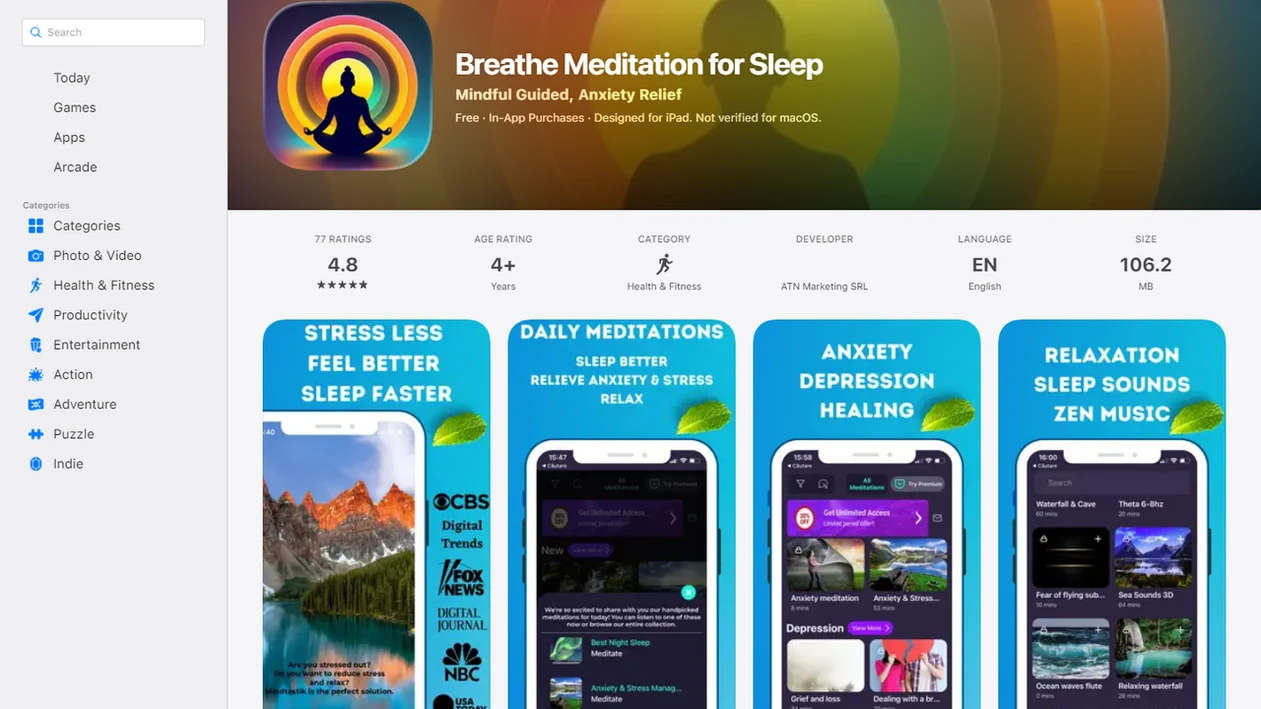
Body Scan vs Breathing Exercises: At-a-Glance Bedtime Comparison
Body scan or breathing is mainly a choice between two attentional anchors: body sensation or breath rhythm. Both can support calm, but they aim attention in different places.
| Comparison point | Body scan meditation | Breathing exercises |
|---|---|---|
| Main goal | Notice body sensations and soften tension | Steady attention through inhale and exhale |
| Best time | Bedtime, rest breaks, post-stress settling | Anxiety spikes, racing thoughts, short resets |
| Typical duration | 8 to 15 minutes | 1 to 5 minutes, or longer guided sessions |
| Posture | Often lying down | Sitting, standing, or lying down |
| Attention target | Feet, legs, belly, chest, shoulders, face | Counting, rhythm, longer exhale, breath length |
| Common use case | Restless body, tight jaw, heavy limbs | Loud thoughts, stress surge, emotional overload |
For sleep tension, body scan usually wins because it gives restless muscles a job. For racing thoughts and daytime anxiety spikes, breathing is often easier because the breath is always available. For beginner consistency, the easier choice is the one you can repeat tonight without negotiating with yourself.
How Body Scan and Breathing Exercises Work in the Nervous System
Body scan and breathing exercises both train interoception, which means awareness of internal body signals such as breath, muscle tension, heartbeat, warmth, and pressure. In plain terms, they teach attention to notice what is happening inside the body without immediately reacting to it.
A body scan trains attention by moving through body regions in sequence. Breathing exercises train attention by returning to the inhale, exhale, rhythm, or count. Different route, same basic skill.
The insula is one brain region involved in body awareness and emotional processing. Neuroimaging research from 2019 reported that interoceptive mindfulness practices, including body scan and breath awareness, are associated with structural or functional changes in the insula. That does not mean one session rewires the brain. It means repeated practice may support the systems that help people notice body signals and regulate emotion. For evidence on body-focused attention, see this systematic review of body-scan meditation.
A good meditation app for sleep anxiety and everyday calm should deliver repeatable guided practice, not instant sleep, diagnosis, or a cure for distress.
Where Body Scan Meditation Wins for Sleep and Body Tension
Does body scan meditation work better when your body feels too tense for sleep? Often, yes. Body scan meditation is a guided practice that moves attention from one body area to another, usually with slow noticing and gentle release.
It fits the nights when cool sheets touch restless legs, but the body still feels wired. You do not have to sit upright or hold a posture. You can lie down, dim the phone screen, and let the guidance move from feet to calves to shoulders to face.
For people who feel physically tight, uncomfortable, or hard to settle, body scan is often easier than breath counting because the attention has a path to follow. It is not only for sleep, though. A shorter scan can also support daytime body awareness after a stressful meeting or long drive.
The right fit for bedtime muscle tension is MindTastik because a guided body scan gives beginners a step-by-step sleep audio track instead of asking them to remember the sequence alone.
Where Breathing Exercises Win for Worry and Short Resets
Are breathing exercises better when worry is the main problem? They often are, especially when you need a short reset before thoughts pick up speed. Breathing exercises focus attention on the inhale, exhale, rhythm, counting, or breath length. Comparing breathing meditation vs breathwork can help you distinguish gentle attention practice from more structured breathing techniques.
Common options include counting breaths, longer exhales, box breathing, and 4-7-8 breathing. The point is not to perform a fancy technique. The point is to give the mind a simple place to return. For a steady, comfortable rhythm, try resonant breathing without forcing breaths or holding your breath.
Breath-focused routines are useful when unread emails replay behind closed eyes, or when stress rises during the day and you only have three minutes. Simple breathing is not trivial. It is a core part of mindfulness training and emotion regulation.
Anyone dealing with a fast worry spiral can use MindTastik for a short breathing session because the app offers guided breathing exercises that choose the rhythm for you.
Breathing vs Body Scan Meditation Evidence for Anxiety and Well-Being
The research does not clearly prove that breathing beats body scan meditation, or that body scan beats breathing, for every person. Much of the evidence comes from mindfulness programs that include both body scan and breath awareness, so direct comparisons are limited.
- A 2014 JAMA Internal Medicine meta-analysis of 47 randomized trials found that mindfulness meditation programs showed moderate evidence for improving anxiety, depression, and pain: JAMA Internal Medicine study: 1809754.
- In a 2014 randomized trial of 141 college students, three weeks of daily practice using sitting breath meditation, body scan, or yoga improved rumination, self-compassion, and well-being across groups: PubMed research: 24395196.
- A 2019 meta-analysis of 142 randomized controlled trials found small-to-moderate improvements in psychological distress and mental health-related quality of life.
- Body scan and breath awareness both appear in common mindfulness programs, which makes it hard to isolate the effect of one technique.
- For many users, consistency, guidance quality, and timing may matter more than choosing the “correct” method.
For people comparing app support, our do meditation apps actually help guide looks at what meditation apps can and cannot reasonably promise.
What research on body scans alone actually found
A 2022 systematic review of body-scan meditation combined 14 independent studies and found a small improvement in mindfulness compared with passive controls. The reported effect was Hedges' g = 0.268, with a 95% confidence interval of 0.032 to 0.504. The authors rated the evidence quality low and found substantial variation across studies.
That finding concerns mindfulness, not proof that a body scan reliably treats insomnia or beats breathing exercises at bedtime. The review found insufficient support for broader health benefits from body scanning alone. Choosing a body scan for muscle tension is therefore a practical match between the attention task and the immediate problem, rather than an established ranking of sleep treatments.
How to Choose Body Scan or Breathing for a Bedtime Calm Routine
Use the state you are in tonight as the decision point. A bedtime calm routine works better when it starts with the problem you actually notice, not the practice you think you “should” do.
- Check your main signal. Choose body scan if the body is tense, restless, sore, or uncomfortable.
- Name the mental state. Choose breathing if the mind is racing, worry is loud, or emotions feel sharp.
- Start short. Use 3 to 5 minutes of breathing when you need a quick reset.
- Go longer for sleep. Use 8 to 15 minutes of body scan when you are already in bed.
- Combine both. Start with breathing to reduce mental noise, then move into a body scan for sleep.
Phone checked and locked again. Still awake.
For many beginners, breathing is often easier than body scan because it has one anchor; body scan is often better at bedtime because lying down supports the practice. If you are comparing audio styles too, guided meditation vs soundscapes is the nearby decision.
Who Should Choose Body Scan vs Breathing Exercises
Choose body scan if bedtime feels mainly physical; choose breathing exercises if the problem is mostly mental or emotional arousal. If both show up together, combine them in a short, simple sequence instead of trying to pick a perfect method.
- Choose body scan when tight shoulders, sore hips, jaw tension, heavy limbs, or restless legs are the loudest signals. The moving attention gives the body something gentle to follow.
- Choose breathing exercises when worry, panic-like activation, looping thoughts, or a sudden stress spike is taking over. A counted rhythm can give the mind one clear place to land.
- Use both when the mind is noisy and the body is braced. Try a few minutes of breathing first, then let a guided scan move through the body.
- Pause breath focus if it makes you monitor every inhale, feel short of air, or become more uncomfortable. Shift to body sensations, sound, or a guided body scan for now.
- Keep it short if consistency is hard. A three-minute practice repeated often is usually more useful than a long session you avoid.
Body Scan or Breathing in the MindTastik App
MindTastik supports both sides of this choice with guided meditation, sleep audio, breathing exercises, self-hypnosis, anxiety support, and everyday calm sessions. A user might choose a guided body scan for sleep, or a breathing session for a short reset between work calls.
Beginners often do well with audio guidance because it removes the pressure to track each step from memory. In a quiet room with a dim light nearby, a calm voice and a steady breath can make the choice between a body scan and a breathing exercise feel easier to follow.
If the priority is a simple bedtime decision, MindTastik fits because the user can choose between a 5-minute breathing exercise and a longer sleep body scan in the same library. The Best Meditation App for Sleep should make that choice feel smaller, not more complicated.
Common Mistakes in Body Scan and Breathing Exercises
Most frustration comes from turning a supportive practice into a performance test. Trying to force relaxation can add pressure, which makes both body scan and breathing exercises feel harder.
- Forcing calm: Relaxation usually arrives indirectly. Notice, return, repeat.
- Choosing too long a session: A 20-minute body scan may be too much when you are already restless. Start smaller.
- Over-focusing on breath: Breath focus can feel uncomfortable for some people. Shift attention to body sensations or ambient sound if needed.
- Treating distraction as failure: Distraction is part of the training. Returning attention is the rep.
- Ignoring context: Bright screens, loud rooms, and late-night scrolling can work against the practice.
Parents looking for a quiet reset after bedtime may prefer MindTastik because guided sessions remove the planning step. Palms pressed against a desk edge, one breath counted, then another.
When inward attention feels overwhelming
Body-focused attention should remain optional, particularly when sensations feel threatening or overwhelming. The low-quality, varied evidence in the body-scan systematic review does not justify treating it as suitable for everyone. Trauma-sensitive adaptations include keeping the eyes open or using a soft gaze, looking around the room, and choosing an external sound or visible object as the attention anchor. If inward attention feels uncomfortable, mindful photography offers a way to practise noticing details in your surroundings.
A shorter practice, permission to move, and permission to stop can make the routine less demanding. If breath monitoring increases distress, there is no need to replace it immediately with another inward-focused exercise. Attention can stay with the room instead. These are safety adaptations, not separately proven treatments; persistent panic symptoms or trauma-related distress deserve professional support.
Guidance for tense nights and short breathing breaks
MindTastik's guided meditation library suits adults who prefer spoken prompts rather than remembering a sequence. A body-focused session can guide attention through physical sensations at bedtime, while its breathing exercises offer a separate option for a short pause when worry is more noticeable.
People who prefer silence can practise either method without an app. Those who find inward attention distressing may prefer sleep stories or soundscapes instead. Persistent insomnia, severe anxiety, or breathing concerns call for professional guidance rather than a different audio session.
Neither method guarantees sleep or suits every nervous system
Body scan and breathing exercises can support calm and self-regulation, but they have limits. They are not medical treatment, crisis care, or a replacement for therapy when therapy is needed.
- Evidence often comes from multi-component mindfulness programs, so outcomes cannot always be attributed to body scan or breathing alone.
- Some people with trauma histories, panic symptoms, or high anxiety may find inward attention uncomfortable.
- Effects vary by person, guidance quality, consistency, context, and sleep environment.
- Breathing exercises can feel too activating if someone monitors every inhale closely.
- Body scans may feel boring or frustrating when the mind is highly agitated.
- Meditation should not delay urgent care, crisis support, or advice from a qualified health professional.
- App choice matters. Calm.com, Headspace.com, Mindful.org, and MindTastik all frame practice differently, so compare your options before assuming one format fits.
People comparing broader app choices may find MindTastik vs Calm vs Headspace useful, especially when sleep audio, cost, and beginner guidance matter.
Body scans need no experience, and breathing need not be deep
- Myth: body scans are only for people who already meditate; reality: they can be useful because the instructions are concrete and sequential.
- Myth: breathing exercises must be deep to work; reality: gentle, comfortable pacing is usually a better starting point than big breaths. For a gentle technique, diaphragmatic breathing focuses on comfortable belly movement rather than taking unusually large breaths.
- Myth: the calmer option is always the quieter one; reality: some people settle faster with clear guidance than with silence.
- Myth: switching methods means you lack discipline; reality: matching the tool to the moment is the discipline.
- Myth: bedtime practice should replace support; reality: persistent anxiety, severe insomnia, trauma symptoms, or breathing concerns deserve professional guidance.
If you are ready to move from tips to practice, MindTastik guided meditation app is where MindTastik keeps its guided meditation experience.
Body scan and breathing questions
Is a body scan better than breathing exercises for sleep?
A body scan may be an easier starting point when tight muscles, restlessness, or physical discomfort are most noticeable. Breathing may fit better when thoughts keep racing. Research does not establish a consistent winner for sleep, so the useful choice is the one that feels comfortable enough to repeat without forcing relaxation.
Which should I try first when I have racing thoughts at bedtime?
Try a short, comfortable breathing practice if following the breath gives thoughts a simple alternative task. Counting can provide a clear place to return after distraction. If breath focus makes things worse, a guided body scan or an external sound is another option. The aim is not to stop every thought.
Can I combine breathing exercises with a body scan?
Yes. A brief breathing practice can come first when worry is prominent, followed by a body scan if physical tension remains. There is no need to complete a long routine or follow a fixed order. Combining methods is a practical option, not evidence that the sequence works better for everyone.
How long should a bedtime body scan take?
The routine described here uses roughly 8 to 15 minutes when already in bed. That is a starting range, not a required dose. A shorter scan may be easier when restlessness is high. Lengthening a session is not helpful if it increases frustration or makes body sensations feel overwhelming.
How long should breathing exercises take before bed?
Start with 3 to 5 minutes for a short reset, keeping the breathing comfortable rather than trying to meet a demanding count. Longer guided sessions are an option, not a requirement. If counting or controlling the breath increases distress, stop the exercise and choose a different attention anchor.
Why do breathing exercises sometimes make me feel panicky?
Monitoring or controlling breathing can feel uncomfortable for some people, especially when panic symptoms or high anxiety are present. A technique that creates air hunger or makes breathing feel like a performance task is not a good fit. Stop breath control, shift attention outward, and seek professional guidance for persistent symptoms.
What if a body scan makes me more aware of discomfort?
Noticing sensations is part of a body scan, but continuing through distress is not required. Keep the eyes open, look around the room, move, or shift attention to an external sound. Shorten or stop the practice if needed. Body-focused attention should be optional, particularly when it feels overwhelming.
Which technique is easier for meditation beginners?
A body scan offers a sequence of body areas to follow; breathing offers one repeated attention target. Either can be simple with clear guidance. Beginners can choose according to comfort rather than difficulty: body sensations for physical tension, breathing for a short reset, or an external anchor when inward attention feels uncomfortable.