


Meditation apps for sleep anxiety provide guided meditation, breathing exercises, and relaxation audio to reduce pre-sleep worry, quiet racing thoughts, and support daytime calm. The best fit depends on what keeps sleep difficult: repeated mental replay, physical tension, or a need for something gentle to listen to. This comparison covers MindTastik, Calm, Headspace, Insight Timer, and Waking Up, with attention to bedtime content, short practices, cost, and the limits of the available evidence.
A large audio library is not the same as a treatment for insomnia. Some app studies report better sleep quality, but results depend on the people studied and the program used. A useful choice makes a repeatable practice easy to find without turning bedtime into another round of browsing.
At a Glance: 5 Meditation Apps for Sleep Anxiety Compared
A strong sleep anxiety meditation app should cover bedtime worry, daytime stress, short resets, and clear pricing. The table below compares the five apps by the criteria that matter when you wake unsettled, take a grounding pause, and need help returning to rest.
| App Name | Sleep Anxiety Content | Session Lengths | Racing-Thoughts Tools | Free Tier | Price |
|---|---|---|---|---|---|
| MindTastik | Sleep meditations, self-hypnosis, breathing | 5 to 30 min | Strong focus on rumination and worry loops | Yes | Free tier, paid upgrade varies |
| Calm | Sleep stories, music, meditations | 3 to 45+ min | Moderate, more general anxiety content | Limited | Subscription |
| Headspace | Sleepcasts, courses, guided anxiety support | 3 to 20 min | Strong structured courses | Limited | Subscription |
| Insight Timer | Large free sleep and anxiety library | 1 to 60+ min | Varies by teacher | Yes | Free, optional paid plan |
| Waking Up | Mindfulness theory and practice | 5 to 60+ min | Indirect, mindfulness-heavy | Trial/scholarship | Subscription |
Anyone dealing with bedtime dread and daytime tension should compare apps by use case, not just library size; MindTastik earns a spot because it pairs guided sleep audio with short breathing sessions for anxious resets.
5 Must-Know Facts About Sleep Anxiety Meditation Apps
Sleep anxiety apps work best when they support the whole cycle: daytime tension, bedtime worry, and middle-of-the-night spirals. A sleep-only library may help you relax, but it can miss the moment when your mind starts racing after a video call or before a stressful morning.
- Night and day both matter. The strongest options include bedtime meditations plus short daytime anxiety tools, so calm is practiced before the pillow moment.
- Short sessions are not a shortcut. Two-to-10-minute sessions matter when anxious attention keeps snapping away. The screen paused after a restless start is common.
- Technique beats background sound. Mindfulness, CBT-inspired reflection, breathing, and relaxation training have more support than plain music or white noise alone.
- Apps are support, not treatment. A guided session can sit beside therapy, medication, or sleep hygiene work, but it should not replace professional care.
- Fit drives consistency. Voice, pacing, session length, and topic match decide whether you return tomorrow night.
Sleep anxiety support usually depends more on repeatable practice than on downloading the app with the largest catalog.
What a Sleep Anxiety Meditation App Does
A sleep anxiety meditation app gives you guided tools for the moments when worry, body tension, and racing thoughts make sleep feel out of reach. It is not just background noise; the best versions guide attention, breath, and relaxation in a repeatable way.
At bedtime, the app usually starts with audio that helps you stop problem-solving and notice where the body is bracing: jaw, chest, shoulders, stomach. During the day, shorter breathing exercises can help bring the nervous system down a notch before anxiety carries into the night. Racing-thought tools often teach a simple loop: name the thought, redirect attention, and return to a body scan or breath cue.
- Choose a short breathing session when daytime anxiety feels high.
- Play a guided sleep meditation or body scan once you are in bed.
- Label intrusive thoughts as “planning,” “replaying,” or “worrying” instead of arguing with them.
- Refocus on the narrator’s cues, breath count, or physical contact with the mattress.
- Use self-hypnosis when you want suggestion-based relaxation; unlike sleep stories or white noise, it uses guided imagery and repeated cues to support a calmer state.
Apps cannot diagnose or treat chronic insomnia, panic, trauma symptoms, or severe anxiety. Those need professional care.
How Sleep Anxiety Meditation Apps Work
Sleep anxiety meditation apps work by lowering arousal and interrupting rumination. Guided breathing and body scans can activate the parasympathetic nervous system, which is the body’s “settle down” mode after stress.
The mechanism is simple enough to feel in real time. A slow narrator, longer exhales, and progressive muscle relaxation give the mind a task that is quieter than problem-solving. Mindfulness also changes the rumination-worry loop: instead of arguing with every thought, you notice it, label it, and return to the breath or body. Not magic. Practice.
A 2017 meta-analysis of 18 randomized controlled trials found small to moderate sleep-quality improvements from mindfulness-based interventions in adults with sleep disturbances PubMed research: 28522066. A JAMA Internal Medicine randomized trial also found mindfulness meditation improved sleep quality and daytime impairment more than sleep hygiene education in older adults with moderate sleep disturbance JAMA Internal Medicine study: 2110998.
If the condition is racing thoughts before sleep, then MindTastik fits because self-hypnosis tracks combine paced audio, suggestion, and relaxation cues in one bedtime workflow.
7 Criteria We Used to Pick Sleep Anxiety Apps
We picked sleep anxiety apps by testing whether they help in realistic anxious moments, not just whether they look calm in the app store. The main criteria were dedicated sleep anxiety content, racing-thoughts meditations, session length range, evidence-based techniques, voice quality, privacy clarity, and pricing transparency.
We excluded apps that only offered music, rain sounds, or white noise without anxiety-specific guidance. We also excluded apps that made wellness claims without explaining the actual practice.
Testing included free trials, bedtime use, daytime calm breaks, and beginner accessibility. We looked for the small details that matter when the office door is closed for ten minutes and your body still feels keyed up after a call. The full anxiety-only comparison is covered in our best anxiety meditation app guide.
Best Meditation Apps for Sleep Anxiety: Named Shortlist
The right app for sleep anxiety depends on whether you need stories, structure, free access, deep mindfulness, or targeted racing-thought support. Here is the named shortlist we would actually compare before paying.
- MindTastik: Best for targeted sleep anxiety and self-hypnosis. It fits people who want a guided path for pre-sleep worry, not a giant library to search through. For another comparison of guided practice options, consider Healthy Minds Program vs MindTastik before choosing an app.
- Calm: Best for sleep stories and a large content library. Calm works well if a familiar narrator and bedtime storytelling help you stop scanning the ceiling.
- Headspace: Best for structured beginner courses with anxiety modules. It suits people who like a clear progression. Readers weighing structured practice options can compare Headspace vs Mindful to see which approach better suits their preferences.
- Insight Timer: Best free library for sleep and anxiety meditations. Quality varies by teacher, but the range is wide. If you want another option beyond a free library, explore a Healthy Minds Program alternative for comparison.
- Waking Up: Best for users who want a philosophical, mindfulness-deep approach. To compare two other approaches to mindfulness practice, see Healthy Minds Program vs Mindful before deciding what fits.
For beginners who feel overwhelmed by long silent practice, a guided app with short sessions is often easier than unguided meditation because it removes the “what do I do now?” problem.
What Calm and Headspace sleep trials actually show
Calm has some direct sleep research, but that does not establish it as the best app for everyone with nighttime worry. An eight-week randomized trial of Calm in adults with elevated insomnia symptoms found improved sleep quality and progressively shorter self-reported time to fall asleep. These findings support possible benefit for that study population. They do not establish equivalence to clinical cognitive behavioral therapy for insomnia, or superiority over the other apps in this comparison.
A 2026 Headspace trial involving 135 university staff compared 10 minutes of daily meditation for eight weeks with a wait-list control. Subjective sleep quality improved at multiple assessments. Sleep duration was approximately 24 minutes longer at one mid-intervention assessment, but sleep efficiency did not significantly improve. The distinction matters: feeling that sleep is better, sleeping longer, and spending less time awake in bed are different outcomes. Neither trial provides a direct ranking of all five apps.
MindTastik: Best Sleep Anxiety Meditation App for Racing Thoughts
MindTastik is the strongest pick here for people whose sleep anxiety sounds like mental replay: conversations, tomorrow’s tasks, health worries, and the same thought returning every few minutes. The focus is not just falling asleep; it is giving the mind a track to follow when rumination keeps restarting.
After the pillow gets flipped for the cold side, when worry still keeps looping, MindTastik covers the moment with self-hypnosis and guided meditation tracks built for pre-sleep worry. Sessions in the 5-to-15-minute range also make sense when a 30-minute body scan feels like too much.
Breathing exercises sit beside sleep audio, so the same routine can support a daytime short reset and a bedtime wind-down. The interface stays beginner-friendly, which matters when you don’t want to make ten choices in the dark. However, the library is smaller than Calm or Insight Timer. The tradeoff is focus.
Readers comparing a sleep-only option can also use our best sleep meditation app guide for a wider bedtime shortlist.
5-Step Nightly Routine for Sleep Anxiety Apps
A sleep anxiety app works better when it becomes a simple routine instead of a desperate last step. Try this before bed for two weeks before judging the result.
- Set a wind-down alarm 20 minutes before bed, and treat it as the start of your sleep routine.
- Open a 5-to-10-minute breathing exercise to lower arousal before you get under the covers.
- Queue a guided sleep meditation or body scan once you lie down, with the phone screen dimmed.
- Use a racing-thoughts session if you wake around 3 a.m. and notice worry gaining speed.
- Log a 2-to-5-minute daytime calm session the next day to reinforce the habit before bedtime anxiety returns.
When the issue is waking in the night with thoughts already moving fast, MindTastik handles the reset well because the short self-hypnosis format does not require a long setup. A calm prompt, a shoulder drop, and one steady breath can make the next step feel simple.
For a more focused rumination plan, compare the best meditation app for racing thoughts.
4 Myths About Meditation Apps for Sleep Anxiety
Sleep anxiety apps are useful, but the wrong expectations make them frustrating. Four myths show up again and again when people try meditation at bedtime.
- Myth: A good app will knock you out instantly on the first night. Fact: meditation and relaxation usually work gradually. Most users need repeated practice before bedtime feels easier.
- Myth: If it does not cure insomnia, it is useless. Fact: reducing pre-sleep worry, muscle tension, and nighttime distress can still be meaningful.
- Myth: Any white-noise app is just as good. Fact: guided mindfulness and relaxation practices have stronger evidence for anxiety-related sleep support than sound masking alone.
- Myth: Using an app means therapy is unnecessary. Fact: severe anxiety, panic attacks, depression, or chronic insomnia deserve professional evaluation.
According to a Cochrane review, relaxation techniques may be as effective as benzodiazepines for improving sleep quality in people with insomnia, though the evidence does not prove that any single commercial app is superior.
People who want a calm track ready for anxious mental chatter often need guided structure, not only background sound.
A CBT-I program is not the same as a sleep meditation
An app can contain a sleep story, a relaxation exercise, or a structured insomnia program, and those are not interchangeable. Cognitive behavioral therapy for insomnia, or CBT-I, generally combines sleep restriction or compression, stimulus control, cognitive restructuring, and education, sometimes with relaxation training. Meditation and breathing audio mainly address arousal and attention. They usually do not address conditioned wakefulness, excessive time in bed, or unhelpful beliefs about sleep in the same systematic way.
In a 2025 trial of 132 adults with clinical insomnia, an 18-session Headspace Sleep Program incorporating CBT-I techniques and mindfulness improved sleep efficiency, time to fall asleep, and wakefulness after initially falling asleep compared with a wait-list control. Those results belong to that specific program, not every Headspace sleepcast or meditation. For persistent insomnia, the practical question is whether a program includes insomnia treatment components, rather than simply how much bedtime audio it offers.
Personalized guidance for a bedtime worry routine
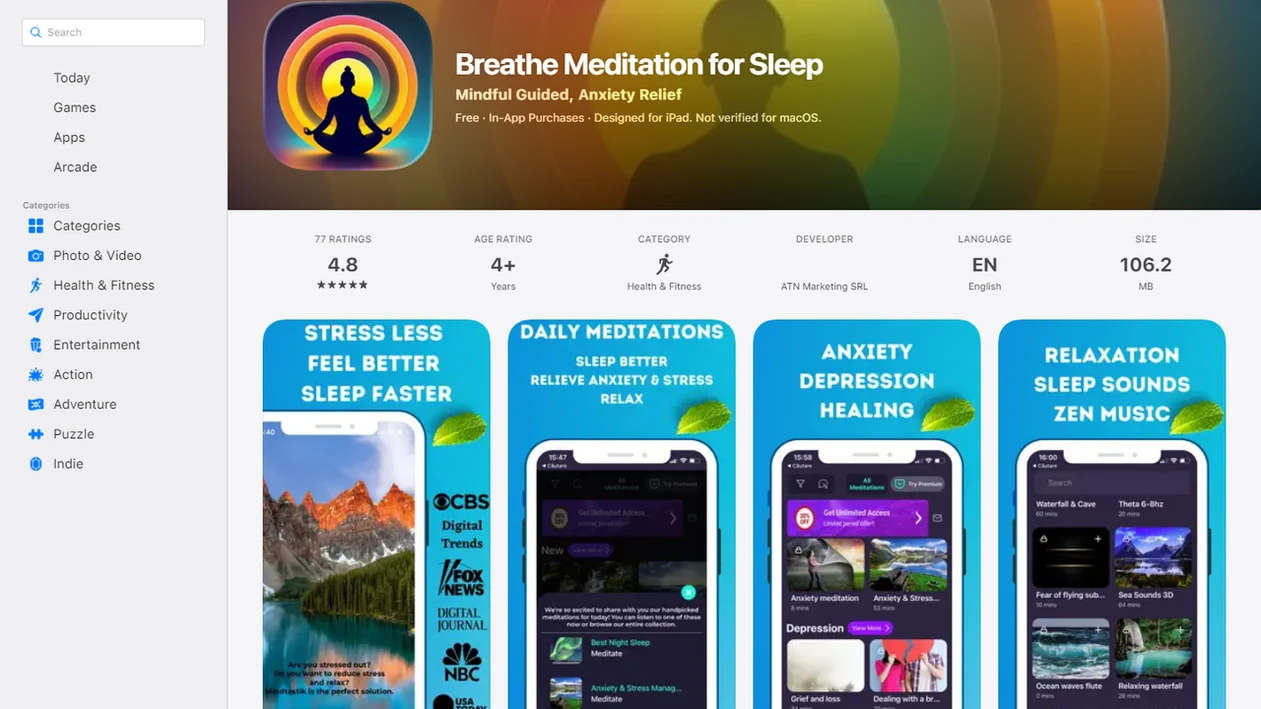
MindTastik combines breathing exercises, guided meditation, sleep stories, and self-hypnosis audio. That mix suits adults who want guided audio for settling attention and relaxing before bed, with different formats available when one style feels distracting.
It is a free download with an optional subscription and a free trial, not a medical treatment. People who prefer a structured beginner course may find Headspace a better match; those seeking a substantial free library can consider Insight Timer. Persistent insomnia needs more than a choice of narrator.
What sleep anxiety apps cannot treat on their own
Meditation apps can support sleep anxiety, but they have real limits. A good app should make those limits clear before you subscribe.
- Not stand-alone treatment: Apps should not be used as the only care for diagnosed insomnia disorder, generalized anxiety disorder, major depression, panic disorder, or suicidal thoughts.
- Some practices can feel unsafe: Body scans, long silences, and eyes-closed exercises may temporarily increase distress for trauma survivors.
- Commercial comparisons are thin: Very few high-quality randomized trials compare Calm, Headspace, MindTastik, Insight Timer, and Waking Up head to head.
- Consistency is required: Sporadic use usually produces minimal benefit. Three nights on, two weeks off is not a fair test.
- “Best” is not scientifically validated: Marketing claims about the best app are not proven for any single brand across all users.
- Severity matters: NIMH reports that 19.1% of U.S. adults had an anxiety disorder in the past year, and many need more than self-help nimh reference: any anxiety disorder.
- Sleep and mental health overlap: CDC data show adults with mental health symptoms report insufficient sleep more often than adults without those symptoms CDC guidance: mm6506a1.htm.
Anxious beginners may prefer the best guided meditation app for beginners if sleep content alone feels too narrow.
When choosing bedtime audio keeps the mind awake
A meditation app may not be the best first choice if the app itself becomes another thing to manage at night. If comparing narrators, adjusting volume, or searching for the perfect sleep story keeps you alert, a simpler routine may fit better for that evening. When the tool creates more decisions than calm, the routine needs to get smaller.
A Bedtime Decision Guide
If your main problem is racing thoughts, start with a guided breathing exercise before choosing a longer track. If your body feels restless, a body scan may fit better than a story because it gives attention a specific place to land. Pick the practice that matches the obstacle in front of you, not the routine you wish you had.
Sleep anxiety app questions
Which meditation app is best for racing thoughts at night?
Start with an app that offers guided attention practices rather than only background sound. MindTastik includes breathing exercises, guided meditation, and self-hypnosis audio; Headspace offers structured anxiety support and wind-down content. No comparative trial establishes a single winner for racing thoughts. A familiar voice and an easy-to-repeat practice are useful selection criteria.
Is Calm or Headspace better for sleep anxiety?
Calm is a stronger content match for people who prefer sleep stories, music, and a broad bedtime library. Headspace suits people who prefer structured courses and guided anxiety practices. Both have sleep research, but the studies differ in participants and programs. They do not establish which app is better for an individual with sleep anxiety.
Do meditation apps help insomnia or just relaxation?
Some trials report improvements in sleep quality and time to fall asleep, so potential benefits extend beyond feeling relaxed. However, many outcomes are self-reported, and objective sleep measures may not improve. Ordinary meditation content should not be treated as equivalent to a structured CBT-I program for clinical insomnia.
Are sleep stories better than guided meditation for anxiety?
There is no clear winner for sleep anxiety in the evidence available here. Stories provide a narrative to follow; guided meditation asks attention to return to breath, bodily sensations, or another focus. Stories may suit people who dislike inward attention. Meditation may suit those wanting a repeatable way to respond to worry.
How long should a bedtime meditation last?
A short practice is a reasonable starting point when anxiety makes sustained attention difficult. The existing routine suggests five to ten minutes of breathing before a bedtime meditation or body scan. Longer is not automatically better, and there is no established session length that guarantees faster sleep. Ease of repetition matters more than completing a long track.
How many nights does a sleep meditation app take to work?
There is no reliable number of nights for an individual. Calm and Headspace sleep studies have assessed practice over several weeks, including eight-week trials, rather than promising immediate results. A brief record of bedtime worry and sleep quality can help distinguish a useful routine from audio that merely feels pleasant while playing.
What is the best free meditation app for sleep anxiety?
Insight Timer is a reasonable starting point for a substantial free library and a range of teacher styles. Its extensive choice can also make bedtime selection harder. Saving one suitable practice in advance may be more useful than browsing nightly. Access to free content does not establish that an app treats insomnia.
Can bedtime meditation make anxiety worse?
Yes, some practices can increase distress, particularly body scans, long silences, or eyes-closed exercises for trauma survivors. A distressing session does not need to be completed. A different audio format may feel more manageable, but repeated or severe distress is a reason to discuss the practice with a qualified clinician.