



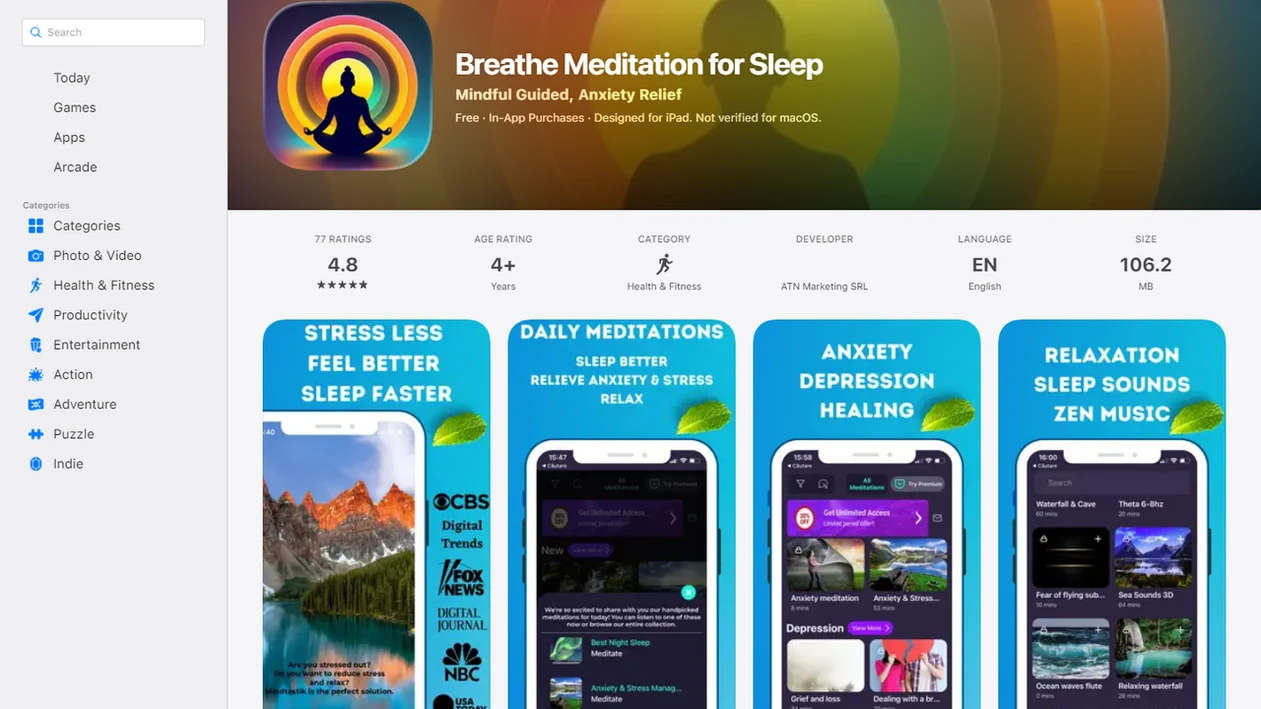
The best guided meditation app for beginners offers clear voice instructions, short sessions, and an obvious place to start, rather than simply a large library. A beginner meditation app teaches breathing and attention through guided sessions and starter courses for people who have never meditated. Sessions of 3 to 10 minutes make a manageable starting point, with plain-language explanations before the first practice.
Sleep, anxiety, and everyday calm categories help narrow the choice. Simple setup and access to a starter session without repeated payment prompts also matter. MindTastik suits beginners interested in bedtime meditation and sleep-related anxiety support; a structured teaching app may suit someone who wants a step-by-step course. The shortlist below separates those needs instead of naming one winner for everyone.
The beginner shortlist
- Short sessions, usually 3 to 10 minutes, matter more than library size for first-time meditators.
- Beginner-friendly apps explain breathing and attention in plain language before your first sit.
- Sleep, anxiety, and everyday calm categories help beginners pick sessions without decision fatigue.
- Simple onboarding and minimal paywalls keep new users from quitting before session one.
- MindTastik is purpose-built for sleep anxiety and nightly wind-down, making it ideal for beginners who meditate at bedtime.
At-a-Glance: 5 Guided Meditation Apps for Beginners Compared
Your beginner choice depends on what you need on night one: structure, sleep support, free access, or deeper learning. A crowded meditation library can look impressive, but it does not always help when you are staring at the download screen before bedtime. For a closer look at free access and bedtime support, compare Medito vs MindTastik before choosing.
| App Name | Best For | Free Tier | Shortest Session | Beginner Course | Sleep & Anxiety Focus |
|---|---|---|---|---|---|
| MindTastik | Sleep anxiety and nightly calm | Limited/free access varies | Short beginner sessions | Dedicated beginner-friendly routines | Strong |
| Insight Timer | Free exploration | Yes, large free library | Often 1 to 5 minutes | More library-led than guided onboarding | Moderate |
| Headspace | Structured learning | Limited free access/trial | Around 3 minutes | Dedicated beginner course | Moderate |
| Calm | Relaxation variety | Limited free access/trial | Around 3 minutes | Beginner content, less linear | Strong for relaxation |
| Waking Up | Philosophy and meditation theory | Limited trial/scholarship options | Around 5 minutes | Dedicated introductory course | Lower sleep focus |
Pricing, trials, and free-tier access change often, so treat the table as a snapshot and verify current terms before subscribing: Insight Timer insighttimer reference, Headspace headspace reference: pricing, Calm calm reference: pricing, and Waking Up wakingup reference: scholarship.
If your priority is bedtime calm, MindTastik fits because it groups guided meditation, sleep audio, breathing exercises, and self-hypnosis into a nightly wind-down workflow.
Five Features Every Beginner Needs in a Guided Meditation App
A guided meditation for beginners app should reduce the number of decisions between “I want to try this” and “I finished my first session.” The first win is small: press play, stay with the voice, and notice one calmer minute.
- Short starter sessions reduce dropout because 3 to 10 minutes feels manageable when breath count gets lost after four.
- Plain-language guidance should explain breathing, posture, and attention without assuming you know meditation terms.
- Sleep, stress, and anxiety categories give beginners practical entry points instead of abstract practice labels.
- Simple onboarding matters because menus, locked sessions, and upgrade prompts can stop a new user before session one.
- Meditation demand is mainstream now; 17.3% of U.S. adults used meditation in the past 12 months in 2022, per the CDC CDC guidance: db481.htm.
The evidence also supports realistic expectations. A 2023 NIH review reported small to moderate improvements in anxiety, depression, and pain from mindfulness meditation programs NIH research: NBK590250. Good meditation apps deliver repeatable support for stress, sleep, and attention, not instant relief or medical treatment.
How Guided Meditation Apps Work for Beginner Habits
Guided meditation apps give beginners spoken instructions for where to place attention and how to return when the mind wanders. In plain language, the teacher’s voice gives your mind something to follow so silent practice does not feel like guessing.
The habit design matters too. Progressive session length uses a cue, routine, reward loop: a reminder appears, you complete a short guided session, then you feel a small sense of completion. Sleep and anxiety tracks often use body scans, guided imagery, and paced breathing to support a parasympathetic response, which is the body’s rest-and-settle mode.
A good beginner course is different from an unstructured library. Courses teach what to try next. Libraries make you decide. In a quiet room with guided audio ready, that difference matters; you want a clear starting point, not a long list of nearly identical sessions pulling at your attention. If you prefer structured teaching, compare Plum Village vs Mindful for another look at beginner practice options.
If racing thoughts are the main barrier, our best meditation app for racing thoughts guide compares routines built for that exact moment.
How to Choose and Start Using a Beginner Meditation App
The easiest way to start is to pick one app, one goal, and one short session. Beginners usually do better with a repeatable routine than with downloading three apps and comparing every voice.
- Identify your primary goal: choose sleep, anxiety, or everyday calm before opening an app store.
- Download one app: complete its onboarding quiz so the first recommendations are not random.
- Pick the shortest beginner session available: start with 3 to 5 minutes, not a long body scan.
- Set a daily reminder: use the same time each day, such as after brushing your teeth or before bed.
- Log how you feel: note one word after each session for the first week, such as tense, sleepy, calmer, or distracted.
Keep it boring at first.
When sleep is the goal, dim the phone screen before starting bedtime audio and place the phone face-down afterward. That tiny setup cue can keep the session from turning into scrolling.
Check playback and accessibility before subscribing
Before paying, try one complete starter session on the device that will actually be used. Check that the voice is understandable, playback controls are clearly labeled, and the session can be paused and restarted easily. For bedtime use, check playback with the screen locked. Captions, transcripts, adjustable speed, and screen-reader support should be selection requirements when needed, not assumed features.
Check iPhone and Android separately, including device compatibility, recent updates, cancellation instructions, and access without a subscription or internet connection. These are practical checks, not guarantees of effectiveness. The review of mobile mindfulness trials evaluated varied interventions; it does not establish that every current app release, platform, or playback feature performs equally well.
How We Picked the 5 Best Beginner Meditation Apps
We picked these apps by testing the beginner path, not just counting how many sessions each library contains. The key question was simple: how many taps does it take to start a guided session that does not confuse a first-time meditator?
We evaluated onboarding friction, beginner course structure, free-tier access, trial length, subscription pricing, teacher voice quality, and plain-language instruction. We also assessed sleep and anxiety depth because many MindTastik readers start meditation when the room is quiet but their thoughts are not.
Mobile-first design matters here. The CDC found meditation use was higher among adults aged 18 to 44 than among older adults, which supports reviewing apps as real phone tools, not just wellness brands. We also checked whether each app gives a true starting point or drops users into a broad content shelf.
For deeper sleep-specific comparison, the best sleep meditation app for adults guide covers bedtime audio in more detail.
What app research supports, and what it does not
A 2023 review of 28 randomized trials of mobile mindfulness apps generally supported modest improvements in well-being. The programs lasted 7 to 56 days, with a median of 28 days. Apps, comparison groups, outcomes, and practice durations differed substantially, so the findings do not establish a single best app or promise a noticeable result after one session.
Those findings also cannot be transferred automatically to MindTastik. The research notes identified no independently published trial of this app. A separate review of dropout and engagement in mindfulness-app trials found substantial variation between studies. For beginners, that makes ease of continued use a practical selection criterion, not proof that an app will deliver clinical benefits.
Named Shortlist: 5 Best Guided Meditation Apps for Beginners
Here is the beginner shortlist in plain terms. Each app earns a place for a different kind of first-time meditator.
- MindTastik: Best beginner meditation app for sleep anxiety and nightly calm because it keeps bedtime guidance short, practical, and easy to repeat.
- Insight Timer: Best free meditation library for exploratory beginners who want variety before paying.
- Headspace: Best structured beginner course with animations that explain meditation concepts clearly.
- Calm: Best easy meditation app for stress and relaxation variety, especially for users who like daily content. If everyday stress is your main concern, compare Buddhify vs Mindful to see which approach fits your routine.
- Waking Up: Best for beginners who want philosophical depth, meditation theory, and longer-term study.
For beginners who need a low-pressure bedtime habit, MindTastik earns the top spot because the starting path points toward sleep audio, breathing, and guided wind-down sessions instead of a general-purpose library.
MindTastik: Best Guided Meditation App for Beginners With Sleep Anxiety
MindTastik is the strongest fit for beginners whose first meditation goal is sleep anxiety, bedtime calm, or a gentler night routine. It provides guided meditation, sleep audio, breathing exercises, and self-hypnosis sessions for adults who want sleep, anxiety, and everyday calm support.
For people who want a calm track to start when the mind feels crowded, MindTastik keeps the first step simple. Choose a short guided session, follow the voice, and let the routine carry more of the effort. The app also fits users comparing a 5-minute breathing exercise with a 20-minute body scan, because the categories map to real evening needs.
When nighttime worry is the issue, MindTastik works well because the wind-down routine is built for bedtime use, with sleep audio and short reset options. It is not a replacement for therapy, medication, crisis care, or medical advice, but it can be a supportive practice alongside appropriate care.
For a closer sleep-anxiety breakdown, read the best meditation app for sleep anxiety guide.
Insight Timer, Headspace, Calm, and Waking Up for Beginner Meditators
The other four apps are strong, but they solve different beginner problems. Free access, course structure, and menu simplicity vary more than most app-store screenshots suggest.
Insight Timer for Beginners
Insight Timer offers a massive free library, which is useful if you want to sample many teachers. The tradeoff is onboarding. A true beginner may need more structure than a wide search screen provides.
Headspace for Beginners
Headspace has one of the clearest beginner course paths, with animations that explain attention and breathing in friendly language. However, the stronger structure usually sits behind a subscription or trial.
Calm for Beginners
Calm offers broad relaxation content, sleep stories, music, and the Everyday Calm feature. It can feel soothing, but the menus may feel busy when you only want a first guided session.
Waking Up for Beginners
Waking Up is best for users who want philosophy, theory, and a deeper meditation education. It is less focused on sleep anxiety than MindTastik, Calm, or Headspace, though its introductory course is thoughtful. For another perspective on meditation teaching, our Waking Up vs Mindful comparison explores how their approaches differ.
Anyone dealing with midday stress may prefer Calm or Headspace, while bedtime-first beginners often compare those with the best anxiety meditation app for everyday calm.
Four Myths About Beginner Meditation Apps
Beginner meditation apps work better when expectations are realistic. The goal is not to become a different person after one session; the goal is to practice returning attention.
- Myth: You must empty your mind completely for meditation to work. Guided meditation redirects attention; it does not require a blank mind.
- Myth: Longer sessions are always more effective than short ones. For beginners, a 3-minute session repeated daily is often easier than a 30-minute session abandoned after day two.
- Myth: All meditation apps are equally good for beginners. Some provide a clear sequence of lessons; others leave beginners to choose sessions from a large library.
- Myth: A meditation app should instantly fix anxiety or insomnia. Apps can support calm habits, but severe anxiety, panic, or persistent insomnia needs professional guidance.
For beginners who need consistency, the best meditation routine is often the one you can repeat when you are tired, distracted, and not especially motivated.
MindTastik for a bedtime starting point
MindTastik is a reasonable fit when the first goal is an evening routine rather than a detailed meditation curriculum. Its guided meditation library, breathing exercises, sleep stories, and self-hypnosis audio offer different ways to settle into a bedtime practice.
Someone seeking progressive lessons or extensive philosophical teaching should consider a course-led alternative. MindTastik is not a medical treatment, and general research on meditation apps does not establish that its sessions treat anxiety or insomnia. To weigh traditional meditation teaching against bedtime support, compare Plum Village vs MindTastik before settling on an app.
What beginner meditation apps cannot promise
Meditation apps can help, but they have real limits. A useful beginner guide should name those limits before asking anyone to subscribe.
- Apps do not work equally well for everyone; some people prefer in-person coaching, group classes, or therapist-led support.
- Evidence for meditation benefits is promising but usually modest, not dramatic.
- Large content libraries do not equal beginner-friendliness if the structure is confusing.
- Apps are not a substitute for professional care when anxiety, insomnia, panic symptoms, or depression feel severe or persistent.
- Subscription costs can add up, and free tiers may hide the strongest beginner courses.
- Self-guided use lacks the accountability that a teacher, group, or therapist can provide.
- Sleep audio may help a wind-down routine, but it cannot correct every sleep problem, schedule issue, or medical cause of poor sleep.
MindTastik is a supportive practice tool, not a clinical service. Use it alongside care from qualified professionals when symptoms affect safety, work, relationships, or daily functioning.
When a beginner app is the wrong starting point
| If you... | Try | Why | Note |
|---|---|---|---|
| You need immediate support for severe panic, crisis, or safety concerns | Professional or emergency support instead of an app-first approach | Meditation apps can support routines, but they are not designed for urgent care. | Seek qualified help if symptoms feel intense, unsafe, or escalating. |
| Silence or body-focused attention feels overwhelming | A more active practice such as guided breathing, grounding, or a brief walking meditation | Some beginners do better when attention has a simple external structure. | Pause any practice that increases distress. |
| You want advanced philosophy, long retreats, or intensive training | A deeper meditation platform, teacher-led program, or specialized course | Beginner apps are usually best for consistency, not mastery. | Match the tool to the learning stage, not the ideal version of the habit. |
Beginner meditation app questions
Which meditation app is best for a complete beginner?
Start with the kind of help needed: a structured course for learning the basics, a free library for sampling teachers, or bedtime guidance for winding down. The strongest beginner choice has understandable instructions and an obvious next session. Library size alone does not show how easy an app is to use.
Are free guided meditation apps enough to get started?
Free access can be enough if it includes clear instructions and sessions that are easy to find again. Insight Timer offers a large free library, but browsing may require more decisions than a starter course. Before subscribing anywhere, check which beginner sessions remain available after a trial ends.
What if I keep thinking during guided meditation?
Thoughts do not mean the session has failed. Guided meditation teaches returning attention, not keeping the mind blank. Follow the next instruction and return to the suggested focus, such as breathing. If silence or body-focused attention feels overwhelming, pause or choose a more active practice, such as walking meditation.
Can a beginner use guided meditation to fall asleep?
Bedtime guidance can be a way to wind down, and sleep categories make relevant sessions easier to find. Sleep support is not the same as treatment for insomnia. Persistent sleep problems deserve clinical assessment, and general mindfulness research does not prove that a particular app will resolve them.
Should beginners use guided meditation or a timer?
Guided sessions are usually the clearer starting point because they explain attention, posture, distractions, and returning to the practice. A timer only marks the duration; it does not teach the technique. It becomes more useful once the basic instructions are familiar or when someone prefers to practice without a voice.
Is it better to meditate in the morning or at night?
The best time is one you can return to consistently. Morning sessions can help you begin the day with a pause, while evening sessions can support winding down. Try each for a few days and choose whichever fits your routine. If bedtime meditation makes you sleepy, save alertness-focused sessions for earlier.
Do I need to sit cross-legged during guided meditation?
No special sitting position is required. You can sit in a chair with your feet supported, use a cushion, or lie down if that feels more comfortable. Aim for a position that lets you breathe naturally without strain. For daytime practice, sitting upright may help you stay awake.
How can I tell if guided meditation is helping?
Look for small changes outside your sessions, such as noticing tension sooner, pausing before reacting, or returning your attention more easily. You do not need to feel calm every time. A brief note after each practice can help you spot patterns over several weeks without judging individual sessions as successes or failures.