
Meditation App vs CBT-I App for Sleep Problems



CBT-I apps are the more targeted choice for chronic insomnia, while meditation apps mainly support relaxation, sleep anxiety, and calmer bedtime routines. CBT-I programs use sleep diaries, stimulus control, sleep restriction, and cognitive restructuring to address sleep patterns and beliefs. Meditation apps offer breathing, guided sessions, and sleep audio, but these are not complete insomnia treatment programs.
The choice between meditation apps versus insomnia apps depends on the sleep problem, not just the content library. Occasional stress-related sleeplessness may suit relaxation support; problems lasting months warrant consideration of CBT-I with professional guidance. Both can be used together. This comparison is educational, not diagnostic. Persistent insomnia, severe daytime impairment, suspected sleep apnea, pregnancy-related concerns, medication or substance use questions, and significant mental health symptoms need professional assessment.
Which approach fits
- CBT-I apps target chronic insomnia with sleep diaries, stimulus control, sleep restriction, and cognitive restructuring.
- Meditation apps support relaxation, nighttime anxiety, breathing, and calmer bedtime routines, but they are not complete insomnia treatment programs.
- Many people use both: CBT-I as the insomnia framework and meditation as support for stress, rumination, and pre-sleep arousal.
Calm and Sleepio: purpose and available details
| Comparison point | Calm | Sleepio |
|---|---|---|
| Program type | Meditation, sleep, and wellness app | Digital CBT-I program |
| Main role | Relaxation and bedtime support | Structured insomnia treatment |
| Core content | Guided breathing, meditations, body scans, and Sleep Stories | Sleep monitoring, behavioral sleep strategies, and cognitive work |
| CBT-I distinction | General relaxation content is not a complete CBT-I program | Uses structured CBT-I techniques |
| Current USD subscription price | Not published | Not published |
| Current platform list | Not published | Not published |
Sources: mattressnut.com, hartfordhospital.org.
Meditation app vs CBT-I app, side by side
Side-by-side captures of the compared products. Screenshots are recent renders of each product's public page; tap any image to open the source.
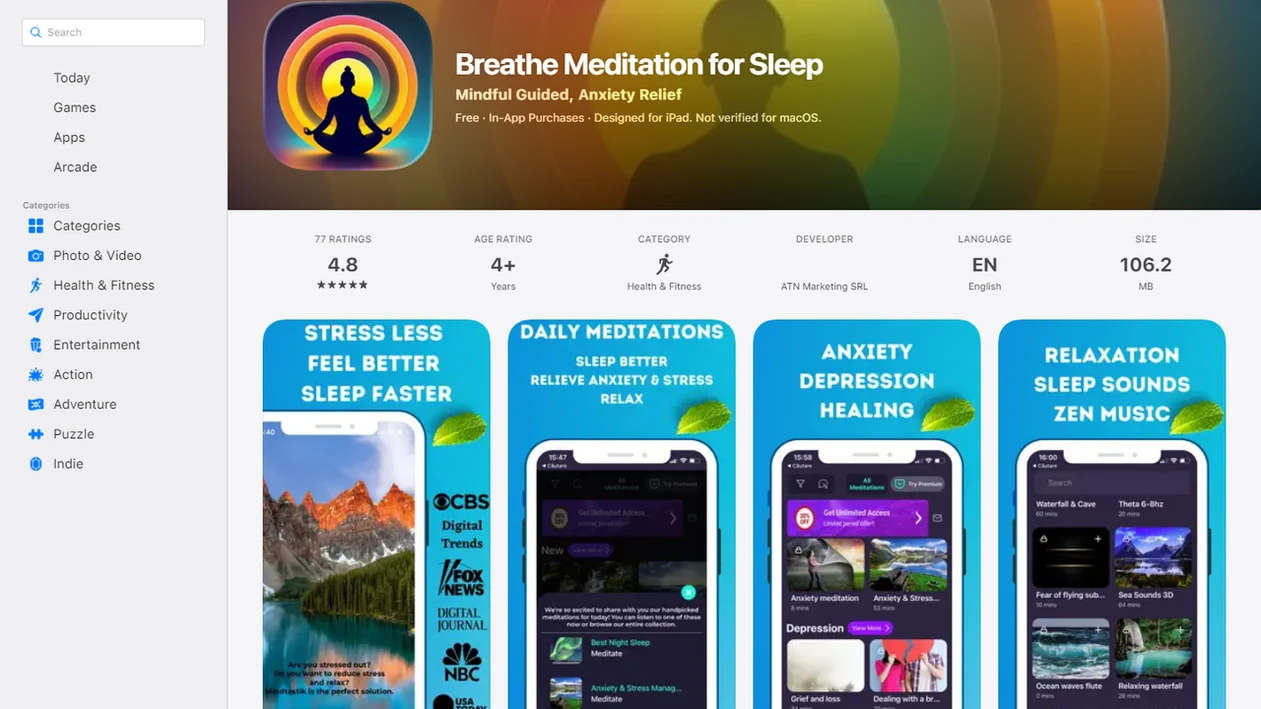
Meditation App vs CBT-I App at a Glance
Meditation apps are wellness tools for relaxation and bedtime support, while CBT-I apps are structured insomnia programs. The right choice depends on whether you need calmer nights or a direct plan for chronic insomnia. If you prefer general relaxation tools, Smiling Mind vs Headspace compares two meditation options rather than insomnia treatment programs.
| Comparison point | Meditation app | CBT-I app |
|---|---|---|
| Main purpose | Relaxation, sleep anxiety, breathing, everyday calm | Chronic insomnia treatment structure |
| User fit | Stress-related sleeplessness, racing thoughts, wind-down routine | Insomnia lasting months or following a pattern |
| Evidence strength | Helpful for stress and sleep quality, less insomnia-specific | Stronger evidence for chronic insomnia |
| Typical features | Guided session, sleep audio, breathing, self-hypnosis | Sleep diary, sleep restriction, stimulus control |
| Time commitment | Flexible, from a few minutes to longer audio | Several weeks of consistent tracking |
| Medical boundary | Wellness support | Treatment-like behavioral program |
Examples include Calm and Headspace for meditation-style support, and Sleepio or CBT-i Coach for CBT-I. The names matter less than the method. For another comparison of meditation tools, consider Medito vs Headspace when weighing free access and app features.
5 Facts About CBT-I vs Meditation for Insomnia
CBT-I has stronger insomnia-specific evidence than meditation, especially for chronic insomnia. Meditation may still help when stress, rumination, or body tension keeps sleep from starting.
- The American College of Physicians and the American Academy of Sleep Medicine recommend CBT-I as first-line treatment for chronic insomnia in adults, according to ACP guidance acpjournals reference: M15 2175.
- Chronic insomnia affects an estimated 10 to 15% of adults, according to clinical sleep-medicine summaries NIH research: NBK526136.
- CBT-I commonly includes sleep restriction, stimulus control, cognitive restructuring, and a sleep diary.
- Clinical reviews commonly report that CBT-I improves insomnia symptoms for about 70 to 80% of patients, although results vary by severity, adherence, and delivery format PMC research article: PMC6796223.
- Mindfulness-based interventions show small to moderate sleep-quality improvements in some studies, but the evidence is weaker and less insomnia-specific than CBT-I JAMA Internal Medicine study: 2110998.
Clinicians typically recommend CBT-I when insomnia is persistent, because it targets the sleep pattern itself.
How CBT-I Apps and Meditation Apps Work
A CBT-I app works by changing sleep timing, conditioned bedroom associations, habits, and sleep-related thoughts; a meditation app works mainly by lowering arousal, stress, rumination, and anxious body activation. In plain terms, CBT-I retrains the sleep system, while meditation helps the nervous system settle.
CBT-I may feel harder at first. Sleep restriction can shorten the time set aside for sleep, so a person might feel more tired before sleep becomes more consolidated. That is different from starting a 5-minute breathing exercise when the mind needs a simple place to settle.
Meditation can support calm without replacing a clinical insomnia protocol. For people comparing wellness-app options rather than insomnia treatment, a separate meditation-app comparison can cover content libraries, pricing, and audio styles.
Where a Meditation App Wins for Sleep Anxiety
A meditation app wins when the main problem is sleep anxiety, bedtime tension, travel disruption, naps, or a need for everyday calm. It is easier to start than a structured insomnia program because you can choose one guided session and begin tonight.
Think of the 2:13 a.m. lock-screen check, when you realize you are still awake and your jaw is tight against the pillow. A short breathing track or sleep audio gives your attention somewhere softer to land.
A meditation app can support sleep anxiety and everyday calm through guided meditation, breathing exercises, sleep audio, and self-hypnosis. They can be used before bed, in the morning, or during a tense daytime moment. For another look at guided practice options, Smiling Mind vs Mindful compares meditation tools for everyday use.
Keep it simple.
For stress-driven sleep trouble, meditation is often easier than CBT-I because it asks for immediate practice, not weeks of sleep tracking.
Where a CBT-I App Wins for Chronic Insomnia
Is a CBT-I app better for insomnia lasting three nights per week for three or more months? Yes, that pattern fits chronic insomnia, and CBT-I is usually the more appropriate starting framework than meditation alone.
CBT-I wins because it addresses the machinery of insomnia directly. Sleep diaries show patterns. Sleep-window adjustments build sleep pressure. Stimulus control weakens the link between bed and wakefulness. Cognitive restructuring works on the thoughts that make bedtime feel loaded.
Sleepio is one example of a digital CBT-I program with clinical trial evidence. A large workplace trial reported a 58% reduction in clinical insomnia at follow-up among participants compared with controls tandfonline reference: 15402002.2015.1028076.
The most common medically supported way to address chronic insomnia is CBT-I, sometimes combined with clinician guidance and supportive relaxation practice.
Sleepio vs Meditation App Evidence and Policy Differences
Sleepio vs meditation app comparisons are really about evidence, claims, and intended use. Some digital CBT-I programs have clinical validation and may appear in health-system or prescription-like contexts, depending on region and documentation.
Evidence strength also depends on the exact app version, study population, follow-up period, and whether users completed the program. A trial of one CBT-I app should not be treated as proof that every sleep app with insomnia language works the same way.
| Area | Digital CBT-I program, such as Sleepio | Meditation app, such as Calm or Headspace |
|---|---|---|
| Claim type | May target insomnia using CBT-I methods | Usually supports relaxation and wellness |
| Clinical outcome | Often measures insomnia symptoms and sleep efficiency | Often measures stress, mindfulness, or sleep quality |
| Adherence need | Requires logs, schedules, and behavior changes | Flexible listening or practice |
| Oversight | May be clinician-recommended or health-system supported | Usually self-directed |
| Boundary | Check local availability and app documentation | Should not claim to treat chronic insomnia |
A meditation app can still be useful. But if the app does not include sleep restriction, stimulus control, and a structured diary, it is not full CBT-I. For audio-specific choices, compare guided meditation vs soundscapes.
A meditation brand can also offer a CBT-I program
The app name alone does not identify the treatment being studied. In a 2025 randomized trial of the Headspace Sleep Program, 132 adults with clinical insomnia received an 18-session program combining CBT-I techniques and mindfulness, or were assigned to a wait-list control. The program improved sleep efficiency, time taken to fall asleep, and wakefulness after sleep onset. Those findings concern the combined program, not Headspace’s meditation or sleep-story library by itself.
A separate 2026 trial of daily Headspace meditation studied 135 university staff over eight weeks. Ten minutes of daily meditation improved subjective sleep quality at multiple assessments, but sleep efficiency did not significantly improve. The practical distinction is the program’s ingredients: a sleep diary, behavioral sleep scheduling, stimulus control, and work on sleep-related thoughts indicate a different intervention from relaxation audio. Evidence for one should not be transferred to the other.
How to Use a Meditation App with a CBT-I App
You can combine meditation with CBT-I if meditation supports calm without undermining the CBT-I schedule. The key is to treat CBT-I as the insomnia framework and meditation as support for arousal, rumination, or daytime stress.
- Identify the pattern: Decide whether your sleep difficulty is occasional and stress-related, or chronic and happening at least three nights weekly.
- Log sleep consistently: If you use CBT-I, complete the diary and follow the prescribed sleep and wake schedule.
- Use meditation strategically: Play short breathing or body-based sessions for pre-bed anxiety, nighttime rumination, or daytime stress regulation.
- Avoid long bed audio if instructed: If CBT-I tells you to leave bed when awake, do not stay in bed for a long track.
- Seek care when needed: Get professional help if insomnia is persistent, severe, unsafe, or linked with other symptoms.
Earbuds on the nightstand, one side tangled around a charging cable, are fine. The plan still matters more than the playlist.
Meditation App vs CBT-I App Decision Checklist
Choose a meditation app for mild, situational, or anxiety-driven sleep trouble, especially when your goal is a calmer wind-down routine. Choose a CBT-I app or clinician-supported CBT-I when insomnia follows a chronic pattern. If your current wellness app feels unsuitable, a Smiling Mind alternative may better match your preferred bedtime practice.
Use this quick checklist:
- Choose meditation when stress, travel, naps, or racing thoughts are the main issue.
- Choose CBT-I when sleep trouble lasts three or more months and repeats weekly.
- Combine both when insomnia and rumination reinforce each other.
- Seek care for severe daytime impairment, safety issues, suspected sleep apnea, depression, trauma, mania, substance use, pregnancy-related concerns, or medication questions.
- Remember that an app cannot diagnose why sleep problems are happening.
An uncertain posture on the couch during a beginner session is normal. It does not answer whether your insomnia needs treatment. For specific practice styles, body scan vs breathing exercises may help you choose a starting point.
5 Myths About Insomnia Apps and Meditation Apps
Wrong app assumptions can delay useful care. These five myths cause the most confusion in CBT-I vs meditation decisions.
- “A meditation app is basically CBT-I with better audio.” It is not. CBT-I includes structured behavioral steps that most meditation apps do not provide.
- “Relaxation alone cures chronic insomnia.” Relaxation may help sleep quality, but chronic insomnia often needs targeted behavior change.
- “Every sleep app is evidence-based CBT-I.” Many sleep apps are trackers, sound libraries, or bedtime content collections.
- “Downloading CBT-I is enough.” A CBT-I app only works if you log sleep and follow the plan over several weeks.
- “CBT-I and meditation cannot be combined.” They can, if meditation does not conflict with the CBT-I instructions.
For broader evidence questions, do meditation apps actually help looks at what wellness apps can and cannot reasonably claim.
When to Seek Professional Help for Sleep Problems
Seek professional help when sleep problems are persistent, unsafe, or tied to symptoms an app cannot evaluate. A common threshold for chronic insomnia is trouble sleeping at least three nights per week for three months or longer.
Use a clinician, sleep specialist, or mental health professional sooner if the issue creates real-world risk. Do not wait if you are nodding off while driving, operating equipment, caring for someone vulnerable, or doing work where fatigue could harm you or others.
- Notice the pattern: Track how often sleep trouble happens and how long it has been going on, especially if it repeats weekly.
- Act on red flags: Ask for care if you suspect sleep apnea, have loud snoring or choking awakenings, or notice depression, mania, trauma symptoms, panic, or substance use concerns.
- Check medical context: Get guidance if you are pregnant, changing medications, using sleep aids, or managing pain, hormones, breathing problems, neurologic symptoms, or other medical conditions.
- Use apps carefully: Treat meditation and CBT-I apps as support tools. They can guide habits and calm arousal, but they cannot diagnose the cause of sleep problems.
MindTastik for wind-down support, not insomnia treatment
MindTastik’s guided meditations, breathing exercises, and sleep stories suit stress-related bedtime tension and overthinking. Its breathing sessions offer a focused relaxation option before bed or during the day. The app is not a medical treatment and does not replace a structured CBT-I program. To compare wellness options for bedtime support, Smiling Mind vs MindTastik focuses on differences between these meditation apps.
For persistent insomnia, clinician-supported CBT-I or an appropriate digital CBT-I program is the more targeted choice. MindTastik can serve as an optional calming activity alongside that plan, provided the session timing does not conflict with treatment instructions.
What sleep apps cannot assess or treat on their own
Apps can help, but they have real limits. This is especially important when sleep loss is persistent, risky, or tied to medical or mental health symptoms.
- Meditation apps are not complete medical treatments for chronic insomnia.
- CBT-I apps require consistent tracking and behavior change over several weeks.
- Sleep restriction can feel difficult and may temporarily increase tiredness.
- Not every app labeled “sleep” or “insomnia” contains evidence-based CBT-I components.
- Meditation evidence for sleep is generally less specific and weaker than CBT-I evidence.
- Digital tools may not be enough for complex mental health, medical, medication-related, or sleep-disorder causes.
- People with persistent insomnia, severe impairment, safety concerns, or suspected sleep apnea should seek professional care.
A phone face-down on the nightstand can support a wind-down routine. It cannot rule out apnea, medication effects, or depression.
Choosing breathing, body scans, or narration alongside CBT-I
| If you... | Try | Why | Note |
|---|---|---|---|
| You feel tense, restless, or mentally overloaded before bed. | Breathing exercise or body scan. | These formats give the mind a concrete anchor instead of asking it to become quiet immediately. | Keep it brief if you tend to get frustrated by long instructions. |
| You dislike silence and notice thoughts speeding up in quiet rooms. | Sleep story or guided self-hypnosis-style relaxation. | Narration can reduce the pressure to monitor whether you are falling asleep. | Choose a familiar voice or style so novelty does not become stimulating. |
| You are following CBT-I and want a non-disruptive add-on. | Daytime meditation or early-evening relaxation practice. | Using meditation outside the sleep window may support calm without interfering with CBT-I instructions. | Follow the CBT-I plan first if the two recommendations conflict. |
Repeat one short relaxation format before switching
People can get stuck when they keep switching formats every night, hoping the next track will be the one that finally works. A better test is to repeat one short format for several evenings and notice whether bedtime feels less effortful, even if sleep is still imperfect. The most useful session is the one that lowers friction, not the one that promises the biggest transformation.
When you want app-based guidance rather than reading steps alone, MindTastik guided meditation app collects the core guided library in one place.
Meditation and CBT-I app questions
Is CBT-I better than meditation for chronic insomnia?
CBT-I has stronger insomnia-specific evidence and addresses sleep timing, habits, conditioned wakefulness, and sleep-related thoughts. Meditation mainly supports relaxation and attention. For insomnia that persists for months, CBT-I is generally the more appropriate treatment framework, with meditation used as optional support rather than a replacement.
How can I tell if a sleep app actually includes CBT-I?
Look for a structured program with a sleep diary, stimulus control, sleep restriction or compression, and work on unhelpful sleep-related thoughts. A library of stories, sounds, or meditations is not enough. Even an app described as an insomnia app needs closer examination of its actual program and supporting evidence.
Can meditation and CBT-I be used together?
Yes, when relaxation practice supports rather than conflicts with the CBT-I plan. Daytime or early-evening meditation can address stress without changing the prescribed sleep window. If long audio sessions encourage extended wakefulness in bed, the CBT-I instructions should take priority. A treating clinician can help resolve conflicting advice.
Can sleep stories or breathing exercises cure insomnia?
They may help with tension, racing thoughts, and subjective sleep quality, but they are not complete treatments for chronic insomnia. Feeling calmer does not necessarily mean sleep timing or nighttime wakefulness has improved. Persistent symptoms call for an insomnia-focused assessment rather than simply adding longer or more frequent audio sessions.
Does Headspace offer CBT-I or just meditation?
Headspace has been studied both as a meditation app and through a specific Sleep Program incorporating CBT-I techniques and mindfulness. A 2025 insomnia trial evaluated that combined program, not ordinary meditation content alone. Its results should not be taken as evidence that every Headspace session provides CBT-I.
Can sleep restriction in a CBT-I app make tiredness worse?
Sleep restriction can temporarily increase tiredness because it reduces the time set aside for sleep. That makes safety and medical context important. Significant daytime sleepiness, driving risks, or other health concerns warrant professional guidance rather than independently adjusting a sleep window through an app.
When should sleep problems be assessed by a clinician?
A common chronic insomnia pattern is difficulty sleeping at least three nights weekly for three months or longer. Assessment is needed sooner when fatigue threatens driving or work safety, or when sleep problems accompany suspected sleep apnea, substantial mental health symptoms, pregnancy-related concerns, or medication and substance use questions.