
Minimum Meditation Time: How Long Beginners Really Need
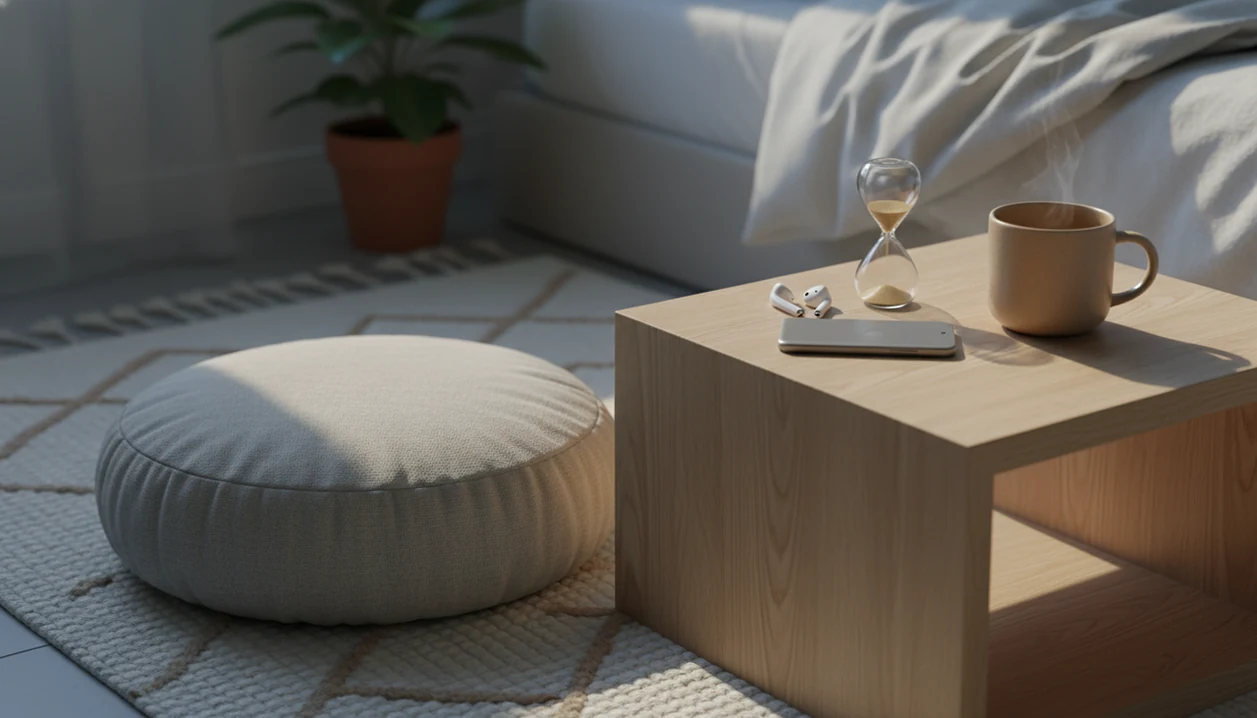


The minimum meditation time for most beginners is 3 to 5 minutes a day, a practical starting point rather than a proven threshold for benefit. Here, minimum means the shortest session that can be repeated often enough to feel useful. That small commitment can make practice more manageable when someone is tired, stressed, new to meditation, or struggling to stay consistent.
For sleep, anxiety support, or focus, 10 to 15 minutes is a reasonable next step once shorter sessions feel easy. There is no requirement to reach that length immediately. A short practice still includes the basic work of meditation: noticing distraction and returning attention. The aim is a repeatable routine, not a perfect session or a particular number on the timer.
The essentials
- Start with 3 to 5 minutes if you are new, tired, stressed, or inconsistent.
- Use 10 to 15 minutes as a practical next step for sleep, anxiety support, focus, and emotional balance.
- Consistency matters more than chasing a perfect session length.
Minimum meditation time guide: the 3-to-5-minute starting range
Quick answer: 3 to 5 minutes is a realistic minimum meditation time for most beginners. It is short enough to start on busy days, tired nights, and mornings when your attention feels scattered.
That range is not a universal clinical threshold. It is a practical starting point. A person sitting with uncertain posture on the couch may need a smaller promise than “meditate for 20 minutes every day.” Three minutes can be enough to learn the basic loop: notice the mind has wandered, return to the breath, repeat.
Small counts.
For many beginners, the next useful target is 10 to 15 minutes. That length gives a guided session more room to settle the body, especially before sleep or after a stressful work block. If you want more technique options, the broader meditation techniques library can help you choose a starting point.
What duration studies say about 5, 10, and 20 minutes
A 2026 randomized experiment involving 636 adults compared a single 5-minute mindfulness practice, a 20-minute practice, and an active control. Immediate effects varied with participant characteristics. Among participants lower in agreeableness, five minutes reduced negative affect more than twenty. This challenges the assumption that longer always produces a better immediate result, but it does not establish five minutes as the best duration for everyone.
A separate 2023 randomized study of 161 participants compared approximately 10 and 30 minutes of daily sitting or movement meditation over two weeks. Well-being and mindfulness increased, and distress decreased, across all four groups. There were no significant differences attributable to session length or meditation type. Over that short period, adding twenty minutes did not show a clear advantage.
Frequency is another part of the dose. A 2025 analysis of reported meditation practice found that frequency was a stronger predictor of outcomes than session duration, particularly early in practice. Because this was observational, it cannot prove that frequent short sessions caused better outcomes. Taken together, these findings support a modest starting commitment, but they do not identify a universal minimum or show that three minutes treats a mental health condition.
How Minimum Meditation Time Works
Minimum meditation time works by making the practice easy enough to repeat before motivation gets involved. The short length does not define your clinical need; it lowers resistance so you can build the habit on ordinary days.
The mechanism is a simple habit loop: a cue reminds you, the behavior is sitting or listening for a few minutes, and the reward is finishing with a little more steadiness or self-trust. Attention training happens inside that loop. You notice the breath or voice, the mind wanders into planning or replaying, and you return without treating the wandering as failure. That return is the mental rep.
A realistic sequence looks like this:
- Choose one cue you already meet each day, such as waking up, lunch, or getting into bed.
- Start with a small behavior that feels almost too easy, like 3 minutes of breathing.
- Let the reward be completion, not a perfectly quiet mind.
- Repeat daily so the cue and practice begin to feel connected.
- Extend the session when 3 to 5 minutes feels normal, especially for sleep preparation, focus, or deeper emotional settling. As your routine becomes steadier, mindfulness for resilience can help you practice responding more flexibly to everyday stress.
Habit formation cues for minimum meditation time
Minimum meditation time works by making the habit small enough that your brain stops negotiating with it. A short session lowers resistance, reduces avoidance, and makes repetition more likely.
How minimum meditation time works is mostly habit design, not willpower. Repeated cues such as waking, lunch, or bedtime connect the practice to an existing routine. The technical term is a habit loop: cue, behavior, reward. Habit-loop research is commonly traced to behavioral models of cue-driven routines and reinforcement, including work summarized by MIT researchers on basal-ganglia habit formation: news reference: habits brain 1108. In plain language, the same moment reminds you to sit, breathe, and finish.
Attention training is also simple, but not always easy. You listen to the guide, drift into planning, then return to the breath or voice. That return is the practice.
Tools like MindTastik can support this pattern with guided meditation, sleep audio, breathing exercises, and self-hypnosis sessions, without replacing medical or mental health care.
Minimum meditation time by goal: sleep, anxiety, and focus
Different goals fit different session lengths, so the minimum should match the moment. A 3-minute reset is not the same job as a 15-minute wind-down routine. For an evening reset, try meditation for letting go of the day to ease the shift from activity to rest.
| Goal or situation | Practical minimum | Why it fits |
|---|---|---|
| Beginner consistency | 3 minutes | It keeps the habit easy enough to repeat. |
| Quick stress reset | 3 minutes | It gives the body one short pause before reacting. |
| Bedtime breathing | 5 minutes | It creates a clear break between the day and bed. |
| Anxiety support | 5 to 15 minutes | Shorter sessions may feel safer when the body is keyed up. |
| Focus practice | 10 minutes | It gives attention more time to settle and return. |
| Deeper sleep preparation | 10 to 15 minutes | It supports a slower wind-down before lights out. |
Longer sessions are optional. Late at night, when rest still feels out of reach, a gentle 5-minute breathing track may be more realistic than a long formal practice. For bedtime options, visualization meditation for sleep can be a softer route.
Five minimum meditation time tips beginners should know
These minimum meditation time tips clear up the biggest beginner confusion. The main idea is simple: choose the smallest session you will actually repeat.
- Any meditation is better than none. A short reset can interrupt scrolling, rumination, or rushing.
- Three to 5 minutes counts. Beginners do not need a long session before the practice is valid.
- Longer is not always better. A 20-minute session you avoid is less useful than a 5-minute session you finish.
- You do not need to empty your mind. The practice is noticing thoughts and returning, not forcing silence.
- Move toward 10 to 15 minutes slowly. Increase only when the shorter session feels normal.
For beginners, a short daily session is often easier than an occasional long session because it reduces the decision load. The thumb rubbing a smooth phone case before pressing play is a real cue. Use it.
How to Use Minimum Meditation Time
Use minimum meditation time by making the first version so small that you can finish it on a normal day. The point is not to prove calm; it is to repeat a clear routine until sitting down feels familiar.
- Choose a 3-minute target for the first week, especially if you are new, tired, or inconsistent. Keep the promise small enough that it does not need ideal conditions.
- Attach the session to one daily cue you already have, such as brushing your teeth, closing your laptop, making coffee, or getting into bed.
- Play one simple practice instead of comparing options. A guided track, breathing exercise, or body scan gives your attention somewhere steady to land.
- Mark completion without grading the session. If your mind wandered the whole time, the practice still counted because you showed up. If progress feels unclear, consider why meditation isn't working before expecting every brief session to produce calm.
- Increase duration only when the routine feels automatic. Move from 3 to 5 minutes first, then consider 10 to 15 minutes when the habit no longer feels like a negotiation.
Daily routine steps for minimum meditation time
Use minimum meditation time as a daily routine, not a test of discipline. The goal is to finish a small practice often enough that it becomes familiar.
- Set a tiny daily target. Start with 3 minutes if you are inconsistent or new.
- Choose one cue. Use waking, lunch, or bedtime so the practice has a clear trigger.
- Pick one simple practice. Try a guided meditation, breathing exercise, or body scan.
- Track completion, not quality. Mark that you practiced, even if your mind wandered.
- Increase only after it feels easy. Move from 3 to 5 minutes, then toward 10 to 15 minutes.
The most useful meditation routine is the one you can repeat on ordinary days, not just calm days. If you need a shorter format, short meditation techniques can help you keep the bar low without dropping the habit.
Best minimum meditation time for beginners, sleepers, and anxious minds
The best minimum meditation time depends on what you need the session to do. Choose the smallest useful length, then let comfort decide whether you add time.
Best for
- Beginners who struggle to start: 3 minutes. It removes the “I don’t have time” argument.
- Bedtime wind-down: 5 to 10 minutes. That is enough for dimming the phone screen and settling into audio.
- Anxiety support: 5 to 15 minutes. Start shorter if body sensations feel intense.
- Focus practice: 10 minutes. It gives the mind more chances to wander and return.
Not for
- Urgent mental health symptoms. Meditation is not a substitute for crisis care, therapy, or prescribed treatment.
- Severe or persistent sleep problems. Sleep disorders may need medical assessment.
- People who feel worse sitting still. Movement, grounding, or professional support may fit better.
MindTastik, Calm, and Headspace can all give structured audio choices, but the starting length should still feel manageable.
Minimum meditation time evidence for sleep quality
Can a short meditation session help sleep quality? Mindfulness meditation has evidence for improving sleep quality, but the research supports it as part of a routine rather than a guaranteed cure.
A 2019 systematic review in Annals of the New York Academy of Sciences found moderate-strength evidence that mindfulness meditation improved sleep quality compared with nonspecific active controls (PubMed research: 30672075). The same review reported effect sizes of 0.33 immediately after the intervention and 0.54 at 5 to 12 months follow-up. That does not mean every 5-minute session changes sleep the same night.
Bedtime practice works better when the rest of the evening is not working against it. A dim light, a quiet room, and a sleep timer set for twenty minutes can all become part of the cue. Some people prefer breathing. Others prefer progressive muscle relaxation for sleep because it gives the body something concrete to do.
Guided sessions for a small daily commitment
MindTastik’s guided meditation library suits beginners who prefer spoken instructions to deciding what to do during each session. Breathing exercises and focus sessions also offer concrete practices for a brief daily pause. The useful choice is a session that fits the available time, not necessarily the longest recording. People who prefer silence may find a simple timer sufficient. Those seeking treatment for persistent anxiety or insomnia need care beyond an app.
What a few minutes of meditation cannot promise
Minimum meditation time is useful, but it has real limits. Duration advice should stay practical and honest.
- No universal minimum guarantees results for every person.
- Short sessions may feel subtle or unnoticeable at first.
- Meditation does not replace medical treatment for severe insomnia, anxiety, depression, or panic.
- Duration recommendations are practical heuristics, not hard clinical rules.
- Some people need movement, therapy, medication, or sleep-hygiene changes alongside meditation.
- Apps can support practice, but they should not overpromise outcomes.
- Sitting quietly can feel uncomfortable for people with trauma histories or intense panic symptoms.
- Longer sessions can backfire if they make the habit feel like another obligation.
Clinicians typically recommend seeking professional support when sleep loss, anxiety, low mood, or panic is severe, persistent, or affecting daily functioning. For urgent mental health risk, U.S. readers can call or text 988 for the Suicide & Crisis Lifeline: 988lifeline reference. Guided audio can be a supportive practice tool for sleep, but it is not a replacement for qualified care.
If you are ready to move from tips to practice, MindTastik guided meditation app is where MindTastik keeps its guided meditation experience.
Minimum meditation time questions
Is 3 minutes of meditation enough for a beginner?
Three minutes is enough to practice the basic sequence: pay attention, notice wandering, and return. It is a useful starting commitment for someone who struggles to begin or repeat longer sessions. It is not a proven minimum for improving sleep or treating anxiety, and an immediate sense of calm is not guaranteed.
Is 5 minutes of meditation as good as 20 minutes?
Sometimes a shorter practice performs as well as, or better than, a longer one on particular short-term outcomes. That does not make five minutes universally equivalent to twenty. Studies differ in participants, instructions, and outcomes. Five minutes is a reasonable starting point when a longer commitment would make regular practice harder.
Should beginners meditate every day or do longer sessions less often?
A short daily session is a practical starting routine. Research on reported practice suggests frequency may matter more than session length early on, although that finding does not prove cause and effect. Longer sessions are optional, not compensation for missed days. The useful schedule is one that remains manageable on ordinary days.
When should I increase meditation from 3 to 10 minutes?
Increase the duration when the shorter session feels manageable and is being repeated reliably. Moving from three to five minutes before trying ten keeps the change modest. There is no required timetable. If the added time makes practice harder to maintain, returning to the shorter session is a reasonable adjustment.
Does meditation count if my mind wanders the whole time?
Yes. Noticing distraction and returning attention is part of meditation, rather than evidence that the session failed. A three-minute practice can contain many such returns. Completing the planned time is a clearer beginner target than achieving silence, although completion alone does not guarantee a noticeable change in mood.
Can I meditate for just one minute when I feel stressed?
One minute can be a useful pause, even if it does not completely settle your stress. Notice your feet on the floor, relax your shoulders, and pay attention to a few natural breaths. The goal is not instant calm, but a brief opportunity to notice what you are feeling before responding.
Can I split my meditation time into several short sessions?
Yes, you can spread meditation across your day instead of completing one longer session. Try a brief practice after waking, during a break, and after work. Short sessions offer repeated opportunities to practice awareness, while longer sessions allow more sustained attention. Choose a schedule you can maintain without making meditation another source of pressure.
How can I meditate without setting a timer?
You can use a simple cue instead of a timer, such as counting ten natural breaths or sitting quietly while noticing sounds around you. If you count breaths, restart gently whenever you lose track. A timer is optional, especially for brief practice, but it can help if checking the clock distracts you.