
Deep Work Meditation for Calm Single-Tasking


Deep work meditation is a short pre-work practice that uses breathing, guided focus cues, and optional ambient audio to prepare for one demanding task with less stress and fewer distractions. A 3-10 minute reset can mark the start of writing, coding, studying, or planning. The aim is a calmer transition into single-tasking, not instant productivity.
Pair the practice with one written task, closed apps, and silenced notifications. Low-volume, non-lyrical audio is optional; silence may suit the work better. MindTastik offers guided practices, breathwork, restful audio, and self-hypnosis for everyday support with sleep, anxious moments, and calmer routines. Benefits can be subtle and depend on consistency. Meditation does not replace sleep, workload boundaries, or clinical care when needed.
Before the focus block
- Use meditation before deep work as a short transition ritual, not a productivity hack.
- Pair guided focus meditation with one written task, closed apps, silenced notifications, and low-volume non-lyrical audio if it helps.
- Benefits are usually subtle and consistency-dependent; meditation does not replace sleep, workload boundaries, or clinical care when needed.
Deep work meditation definition for calm task starts
Deep work meditation is a short, intentional practice done before a focused work block to calm the body, narrow attention, and choose one task.
Most people use it for 3-10 minutes at a desk, library table, study space, or quiet corner before opening the real work. The practice usually combines slow breathing, a guided focus meditation, a clear single-task intention, and optional ambient audio. It is not meant to produce instant peak productivity.
The point is simpler: make the first minute of hard work feel less jagged. One person might breathe for five minutes before drafting a proposal. Another might choose between a 5-minute breathing exercise and a 20-minute body scan, then pick the shorter one because the code review starts soon.
Calmer entry matters.
Five deep work meditation facts before your next focus block
- Short mindfulness practices can support attention and reduce mind-wandering when repeated consistently, especially when they happen before the same kind of work block. For one brief-training study on attention and mind-wandering, see Mrazek et al., doi reference: 0956797612459659.
- Mindfulness training has evidence for reducing perceived stress and improving well-being in workers. In one randomized trial of 239 workers, eight weeks of mindfulness meditation training reduced perceived stress and improved well-being compared with a wait-list control group. Source: Wolever et al., randomized workplace mindfulness trial, doi reference: a0027278.
- Single-task cues make deep work meditation more practical than meditation alone. A written task, closed tabs, and silenced notifications remove the obvious escape routes.
- Deep work focus audio can help some people settle into the room, but it should stay low-volume, steady, and non-lyrical. Lyrics can pull language-heavy work off track.
- This is support for stress and attention, not treatment for ADHD, severe anxiety, depression, or burnout. If attention problems feel persistent or disabling, ADHD meditation app support should be viewed as a support topic, not a diagnosis tool.
Nervous system mechanisms in deep work meditation
Deep work meditation works by lowering stress arousal before a demanding task, which can make attention control easier to access. In plain language, the body gets a cue that it is safe enough to start.
The mechanism is often described through the relaxation response, a shift away from high-alert tension and toward steadier breathing, muscle tone, and heart-rate patterns. That matters because executive function depends on a brain that can hold a goal, ignore competing pulls, and resist unnecessary task switching.
A systematic review of neuropsychological findings reported that mindfulness training is associated with improvements in attention and executive-control measures, while noting that study quality and effects vary by population and practice design (doi reference: j.cpr.2010.11.003). The effect is not dramatic for everyone, but it is real enough to explain why a pre-work ritual can help.
It is especially useful before emotionally loaded tasks. The report you keep avoiding. The blank document. The inbox with one email you do not want to open. Dread makes switching easier; a short reset makes starting more likely.
Why closing messages matters as much as settling attention
Meditation and interruption control address different parts of a work start. A review of laboratory task-switching research found that responses were substantially slower and usually more error-prone immediately after a switch. Preparation reduced these costs but did not remove them. This supports protecting the task after the meditation, rather than expecting a calm start to cancel the effects of repeated checking.
A practical application is to group email and messaging into designated windows instead of checking continuously during demanding work. Keep a note beside the task for unrelated thoughts or requests, then review it at the end of the block. This is an application of task-switching evidence, not a trial-proven meditation schedule or a promise of a fixed productivity gain.
Before You Start a Deep Work Meditation
Before you start a deep work meditation, decide what the meditation is preparing you to do. The setup is simple: pick the task, remove the obvious escape routes, and choose the kind of quiet or audio that will help you begin.
- Choose one demanding task first. Name the work before opening a meditation, app, or audio track. “Work on project” is too vague; “draft the introduction” or “review the first spreadsheet tab” gives your attention somewhere to land.
- Set a realistic block. Choose a timer you can actually keep, such as 25 minutes for a hard start or 45 minutes for a deeper session.
- Close the exits. Shut chat, email, social apps, spare browser tabs, and anything else you already know will pull you away.
- Pick the sound environment. Decide on silence, breathing-only practice, guided meditation, or steady ambient audio before you begin, so you are not browsing for the perfect track.
- Stop if it backfires. If meditation increases distress, panic, numbness, or avoidance, end the session and use a more grounding or supported option.
Five-step meditation routine before deep work
Use this routine when you need a clean start, not a long ceremony. It works well before focus meditation for work, study blocks, writing sessions, or planning work.
- Set one specific task. Write the next work block in one line, such as “outline the grant section” or “debug the login error.”
- Close distractions first. Shut extra tabs, messaging apps, and notifications before the meditation begins.
- Play or practice for 3-5 minutes. Use a guided focus meditation, or breathe slowly without audio if speech feels distracting.
- Reset your body. Stand, stretch, roll your shoulders, or adjust your chair for 30-60 seconds.
- Start with a commitment. Write “For the next 25 minutes, I am only doing ___,” then set a realistic timer.
The tiny written promise helps. Not fancy. Just visible.
Guided focus meditation versus deep work focus audio
Guided focus meditation is best before the work starts; deep work focus audio is usually better after the intention is set. Silence is also a valid choice.
| Option | Best fit | Watch for |
|---|---|---|
| Guided focus meditation | Beginners, anxious task starts, scattered attention | Too much talking can interrupt the actual work |
| Breathing-only meditation | People who dislike narration or need a quick reset | Easy to drift without a clear task cue |
| Ambient focus audio | Longer writing, coding, reading, or design blocks | Keep it low-volume and non-lyrical |
| Silence | People who focus better without sound | Quiet can feel uncomfortable at first |
If audio helps, choose steady soundscapes instead of music with lyrics. For a deeper comparison of sound choices, the guide to concentration music for meditation explains when audio supports focus and when it becomes another tab for the brain.
Best-fit tasks and poor-fit situations for deep work meditation
Deep work meditation fits tasks that require sustained attention, emotional steadiness, and a clear starting line. It is a poor fit when the real problem is exhaustion, unsafe workload, or a situation that needs immediate responsiveness.
Best for
| Best-fit use | Why it helps |
|---|---|
| Writing and editing | Reduces the friction of the blank page |
| Coding and debugging | Helps narrow attention before complex logic |
| Studying and review | Gives students a transition into learning mode |
| Planning and strategy | Slows reactive thinking before decisions |
| Creative work | Makes space before generating or refining ideas |
For students, study meditation for students can be a cleaner starting point than a general productivity routine because learning has its own pressure.
Not for
| Poor-fit situation | Better response |
|---|---|
| Chronic sleep loss | Protect sleep before optimizing focus |
| Unrealistic deadlines | Adjust scope, workload, or support |
| Emergencies | Stay responsive to the external situation |
| Trauma activation or worsening symptoms | Stop and consider professional guidance |
| Severe anxiety, depression, ADHD, or burnout | Seek qualified support when symptoms interfere with life |
For hard-task avoidance, meditation usually works best when it lowers the starting friction, while planning handles the actual workload.
Screen breaks still belong inside focused work
Single-tasking does not require staring at a screen without a pause. The American Optometric Association’s digital eye strain guidance recommends looking at something at least 20 feet away for 20 seconds every 20 minutes of screen use. It also recommends a longer 15-minute break after two hours of continuous device use. These are eye-health recommendations, not evidence of a particular increase in concentration or output.
A distance-looking pause can leave the work task unchanged: look away from the display without opening messages or another app, then return to the same document. At the end of a work block, add a brief screen-and-body break before deciding what comes next. Meditation prepares the start; visual breaks address prolonged screen use. Neither needs to become an excuse to begin a different task.
MindTastik single-task meditation routine
A useful app-based routine starts with the problem, then chooses the shortest fitting practice. Tools like MindTastik, Calm, and Headspace can support a pre-work ritual with guided meditation, breathing exercises, sleep audio, and self-hypnosis sessions, but no app can guarantee productivity.
Keep the setup easy. Open a short guided focus meditation, place the phone nearby in a quiet room, take a few steady breaths, and note the single task you plan to begin afterward. If you are preparing for tomorrow’s concentration, rest support may help more than another round of late-night planning. A focus meditation app can make this short routine easier to repeat before demanding tasks.
The same routine can also fit a broader wind-down habit, especially when better rest makes next-day focus feel less forced. For a fresh perspective on demanding work, explore how rest supports creative thinking before adding another focus session.
Suggested image caption
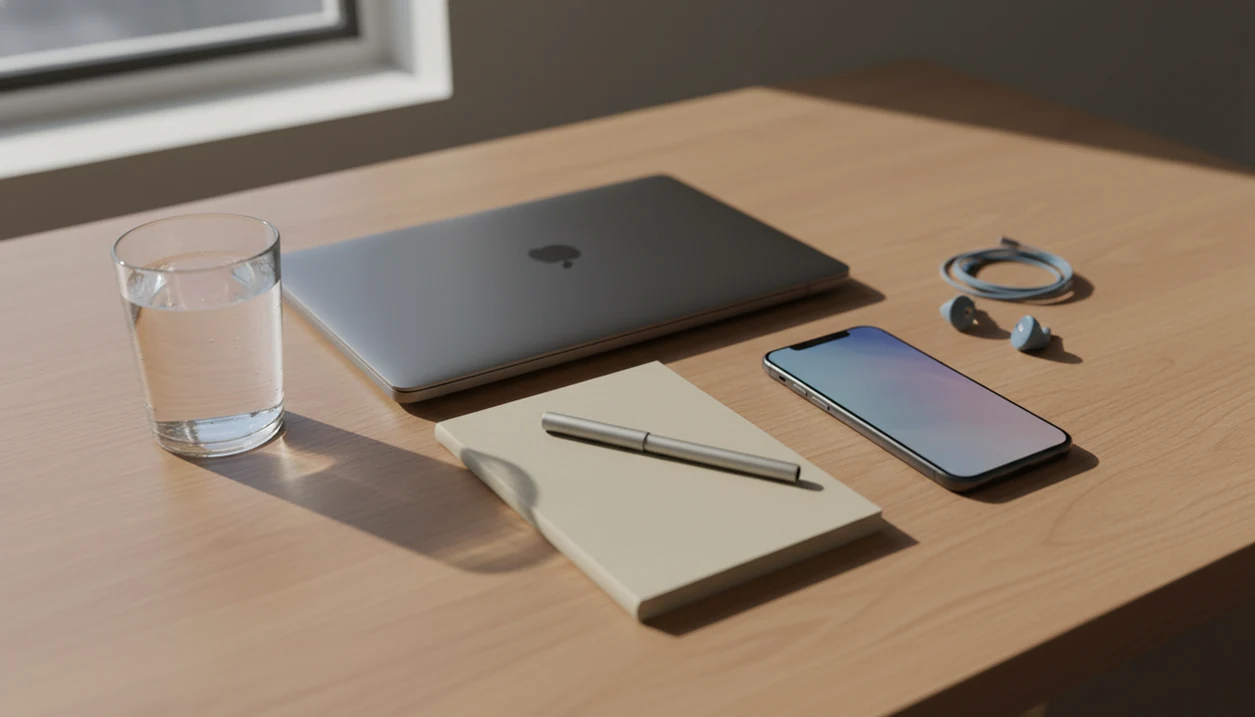
A desk ritual with a written task, dimmed phone screen, and deep work meditation ready before a focused work block.
MindTastik sessions for a short pre-work pause
MindTastik’s focus sessions and breathing exercises suit a brief pause before writing, studying, or coding. Choose a short practice, then begin the task already written down. Guided meditation can supply cues when self-guiding feels difficult, but narration need not continue during the work.
People who find spoken guidance distracting may prefer silent breathing. When exhaustion or excessive workload is the main obstacle, rest or a workload change matters more than another session. MindTastik is not a medical treatment.
What a pre-work meditation cannot fix
Deep work meditation is useful, but it has clear limits. Treat it as a supportive practice, not a fix for every focus problem.
- Benefits are usually small to moderate, subtle, and consistency-dependent.
- Meditation cannot compensate for chronic overwork, poor sleep, toxic work environments, or unrealistic deadlines.
- Deep work focus audio is not universally helpful; some people focus better in silence.
- A one-time session before a major project is unlikely to match daily or near-daily practice.
- Guided focus meditation does not cure anxiety, depression, ADHD, or burnout.
- People who feel worse during meditation, especially those with trauma histories or significant symptoms, should stop and consider professional support.
- Long sessions can become avoidance if the task never actually starts.
Clinicians typically recommend professional evaluation when anxiety, attention problems, low mood, or burnout symptoms interfere with work, sleep, relationships, or daily functioning. Meditation may still be part of the plan, but it should not be the whole plan.
Short focus resets after meetings and messages
- If you keep reopening the same tab before starting, use a 3-minute breathing reset with the laptop closed; the first win is removing the next click.
- If you have a short calendar gap between meetings, choose a single cue such as “one task, one window” instead of a full-length meditation.
- If a meeting reset leaves your attention scattered, try a desk pause that ends with writing the next physical action on paper.
- If you are starting a demanding task after messages or Slack, pick the shortest session that helps you stop switching contexts.
- If you only have enough energy for one decision, decide the task before the meditation; focus practice works better when it has somewhere to land.
Deep work meditation questions
How long should I meditate before deep work?
Start with 3-5 minutes of slow breathing or guided focus, then begin one clearly defined task. A 3-10 minute session is a practical range for this routine, not a proven optimal dose. A longer meditation is not automatically more useful if it delays starting the work.
Can meditation help with procrastination before a difficult task?
A short meditation can serve as a transition into a difficult task, but it does not resolve every reason for delay. Write a concrete first action before starting, such as drafting one paragraph. If choosing another session keeps postponing that action, shorten the ritual and begin the work.
What should I do when my mind wanders during focus meditation?
Choose one focus point, such as the breath, a sound, or the feeling of sitting in the chair. When attention wanders, notice it and return to that point. An empty mind is not the goal. The practice is the repeated return, followed by returning to one work task.
Is meditation before studying different from meditation before writing?
The basic practice can be the same: settle attention, choose one task, and remove distractions. What changes is the task cue. For studying, name a section to review or a problem set to attempt. For writing, name a paragraph or outline to draft rather than the whole project.
What should I do after an interruption during deep work?
Return to the original task rather than opening more messages. If attention remains scattered, take a brief breathing pause and write the next physical action. Laboratory research shows that switching tasks can carry performance costs, but it does not establish one exact recovery time for every workplace interruption.
Does deep work meditation treat ADHD or burnout?
No. Deep work meditation is a supportive routine, not a treatment for ADHD, anxiety, depression, or burnout. It also cannot compensate for poor sleep or an excessive workload. Persistent concentration problems that affect daily functioning need more than a pre-work ritual and may warrant professional assessment.