
Single-Tasking Meditation for Calm, Steady Focus
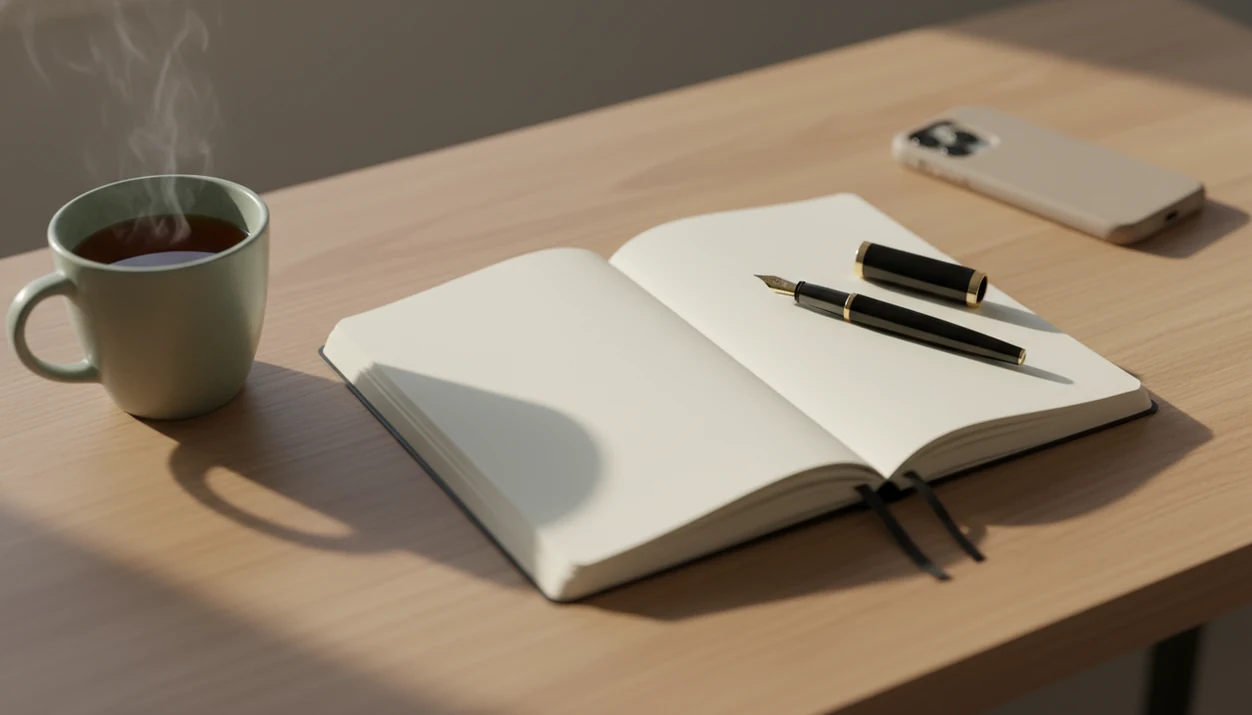


Single-tasking meditation is a short mindfulness practice that uses one anchor or activity as the focus, with a gentle return whenever attention wanders. The anchor can be breathing, writing one email, reading a paragraph, or drinking tea. Distractions are noticed without judgment rather than treated as mistakes. The goal is not an empty mind, but the repeated act of coming back to one chosen focus.
A 3-10 minute session can serve as a calmer reset before work, study, writing, meetings, or a change of task. It does not promise perfect concentration or guaranteed productivity. Research on broader mindfulness practices should not be treated as proof that single-tasking meditation, as a named method, improves work output.
The essentials
- Use this practice for 3-10 minutes before work, study, writing, meetings, or task switching.
- The goal is not a blank mind; the goal is noticing distraction and returning to one chosen focus.
- Research supports mindfulness for attention and stress in general, but single-tasking meditation should not be framed as a productivity cure.
Single-tasking meditation definition for one-task attention
Single-tasking meditation means the task itself becomes the meditation object, rather than a distraction from meditation. You choose one focus, such as breathing, reading one paragraph, drafting one email, or opening a notebook, then return to it each time attention drifts.
That is the key difference from multitasking. Multitasking asks the mind to keep several loops open at once. Meditation for single tasking asks you to close most loops and stay with one. When switching tasks is unavoidable, mindful multitasking offers a different approach to handling competing demands with less stress.
The wandering is not failure.
If you notice the message tab, the half-written note, or the urge to check your calendar, that noticing is part of the practice. The return is the rep. For deeper focus routines, some readers pair this with deep work meditation, especially before longer writing or planning blocks.
How single-tasking meditation works in the distracted brain
Single-tasking meditation works by training attention as a repeatable cycle: choose, notice, return. In plain terms, you pick one target, catch the moment your mind leaves it, and guide attention back without turning the drift into a problem.
Task switching creates friction because the brain has to reorient. The document, the chat, the open browser tab, and the next meeting all carry different rules. The American Psychological Association summarizes switching-cost research and notes that multitasking can reduce productivity by as much as 40% because shifting attention costs time and mental effort: APA research: multitasking.
The browser tab is still glowing.
Mindfulness research is stronger for attention and stress in general than for “single-tasking meditation” as a named technique. A 2013 randomized controlled trial by Mrazek and colleagues found that a two-week mindfulness training program reduced mind wandering and improved working-memory and reading-comprehension performance compared with a nutrition-control group: PubMed research: 23538911. That supports the broader mechanism, but it does not prove every short focus reset will work the same way for every person.
An interruption can outlast the notification
Closing a message does not necessarily end its effect on attention. In two laboratory experiments on lingering multitasking costs, participants performed a tracking task or drove in a simulator while intermittently completing a counting task. Performance remained worse throughout the following 30-second interval after the counting stopped. The largest impairment came immediately afterward. These results concern laboratory tasks, not a measured benefit from meditation or a universal recovery time for office work.
The practical implication is to protect the task that follows the reset, rather than immediately reopen every communication channel. Where work responsibilities allow, reserve a bounded block for one demanding task and group messages into a separate window. A review of task-switching research found that preparation reduced switching costs but did not remove them. Communication batching is an application of that evidence, not a tested promise that a particular schedule will increase output by a fixed percentage. If competing demands still feel overwhelming, explore coping with cognitive overload alongside practical changes to your workload.
Before you start single-tasking meditation
Before you start single-tasking meditation, make the practice small, specific, and safe. It works best when you know exactly what you are returning to and have reduced the obvious interruptions around you.
- Choose one real task before the timer begins: one email, one paragraph, one worksheet, one design edit, or one breathing anchor. “Be productive” is too vague; “open the draft and write the first sentence” gives attention somewhere to land.
- Reduce avoidable interruptions by silencing the phone, closing extra tabs, and pausing messages if you can. You are not building a perfect cave, just removing the easiest hooks.
- Set a short timer, such as 3 or 5 minutes, so the reset feels repeatable on an ordinary workday.
- Place what you need within reach: water, glasses, a notebook, a pen, headphones, or the document you plan to use.
- Skip the practice during emergencies, driving, caregiving moments that need full vigilance, or any unsafe situation. Single-tasking meditation is for steadier attention, not delayed action.
How to use single-tasking meditation before work
Use single-tasking meditation before work as a 3-10 minute ritual that narrows your attention before the first real task. It works best when the environment is slightly prepared, not when the phone is buzzing beside your keyboard.
- Set a timer for 3, 5, or 10 minutes, short enough that you won't negotiate with it.
- Choose one anchor, such as your breath, your seated posture, or the first sentence of one task.
- Silence notifications, close extra tabs, and clear one surface in front of you.
- Breathe slowly for three rounds, letting your shoulders drop without forcing a special state. For a closer look at this attention anchor, consider how mindful breathing trains focus through repeated, gentle returns.
- Notice distractions by naming them simply: “planning,” “worrying,” “checking,” or “remembering.”
- Begin one clear work, study, or creative task when the timer ends.
For students, the same structure can sit before reading, revision, or problem sets. We cover that use case more directly in study meditation for students. Students interested in the science behind learning can also explore how to learn faster using neuroscience.
A 5-minute guided focus reset script
How do I do a 5-minute guided focus reset? Sit in a stable position, choose one task, and use your breath as the bridge between distraction and action.
Place both feet on the floor. Let your hands rest where they can soften. Look at the task you are about to begin, then lower your gaze or close your eyes.
Take one slow inhale. Exhale a little longer than usual. Do that twice more.
Now choose the task: one email, one paragraph, one design edit, one worksheet, one plan. Silently say, “For the next few minutes, this is the object.”
When thoughts pull away, notice them. “Later.” “Planning.” “Noise.” Then return to breathing and the chosen task.
No scolding.
After five minutes, open your eyes and begin with the smallest visible action. Tools like MindTastik guided focus reset cues can help when you prefer audio guidance instead of reading a script from the screen.
Common mistakes in single-tasking meditation
The most common mistake in single-tasking meditation is trying to win the session by having no thoughts. The practice is not a blank mind; it is the ordinary return after the mind has wandered.
Use a quick check before you begin:
- Define the task so it has edges: one paragraph, one reply, one breath anchor, one page. If the task is “catch up on everything,” attention has nowhere stable to land.
- Close the easiest distractions before blaming yourself. A buzzing phone, open inbox, or blinking chat tab is designed to pull you away.
- Return without drama when you drift. Label the distraction, breathe once, and come back to the same object.
- Decide whether the real problem is focus or priority. Meditation can steady you, but it should not become a way to avoid choosing, delegating, renegotiating, or resting.
- Expect a modest reset, not guaranteed deep work. One session may make the next action easier; it does not promise flow, output, or a perfect work block.
The quieter win is noticing sooner and restarting with less friction.
Best uses for mindful single tasking, and poor fits
Mindful single tasking is best for short transitions where attention feels scattered but the next step is clear. It is not a fix for unsafe situations, clinical symptoms, or impossible workloads. When scattered attention comes with mental overload, mindfulness for brain overload offers a related perspective on responding to that strain.
| Use case | Better fit | Not ideal for |
|---|---|---|
| Beginning work | A 3-5 minute focus before work meditation | Emergencies or time-critical decisions |
| Studying | One anchor before reading or practice problems | Replacing needed sleep |
| Writing or email | One draft, one reply, one sentence start | Solving unclear workload priorities |
| Creative warm-up | Breath, posture, then one small creative action | Guaranteeing output or “flow” |
| After distraction | Reset after a call, message thread, or interruption | Complex clinical symptoms without support |
For busy readers, single-tasking usually works best when the next task is concrete, while planning tools fit better when the problem is unclear priorities. If you want a broader frame, meditation for productivity without hype keeps the same realistic line.
Five facts about meditation for single tasking
- Single-tasking meditation uses one task at a time with nonjudgmental attention. The practice is the return to one chosen focus, not the absence of thoughts.
- It can be woven into everyday actions. Making coffee, walking down a hallway, or writing one email can become the meditation object when done deliberately.
- Mindfulness research supports some attention and stress-related benefits, but not every claim equally. A 2014 JAMA Internal Medicine systematic review of 47 trials found moderate evidence for improvements in anxiety, depression, and pain, while attention-specific evidence was more mixed: JAMA Internal Medicine study: 1809754.
- Short practices may still matter. A review of brief mindfulness interventions, often under 15 minutes, found small short-term benefits for attention and negative mood.
- Results depend on conditions around the practice. Consistency, sleep, workload, interruptions, and the physical workspace all influence whether a guided focus reset feels useful.
The most useful single-tasking practice is often the one you can repeat on an ordinary Tuesday, not the one that looks impressive in a journal.
MindTastik cues for a calmer guided focus reset
MindTastik offers guided wellness audio, sleep support, breathing practices, and self-hypnosis sessions for adults looking for help with rest, stress, and daily calm. For single-tasking, a brief guided meditation or breathing exercise can frame the practice with a clear start and finish.
If you found MindTastik through its Best Meditation App for Sleep positioning, treat this as a different use case: a short daytime reset for beginning one task, not a bedtime session designed to wind the body down.
A practical setup is simple: turn on Do Not Disturb, place the phone face-down after pressing play, and choose one work surface to keep clear. Then let the audio cue posture, breath, and the return to one task.
Some readers who want app-based support may also compare a focus meditation app with plain timers or quiet background audio.
Short guided sessions before one work task
MindTastik's focus sessions, breathing exercises, and guided meditation library can provide a clear start and finish for a brief desk pause. A short daytime practice fits this purpose better than a sleep story: choose one task before pressing play, then begin that task when the audio ends.
A silent practice may suit people who find spoken guidance distracting. When the obstacle is an unclear deadline, an excessive workload, or symptoms needing care, planning, workload changes, or professional support matter more than another audio session.
What single-tasking meditation cannot fix
Single-tasking meditation is useful for many people, but it has clear limits. It should stay in the category of supportive practice, not cure language.
- There is limited research on single-tasking meditation as a named method; most evidence comes from broader mindfulness studies.
- It does not cure ADHD, anxiety disorders, depression, burnout, or insomnia.
- It cannot fix structural overwork, constant interruptions, unclear expectations, or poor sleep.
- Some people feel frustrated, restless, or uncomfortable when focusing inward.
- It may not help if the real problem is pain, hunger, conflict, or an unrealistic deadline.
- People with significant, distressing, or trauma-related symptoms should consider professional support.
- For attention-related challenges, meditation may be one support among others, not the whole plan.
Clinicians typically recommend professional assessment and care when concentration problems cause major distress, safety issues, or impairment. For related app-based context, ADHD meditation app support takes a cautious, non-replacement approach.
Single-tasking meditation questions
How do I practice single-tasking meditation?
Choose one concrete focus, such as the breath, one paragraph, or one email. Set a short timer and remove avoidable interruptions. When attention moves elsewhere, notice the distraction and return to the same focus. The return is the practice, not evidence that the session has failed.
How long should single-tasking meditation take before work?
Start with 3-5 minutes before one clearly defined task. A session can last up to 10 minutes, but longer is not automatically more useful. If time is tight, one slow breath and a clear next step may fit better than a full guided session.
Can writing an email count as meditation?
Yes, one email can become the meditation object when attention stays with that activity and distractions are noticed without judgment. Define the boundary first, such as drafting one reply. Moving between the inbox, calendar, and messages is task switching rather than the one-task practice described here.
Does single-tasking meditation improve productivity?
It should not be presented as a productivity cure. Task-switching research shows costs to speed and accuracy, but that does not establish how much this meditation improves workplace output. Its practical role is a brief transition into one task, with no guaranteed increase in completed work.
Do I have to close my eyes to practice?
No. The practice can use a visible task, a lowered gaze, or an everyday activity such as drinking tea. Closing the eyes is optional for a seated breathing reset. Keep the practice appropriate to the setting, and do not close the eyes during activities that require visual attention for safety.
Can single-tasking meditation treat ADHD?
Single-tasking meditation does not cure ADHD and is not a replacement for clinical care. It can be used as a supportive routine for choosing one next action and noticing distractions. Persistent attention difficulties that affect daily functioning need more than a focus exercise and may warrant professional assessment.