
Meditation for Creative Focus
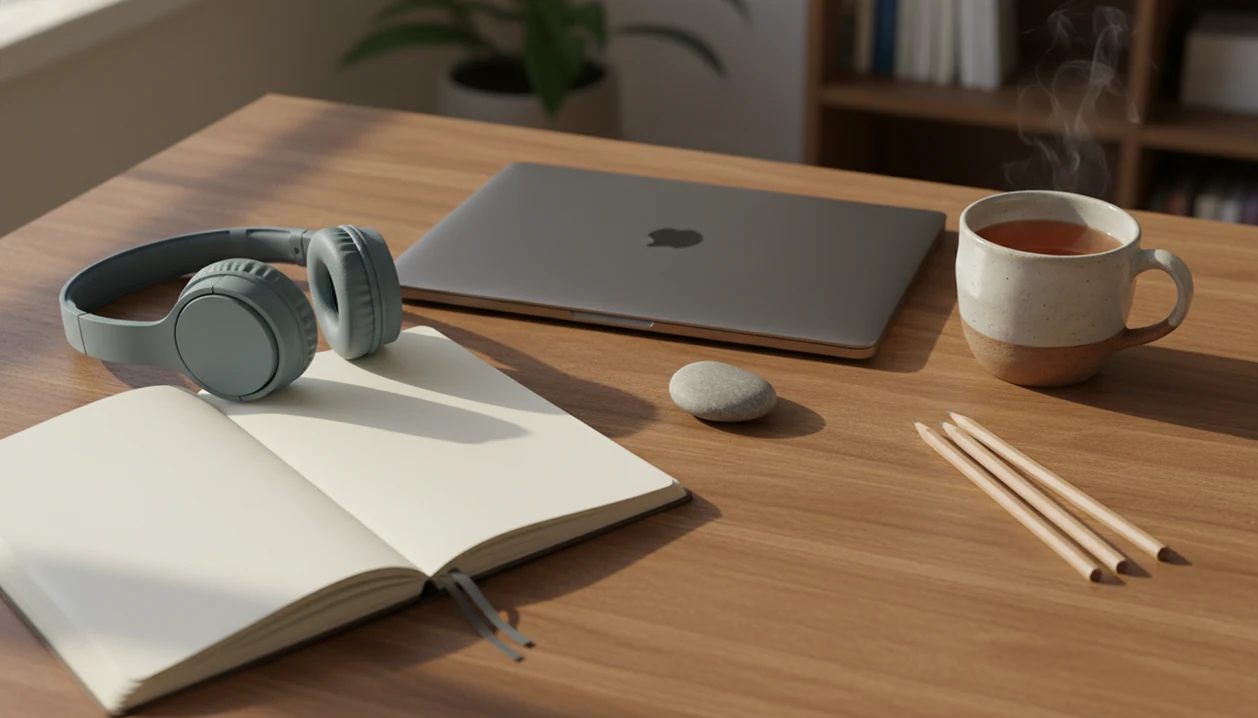


Meditation for creative focus is a short practice that uses breath, body awareness, sound, or visualization to settle attention before writing, designing, coding, or making art. It does not guarantee better ideas or require an empty mind. The aim is to notice distraction, return to a simple anchor, and give the next task a calmer starting point.
A five- to ten-minute guided session can fit before drafting, between editing and brainstorming, or after a meeting. Breathing, body scans, and visualization offer different ways to pause without trying to solve the project during the practice. Research suggests benefits for attention and some creative tasks, but results vary by practice and task. A calmer start is a useful goal, not a promise of inspiration.
Creative focus essentials
- Use meditation before creative sessions, between tasks, or when mental clutter spikes.
- The strongest evidence supports stress reduction, attention, and executive control rather than guaranteed creativity gains.
- A 5-10 minute guided meditation is enough for many writers, artists, designers, and makers to create a calmer starting point.
What meditation for creative focus means
Creative focus meditation prepares attention for creative work; it does not force inspiration to appear on command. The practice gives your mind one simple place to return, usually breath, body sensation, sound, or a guided voice.
Writers may use it before drafting. Designers may use it after feedback. Coders may use it before untangling a hard problem. Artists may use it before sketching, editing, brainstorming, or switching mediums.
It is not about emptying the mind completely. You notice the thought, return to the anchor, and begin again. That small return is the training.
Tools like MindTastik can offer guided calm, sleep, anxiety support, and everyday calm sessions, but the goal here is still simple: settle enough to start.
Five creative focus meditation facts to know first
- Meditation supports creativity indirectly. It is more defensible to say meditation may reduce stress, anxiety, and mind-wandering than to say it creates better ideas.
- Brief practice can support attention. A meta-analysis of 10 randomized trials found small to moderate gains in focused attention and executive control after brief meditation interventions.
- Consistency matters more than marathon sessions. Five minutes before the same daily writing block often beats one long session on Sunday night.
- Different tasks need different styles. Drafting may fit breath awareness, while sketching may feel better with sound or visualization.
- Meditation can become delay. If the notebook stays closed for another 40 minutes, the practice has turned into avoidance.
For creative workers, a short repeatable meditation is often easier than a long formal sit because it fits the actual start of the work.
How meditation for creative focus works
Meditation for creative focus works by training attentional control: you choose an anchor, notice distraction, and return without turning the distraction into a full detour. In plain language, it teaches the mind to come back sooner.
That matters because creative work uses working memory and executive control. You hold an idea, compare options, ignore noise, and decide what comes next. Stress can crowd that space. A JAMA Internal Medicine review of 47 trials found moderate evidence that mindfulness meditation programs improve anxiety, depression, and pain, with lower evidence for stress/distress (JAMA Internal Medicine study: 1809754).
Not magic. Just less noise.
A brief-meditation experiment also reported improved attention and working memory after four 20-minute sessions, but it did not test creativity directly (PubMed research: 20363650). That does not prove meditation directly boosts creativity on demand. It does suggest a calmer nervous system can give attention more room to do its job.
For longer single-tasking routines, deep work meditation uses a similar return-to-task principle.
How to use meditation before writing or making art
Use meditation before creative work as a short doorway, not a second project. The session should end with the pen moving, the file opening, or the canvas in front of you.
- Set a 5-10 minute timer or choose a short guided track.
- Name the creative task in one sentence, such as “draft the first paragraph” or “sketch three thumbnails.”
- Breathe slowly for a few rounds, letting the shoulders drop.
- Notice distractions without solving them. Put urgent reminders on paper if needed.
- Start the work promptly when the track ends.
A useful cue is the dimmed phone screen beside the keyboard. The audio ends. You begin.
A saved guided session can become a repeatable pre-session ritual, but don't keep adding tracks to postpone the blank page.
Best creative focus meditation styles by task
The right creative focus meditation style depends on the task you are about to do. Editing and brainstorming ask for different mental gears.
| Meditation style | Best for | Not ideal for |
|---|---|---|
| Breath awareness | Drafting, coding, starting a hard block | People who get tense when watching the breath |
| Body scan | Editing, revision, calming physical restlessness | Fast transitions when you only have two minutes |
| Visualization | Brainstorming, storyboarding, sketch planning | Detail-heavy proofreading or bug fixing |
| Sound-based meditation | Sketching, low-pressure making, ambient focus | Work that needs verbal precision |
| Guided meditation | Beginners, artists, task transitions | People who prefer silence or self-directed practice |
Guided meditation for artists can help create a calmer entry point, but it does not create artistic talent. If sound helps you settle, concentration music for meditation can be a gentler option than spoken guidance.
Generating ideas and choosing one need different kinds of attention
Creative work includes both generating possibilities and selecting a useful answer. A 2023 meta-analysis of mindfulness and creativity found a small-to-medium improvement in controlled studies, with larger effects for convergent thinking, finding one solution, than for divergent thinking, producing multiple possibilities. These are measured task outcomes, not evidence that meditation reliably improves a finished story, design, or piece of software.
An experiment summarized in that review found different effects from focused attention and open monitoring. Focused attention, repeatedly returning to one anchor, improved convergent-thinking performance. Open monitoring, noticing thoughts and sensations without selecting one anchor, improved divergent-thinking performance. A practical inference is to try focused attention before selecting or refining an idea, and open monitoring before generating alternatives. This task-matching approach is not a proven routine for every creative project.
Calm focus for creativity during task transitions
Does meditation help during creative task transitions? Yes, it can help because transitions are when attention is already loose and easier to redirect.
Try it after email before writing. Use it after meetings before design work. Take three minutes after editing before brainstorming, so the critic brain does not run the idea session. A laptop fan during a five-minute pause can become the whole soundscape.
Short is enough.
In a randomized study of university students, two weeks of mindfulness training reduced mind-wandering and improved reading comprehension during a GRE-style task (journals reference: 0956797612459659). That fits the real need here: coming back to one task after mental scatter.
Should I meditate before writing?
Yes, meditate before writing if your thoughts feel crowded, reactive, or jumpy. A 3-5 minute reset is usually better than a long formal session because it keeps momentum pointed toward the page.
If your main issue is planning, not attention, pair the meditation with one concrete next action. For academic or reading-heavy work, study meditation for students covers a similar focus pattern.
A low-demand break can leave room for new associations
Not every useful creative pause needs tighter concentration. In a 2012 experiment on creative incubation, participants who took a break involving an undemanding task later performed better on the Unusual Uses Task than those who took a demanding break, rested, or had no break. The finding supports a distinction between recovering attention and allowing ideas to develop during low-demand activity.
When a project needs more possibilities rather than more editing, one option is to work on it first, then take a simple, low-demand break before returning. The purpose is to leave room for gentle mind wandering, not to spend the entire break forcing an answer. This is an application of a laboratory finding, not a guaranteed remedy for creative block. It also does not mean every distraction is helpful.
Guided meditation for artists and makers
A meditation app can provide guided meditation, sleep audio, breathing exercises, and self-hypnosis sessions for adults who want sleep, anxiety, and everyday calm support. For artists and makers, that can translate into simple routines around starting, switching, and winding down.
Save one breathing session for pre-work. Save one guided meditation for tense transitions. Keep sleep audio separate, so bedtime does not become another planning meeting in your head. Some users also keep a self-hypnosis session for habit cues, such as returning to the studio at the same hour.
The point is calm attention, not creative performance claims. If you already compare app features for focus, a focus meditation app guide may help you choose a starting point.
Suggested image caption
A creator starting a short guided session before sketching, showing meditation for creative focus as a calm pre-work routine.
When to seek professional support
Seek professional support when distress is intense, persistent, or getting in the way of daily life. Meditation can sit beside care, but it should not replace therapy, medical treatment, crisis support, or a safety plan.
If quiet sitting makes panic, trauma symptoms, severe anxiety, depression, burnout, or intrusive thoughts feel louder, pause the practice. The goal is not to prove you can sit through distress. The goal is to find the kind of support that helps your nervous system feel safer.
- Stop the session if breathing practice or silence increases fear, flashbacks, hopelessness, or urges to harm yourself.
- Ground yourself with something external, such as opening your eyes, naming objects in the room, stepping outside, or contacting someone you trust.
- Contact a licensed clinician, therapist, doctor, or counselor if symptoms keep returning or interfere with work, sleep, relationships, or basic care.
- Use crisis resources or local emergency services right away if you feel unsafe, might hurt yourself or someone else, or cannot get through the moment alone.
Calm audio can be useful. Human care may be necessary.
Staying Present During Client Reviews and Critiques
Client reviews can require you to explain unfinished work, absorb conflicting opinions, and negotiate revisions while a deadline stays fixed. A study of 80 designers and applied arts workers identified social interactions, organizational uncertainty, mental workload, and insufficient support among frequently reported stressors. During a critique, use the physical contact of your feet with the floor as a quiet attention anchor while continuing to listen. If you notice yourself preparing a defense instead of hearing the request, return attention to the speaker’s exact words. Ask which audience need or brief requirement the comment addresses.
Keep feedback notes in two columns: the requested change and the question that needs clarification. This gives vague comments such as “make it stronger” somewhere concrete to go, rather than treating them as a verdict on your ability. An IDSA report analyzing 90 survey responses described creative burnout alongside personal expectations and perceived failure. These findings concern occupational strain, not proof that meditation improves design quality. Here, mindful attention serves a narrower purpose: hearing feedback accurately without automatically turning each revision into self criticism.
Guided sessions for starting and switching creative tasks
MindTastik’s guided meditation library, breathing exercises, and focus sessions suit short pauses before drafting or between demanding tasks. Guided audio offers a clear point of attention when silent sitting feels too open. The session should prepare the work, not compete with it.
People who prefer silence may need only a timer. If the obstacle is an unclear brief, an unrealistic deadline, or persistent distress, a meditation session will not resolve it. MindTastik is not a medical treatment.
What meditation cannot fix in creative work
Meditation has real limits for creative focus, especially when the problem is not mainly attention. It can support readiness, but it cannot repair every condition around the work.
- Evidence for direct creativity improvement is limited and mixed.
- Meditation will not fix lack of time, unclear briefs, poor sleep, burnout, or unrealistic deadlines.
- Some people feel more distress when sitting quietly. Seek clinical guidance before intensive practice if silence brings panic, trauma symptoms, or worsening anxiety.
- Benefits tend to fade without ongoing practice.
- Meditation can become avoidance if it replaces writing, drawing, designing, coding, or making.
- MindTastik is not medical treatment, therapy, or a replacement for professional mental health care.
- If your block comes from depression, severe anxiety, or exhaustion, support from a qualified clinician may matter more than another session.
Reset the plan. Then do the smallest piece of the work.
Focus Without Force
Imagine a designer coming out of a meeting reset with twelve minutes before the next call and a half-finished concept open on the desk. Instead of pushing harder, they close the laptop for five minutes, use a simple breath-counting session, and return with one narrow aim: revise the first screen only. Creative attention often improves when the task gets smaller before the effort gets bigger.
Avoid turning a creative reset into another task
Picking a long session during a short calendar gap
A 20-minute practice can be useful, but it may create pressure when you only have eight minutes. Choose a shorter reset that you can finish cleanly before returning to the work. For a practical short-term reset, learn how to upgrade your focus in one day while keeping expectations realistic.
Using silence when the mind is already loud
Silent practice may feel spacious for some people, but it can seem too open when ideas are racing. A guided meditation or breathing exercise can provide just enough structure to keep attention from splintering.
Trying to meditate and solve the project at the same time
Creative focus meditation works best when it prepares the mind rather than forcing the answer. Let the session clear the runway, then use the next desk pause to choose one concrete creative action.
Creative focus meditation questions
Does meditation actually improve creativity?
A 2023 meta-analysis found small-to-medium improvements on creativity tasks in controlled studies. Results varied by task and study design, with larger effects for finding one solution than generating many possibilities. That does not establish that meditation consistently improves real-world creative output. Treat it as preparation, not a source of guaranteed ideas.
Should I meditate before writing or after starting?
A short practice before writing can provide a clear transition into drafting. If ideas remain stuck after some work, a low-demand break may be more useful than another meditation session. Starting first gives the break a specific problem to follow. Neither approach removes the need to draft, revise, or clarify the assignment.
What type of meditation is best for brainstorming?
Open monitoring is a reasonable option for generating possibilities. It involves noticing thoughts, sounds, and sensations without repeatedly narrowing attention to one anchor. An experiment summarized in a creativity review found benefits for divergent thinking. The finding supports trying this approach, but does not establish that it is best for every brainstorming task.
What meditation should I use before editing or coding?
Focused-attention practice is a reasonable match for selecting, refining, or implementing an idea. Choose one anchor, such as breath or sound, notice when attention shifts, and return. Research supports task-specific benefits rather than one universally superior technique. After the practice, define one concrete editing or coding task and reduce competing distractions.
Can meditation get rid of creative block?
Meditation may help when distraction or mental clutter makes starting difficult, but creative block can also involve unclear goals, limited time, poor sleep, or burnout. A session cannot fix those conditions. Pair any pause with a small next action, such as drafting one paragraph or listing three possible approaches.
Is mind wandering bad during creative work?
It depends on the task. Wandering attention can interrupt proofreading or implementation, where sustained focus matters. During a low-demand break after working on a problem, it may allow useful associations. One laboratory study found better creative-task performance after an undemanding activity, but that does not make all interruptions or distractions beneficial.
What if meditation makes me more anxious before working?
Pause rather than pushing through a session that increases distress. An external anchor, such as sound or an object in the room, may feel more manageable than watching the breath or sitting in silence. Seek professional support if symptoms are intense, persistent, or disrupt daily life. Meditation should not replace clinical care.