
Meditation for Exam Focus and Calm


Meditation for exam focus is a short guided or self-led practice that uses breathing, body relaxation, and attention cues to settle test nerves and return attention to the task. It can fit before a study block, a practice paper, or the exam itself. The aim is to start the next useful action with less distraction, not to guarantee higher grades.
A brief session can involve slowing the breath, releasing tension in the jaw and shoulders, and choosing a cue such as “one question at a time.” Meditation works best alongside revision, sleep, and practice questions. It cannot replace subject knowledge, tutoring, or professional help when anxiety becomes severe, and feeling completely calm is not a requirement for beginning.
The essentials
- Use exam focus meditation as a calm reset before study blocks, practice tests, or the exam itself.
- Short sessions can be useful: research has found benefits from five minutes of guided slow breathing before an exam.
- Meditation supports preparation but cannot replace studying, sleep, tutoring, or professional help for severe anxiety.
Exam focus meditation in one practical definition
Exam focus meditation is a short attention practice used before or during exam preparation to steady the body and bring the mind back to the task. It usually combines slow breathing, present-moment attention, and gentle redirection from thoughts like “I’m going to forget everything.”
The goal is calm focus, not a guaranteed grade change. A student might use it before starting a practice paper, after a difficult revision block, or late at night when a quiet room and steady breath feel more useful than more cramming.
Tools like MindTastik can provide guided audio for students who prefer a voice-led starting point.
2022 and 2023 research on meditation before test moments
Research on meditation before test moments is promising, but it should be read as support evidence, not proof of guaranteed exam improvement. The clearest findings point toward reduced anxiety and better attention under pressure.
- A 2022 randomized experiment found that five minutes of guided slow breathing immediately before an exam was linked with higher test scores than a control condition NIH research: PMC9018237.
- A 2023 randomized trial of 191 secondary school students found lower test anxiety and higher math scores after eight weeks of mindfulness training doi reference: edu0000785.
- A meta-analysis of mindfulness-based interventions for young people found small-to-moderate effects on cognition and mental health, with results varying by study quality doi reference: fpsyg.2016.00609.
- Reviews of mindfulness interventions for college students report reductions in stress and anxiety, but effects vary by program design, duration, and follow-up length NIH research: PMC5488103.
- Benefits likely come from calmer arousal and steadier attention, not from learning new subject knowledge.
For students who want a broader study routine, study meditation for students fits better than relying only on exam-day breathing.
Less anxiety does not necessarily mean higher marks
The comparison group matters when reading mindfulness research. A review of 33 randomized trials involving children and adolescents found small benefits for attention, executive functioning, and anxiety or stress against usual controls. Against active controls, which offered another intervention rather than usual provision, attention and executive-function benefits were not consistently significant. This makes it harder to say how much benefit comes specifically from mindfulness rather than participating in a structured activity.
Grades also need a separate evidence check. A Campbell systematic review of school-based mindfulness interventions synthesized 35 studies with 6,207 students and found no statistically significant overall effect on academic outcomes. Feeling less anxious and achieving a higher score are different outcomes. A useful goal for exam meditation is therefore to settle enough to read, recall, and answer, while keeping revision and practice questions central to preparation.
Nervous system effects behind meditation for exam focus
Meditation for exam focus works by lowering arousal, giving worry a label, and returning attention to the next concrete exam action. Slow breathing can cue the autonomic nervous system toward lower physiological arousal. In plain language, the body gets fewer danger signals.
Attention training also helps students catch worry loops earlier. You notice “I’m going to fail,” label it as a thought, and return to the next question or paragraph. That small return matters during timed work.
Body relaxation and calm visualization may reduce threat perception in exam settings. Picture opening the paper, reading the first question, and choosing one next action. Simple. Not magical. For creative assignments alongside revision, meditation for creative focus offers a different way to prepare your attention.
Meditation does not replace memory consolidation from sleep, repeated practice, or understanding the material. For longer single-tasking habits outside exam week, deep work meditation may be a better training frame.
5-step meditation routine for exam focus during revision week
A revision-week meditation routine should be short enough to repeat when the timetable gets messy. For most students, one or two five-minute sessions per day is more realistic than a long practice they abandon.
- Choose one cue: Use the same phrase, track, or breathing count before study so it becomes a familiar focus switch.
- Start before a study block: Sit down, lower distractions, and do five minutes of slow breathing before opening notes.
- Return during breaks: Use one minute of breathing after practice questions, especially if marks shook your confidence.
- Add a bedtime option: Try a short wind-down routine before sleep, not a late-night cram replacement.
- Repeat gently: If you skip a session, restart at the next useful study block.
A phone with guided audio, a dim light, and a few minutes of privacy can be enough. You don’t need a perfect setup.
5-minute exam focus meditation routine before the test
A five-minute exam focus meditation should feel familiar, brief, and allowed within your school’s rules. Don’t try a brand-new 30-minute body scan minutes before the exam door opens.
- Settle: Sit or stand still, place both feet on the floor, and soften your gaze.
- Breathe slowly: Inhale gently, exhale longer, and let the shoulders drop.
- Relax the face: Unclench the jaw, release the brow, and loosen the hands.
- Visualize the start: Imagine reading the first question calmly and underlining key words.
- Choose a phrase: Try “one question at a time” or “breathe, read, answer.”
If phones or audio are not allowed near the exam room, practice without them. A familiar silent cue can still work. Students comparing audio options may prefer a focus meditation app during revision, then use the same cue offline on test day.
Best-fit students and poor-fit cases for exam meditation
Exam meditation fits students who need a short reset, but it is not the right tool for every exam problem. Use it as one support alongside revision, sleep, and asking for help when needed.
| Best for | Not ideal for |
|---|---|
| Mild to moderate pre-test nerves | Replacing study or practice questions |
| Racing thoughts before a study block | Severe panic or emergency distress |
| Short calming breaks between revision tasks | Chronic sleep deprivation |
| Bedtime wind-down during revision week | Untreated anxiety disorders needing care |
| A familiar cue before opening the paper | Students who feel worse when meditating |
MindTastik offers guided sessions, sleep audio, breathing exercises, and self-hypnosis support for adults looking for help with rest, anxiety, and everyday calm. For attention patterns that feel more complex, ADHD meditation app support may be a more relevant starting point.
When to seek help for exam anxiety
Seek help for exam anxiety when stress stops being a normal pre-test wobble and starts disrupting safety, sleep, attendance, or daily life. Meditation can support calm, but it is not treatment for an anxiety disorder or a replacement for qualified care.
If panic feels severe, you avoid school or exams, or you cannot sleep for several nights because of test fear, involve someone early. Good first contacts can include a school counselor, a trusted teacher, a parent or caregiver, a primary care doctor, or a licensed therapist. If there are thoughts of self-harm, feeling unsafe, or a risk of hurting yourself, contact emergency services or a local crisis line immediately.
- Tell a trusted adult before the pressure becomes a private emergency.
- Name the red flags clearly, such as panic attacks, not attending school, self-harm thoughts, or being unable to function.
- Ask for practical support with appointments, exam adjustments, study planning, or sleep routines.
- Keep meditation supportive by using short calming practices while professional help addresses the bigger anxiety pattern.
Calm focus before exam day without a lucky ritual
Meditation should lower pressure before exam day, not become another thing students fear getting wrong. If you miss the routine, return to the next useful action: review one topic, drink water, pack your bag, or go to bed.
Pair meditation with practical preparation. Practice questions, spaced review, hydration, and sleep usually matter more than whether you breathed for exactly five minutes. The most useful exam meditation is often the one you can repeat without drama.
Sleep meditation before an exam may support wind-down, especially when calendar worries get loud in the dark. However, it should not be used instead of adequate rest. Clinicians typically recommend getting support when anxiety, panic, or sleep loss starts interfering with daily functioning, school attendance, or safety.
Reset the plan.
Image caption for meditation before test preparation
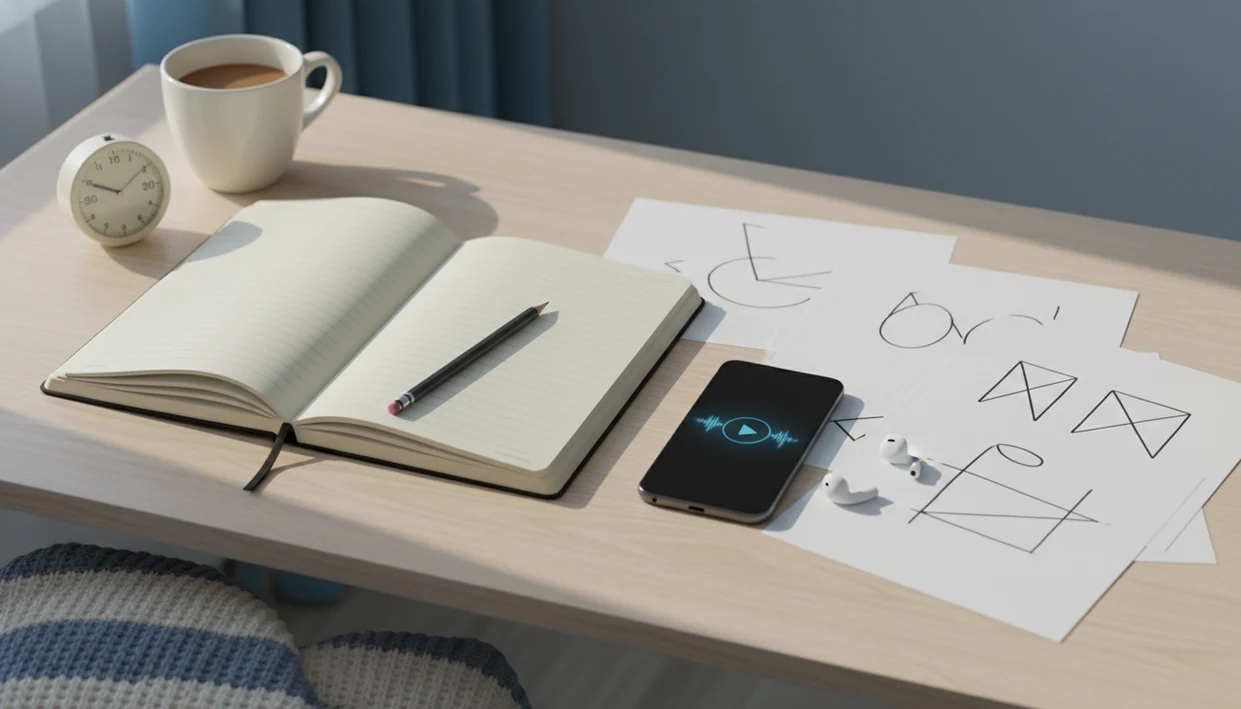
Image caption: A student sits at a desk with headphones in, using a short guided breathing practice before a study session. The scene shows calm preparation through meditation for exam focus, with notes and practice questions nearby to make clear that meditation supports revision rather than replacing it.
The useful message is ordinary: breathe, settle, begin. A caption should not imply that audio alone causes exam success. It can show a student choosing between a five-minute breathing exercise and a longer body scan, then picking the shorter option because the next study block starts now. For sound-based routines, concentration music for meditation may also support a calm study environment.
Resetting Between Exams Without Replaying Every Answer
When two papers fall on the same day, the gap can disappear into comparing answers with classmates, checking unofficial solutions, and calculating how many marks you might have lost. Before leaving the first exam, separate anything requiring action, such as reporting a disrupted sitting through your institution’s procedure, from answers you can no longer change. Then check the next paper’s room, start time, and permitted materials. If an answer discussion keeps pulling you back, leave the conversation or mute the group chat until your exams are finished.
A review of university student mindfulness trials found short term improvements in rumination compared with passive controls, although benefits were weaker against active alternatives. That supports using mindfulness to disengage from replaying the previous paper, not to decide whether your answers were correct. While eating or walking to the next room, notice when your attention returns to a disputed answer, then redirect it to your surroundings and the next practical step. Save any useful review of the first paper for a scheduled time that does not consume preparation for the next one.
Guided breathing before revision, focus sessions between tasks
MindTastik’s guided breathing exercises suit students who want voice-led cues for a short pause before revision or a test. Its focus sessions offer another option when the main difficulty is returning attention after distraction. A self-led practice is a better fit when audio is distracting or phones are prohibited near the exam room. Students with severe panic or anxiety that disrupts daily life need qualified support, not an app alone.
What exam meditation cannot fix
Meditation for exam focus has real limits. It may help some students feel steadier, but it should never be sold as an academic shortcut.
- Benefits are modest on average, and some students may notice only subtle changes.
- Meditation cannot compensate for weak subject understanding, poor preparation, or missed sleep.
- Severe anxiety, panic attacks, trauma histories, or distress during meditation may need professional support.
- Many student mindfulness studies have short follow-ups, small samples, or school-specific settings.
- Over-reliance on meditation as a required ritual can add pressure before exams.
- No ethical app, course, or program should guarantee specific scores or exam outcomes.
- If breathing practices make you dizzy or more anxious, stop and use a simpler grounding cue.
Guided audio can support calm routines, but no meditation app can replace care, tutoring, sleep, or exam preparation.
Three ways a pre-exam meditation can add pressure
Mistake: choosing a long session right before the exam
A 20-minute meditation can feel like one more task when the clock is already loud. For the final desk pause, a 3- to 5-minute breathing exercise usually fits better because it lowers the decision load without replacing preparation.
Mistake: using meditation to test whether you feel calm enough
Checking your anxiety every few seconds can make the session feel like a performance review. A better aim is to return attention once, then again, because focus practice is built from small returns.
Mistake: starting with complex visualization
If your mind is full of formulas, dates, or essay outlines, a detailed mental image may add clutter. Simple breath counting or a body scan tends to be easier to repeat during a calendar gap or after closing the laptop. When revision includes generating essay ideas, creativity meditation for sharper focus may suit that task better than exam-day breathing.
Exam focus meditation questions
Does meditation before an exam improve scores?
Meditation may help some students settle anxiety and redirect attention, but higher marks are not a reliable outcome. Research on academic performance is mixed, and broader reviews have not established a consistent benefit. Use meditation to support preparation, not as a substitute for learning the material or practising exam questions.
How long should I meditate before studying or a test?
Five minutes is a practical starting point, not a required dose. Before studying, keep the session short enough that it does not delay opening the material. Before a test, use a familiar routine that fits the available time and school rules. A brief pause is preferable to rushing through a longer session.
Is it better to meditate before studying or before the exam?
Both can serve a purpose. Before studying, meditation can provide a clear transition into a revision task. Before an exam, a familiar breathing or grounding routine can help settle nerves. Practising during revision gives the routine a familiar shape, rather than making exam day the first attempt.
What can I do if I go blank during an exam?
Try a brief pause with both feet on the floor, soften the jaw, and take a gentle breath. Then return to one concrete action, such as rereading the question and identifying what it asks. Meditation cannot retrieve material that was not learned, but the pause can help redirect attention from worry to the paper.
Can I meditate before an exam without headphones?
Yes. A self-led routine can use a softened gaze, relaxed hands, gentle breathing, and a short phrase such as “breathe, read, answer.” Practise it without audio during revision so it is familiar. Follow exam rules, especially any restrictions on phones or headphones near the room.
What if meditation makes me more anxious before a test?
Stop rather than forcing the session. An eyes-open grounding pause or returning to a concrete preparation task may suit the moment better. Meditation is optional, and complete calm is not necessary to begin. If panic is severe or anxiety disrupts sleep, attendance, or daily life, seek qualified support.
Should I meditate or keep revising the night before an exam?
Meditation can be a short wind-down, but it should not take time away from needed sleep or become another revision task. Sleep supports learning, memory, and concentration. Keep any evening practice brief, finish realistic preparation, and avoid treating either late-night cramming or meditation as a way to compensate for missed rest.