
Meditation for Productivity Without Hype
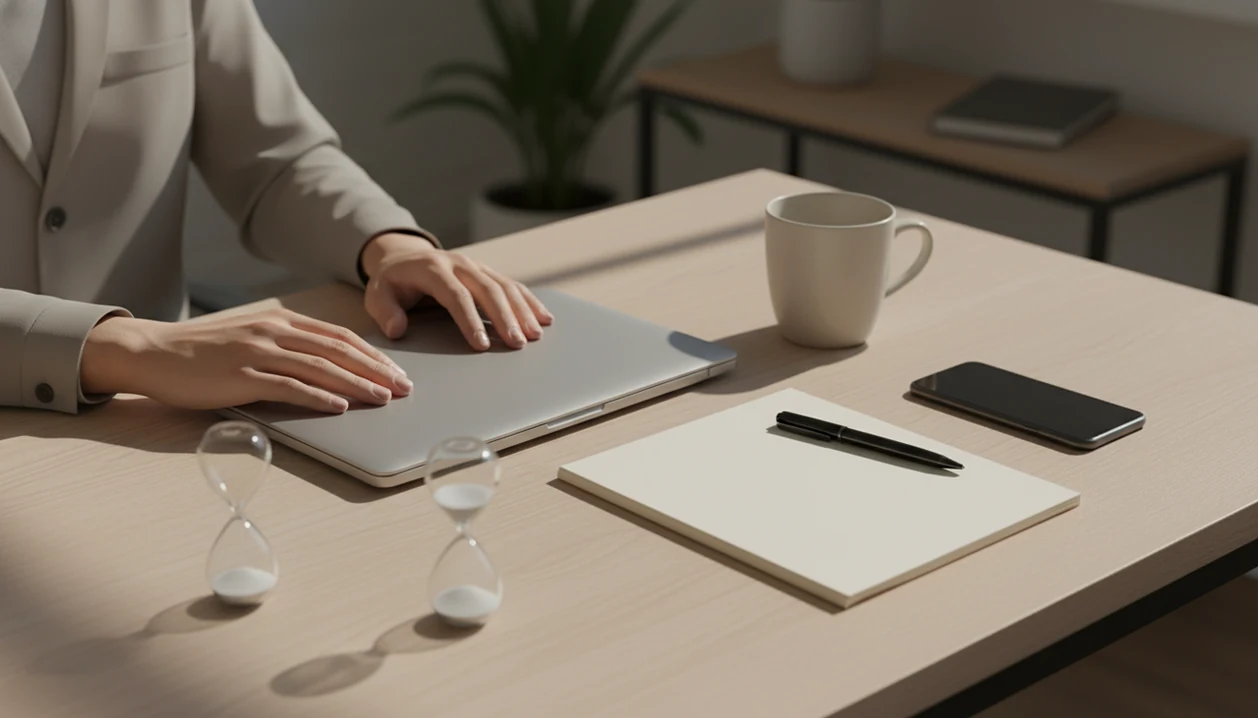


Meditation for productivity is a short breathing or mindfulness practice used before work to settle attention and choose one task, not a way to guarantee more output. It can support a calmer start and help make distraction easier to notice. The useful goal is concrete: move from scattered thoughts to a defined next action, such as drafting a paragraph or reviewing an invoice.
A realistic routine pairs a brief session with clear priorities, a bounded work block, and fewer digital interruptions. Feeling calmer is not the same as completing more work, so those outcomes should be considered separately. This guide covers meditation as a work-start ritual. It is educational, not medical advice or a treatment plan for anxiety, ADHD, insomnia, trauma, or burnout.
What matters most
- Productivity meditation works mainly by supporting calm, attention, and emotional regulation, not by guaranteeing more output. When difficult feelings arise before work, learning how to process emotions without suppressing them can support a more mindful response.
- Short daily sessions can matter: one 2-week smartphone mindfulness trial using 10 minutes per day found a 22% reduction in mind-wandering during a sustained attention task.
- Use meditation before a work session as a repeatable start-work cue, then combine it with one priority, one work block, and fewer interruptions.
What productivity meditation can realistically do
Productivity meditation is a short attention practice that helps reduce stress, mental clutter, and mind-wandering before work. It does not magically increase output, revenue, completed tickets, or finished pages by itself.
That distinction matters. Feeling calmer before a spreadsheet or planning call is real, but it is not the same as proving a measurable productivity gain. A calm focus meditation can make it easier to start, stay with one task, and notice when you drift. The work still needs a clear target.
The palms-on-desk moment is familiar. You have seven tabs open, one message half-written, and no clean place to begin.
Meditation for productivity without hype works best as a cue, not a miracle. App-guided routines can help beginners because the voice, timing, and structure remove one more decision from an already noisy workday.
Five evidence-backed facts about mindfulness for productivity
- Mindfulness can support core attention skills. A systematic review of randomized trials found small to moderate improvements in attention, executive functioning, and working memory in adults: PubMed research: 24395196
- Short phone-based practice has shown measurable attention effects. A 2-week smartphone mindfulness trial using 10 minutes per day found a 22% reduction in mind-wandering during a sustained attention task: link reference: s41465 017 0020 9
- Workplace programs may help work readiness. In a workplace mindfulness study, participants reported lower distress and improved wellbeing-related work measures, but the findings still rely heavily on self-report outcomes: journals reference: 2167702614525481
- The evidence is stronger for attention and stress than output. Research usually measures mind-wandering, wellbeing, anxiety, distress, or executive function, not how many emails someone sends.
- Regular brief practice usually beats rare long sessions. For most workdays, a 5-minute reset before a demanding task is easier to repeat than a 45-minute silent sit.
For anxious beginners, a useful goal is returning attention to one task, not expecting a dramatic increase in output.
How meditation for productivity works in the brain and workday
Meditation for productivity works through attention training, stress downshifting, and task cueing. The practice asks you to notice distraction, label it lightly, and return to an anchor such as breath, sound, or body sensation.
That loop is the training. Attention drifts, you notice, and you come back. Over time, that repetition can make it easier to catch the moment when you leave the report and reach for a notification.
Slower breathing and guided awareness can also reduce overarousal before demanding work. In plain language, your body gets a signal that it does not need to sprint through the next task. Clinicians typically recommend mindfulness as a supportive stress-management skill, not as a replacement for therapy, medication, emergency care, or workplace changes when those are needed.
A repeated meditation-before-work-session ritual can become a behavioral cue. Same chair. Same timer. Same first document. For people building longer single-tasking blocks, deep work meditation uses the same cue-and-return pattern with more focus on uninterrupted work.
Why a calm start still needs protection from interruptions
Meditation before work does not remove the cost of switching tasks once work begins. A 2003 review of laboratory task-switching research found that responses were substantially slower and usually more error-prone immediately after a switch. Preparation reduced the cost but did not eliminate it. This supports protecting demanding work from repeated interruptions, rather than expecting a breathing exercise to compensate for continuous message checking.
Interruption effects can also outlast the interruption itself. In two controlled experiments reported in 2022, performance costs remained detectable throughout the 30 seconds after a secondary counting task ended. The main tasks involved tracking or simulated driving, not office work, so this is not a measured workplace productivity gain. A practical application is to group communication into designated windows and leave a brief written note about the next step when an interruption cannot be avoided.
How to use meditation before a work session
Use meditation before work as a short start cue, then move into one defined task. Start with 3 to 10 minutes, especially if silent sitting makes you restless.
- Set one work target before opening the meditation, such as “draft the first section” or “clear five invoices.”
- Choose a short guided calm focus meditation rather than searching through a huge library for ten minutes.
- Silence avoidable notifications on your phone, laptop, and watch before the audio starts.
- Breathe and follow the guide without trying to force a blank mind.
- Start one timed work block immediately after the session, even if it is only 25 minutes.
- Reset briefly if distracted by taking three slow breaths and naming the next small action.
Tools like MindTastik can provide focus audio for people who want structure, but no app can guarantee performance.
Best-fit and not-fit uses for calm focus meditation
Calm focus meditation is useful when the barrier is activation, stress, or scattered attention. It is not enough when the real problem is workload, safety, sleep loss, or unclear direction.
| Situation | Good fit | Not enough by itself |
|---|---|---|
| Starting a work block | Helps create a clear start ritual | Still needs a defined task |
| Recovering from scrolling | Interrupts autopilot and resets attention | Does not remove addictive app design |
| Calming pre-task anxiety | Supports slower breathing and steadier pacing | May not be enough for severe anxiety |
| Transitioning between meetings | Creates a short mental boundary | Cannot fix back-to-back scheduling alone |
| Reducing mental clutter | Helps choose one anchor and one next action | Does not replace planning or prioritizing |
Meditation supports execution, but it does not replace planning, boundaries, rest, therapy, or medical care when needed. For people comparing work-specific routines, focus meditation for work is a more direct fit than general relaxation audio.
MindTastik guided productivity meditation routines
MindTastik is a guided meditation, sleep audio, breathing exercise, and self-hypnosis app for adults seeking sleep, anxiety, and everyday calm support. For productivity, the useful part is not hype. It is having a guided session ready when your brain is bargaining with the task.
If you are comparing guided-audio options, Headspace and Calm also offer short mindfulness sessions; MindTastik’s fit here is as a structured pre-work cue, not as proof of higher output.
A short audio routine reduces friction. You do not need to decide whether to count breaths, scan the body, or sit in silence. You press play, follow the prompt, and begin.
Common workday uses include:
- Before focused writing: use a brief breath-led session before opening the draft. For writing or other creative tasks, meditation for creative focus offers a more specific way to prepare your attention.
- Before admin work: settle the “I’ll do it later” feeling before small tasks pile up.
- Between meetings: take a short reset before the next call starts.
- After anxious procrastination: return to one doable action instead of judging the whole morning.
- During an afternoon reset: pair audio with a timer when attention gets thin.
Some people use a focus meditation app for this because the routine is already shaped.
Common myths about productivity meditation
Does productivity meditation instantly double your output? No. It may help you start work with less stress and more intention, but it does not create all-day flow on command.
Another myth is that you need 30 to 60 minutes for focus benefits. Many beginners do better with 3 to 10 minutes, especially before a specific task. A guided voice through cheap earbuds can be enough to stop the spiral and begin.
The blank-mind myth also gets in the way. Meditation is not a test where thoughts mean failure. Noticing distraction and returning to the breath is the repetition, like one rep in attention training.
Finally, productivity meditation is not “just relaxation.” Relaxation may happen, but the deeper skill is redirection. For students, similar principles apply when a study block needs a calmer entry point; the guide to study meditation for students covers that use case more closely. When preparing for a test, meditation for exam focus applies these attention skills to revision and exam preparation.
A realistic calm focus meditation script for work
Use this script for a 3 to 5 minute pre-work practice. Keep it plain. No special posture required.
Sit comfortably and let your screen rest for a moment. Exhale slowly, as if you are making a little more room in the body. Notice your feet, your seat, and the contact of your hands. Name the task you are about to begin. Say quietly, “For this block, I am working on this one thing.” When another thought appears, note “thinking” and return to the breath. Let the next exhale be slightly longer than the inhale. Open the document, message, or tool, and take one small action.
The first action matters. One sentence. One file. One reply.
Image caption suggestion: A short calm focus meditation can become a repeatable start-work ritual before deep work.
For people who focus better with background sound, concentration music for meditation can be paired with the work block after the breathing practice ends.
Closing Open Work Loops Before Bedtime
A half-written proposal, unresolved spreadsheet error, or document awaiting approval can keep tomorrow's workload mentally active after the laptop closes. Before leaving your desk, write down the exact next action for each unfinished priority, plus anything that depends on someone else's response. Keep this note in your work system, not beside your pillow. The aim is to give tomorrow's work a clear landing place without turning the evening into another planning session. If a deadline thought returns at bedtime, acknowledge it without mentally reopening the document.
Then use a quiet meditation that does not ask you to visualize success, rehearse a presentation, or generate ideas. Notice the contact of your body with the bed and let breathing remain comfortable. The Sleep Foundation lists mindfulness and guided meditation among relaxation approaches for nighttime stress, but this guidance does not establish that every recording improves insomnia. For desk workers whose evenings become extensions of project time, the useful distinction is purpose: this practice ends engagement with work rather than preparing you to produce more.
Guided audio for the pause before work
MindTastik’s focus sessions, guided meditations, and breathing exercises suit a brief pause before a demanding task or between meetings. The guided meditation library offers spoken direction for people who prefer prompts to silent sitting. The session still needs to lead into a clear next action. A timer may be enough for someone comfortable practicing alone; workload changes or clinical support are more appropriate when the main barrier is overload or persistent distress.
What meditation cannot fix in a workday
Meditation can be a supportive practice, but it has real limits. The honest version is more useful than the shiny one.
- Evidence for direct productivity gains is limited compared with evidence for attention, stress, and wellbeing.
- Meditation will not fix overload, unclear priorities, poor sleep, impossible deadlines, or toxic workplace demands.
- Some people initially feel more restless, anxious, bored, or physically uncomfortable when sitting quietly.
- Very short guided sessions are often better for beginners or anxious users than long silent sits.
- People with high anxiety, trauma symptoms, panic, or worsening distress may need support from a qualified professional.
- Benefits depend on consistency and can be subtle. You may notice a calmer start before you notice more completed work.
- Meditation can support task initiation, but it works better with time blocks, written priorities, and fewer digital interruptions.
- If you are sleep-deprived, a 5-minute focus practice cannot replace rest.
After a short night, sitting down to work can feel different before the first task even starts. Focus lives in the body, not only on the calendar.
A first week of work-start cues and meeting resets
- Day 1: Use a closed laptop as the cue, then take three slower breaths before opening your work session. A ritual works best when it is attached to something you already do.
- Day 2: After a desk pause, name the single task that deserves the next 25 minutes. Meditation supports productivity most when it leads to a clearer next action.
- Day 3: Try a one-minute meeting reset before responding to follow-up messages. A calmer reply is often more useful than a faster reply.
- Day 4: Use a calendar gap for a short breathing exercise instead of filling it with inbox checking. Empty space can become a focus tool when it has a purpose.
- Day 5: Compare your start-of-work friction, not your total output. The first useful sign is often less resistance to beginning.
- Day 6-7: Repeat the shortest version that felt realistic, even if it seemed almost too easy. A small routine you repeat beats an impressive routine you avoid.
Desk Reset
A desk reset works best between contexts: after a call, before a draft, or when a calendar gap is too short for deep work but long enough to regain direction. Keep it physical and obvious: hands off the keyboard, shoulders down, one breath cycle, then one written priority. This is not about becoming perfectly calm; it is about lowering the noise enough to make the next choice cleaner. The best reset is the one that protects your next ten minutes.
When to Seek Professional Support
Seek professional support when anxiety, sleep loss, panic, trauma symptoms, or distress keep getting stronger or start interfering with daily life. Meditation can be a useful support skill, but it is not a substitute for clinical care.
A short breathing practice may help you pause before a task, but persistent anxiety, repeated panic, intrusive trauma memories, severe insomnia, or worsening distress deserve more than another timer. A licensed clinician can help assess what is happening and suggest care that fits your situation. If you have thoughts of self-harm, feel unable to stay safe, or think someone is in immediate danger, contact emergency services or a local crisis line right away.
- Notice whether symptoms are lasting for days or weeks, disrupting sleep, work, relationships, or basic routines.
- Contact a licensed therapist, doctor, or qualified mental health professional if anxiety or impairment persists.
- Use meditation only as a supportive practice while you arrange appropriate care.
- Tell a manager, HR contact, or occupational health provider if workplace overload is part of the problem.
- Ask about workload changes, accommodations, or medical leave if rest and boundaries are no longer enough.
Meditation before work: common questions
Does meditation actually improve productivity?
Meditation may support attention and a calmer start, but that does not establish a reliable increase in completed work. Direct productivity gains are less certain than attention or wellbeing benefits. A useful assessment separates feeling calmer from concrete outcomes such as completion time, errors, and whether the intended task was finished.
How long should I meditate before work?
A practical starting point is 3 to 10 minutes before one defined task. That is a routine suggestion, not a proven optimal dose. If sitting feels uncomfortable or becomes another reason to delay, use a shorter pause and begin work immediately afterward. A longer session is not automatically more useful.
Is it better to meditate before work or during a break?
Before work, meditation can serve as a start cue. Between meetings or tasks, a brief practice can mark the change in context. The choice depends on where attention gets scattered. During screen-heavy work, meditation should not replace breaks that rest the eyes and allow movement away from the desk.
Can meditation help with procrastination?
It can provide a pause when stress or scattered attention makes starting difficult. The important step comes afterward: take one small, defined action, such as opening the document and drafting its first sentence. Meditation alone does not resolve an unclear assignment, an unrealistic workload, or a task that needs additional information.
Why do I feel restless when I meditate before work?
Quiet sitting can initially feel restless, anxious, boring, or physically uncomfortable. That does not mean a longer session is needed. A shorter guided practice or a simple desk pause may be more manageable. If distress becomes stronger or repeatedly interferes with daily life, seek professional support rather than extending the practice.
Do I need to clear my mind to meditate for focus?
No. The practice is noticing that attention has moved and returning to an anchor such as breath, sound, or body sensation. Thoughts are not evidence of failure. Before work, the aim is to recognize distraction and return to one chosen task, not to maintain a completely empty mind.
How can I tell if a pre-work meditation routine is helping?
Track a narrow outcome: resistance to starting, time spent on the chosen task, errors, or mental fatigue. Keep the work target and interruption controls reasonably consistent so the comparison is useful. A calmer session can be valuable even without more output, but it should not be counted as a productivity increase.