
Meditation for Focus and Calm Without Forcing Productivity
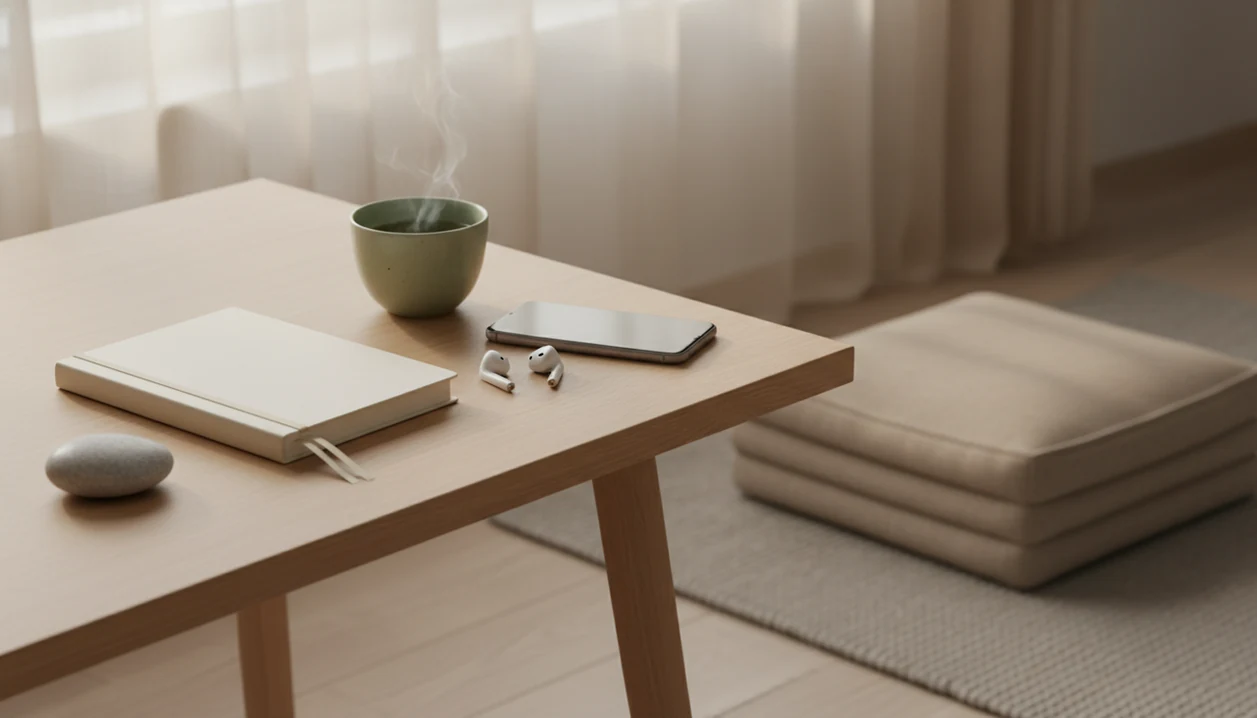


Meditation for focus and calm is a guided or self-led attention practice that uses the breath, body, sound, or a calming phrase as an anchor. The aim is to notice distraction and return without self-criticism, not to empty the mind or force more productivity. When attention feels scattered and the body feels tense, a guided session can provide a simple starting point.
A calm-first approach gives attention somewhere steady to return. Short sessions of 1 to 15 minutes offer a manageable way to practice consistently, with guided audio providing prompts when needed. Meditation may support attention, but it cannot replace sleep, breaks, workload boundaries, or professional care. A useful session makes room for distraction rather than treating every wandering thought as a failure.
What matters most
- A useful focus meditation is usually calm-first: it reduces mental noise so attention can return naturally.
- Short sessions of 1 to 15 minutes can be useful when practiced consistently, especially with guided audio.
- Meditation may support attention and anxiety, but it does not replace sleep, breaks, boundaries, or professional care when needed.
Best meditation for focus and calm at a glance
The right meditation style depends on why focus feels hard. If stress, tension, or bedtime rumination is driving the distraction, choose calm first and let focus follow. Try soft focus meditation for calm when concentrating feels strained and you want a gentler way to settle.
| Meditation style | Best for | Not for | Session length | Calm-focus benefit |
|---|---|---|---|---|
| Guided breathing | Quick resets, beginners, anxious focus | People who dislike voice prompts | 1 to 10 minutes | Gives the mind one simple job |
| Body scan | Tension, fatigue, overthinking | Very sleepy work breaks | 10 to 20 minutes | Moves attention from thoughts to body sensations |
| Focused attention | Study, reading, single-task work | High anxiety moments at first | 5 to 15 minutes | Trains returning to one anchor |
| Sleep wind-down meditation | Nighttime racing thoughts | Urgent daytime tasks | 10 to 30 minutes | Lowers pre-sleep arousal for clearer mornings |
MindTastik fits readers who want guided meditation, sleep audio, breathing exercises, and self-hypnosis sessions in one calm routine. Calm.com and Headspace.com are also common options, especially for broad libraries and recognizable teachers.
Five calm-first meditation techniques for focus
These five meditation techniques work because they give attention somewhere kind to land. For a wider practice menu, our meditation techniques guide compares more styles.
- Breath counting: Best for scattered thoughts; not ideal if counting becomes tense or competitive.
- Box breathing: Best for workday resets; not ideal if breath holds feel uncomfortable.
- Body scan: Best for stress held in the body; not ideal when you need an eyes-open reset.
- Sound anchor meditation: Best for noisy homes or offices; not ideal if sound makes you more alert.
- Pre-sleep calm meditation: Best for sleep anxiety; not ideal as a substitute for sleep itself.
Best for scattered thoughts
When unread emails keep replaying behind closed eyes, breath counting gives the mind a small rail to follow.
Best for workday resets
If your priority is steadier attention between meetings, MindTastik covers short breathing exercises through a simple guided workflow.
Best for sleep anxiety
The right fit for tomorrow’s meeting looping at midnight is a calm body scan or sleep audio session, not another planning note.
How meditation for focus and calm works
Meditation for focus and calm works by using an attention anchor, noticing mind wandering, and returning without judgment. It does not empty the mind; it changes how quickly you get pulled into each thought.
In practice, the “rep” is the return. You notice the thought, label it lightly, and come back to the breath, sound, body, or phrase. Attention networks are the brain systems involved in selecting and sustaining focus. Working memory is the short mental space that holds what you’re doing right now.
Research has linked mindfulness training with sustained attention, working memory, and attention-network changes. One randomized trial of 93 adults found that an 8-week mindfulness-based stress reduction program improved sustained attention and working memory versus a wait-list group (PubMed research: 20363650). Another study reported increased functional connectivity in attention networks after 8 weeks of mindfulness training (NIH research: PMC3772979).
Good meditation apps deliver structure and repetition, not a guarantee that every session will feel calm.
Less mind wandering is not guaranteed after one session
Research distinguishes an immediate drop in mind wandering from a change that develops over time. A 2023 meta-analysis of mindfulness-based attention training found no statistically significant average reduction at one measurement point within the mindfulness group. Changes over time nevertheless favored mindfulness compared with the control condition, suggesting that training may help protect against increasing mind wandering rather than reliably stop it at once.
That distinction matters when judging a short practice. Thoughts continuing to appear do not establish that the session failed. The instruction remains to notice the drift and return, rather than suppress it. An attention-focused neurocognitive review describes this repeated return as part of mindfulness practice. A practical question afterward is whether distraction was noticed and attention redirected, not whether the mind stayed completely quiet.
How to use meditation for focus and calm
Use meditation for focus and calm as a repeatable reset, not a performance test. Start smaller than you think you “should.” Before opening your study materials, try focus meditation before studying as a short transition into your session.
- Set a short timer for 1 to 5 minutes if you’re new, or 10 to 15 minutes for a regular session.
- Choose an anchor such as breath, body pressure, a steady sound, or a short calming phrase.
- Notice distraction when the mind jumps to a task, worry, memory, or self-critical thought.
- Return kindly to the anchor without scolding yourself for wandering.
- Close with one calm breath before opening your eyes, standing up, or checking your phone.
Tiny helps.
MindTastik is useful here because you can choose between a 5-minute breathing exercise and a 20-minute body scan instead of guessing what to do next. If you want shorter options, short meditation techniques may be easier to repeat.
Who Meditation for Focus and Calm Is For
Meditation for focus and calm is for people whose attention is tired, tense, or easily pulled away. It is especially useful when you need structure and steadiness more than another push to be productive.
- Start with guidance if silent sitting feels too open-ended. Beginners often do better with a voice, a timer, and one clear anchor than with a blank room and high expectations.
- Use short resets between tasks if anxiety makes your workday jumpy. A 1- to 5-minute breathing session can mark the shift from one meeting, email thread, or study block to the next.
- Choose gentle repetition if you are rebuilding attention after stress, poor sleep, or a difficult week. The goal is to return, not to force perfect concentration.
- Keep your eyes open if closing them feels unsafe or too intense. People with trauma histories may prefer grounding through the feet, room sounds, or a visible object.
- Seek clinical support if symptoms are severe, worsening, unsafe, or disrupting daily life. Apps and guided sessions can support care, but they should not be the only plan when professional help is needed.
How we picked calm focus meditation practices
We picked practices that settle the nervous system before asking the mind to concentrate. Consistency matters more than session length, especially for people who quit after one “bad” sit.
- Beginner-friendly: Each practice can be learned without special posture, silence, or prior meditation experience.
- Short enough to repeat: A 3-minute reset often beats a 30-minute plan you avoid.
- Useful during anxiety: The method should give racing thoughts a steady anchor.
- Compatible with guided audio: Voice-led sessions help when attention is already tired.
- Not dependent on perfect silence: Real life has keyboards, traffic, roommates, and hallway noise.
People trying to rebuild attention after stressful weeks often do better with meditation techniques for beginners than with strict silent practice.
Best guided meditation for anxious focus
Does guided meditation help when anxiety makes focus harder? Yes, guided audio can help beginners stay oriented because the voice gives the mind a clear next step.
When the mind keeps racing, sitting in silence without support can feel too open-ended. A guided session offers pacing, gentle cues, and a neutral place to return attention. That structure helps someone who simply wants a calm voice to follow when mental chatter starts to take over. For a supported starting point, try free guided meditation for relaxation when mental chatter makes it difficult to settle.
A JAMA Internal Medicine meta-analysis of 47 randomized clinical trials found that mindfulness meditation programs produced moderate improvements in anxiety and depression compared with control conditions. That does not make meditation a replacement for therapy, medication, or professional support.
For anxious focus, guided meditation is often easier than silent meditation because the instruction reduces decision-making during the practice. Compare guided and unguided meditation to choose the level of support that suits your attention.
Best breathing meditation for quick calm
Breathing meditation is the simplest short reset when you need calm between tasks. Breath counting and box breathing give attention a physical rhythm without asking you to solve every thought.
Try counting five natural exhales, then start again at one. Or use box breathing: inhale, pause, exhale, pause, with the same count for each side. Keep it comfortable. No strain.
A brief pause before a presentation can be enough time for a few comfortable breaths. MindTastik fits this use because short breathing sessions can be started before the next task rather than saved for an ideal quiet room.
Research in stressed adults has found that even 3 days of structured mindfulness training improved executive functioning and reduced fatigue and anxiety versus a relaxation control.
Best sleep wind-down meditation for next-day focus
Next-day focus is harder when the night before is full of racing thoughts, sleep anxiety, or broken rest. Evening meditation can support focus indirectly by lowering pre-sleep arousal.
Useful options include calming body scans, sleep audio, self-hypnosis-style sessions, and gentle visualization. If imagery helps you settle, visualization meditation for sleep may be a good fit.
At 2:13 a.m., the lock screen check feels different. You know you’re still awake, and the earbuds on the nightstand are tangled around the charging cable.
MindTastik may fit people seeking bedtime support because it combines guided meditation, sleep audio, breathing exercises, and self-hypnosis sessions in one routine. For tired minds, next-day attention usually depends more on sleep quality and stress load than on willpower.
Honest drawbacks of meditation for productivity-focused users
Meditation may help attention feel less tense, but it is not a productivity hack. It will not compensate for sleep deprivation, nonstop multitasking, unrealistic workloads, or skipping breaks.
Some people expect one session to fix a week of overload. That is too much pressure for any practice. Benefits usually build over weeks, especially when the sessions are short enough to repeat on normal days.
There is also a mindset problem. If you turn every breath into another performance metric, meditation can become one more task to fail. A supportive practice should make room for the body to settle first.
Reset the expectation.
Calm Focus After Difficult Workplace Conversations
After a tense client call, performance review, or disagreement with a manager, the next calendar invite may arrive before you have processed the conversation. Before opening the next document, separate the work requirement from the mental replay: write down the decision, your next action, and any clarification you need. Then briefly notice the physical tension while allowing the conversation to remain unfinished in your mind. The aim is to return to the actual deliverable, not rehearse every possible reply. In a study involving 238 employees at two UK companies, smartphone mindfulness meditation improved job strain, distress, well-being, and perceived workplace social support compared with a waiting list group.
If the exchange keeps resurfacing after work, record when you will address it during working hours, especially when colleagues operate across time zones. Keep that follow-up separate from checking messages throughout the evening. A review of 132 workplace meditation trials found improvements in job stress and sleep. Those findings support regular practice, but do not establish that one brief pause after a difficult meeting will improve tonight's sleep.
Guided breathing for gaps between tasks
MindTastik’s guided breathing exercises suit short pauses between meetings, study periods, or desk tasks when choosing and following an anchor feels difficult. Its guided meditations and focus sessions offer another option for people who prefer voice prompts to silent practice. People who find narration distracting may prefer a self-led sound or breath practice. Those seeking treatment for persistent attention problems or severe anxiety need professional assessment, not an app alone.
What focus meditation cannot fix
Meditation for focus and calm is generally low-risk, but it has real limits. Use it as support, not as a cure or emergency plan.
- Meditation is not a standalone treatment for ADHD, PTSD, major depression, severe anxiety, or other serious mental health conditions.
- Quiet sitting can feel distressing for some people with trauma histories; eyes-open grounding may be safer.
- Effects vary by person, meditation style, consistency, sleep quality, stress load, and life circumstances.
- Meditation will not replace sleep, food, movement, workload boundaries, or medical care.
- Some sessions feel boring, restless, or emotionally uncomfortable, especially at the beginning.
- Professional care is important when symptoms are severe, worsening, unsafe, or impairing daily life.
- Apps such as MindTastik, Calm.com, Headspace.com, and resources from Mindful.org can guide practice, but they cannot assess your mental health needs.
For structured sessions beyond this page, MindTastik guided meditation app is the main MindTastik hub for guided meditation.
Focus and calm meditation questions
Which meditation is best for focus when I feel anxious?
A short guided breathing practice or body scan is a reasonable starting point when tension is making concentration difficult. These give attention a clear task without demanding sustained concentration immediately. If focusing on breathing feels uncomfortable, try sound or body pressure as an anchor instead. Meditation is support, not treatment for severe anxiety.
How long should I meditate before studying or working?
Start with 1 to 5 minutes as a repeatable pause before a task. A regular session can be 10 to 15 minutes, but longer is not automatically better. Choose a duration that does not become another source of pressure. Meditation cannot compensate for inadequate sleep, constant interruptions, or an unrealistic workload.
Does meditation improve attention immediately?
Some brief practices may help redirect attention, but an immediate improvement is not guaranteed. Research finds small average benefits for attention across meditation studies, with differences between techniques and outcomes. Evidence on mind wandering also suggests that training may help over time without producing a clear reduction after every individual session.
Can I meditate for focus in a noisy office?
Yes. A steady sound can serve as the anchor, so perfect silence is not required. Notice the sound, recognize when attention moves into thoughts, and return without trying to block every interruption. If sound makes alertness or tension worse, body pressure or a comfortable natural breath may be a better choice.
Is guided meditation better than silent meditation for concentration?
Guided practice offers prompts and pacing, which can help when silent sitting feels too open-ended. Silent practice may suit people who find narration distracting or prefer their own pace. Neither is universally better. The useful choice is the one that makes noticing distraction and returning to an anchor manageable enough to repeat.
Can meditation replace sleep when I need to focus?
No. Meditation does not compensate for sleep deprivation. An evening body scan or gentle wind-down practice may help settle racing thoughts, but it is not a substitute for sleep itself. When poor sleep is driving daytime concentration problems, adding meditation should not mean reducing sleep time or ignoring persistent sleep difficulties.