
Ambient Sounds for Focus and Calm Work
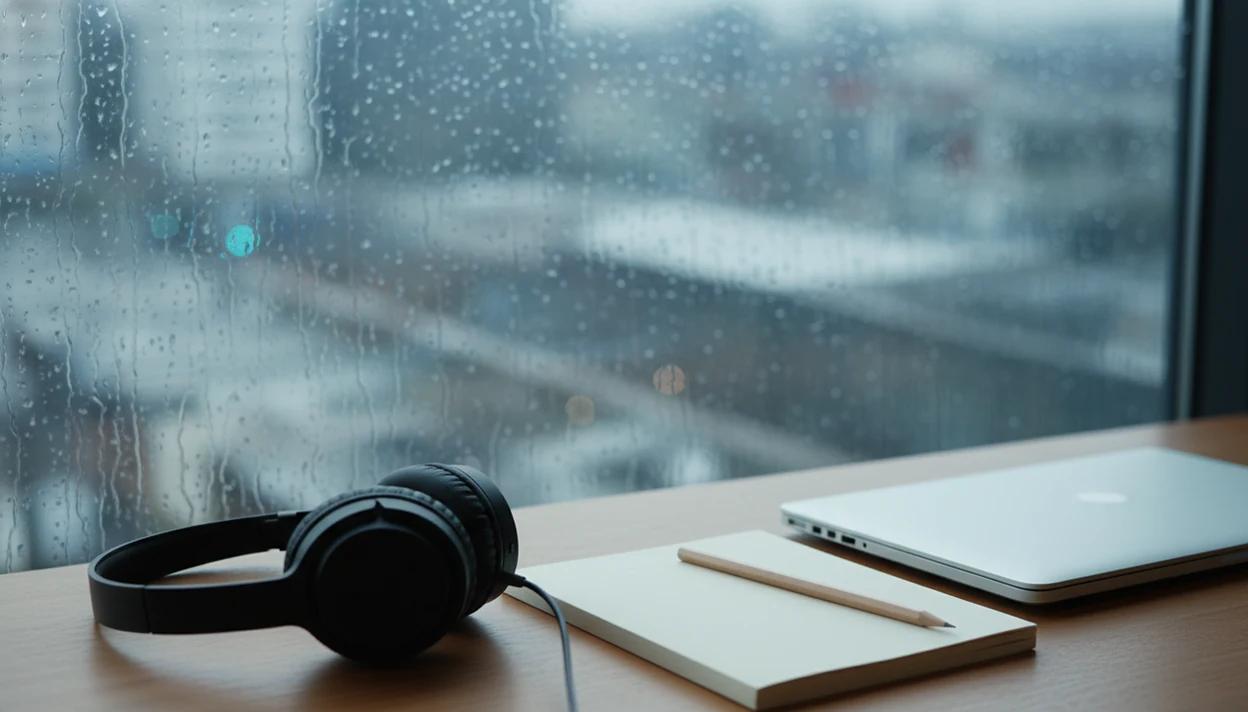


Ambient sounds for focus are steady background sounds, such as rain, flowing water, pink noise, soft drones, or calm instrumental tones, used to reduce distraction during work, study, or meditation. The most practical starting point is simple, low-volume audio without lyrics, sudden changes, or busy arrangements. The sound should stay in the background rather than compete with the task.
No sound type guarantees better concentration. Rain, white noise, pink noise, and silence can suit different people and tasks, so a short comparison is more useful than choosing by label alone. MindTastik offers soundscapes and guided focus sessions for calm work routines. Audio remains a support layer alongside defined tasks, timed sessions, breaks, and fewer notifications, not a productivity cure.
What matters most
- Choose simple, steady, non-lyrical soundscapes for concentration instead of busy music or loud playlists.
- Test several sound types because white noise, nature sounds, pink noise, and silence affect people differently.
- Use ambient audio with focus habits such as timed sessions, breaks, notification blocking, and guided refocusing when needed.
Ambient sounds for focus meditation: 5-minute choice guide
Start with a simple sound that does not ask for attention: rain, flowing water, soft hums, pink noise, or low-arousal instrumental tones. If you are reading, writing, coding, or studying, avoid lyrics, sudden swells, high-energy tracks, and complex arrangements.
The practical test is boring on purpose. Put on one sound, lower the volume, and work for five minutes. If you notice the track more than the task, switch or use silence.
Tools like MindTastik can work as an ambient focus app by playing soundscapes alone or beneath guided focus meditations. That matters when you want a stable background one day and a little verbal refocusing the next.
For most people, the useful track is personal and task-dependent, not universal. A spreadsheet, a novel draft, and a dense textbook chapter may each need different sound.
How Ambient Sounds for Focus Meditation Work
Ambient sounds for focus meditation work by making the sound environment more predictable and by setting a useful level of stimulation. They do not force concentration; they reduce some competing inputs so attention has less to fight.
The first mechanism is auditory masking, which means one steady sound makes small interruptions less sharp. In a workplace, soft rain in headphones may not erase a nearby conversation, but it can make keyboard taps, chair squeaks, and hallway footsteps stand out less. The second mechanism is arousal regulation: too little stimulation can feel dull and restless, a moderate level can support alert calm, and too much sound can become another distraction. Non-lyrical sounds also avoid a common conflict during reading and writing, because there are no sung words competing with the words on the screen.
Use the mechanism as a small test loop:
- Start with a simple, non-lyrical track.
- Keep the volume low enough that the task stays in front.
- Notice whether your baseline attention, task type, or sound sensitivity changes the result.
- Repeat the later 6-step routine before deciding whether the sound helps.
Auditory masking, arousal, and focus ambient audio in the brain
Auditory masking is the process where steady background sound makes intermittent distractions feel less noticeable, so a chair scrape or hallway voice stands out less. In plain language, one predictable layer can soften the impact of many unpredictable ones.
Focus ambient audio can also act as an attention anchor. A neutral sound gives the mind a calm background object without forcing language processing. That is why non-lyrical rain often feels easier than a song when the sentence on screen already needs your words.
Arousal level is the catch. Moderate sound may help someone who feels under-stimulated, but it can distract someone who already focuses well. A 2013 randomized trial on white noise found improved memory in adults with attention difficulties and worse performance in adults with strong baseline attention (doi reference: fnhum.2013.00127).
Open-office noise research points in the same direction from another angle. Chosen masking sound is different from stressful, uncontrolled noise. Palms pressed against a desk edge tell you the difference fast.
Best ambient soundscapes for concentration by task type
Different soundscapes for concentration fit different tasks, and silence still belongs in the comparison. The safest starting point is steady, simple, low-volume audio, then adjust after a few real work sessions.
| Sound type | Best use | When to avoid |
|---|---|---|
| Rain or flowing water | Writing, planning, journaling, light reading | If water sounds make you sleepy or pull attention |
| Pink noise | Masking light household noise or office chatter | If constant noise feels irritating or fatiguing |
| Soft drones | Repetitive admin, inbox sorting, visual work | If the tone becomes the main thing you hear |
| Low-arousal instrumental tones | Calm work blocks and gentle transitions into focus | If melody competes with memory or reading |
| Silence | High-load reasoning, legal reading, complex editing | If small environmental noises become distracting |
A 2021 review of natural-sound experiments found mood, restoration, and cognitive-performance benefits from sounds such as flowing water compared with urban noise or silence (doi reference: pnas.2013097118). Reviews of music and cognition also suggest calm, simple, low-intensity music is more likely to help than lyrical or high-arousal music, especially during language-heavy tasks (doi reference: 0305735618775907).
For bedtime-style nature audio, the same low-stimulation idea shows up in a nature sounds bedtime routine, though work sessions need a more alert tone.
Pure soundscapes versus guided background meditation sounds for work
Pure soundscapes are best when you already know what to do and only need a stable background. Guided background meditation sounds for work add breathing cues, attention prompts, and gentle reminders to return to the task.
| Option | Best for | Watch for |
|---|---|---|
| Pure soundscape | Independent work, reading, writing, study blocks | Too little structure when the mind keeps wandering |
| Guided focus meditation | Restless starts, procrastination, anxious work transitions | Spoken cues can interrupt language-heavy tasks |
| Soundscape plus timer | Single-tasking and defined work sprints | The timer helps only if notifications stay off |
If the screen is paused after a restless start, sound alone may not be enough. A guided session can help you choose the first breath, the first sentence, or the first small task.
A focus audio app is useful here when it lets you switch between sound-only sessions and guided focus sessions without rebuilding the routine each time. For a deeper work-specific setup, a focus meditation app can help connect audio to task routines.
6-step ambient focus app routine for calm work sessions
Use ambient audio as a routine, not a rescue button. The track matters, but the setup around it matters more.
- Set a session length, such as 25 or 45 minutes, before you press play.
- Choose one soundscape, such as rain, pink noise, or a soft drone. If you prefer drones to rain, compare dark ambient music at low volume before using it during work.
- Lower the volume until it masks distraction without becoming the main object of attention.
- Turn off notifications, extra tabs, and anything that keeps pulling your eyes away.
- Start one defined task, then keep the same sound for several sessions before judging it.
- Take a short break when the timer ends, or use guided focus meditation if you feel restless or overwhelmed.
Tiny detail, big difference: dim the phone screen before starting if the app stays nearby.
Keep headphone volume low during long work sessions
A quiet-sounding track still contributes to total listening exposure when it runs through hours of work. The World Health Organization’s safe-listening guidance recommends keeping personal-device volume below 60% of maximum and using well-fitted, preferably noise-cancelling headphones to reduce the need to turn it up. That percentage is a precaution, not a measurement of the sound reaching the ears.
WHO identifies exposure below 80 dB for up to 40 hours a week as a safe leisure-listening reference; risk depends on level, duration, and frequency. This is not a target volume for concentration. Keep focus audio as quiet as practical, include breaks from headphones, and avoid raising the volume simply to overpower a loud room. A quieter workspace may be more useful than louder masking audio.
Five evidence facts about focus ambient audio before you press play
- Effects vary by person and attention baseline. The 2013 white-noise trial found opposite effects depending on baseline attention, so your response may not match someone else’s.
- Steady and non-lyrical audio is usually safer for cognitive tasks than songs with lyrics. Words in music often compete with reading, writing, and memory.
- Nature soundscapes may help mood and perceived restoration. Research on flowing water and other natural sounds suggests benefits compared with urban noise or silence. Claims about a healing frequency deserve caution, especially when choosing audio for relaxation rather than medical treatment.
- Uncontrolled office noise is not the same as intentionally chosen masking sound. A loud open office can raise stress, while chosen audio can make small interruptions less sharp.
- Ambient sound works better with focus habits than as a standalone productivity hack. Timers, breaks, and notification blocking do a lot of the heavy lifting.
For people comparing sound colors, the white noise vs meditation question is less about winning and more about fit. If you also compare tonal tracks, treat 528 Hz as an audio preference, not a concentration guarantee.
Best-fit and poor-fit use cases for ambient sounds for focus meditation
Ambient sounds for focus meditation fit best when the main problem is environmental distraction, not a lack of sleep, clinical distress, or an impossible workload. They are a support layer for work, not the work system itself.
Best for - Open offices and light household noise. Steady audio can make nearby taps, doors, and quiet voices less noticeable. - Study blocks and single-tasking. A familiar background can mark the start of a focused session. - Journaling, planning, and calm transitions. Soft rain or water can help the body shift out of scattered mode. - Users who want fewer lyrics and less stimulation. Normal playlists can feel too busy for language-heavy tasks.
Not ideal for - People who find all background sound overstimulating. Silence may be the kinder option. - Tasks requiring intense verbal processing. Dense reading and memory work may suffer. - Anyone seeking a medical or therapy replacement. Ambient audio is not care. - People who feel unable to work without one track. Dependence gets inconvenient fast.
Image caption: A calm workspace with headphones and a soft rain soundscape open in MindTastik
Suggested image caption: A calm workspace with headphones and a soft rain soundscape open in MindTastik, showing ambient sounds for focus meditation during a work session.
MindTastik ambient focus app features that matter
The most useful ambient focus app features are the quiet ones: timers, gentle starts, and quick access to the same sound without hunting through a crowded screen. Too many choices can become another task.
For focus use, the practical value is not a giant audio library; it is timers for defined sessions, fade-in and fade-out to reduce abrupt starts and stops, and the option to play soundscapes alone or with guided meditation where available.
That range matters because focus is not always solved by pushing harder. Sometimes it is the midafternoon dip, a crowded inbox, or someone simply wanting a steady background sound while their mind feels overactive. For related calm-audio use, soundscapes for anxiety support may be a better starting point than a work timer.
Soundscapes for work, guided sessions for getting started
MindTastik’s soundscapes suit work sessions that need a steady background without spoken instructions. Its focus sessions and guided meditation library are a better match for a restless start or a pause between tasks. For reading and writing, spoken guidance may be more useful before work than during it. People who concentrate best in silence, or whose work requires careful listening, should choose quiet rather than add another audio layer.
Ambient sound cannot solve every attention problem
Ambient audio can be useful, but the evidence is mixed and the effects are usually modest. Clinicians typically recommend professional evaluation for persistent attention, anxiety, sleep, or mood problems rather than relying on an app or soundscape alone.
- Some people focus better in silence, especially during complex reading, memory work, or verbal reasoning.
- White noise can help some distractible users and impair others, depending on baseline attention.
- Loud, complex, or lyrical audio can reduce performance because it competes with the task.
- Ambient audio is not a treatment for ADHD, anxiety disorders, insomnia, or any other medical condition.
- Claims about special frequencies, 432 Hz, or binaural beats are often stronger than the available evidence.
- Dependence on one soundscape can become inconvenient when headphones die, travel disrupts access, or the track is unavailable.
- Open-office noise and chosen masking sound should not be treated as the same thing.
- If sound makes you tense, irritated, or more alert at bedtime, stop using it and reassess.
Restless feet under the blanket in the early hours are not a productivity issue. If the problem is sleep, a sleep soundscapes meditation app may fit better than daytime focus audio.
Skip background sound for listening tasks and overstimulated breaks
- Skip ambient focus audio when the task requires careful listening, such as reviewing recorded calls, editing spoken content, or preparing for a live discussion.
- If you are already overstimulated after back-to-back meetings, silence or a breathing exercise may be a better first step than adding more sound.
- When a calendar gap is only two minutes, use the time to stand, breathe, or close open tabs instead of searching for the perfect soundscape.
- Ambient audio is a support tool, not a substitute for clarifying the task, reducing interruptions, or taking a real break.
- If the sound starts to feel like pressure to perform, lower the volume, shorten the session, or choose a calmer reset.
When story-style audio fits your routine better than active meditation, browse MindTastik sleep stories for calm bedtime listening.
Ambient sound and concentration questions
Do ambient sounds actually improve focus?
They can make intermittent background noise less noticeable, but they do not reliably improve concentration for everyone. Effects depend on the sound, the task, and the listener. Compare a simple soundscape with silence during the same kind of work, and judge by task progress rather than how pleasant the audio feels.
Is white noise or pink noise better for studying?
The supplied research does not establish one as the best study sound. Either may serve as steady masking audio, but a constant noise can also feel distracting or tiring. Start at low volume and compare each with silence. Sleep findings about pink noise do not establish a benefit for studying.
Are rain sounds good for reading and writing?
Steady rain is a practical option because it has no lyrics and can soften small environmental distractions. It is not guaranteed to improve reading or writing. Avoid recordings with prominent thunder or sudden changes, and switch to silence if the rain draws attention or makes the task feel harder.
Why are songs with lyrics distracting while studying?
Lyrics add words while reading, writing, and memory tasks already require language processing. A systematic review found that background music generally impaired memory and language tasks, with lyrical music tending to be more detrimental than instrumental music. Instrumental tracks are not automatically helpful, especially when the work is difficult.
How loud should ambient sounds be for concentration?
Use the lowest level that makes small distractions less noticeable without becoming the main thing heard. WHO recommends keeping personal-device volume below 60% of maximum, but that setting is not a precise sound-level measurement. Long sessions also count toward listening exposure, so louder masking is not a good answer to a noisy room.
Is brown noise proven to improve concentration?
The cited systematic reviews do not establish a distinct, reliable cognitive benefit for brown noise. The label alone says little about how well a recording suits a task. Loudness, abrupt changes, and personal noise sensitivity matter. A comfortable brown-noise track can be an option, but it should be compared with silence.
Should guided meditation play in the background while working?
Spoken prompts can interrupt language-heavy work, so guided meditation often fits better before a reading or writing session than throughout it. Pure soundscapes suit work that needs an uninterrupted background. A brief guided focus session may help structure a restless start, but the work period itself can remain quiet.