
Soundscape or Sleep Story Before Bed?
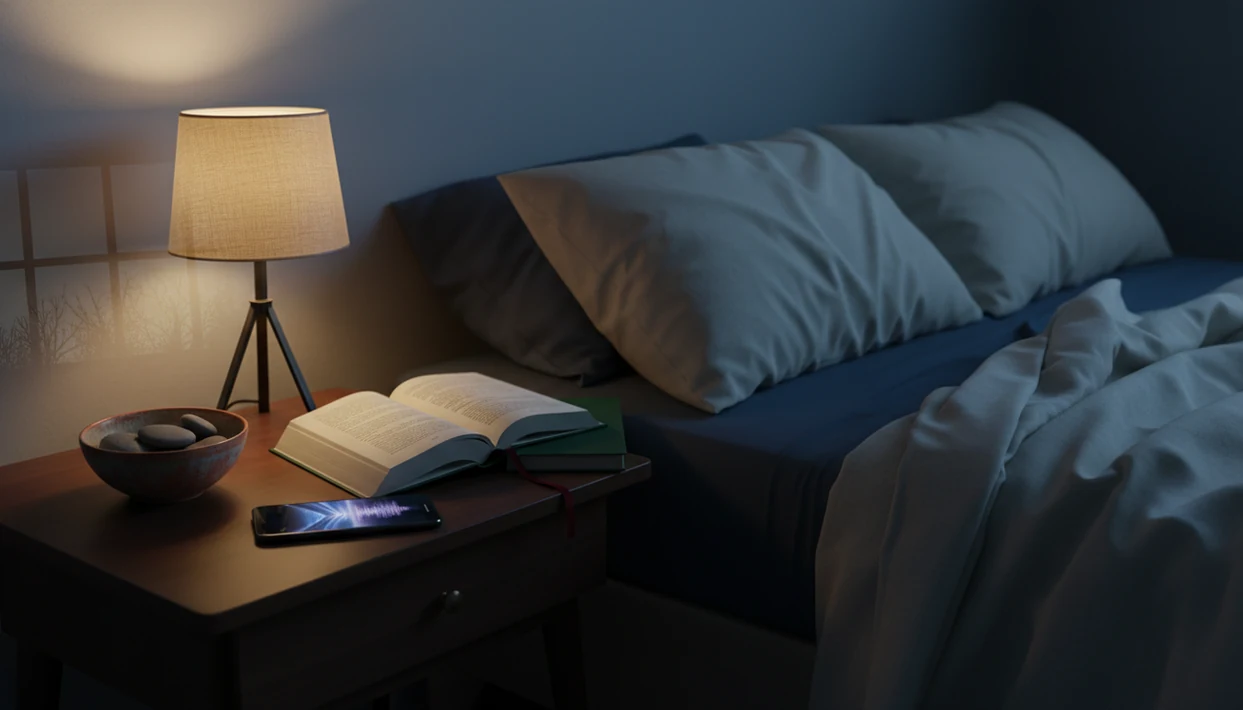


A sleep story is usually the better choice for racing thoughts, while a soundscape suits people who want steady background audio without following words. A sleep soundscape is mostly wordless bedtime audio, such as rain, waves, white noise, or soft music. A sleep story is a slow spoken narrative that gives attention something simple to follow as sleep approaches.
The useful distinction is how much attention the audio asks for. Narration can interrupt mental chatter, but an interesting plot or distracting voice can keep a listener awake. Soundscapes may suit light sleepers, shared bedrooms, and people who dislike voices at night. A short breathing practice or meditation can come first, with either format as the final part of the bedtime routine.
Choose by bedtime state
- Sleep stories are usually better for racing thoughts because narration gives the mind something low-stakes to follow.
- Soundscapes are usually better for light sleepers, shared bedrooms, and people who dislike voices at night.
- MindTastik-style routines work best when meditation or breathing comes first, followed by either a story or soundscape for sleep.
Sleep story vs soundscape comparison table
Neither option is universally better. The right sleep story vs soundscape choice depends on how much attention your mind needs at bedtime.
| Bedtime audio option | Audio type | Attention demand | Best use case | Possible downside | Ideal routine placement |
|---|---|---|---|---|---|
| Sleep story | Slow spoken narrative, sometimes with soft background sound | Medium | Racing thoughts, worry loops, mental chatter | Plot or voice may keep you listening | After breathing or a short meditation |
| Soundscape | Rain, ocean, white noise, soft music, nature audio | Low | Shared bedrooms, noise masking, light sleep | Repetition may become irritating | During wind-down or all-night background |
| Guided wind-down | Spoken meditation or body scan | Medium to high | Sleep anxiety, tense body, restless mind | Too much instruction can feel effortful | Before story or soundscape |
A few nights of testing usually tells you more than one tired guess. App-led routines can make that comparison easier because you can repeat the same bedtime window and swap only the audio type.
The download screen before bedtime can feel crowded. Keep the test simple.
Best bedtime soundscape or story for your current state
Pick the audio that matches your current state, not the one that sounds more relaxing in theory. For racing thoughts, a story often helps; for sensory comfort, a soundscape usually fits better.
Sleep story is best for
✅ Racing thoughts: Choose a sleep story when narration gives the mind a gentle thread to follow. ✅ Physically tired, mentally alert: Start with a short meditation, then move into a story. If you keep checking the time in a dark room, your attention may simply need a soft place to land. ✅ People who need words: Some listeners settle more easily when a calm voice fills the space.
Soundscape is best for
✅ Noise sensitivity or a shared bed: Choose a low-volume soundscape that does not demand attention. ✅ Frequent waking: Consider continuous rain, ocean, or soft ambient sound after the initial wind-down. More options live in our sleep soundscapes meditation app guide.
Neither is best for
✕ Active distress, panic, or trauma reactions: Start with professional support when symptoms feel unmanageable. ✕ When audio becomes the problem: If every sound irritates you, silence may be kinder.
How sleep audio comparison works in bedtime attention
Sleep audio works by changing bedtime attention: soundscapes create a stable sensory background, while sleep stories give the mind a simple narrative anchor. One masks the room; the other redirects thought. For daytime tasks rather than bedtime, ambient sounds for focus offer background audio without a spoken narrative.
A soundscape can act like an audio blanket. Rain, waves, or soft music may cover small disruptions, such as a hallway door or a passing car. A story works differently. It gives your attention a thread to follow, so unread emails have less room to replay behind closed eyes. If you prefer woodland audio to rain or waves, try forest sounds meditation as a wordless bedtime option.
Too much plot can backfire. Suspense, conflict, or emotional narration can increase alertness, especially if you start wondering what happens next.
Meta-analysis data suggest music-based interventions can improve subjective sleep quality in adults, though results are not the same as medical treatment NIH research: PMC6458322. Sleep apps for sleep anxiety and everyday calm deliver supportive routines, not diagnosis, therapy, or a guaranteed fix.
Evidence for soundscapes, sleep stories, and sleep quality
The strongest evidence is encouraging but modest. Sleep audio is best understood as a routine support, especially when paired with meditation or breathing.
- A cross-sectional survey of 12,151 Calm app users found that frequent use of Sleep Stories, sleep meditations, and music or soundscapes was associated with perceived improvements in falling asleep, staying asleep, and restful sleep NIH research: PMC8535359.
- The same study found that Sleep Stories and music or soundscapes were not associated with self-reported anxiety or depression improvements, while meditation components were.
- Population data suggest chronic insomnia affects about 10% to 30% of adults worldwide, with higher estimates in some groups NIH research: NBK526136.
- Among older adults, reported insomnia symptoms are common, which helps explain why scalable sleep audio tools get attention.
- Tools like MindTastik, Calm, and Headspace can support sleep, anxiety, and calm routines, but they should not replace therapy, medication, or medical care.
For plain background audio, some people start with rain sounds for sleep meditation because the pattern feels familiar and steady. For an urban rain option, try the city rain soundscape for calm at a comfortable, low volume before bed.
Music research does not prove that stories or rain sounds work better
Evidence about bedtime music should not be treated as evidence for every kind of sleep audio. A 2022 Cochrane review of music for insomnia included 13 studies with 1,007 participants in its main sleep-quality analysis. Music probably improved subjective sleep quality compared with no treatment or usual care, but evidence for objective sleep measures and insomnia remission was more limited. If you prefer tonal audio, our 528 Hz routine explains its uses and limits without promising sleep benefits.
That distinction matters when choosing between a narrated story and a rain track. In a 2019 trial involving 57 people with insomnia disorder, bedtime music improved perceived sleep improvement and quality of life, but objective sleep measures did not change. The trial included an audiobook control, not a direct comparison of sleep stories with soundscapes. It does not establish a winner between these two formats.
How to use a soundscape or sleep story in MindTastik
Use sleep audio as the last part of a wind-down routine, not the whole plan. If sleep anxiety is present, calm the body first, then choose the bedtime sound. A nature sounds bedtime routine can pair steady outdoor audio with a consistent wind-down before lights out.
MindTastik offers guided wellness audio for adults, including meditation, sleep sounds, breathing practices, and self-hypnosis sessions designed to support rest, anxiety management, and everyday calm.
MindTastik offers breathing exercises and guided meditation for winding down before a sleep story or soundscape.
- Start with a short breathing exercise, guided meditation, or self-hypnosis session if your body feels keyed up.
- Choose a story for racing thoughts and a soundscape for sensory comfort or shared-room listening.
- Dim the phone screen before starting the audio, so the app choice does not become another alerting task.
- Set the volume low enough that the sound fades into the background.
- Test one option for several nights before switching, unless it clearly irritates you.
- Adjust after waking patterns, not after one restless night.
A small speaker playing at low volume in a dark room. That feels like an ordinary bedtime scene, not a controlled study.
Set a timer and keep headphone volume low
All-night playback is not an established requirement for bedtime audio to help. The bedtime music trial evaluated a structured routine, rather than unrestricted overnight listening. For headphone use, Cleveland Clinic’s sleep-listening guidance recommends a timer so audio stops after falling asleep, volume at about half or lower, and avoiding noise-cancelling modes during sleep.
The same guidance suggests keeping the sound low enough that a nearby person could still be heard. Houston Methodist’s audiology advice also recommends device volume at or below approximately 50% and cautions that prolonged exposure to louder sleep sounds or music can damage hearing. A relaxing track is not automatically safe at high volume or over a long listening period.
Best audio for racing thoughts at night
The best audio for racing thoughts is often a slow sleep story or guided wind-down because spoken narration gives worry less room to loop. If words keep you awake, switch to a soundscape.
Verbal audio can interrupt repetitive thought loops by giving the mind a neutral task. You are not solving the day. You are following a quiet description, a simple place, or a narrator who moves slowly enough that missing a sentence does not matter.
The story has to stay boring in the right way. Dramatic plots, suspense, celebrity voices you focus on, or emotional scenes can make you more alert.
For many people, the better sequence is a short anxiety-focused meditation first, then a low-stakes story. If the voice starts to feel like conversation, change lanes. A steady option such as ocean sounds for sleep meditation may be easier to let go of.
Image caption for bedtime soundscape or story choice
Use an image that teaches the choice at a glance. One side can show rain or ocean audio beside a dim bedside lamp; the other can show a gentle narrator icon beside a simple bedtime story path.
The image should not imply that one option is the winner. It should show two practical routes for different bedtime states. A dim lamp beside wrinkled pillows says more than a glossy phone mockup.
Caption: Choose a bedtime soundscape or story based on whether your mind needs steady background sound or a gentle narrative anchor.
Alt-text guidance: “Bedtime soundscape or story choice showing rain and ocean audio on one side and a gentle narrated sleep story on the other.”
If the page later includes a product screenshot, keep it secondary. The comparison should stay educational, not promotional.
A short wind-down before the bedtime audio
MindTastik’s breathing exercises and guided meditations suit adults who feel physically tense before choosing bedtime audio. Its sleep soundscapes offer a wordless option, while sleep stories provide narration for those who prefer an attention anchor. People who find all audio distracting may prefer silence. Persistent sleep problems need more than an app, and these sessions are not a medical treatment.
What bedtime audio cannot establish or treat
Soundscapes and sleep stories can be useful, but they are not a medical sleep plan. Treat them as supportive tools inside a consistent routine.
- Most evidence is self-reported or survey-based, not large randomized sleep trials.
- Soundscapes and sleep stories are not treatments for anxiety, depression, insomnia disorder, or trauma.
- Some people find voices distracting, especially when the narrator’s tone feels too personal.
- Some people find repetitive noise irritating after a few minutes.
- Shared rooms, headphones, hearing sensitivity, and device notifications can limit usefulness.
- Benefits may require consistent routine use rather than one-night testing.
- All-night audio may bother a partner or make waking harder for some listeners.
- Persistent insomnia, severe anxiety, loud snoring, breathing pauses, or suspected sleep disorders deserve professional guidance.
The white noise vs meditation comparison separates two different approaches: changing the sound environment and practicing how attention is directed.
Nighttime Reset
Myth: A sleep story is always better for racing thoughts.
Reality: A sleep story can help when the mind wants something gentle to follow, but it may be too interesting if you start tracking the plot. If you keep waiting for what happens next, a low-detail soundscape or short body scan may be the better reset.
Myth: Soundscapes are only background noise.
Reality: A steady soundscape can act like a soft boundary around the room, especially with a dim lamp off and attention resting on a slow exhale. The simpler the audio, the less the tired brain has to solve.
Myth: The right choice should work immediately.
Reality: Bedtime audio often works best as a repeated cue, not a one-night test. The useful question is not which option is impressive, but which one you can repeat without negotiating with yourself.
If you want narration instead of instruction at bedtime, MindTastik sleep stories is a practical place to start inside MindTastik.
Soundscape and sleep story questions
Is a sleep story or soundscape better for racing thoughts?
A slow sleep story may help when repetitive thoughts need a simple alternative to follow. A soundscape may fit better when words feel distracting or demanding. The useful check is whether narration reduces mental chatter or makes the listener concentrate on the story. Neither format is universally better.
Why do sleep stories sometimes keep me awake?
A story can become another reason to stay alert if the plot is suspenseful, the narration is emotional, or the voice attracts too much attention. A low-detail story may be less engaging. If listening still feels like following entertainment, a wordless soundscape or short body scan may be a better fit.
Do rain sounds and white noise improve sleep?
Steady sound can provide a background that makes small room noises less noticeable, but that does not establish that rain or white noise treats insomnia. Evidence for music should not be applied automatically to every ambient track. Comfort and irritation vary, so the sound needs to be tolerable rather than merely labeled relaxing.
Should sleep audio play all night?
There is no established need for all-night playback. Research on a structured bedtime music routine does not prove that longer listening is better. For headphones, Cleveland Clinic recommends using a timer so playback stops after falling asleep. Continuous audio can also become irritating or disturb someone sharing the room.
Can sleep stories help with bedtime anxiety?
A calm narrative may give worry less room to repeat, but sleep stories are not a treatment for an anxiety disorder. When physical tension is part of the problem, a short breathing exercise or guided meditation can come first. If the narrator makes listening uncomfortable, a wordless track may be preferable.
What volume should bedtime audio be?
Keep headphone volume low. Cleveland Clinic advises about half volume or lower, with the sound quiet enough to hear a nearby person. Houston Methodist also recommends approximately 50% or less and warns about prolonged louder listening. A sleep timer limits playback without relying on waking up to turn it off.
Which bedtime audio works better in a shared bedroom?
A quiet, steady soundscape may be easier to share than narration because neither person needs to follow words. That is a practical preference, not proof of better sleep. Repetitive noise can still irritate a partner, and a sound that comforts one listener may disturb the other. Silence remains a reasonable choice.