
Should You Choose a Sleep Story or Guided Meditation Before Bed?


Choose guided meditation before bed when thoughts are racing or muscles feel tense; choose a sleep story when tiredness makes instructions feel like work. A sleep story is passive, calming narration. Guided meditation uses breathing, body scans, visualization, or mindfulness to help the body settle for sleep. The choice depends on attention, anxiety, and the routine that feels manageable that night.
Meditation offers a simple task for a busy mind and a way to practice relaxation over time. A story offers gentle distraction without much participation, especially when its voice and plot are predictable. Both can fit the same evening: 5 to 10 minutes of breathing or a body scan, followed by quiet narration. Neither requires finishing the recording before falling asleep.
Which audio fits tonight?
- Pick guided meditation for racing thoughts, sleep anxiety, physical tension, or long-term relaxation practice.
- Pick a sleep story when you feel too tired to follow instructions and want a gentle, predictable audio cue.
- Many people do best with both: 5-10 minutes of breathing or body scan, followed by a quiet story.
Sleep story vs meditation before bed: the quick comparison
Sleep story vs meditation before bed comes down to effort: stories are passive, while guided meditation asks for brief participation before attention can fade. Per the CDC, 35.2% of U.S. adults report sleeping less than 7 hours, which is one reason bedtime routines matter CDC guidance: adults sleep facts and stats.html.
| Bedtime state | Sleep story | Guided meditation |
|---|---|---|
| Attention required | Very low, mostly listening | Moderate at first, then fading |
| Best use case | Low energy, boredom, gentle distraction | Racing thoughts, tension, sleep anxiety |
| Effort level | Minimal | Light structure |
| Likely benefit | Soothing bedtime cue | Better-studied relaxation skill |
| Example moment | You want narration under a closed door | You need breathing counted for you |
Meditation has stronger evidence for relaxation and sleep quality. Sleep stories are mainly a calming cue. For many people asking “guided meditation or sleep story,” the answer changes night by night.
Bedtime audio choice for racing thoughts, tension, or low energy
What bedtime audio should I choose? Choose guided meditation if your body feels keyed up, your jaw is tight, or unread emails keep replaying behind closed eyes. Slow breathing, a body scan, or progressive muscle relaxation gives the mind a simple job.
Choose a sleep story when effort feels annoying. If you are lonely, bored, or too tired to follow instructions, a predictable voice may be enough. The plot should not be gripping. That is the point.
For racing thoughts plus low energy, use both. Start with 5 minutes of breathing, then switch to a quiet story. For high-arousal nights, guided meditation is often easier than a story because it gives worry a physical task to follow.
Bedtime audio mechanisms: how sleep stories and guided meditation work
Both sleep stories and guided meditation work by lowering stimulation and turning audio into a repeatable cue that sleep is approaching. In plain terms, the brain learns, “this sound means we are done for the day.”
Sleep stories act as passive attention anchors. They gently replace rumination with low-stakes imagery, such as a train ride, a quiet island, or a slow walk through a garden. You do not need to do much besides listen.
Guided meditations are active relaxation scripts. They may use slow breathing, progressive muscle relaxation, body scans, or guided imagery to reduce arousal. Clinicians typically recommend relaxation training as part of behavioral insomnia care, and the American Academy of Sleep Medicine lists relaxation training among behavioral treatments for chronic insomnia PubMed research: 20205380. That does not mean every app track treats insomnia.
A good meditation app for sleep anxiety and everyday calm should deliver repeatable cues and easy starting points, not medical promises or pressure to “fix” yourself overnight.
Five facts about guided meditation or sleep story choices
- Sleep stories are usually passive and require less effort than meditation, which helps when you feel too tired to follow steps.
- Guided meditation requires some attention at first, but sleep-focused tracks are designed to let attention fade as the body settles.
- Relaxation and mindfulness techniques have stronger research support than narrative audio alone for reducing arousal and improving sleep quality.
- Sleep stories can be useful when the problem is overstimulation, bedtime resistance, or the habit of reaching for a brighter screen.
- A combined routine can solve both problems: settle the nervous system first, then drift with narration.
The pocket check is real.
If repeated phone checks interrupt bedtime, choose a familiar recording before lying down to reduce further decisions. A simple meditation before sleep checklist can help you set the track before bed.
Best-fit sleep story or meditation before bed use cases
The best-fit choice depends on what feels manageable in the moment, not on one format being universally better. Use “best for” and “not ideal for” as a quick filter. If audio does not suit tonight, try these ways to rest for other gentle options before bed.
Sleep stories are best for low-effort drifting
✓ Best for: low energy, boredom, loneliness, bedtime resistance, and nights when instructions feel like work. ✕ Not ideal for: panic-like restlessness, intense worry loops, or strong physical tension.
Guided meditation is best for active calming
✓ Best for: racing thoughts, tight muscles, shallow breathing, and building a longer-term relaxation practice. ✕ Not ideal for: moments when inward attention feels unsafe or too intense.
People with trauma histories or severe anxiety may need gentler, less body-focused practices. Eyes-open breathing, external sounds, or a nighttime wind-down routine may feel safer than a deep body scan.
Guided meditation or sleep story routine for tonight
Use this routine before getting into bed, not after 20 minutes of scrolling. The small decision of dimming the phone screen matters more than it seems.
- Set a low volume and choose your track before you lie down.
- Choose a 5-10 minute guided meditation first if thoughts are racing.
- Start with breathing or a body scan, keeping the screen dim and face down.
- Switch to a longer sleep story if you still want a soft landing.
- Repeat the same sequence for several nights so the cue becomes familiar.
- Adjust if a voice, pace, or topic makes you more alert.
Apps such as MindTastik, Calm, and Headspace can hold both formats in one library. MindTastik includes guided meditation, sleep audio, breathing exercises, and self-hypnosis sessions, so you can choose a starting point without rebuilding the whole routine. If screens are the main problem, try a screen-free bedtime meditation.
Set the audio to stop, not play until morning
A sleep timer makes bedtime audio a bounded activity rather than an all-night soundtrack. Royal Papworth Hospital's insomnia guidance says some people find quiet music or sounds helpful, but advises that the audio should not continue all night. One recording of roughly 20 to 45 minutes is a practical starting point, not a duration established as best by clinical trials.
Choose a recording with steady volume and no sudden advertisements or loud transitions. Disable notifications, keep the device outside the bed, and set automatic stop before listening. The NHS sleep guidance recommends avoiding phones, tablets, and computers for about an hour before bed. Downloaded audio or a speaker can separate listening from screen use. Stop or change the recording if it increases alertness, anxiety, tinnitus, or nighttime awakenings.
Evidence behind guided meditation before bed
Research favors relaxation and mindfulness techniques for lowering arousal, but it does not prove that meditation always beats sleep stories. Direct head-to-head research on sleep stories versus guided meditation is limited.
Evidence for sleep stories is limited and mostly indirect, drawing on distraction, familiar bedtime cues, and reduced stimulation rather than trials of story recordings themselves. That makes sleep stories a practical tool, not an evidence-equivalent substitute for relaxation training.
A 2013 randomized controlled trial in adults with chronic insomnia found that mindfulness-based stress reduction reduced total wake time by about 20 minutes and improved sleep quality versus a wait-list control PubMed research: 23419786. A 2018 meta-analysis of 18 randomized controlled trials found small-to-moderate improvements in sleep quality from mindfulness meditation, especially in people with clinical sleep disturbance NIH research: PMC6557693.
That is not an instant sleep guarantee. It is a signal that relaxation skills can help the body downshift. The most common medically supported way to improve chronic insomnia is behavioral sleep care combined with relaxation training, not relying on a single audio track.
Music research does not prove that sleep stories work
Evidence about bedtime audio needs careful labels. A 2022 Cochrane review of music for insomnia included 13 randomized controlled trials with 1,007 participants. Music probably improved reported sleep quality, but evidence for changes in time to fall asleep, total sleep time, and sleep efficiency was less certain. These findings concern music, not spoken stories or commercial meditation recordings.
That distinction matters when comparing formats. The reviews in these research notes do not establish that spoken stories outperform music, relaxation recordings, or usual care. A calm, predictable recording is a reasonable practical trial, but a pleasant listening experience is not proof of an insomnia treatment. If narration keeps attention on the plot, quiet music may be a better fit than another story.
Combined MindTastik bedtime audio routine for breathing, body scan, and sleep story
Use it as routine support, not as a replacement for therapy, medication, or clinical care.
A simple sequence is enough: short breathing track, brief body scan, then a sleep story or soundscape. The person who says, “I just need something to play when my thoughts get loud,” often needs fewer choices, not a crowded screen of categories.
A calm bedtime audio routine can start with breathing and end with a low-stimulation sleep story.
If you are building the whole evening pattern, a bedtime routine for adults can help place audio after light, caffeine, and screen decisions.
MindTastik for nights that need different kinds of audio
MindTastik includes guided meditations, breathing exercises, sleep stories, and soundscapes. Its guided meditation library suits nights when a breathing practice or body scan feels more useful than narration. Sleep stories offer a lower-effort option when following instructions is tiring.
A familiar recording may be enough for someone who does not want an app library. If inward attention increases discomfort, a neutral story or soundscape may fit better than a body scan. Persistent insomnia or severe anxiety needs more than bedtime audio; MindTastik is not a medical treatment.
When bedtime stories and meditation are not enough
Sleep stories and bedtime meditations can support a calmer night, but they have real limits.
- Neither format is a standalone medical treatment for chronic insomnia, severe depression, PTSD, or an acute mental health crisis.
- Direct scientific comparisons between sleep stories and guided meditation are limited.
- Severe anxiety or trauma histories can make body scans, breath focus, or inward attention uncomfortable.
- Audio can become a psychological crutch if you believe you cannot sleep without it.
- Bedtime audio does not replace sleep hygiene basics, including caffeine timing, screen habits, light exposure, and consistent wake times.
- Some narrators, music loops, or storylines may be too stimulating.
- Persistent, worsening, or daytime-impairing sleep problems deserve clinical evaluation.
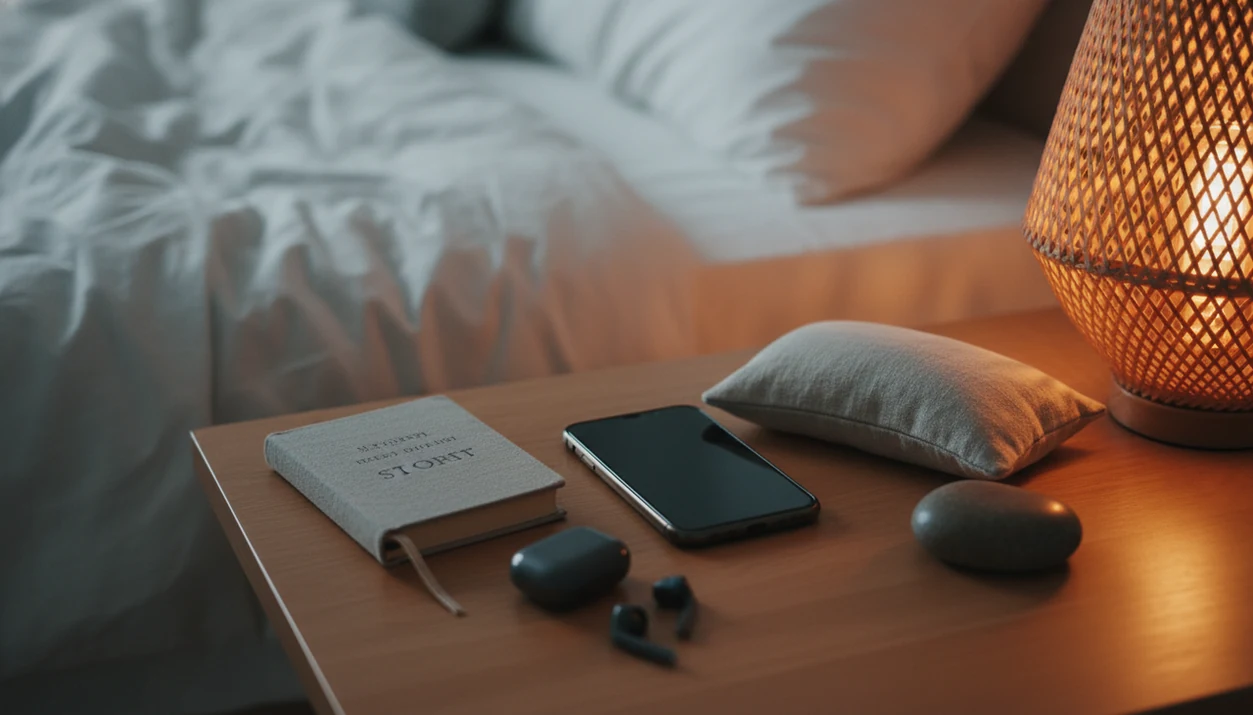
Keep it practical. Earbuds on a nightstand, one side tangled around a charging cable, are not a treatment plan. If sleep problems continue, use audio as one support while you review broader sleep hygiene.
Bedtime listening does not require perfect focus or a finished track
- Do not overestimate how much focus you need. A bedtime meditation can still be useful when attention drifts every few breaths.
- Do not overestimate the value of finishing the full track. Stopping halfway because sleep arrives is usually a sign the routine fit the moment.
- Do not overestimate novelty. Repeating the same sleep story may feel boring during the day but reassuring once the lights are low.
- Do not overestimate volume. Softer audio often supports bedtime better because the brain does not have to keep checking every word.
- Do not overestimate the perfect order. A simple sequence, slow exhale, short body scan, then sleep story, often works better than a complicated routine.
On nights when guided practice feels like too much effort, MindTastik sleep stories offers low-stimulus audio you can play in the background.
Sleep story or meditation questions
Is a sleep story the same as guided meditation?
No. A sleep story mainly asks for listening to calm narration, while guided meditation asks for some participation, such as noticing the breath or relaxing parts of the body. Both can use imagery and a quiet voice, but a story usually requires less deliberate attention.
Is meditation better than a sleep story for falling asleep?
Neither is best for every night. Meditation fits racing thoughts or physical tension because it provides a simple relaxation task. A story fits low energy and a desire for gentle distraction. Direct comparisons are limited, so the choice should reflect comfort and effort rather than a claim that one always works better.
What should I listen to when my mind is racing at bedtime?
A short breathing practice or body scan can give attention a simple task instead of another worry to follow. If instructions feel tiring, try a predictable story afterward. If breath focus or inward attention makes anxiety worse, choose neutral narration or quiet sound instead of continuing the meditation.
Can guided meditation keep me awake?
Yes, a recording can be a poor fit if its instructions demand too much attention or its voice, pace, or imagery feels stimulating. Inward attention can also feel uncomfortable for some people. Try fewer instructions, longer pauses, or passive narration, and stop if listening increases alertness or distress.
How long should I meditate before switching to a sleep story?
Five to ten minutes of breathing or a body scan is a practical starting point, followed by a quiet story if more audio feels helpful. That is not a clinically established ideal duration. There is no need to finish either track or preserve the sequence once sleep arrives.
Is it okay to use the same sleep story every night?
Repeating a familiar story can reduce decisions and make the recording a predictable bedtime cue. New content is not necessary if the existing track remains calming. Audio should stay optional, though. Believing sleep is impossible without it can turn a useful routine into another source of bedtime worry.
Can sleep stories or meditation treat chronic insomnia?
Neither format is a standalone treatment for chronic insomnia. They can support a calmer bedtime, but persistent sleep problems need clinical assessment rather than repeated changes of recording. Evidence for spoken sleep stories is limited, and studies of music should not be treated as proof that narration treats insomnia.