
Mindful Movement for Sleep: A Gentle Nightly Guide
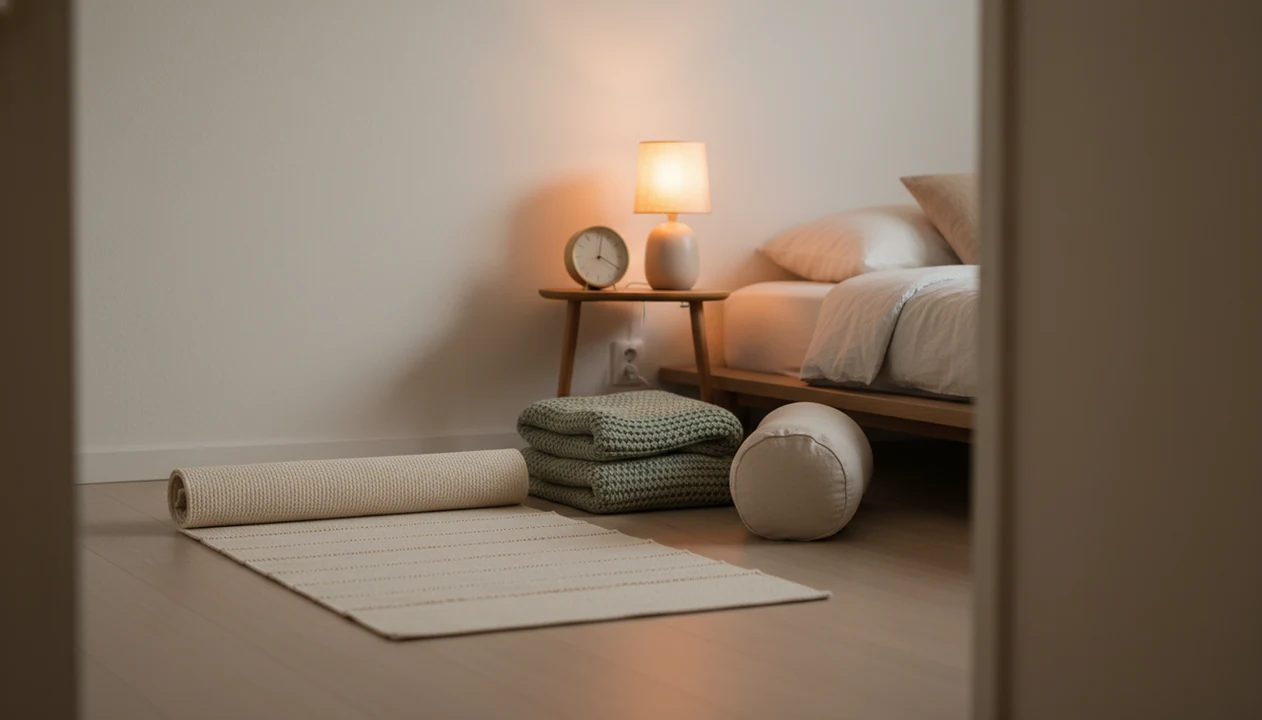


Mindful movement for sleep is a short, low-intensity bedtime routine that combines gentle stretches, slow breathing, and attention to body sensations. The aim is to release physical tension, quiet racing thoughts, and create a familiar cue for rest, not to improve fitness or reach a deeper stretch. A routine can take 5 to 20 minutes and stay simple enough for a tired evening.
Repeating the same comfortable sequence most nights gives the practice a predictable place in the bedtime routine. Seated shoulder movements, gentle spinal movement, or supported stretches can lead into quiet breathing or a body scan. Calming sleep habits still matter, and movement is a support for winding down rather than a guaranteed way to fall asleep.
The bedtime essentials
- Keep the routine gentle: stretching, slow mobility, and longer exhales are the goal, not fitness intensity.
- Start with 5 to 10 minutes and repeat the same sequence most nights so your body learns it as a sleep signal.
- Use guided sleep audio, breathing exercises, or a meditation app after movement if your mind stays active.
Mindful Movement for Sleep Guide: What It Means
Mindful movement for sleep is moving meditation: slow bedtime movement guided by breathing, body sensation, and a clear goal of relaxation. It is not a flexibility test, calorie burn, or yoga performance.
In practice, you might move through cat-cow, shoulder circles, neck rolls, hip openers, or a supported forward fold. The point is to notice what changes as you move. Does the jaw unclench. Do the shoulders drop. Does the breath get quieter.
Keep it simple.
A useful mindful movement for sleep guide starts with the body you have tonight. Some nights that means a mat. Other nights it means sitting on the edge of the bed with one foot on the floor and one hand resting on your ribs.
Five Mindful Movement for Sleep Facts to Know First
- Mindful movement combines movement, breathing, and present-moment attention. You are not just stretching; you are using the body as an anchor when thoughts keep circling. The idea of two realities to choose from offers another perspective on relating to thoughts during quiet evening practice.
- Mind-body practices have sleep evidence behind them. A systematic review found that yoga, tai chi, and qigong improved sleep quality in people with insomnia and other conditions PubMed research: 26391452.
- Short consistent routines usually beat rare long sessions. For bedtime, a 10-minute routine repeated most nights teaches the brain more than one ambitious hour on Sunday. This is consistent with behavioral sleep approaches such as stimulus control and consistent pre-sleep routines, which are commonly used in insomnia care PubMed research: 26847931.
- Longer exhales fit bedtime better than effort. Slow movement paired with extended breathing can reduce the sense of bracing in the neck, belly, and hips.
- Mindful movement works best as part of a wider sleep plan. Pair it with sleep hygiene, anxiety support, and optional guided audio if your thoughts stay loud.
What the sleep studies actually measured
The strongest claim for mindful movement is about perceived sleep quality, not a proven reduction in the minutes it takes to fall asleep. A 2022 review of mindfulness-based movement found improvements in self-reported sleep quality, but the pooled evidence relied mainly on questionnaires rather than laboratory sleep measurements. That distinction matters: feeling better rested is useful, but it does not establish that a particular five-minute stretching sequence changes sleep onset or sleep stages.
Slow breathing has a similar gap between reported benefits and objective measurements. A 2026 review of nine bedtime breathing studies, involving 457 participants, found that seven studies reported better sleep duration or quality. Results from actigraphy and polysomnography were inconclusive. Most objective studies covered only one night, while several self-report studies lasted 28 to 30 days. These findings support a repeatable wind-down practice without promising an immediate or measurable sleep change.
How Mindful Movement for Sleep Works in the Body
Mindful movement for sleep works by shifting the body away from stress arousal and toward rest readiness. The mechanism is not magic. Slow motion, longer exhales, and predictable repetition give the nervous system fewer reasons to stay on alert.
Two useful terms are autonomic regulation and attentional anchoring. Autonomic regulation means your body moves from a keyed-up state toward a calmer one. Attentional anchoring means you place attention on breath, weight, pressure, and sensation instead of replaying tomorrow’s meeting.
In the small hours, even a dim lamp can make wakefulness feel personal.
Research on yoga and other mind-body practices suggests these routines may improve sleep quality, although studies often test broader practices rather than one exact bedtime sequence. The most common medically supported way to improve persistent sleep problems is behavioral sleep care combined with consistent sleep habits, not one isolated relaxation tool.
Before You Start: Safety and Setup for Bedtime Movement
Before you begin, make the routine safe, quiet, and easy to stop. Bedtime movement should feel like a soft landing, not a balance test or a deep flexibility session.
Use the room you actually have tonight. A clear patch beside the bed, a yoga mat, or the edge of the mattress is enough if you can move without stepping over cords, laundry, pets, or sharp furniture corners. If you are recovering from injury, dealing with pain, pregnant, dizzy, or unsure about a movement, choose smaller shapes and get medical guidance when needed.
- Clear a flat space beside the bed or on a mat so your feet and hands can settle without clutter.
- Set up support with pillows, a chair, the wall, or the mattress before you need it.
- Skip positions that create pain, numbness, strain, balance worries, or strong pulling after an injury.
- Lower the lights and keep any guided audio soft enough that it does not pull you back into alert mode.
- Move earlier in the evening if even gentle stretching leaves you awake, warm, or mentally switched on.
How to Use Mindful Movement for Sleep Tonight
Does mindful movement for sleep work tonight if you only have a few minutes? Yes, it can still help if you keep the routine quiet, slow, and repeatable.
- Dim the room and lower phone brightness if you need audio; skip bright lights and performance goals.
- Breathe slowly for 60 seconds, letting each exhale last slightly longer than each inhale.
- Move the spine gently with cat-cow or seated rounding and arching.
- Release the neck and shoulders with slow rolls, shoulder drops, or arms resting across the body.
- Open the hips softly with a supported child’s pose, figure-four stretch, or pillow-supported rest.
- Finish in stillness with a body scan, quiet breathing, or guided sleep meditation.
If the body settles but the mind keeps talking, tools like MindTastik can provide a guided session after movement. For a fuller evening structure, use this inside a bedtime routine for adults.
Best Mindful Movement for Sleep Tips by Routine Length
Choose the shortest routine you will actually repeat. For most people, consistency matters more than duration because the routine becomes a familiar sleep cue.
5-minute mindful movement routine
Use this on exhausted nights. Try 60 seconds of breathing, 90 seconds of neck and shoulder release, then child’s pose or supported rest with a pillow. If getting on the floor feels like too much, do it in a chair.
10-minute mindful movement routine
This is the usual starting point. Move through cat-cow, a hip opener, a gentle forward fold, and legs-supported rest. Keep each transition slow enough that you can feel the breath change.
20-minute mindful movement routine
Use this for high-stress nights. Add longer holds, slower transitions, and guided audio afterward. The small decision between a 5-minute breathing exercise and a 20-minute body scan matters; pick the one that still feels manageable.
Mindful Movement for Sleep: Best For and Not For
Mindful movement for sleep is best for bedtime tension, restlessness, and a busy mind. It is not a substitute for medical care when sleep problems are severe, chronic, painful, or linked to breathing symptoms. If trauma contributes to bedtime tension, explore how trauma, sleep, and meditation can relate to gentle relaxation.
| Fit | Best for | Not ideal for |
|---|---|---|
| Wired at bedtime | People who feel tense, restless, or mentally busy after work or screens | People expecting movement to cure chronic insomnia |
| Beginners | Anyone wanting a non-strenuous bridge from screen time to bed | People who feel more energized by any evening movement |
| Audio users | People pairing movement with meditation, breathing, or sleep audio | People skipping medical evaluation for sleep apnea or restless legs |
| Stress-related sleep disruption | People who calm down through body awareness | People with severe pain, major depression symptoms, or unsafe movement limits |
Using Guided Sleep Audio After Mindful Movement
Guided sleep audio can provide guided meditation, sleep audio, breathing exercises, and self-hypnosis sessions for adults who want sleep, anxiety, and everyday calm support. After a gentle movement routine, audio can help bridge the gap between relaxed muscles and a still-busy mind.
A common bedtime need is simple: a steady voice to follow when the mind will not settle. Guided breathing, sleep stories, or a calm body scan can help you stay with the wind-down instead of reaching for another scroll. For a reflective approach to winding down, consider perspectives on spiritual teachers and sleep calm alongside your usual routine.
Apps such as MindTastik, Calm, Headspace, and Mindful.org can support sleep, focus, anxiety routines, and everyday calm. They should not be used as medical treatment. Ready to try a guided session? Start tonight’s calm routine softly, then notice whether the same sequence feels easier by the end of the week.
Mindful Movement for Sleep Mistakes That Keep You Awake
The biggest mistake is turning mindful movement into a workout. Fast flows, deep strength holds, or sweaty mobility drills too close to bed can make the body feel switched on instead of ready for sleep.
Another mistake is chasing the pose. If you are worrying about whether your forward fold looks “right,” the practice has moved away from calm attention. Better to use a pillow, bend the knees, or stay seated. Practicing acceptance for calm evenings can help you meet tonight’s limits without judging your body or forcing a pose.
The pocket check is real.
Other sleep blockers still matter. Caffeine, late screens, irregular schedules, and unresolved stress can blunt the effect of any bedtime practice. If you need a quieter transition after movement, a nighttime wind-down routine can help you move from motion into stillness instead of stopping abruptly.
Guided breathing or meditation after movement
MindTastik's breathing exercises and guided meditations suit the quiet minutes after stretching, especially when physical tension has eased but thoughts remain busy. Its guided meditation library offers an audio option for keeping attention on a voice rather than returning to the phone screen. People who find narration distracting may prefer silence. Those who feel more alert after movement can skip the stretches and begin with stillness. Persistent insomnia needs more than an app-based relaxation routine.
What bedtime movement cannot treat
Mindful movement can support sleep, but it has real limits. Treat it as a supportive practice, not a guaranteed fix.
- It does not replace medical evaluation for chronic or severe sleep problems.
- It is not a guaranteed cure for insomnia, anxiety disorders, sleep apnea, restless legs, depression, or pain.
- Evidence for specific bedtime sequences is often indirect and drawn from broader yoga or mind-body research.
- Some people feel more energized by movement near bedtime and may need to practice earlier.
- Poor sleep hygiene, heavy caffeine use, erratic schedules, and late screen use can blunt benefits.
- Sporadic practice is unlikely to create a reliable sleep cue.
- Painful movements should be stopped or modified, especially after injury, surgery, pregnancy changes, or balance problems.
According to national sleep health information, sleep deprivation and insomnia symptoms are common among adults nhlbi reference: sleep deprivation. Clinicians typically recommend professional evaluation when poor sleep is persistent, dangerous, or tied to breathing pauses, severe daytime impairment, mood symptoms, or pain.
When story-style audio fits your routine better than active meditation, browse MindTastik sleep stories for calm bedtime listening.
Mindful movement before bed: common questions
How long should mindful movement before bed take?
Start with 5 to 10 minutes of comfortable movement, then finish with quiet breathing or stillness. A 20-minute routine is an option, not a requirement. The sequence should be manageable on tired nights and gentle enough that it does not become an evening workout.
Which stretches are best before sleep?
Gentle cat-cow, seated spinal rounding and arching, shoulder circles, a supported forward fold, or a comfortable hip stretch can fit a bedtime routine. No single sequence is established as best for sleep. Choose movements that feel easy, use support where needed, and avoid pushing for a deeper stretch.
Can mindful movement be done in bed or in a chair?
Yes. Small shoulder movements, gentle seated spinal movement, and quiet breathing can be done on the edge of the bed or in a chair. Supported rest on the mattress is another option. The setup should feel stable and allow movement without strain; floor poses are not necessary.
Does mindful movement help with insomnia?
Mindfulness-based movement studies support improvements in self-reported sleep quality, but evidence for specific bedtime stretching routines is indirect. Movement may help with tension and restlessness without resolving insomnia. Persistent insomnia is generally better addressed with cognitive behavioral therapy for insomnia than with relaxation exercises alone.
Can stretching before bed make sleep harder?
Some people feel more alert after evening movement, particularly when it becomes strenuous. Fast flows, strong holds, and demanding stretches do not fit the aim of a quiet bedtime routine. If even gentle movement feels stimulating, practice earlier or replace it with still breathing or a body scan.
How should breathing fit into a bedtime movement routine?
Let breathing stay gentle and unforced during movement, with a slightly longer exhale if comfortable. Quiet breathing can also follow the stretches. Practical guidance suggests about 5 to 10 breaths per minute, but the pace should not cause strain. Stop if it brings dizziness, anxiety, or discomfort.
When should sleep problems get medical attention instead of more stretching?
Seek medical guidance when sleep problems are persistent, severe, painful, or linked to breathing symptoms. Suspected sleep apnea or restless legs also needs evaluation rather than a longer bedtime routine. Mindful movement can remain a supportive practice, but it does not diagnose or treat the underlying cause.