
Best Bedtime Routine for Light Sleepers
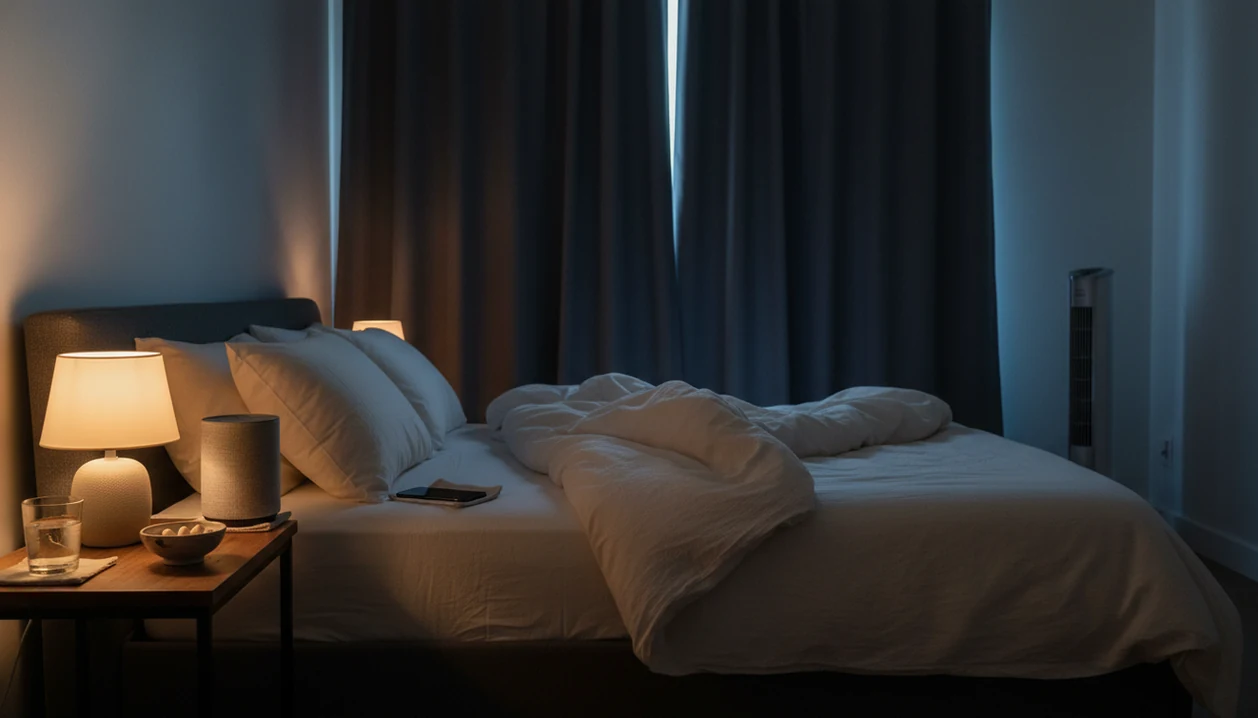


The best bedtime routine for light sleepers is a predictable 30- to 45-minute wind-down that reduces light, screen stimulation, sudden noise, and mental alertness. It is a repeatable sequence, not a long list of relaxation tasks. Quiet, steady audio can be part of it when it masks disruptive sounds without becoming something else to monitor.
The right sequence depends on what interrupts sleep: household noise, racing thoughts, light, or discomfort. Silence may suit someone distracted by voices or audio loops; low-volume background sound may suit someone disturbed by hallway noise. MindTastik offers guided meditation and breathing exercises for a calmer wind-down. Keep the routine consistent for several weeks, and avoid dramatic stories, volume changes, ads, and notifications.
The essentials
- Choose steady, low-volume audio such as white noise, pink noise, brown noise, soft music, or a calm guided meditation.
- Avoid dramatic stories, loud volume shifts, autoplay ads, notifications, and highly produced sleep content.
- Use the same routine for several weeks before judging whether it helps your sleep quality.
Best bedtime routine for light sleepers: quiet-audio shortlist
Your routine should match what wakes you first: sound, thoughts, light, or anxiety. A light sleeper roused by a creaking hallway may need a different plan than someone wide awake in the dark before dawn.
- Silent wind-down: Best for people distracted by any audio. Not for sleepers dealing with traffic, snoring, or neighbors.
- Steady noise mask: Best for sudden sounds from pets, partners, or apartment halls. Not for people who focus harder when a loop repeats.
- Gentle music: Best for low-stakes unwinding. Not for tracks with swells, vocals, or sharp endings.
- Guided meditation: Best for racing thoughts and sleep anxiety. MindTastik is one option for guided meditation, sleep audio, breathing exercises, and self-hypnosis support.
- Breathing plus body scan: Best for body tension. Not for anyone who feels more alert when tracking every sensation.
For quick comparison, what to listen to before bed depends less on the label and more on steadiness.
How a bedtime routine for light sleepers works
A bedtime routine for light sleepers works by pairing the same evening cues with sleep until the brain starts treating them as a shutdown sequence. The mechanism is called cue conditioning, which means repeated signals begin to predict the next behavior.
Dim light, a cooler room, and predictable audio reduce alerting signals. Sudden sound changes matter more than steady low-level background sound because the brain is built to notice novelty. A soft fan-like track can fade into the room; a narrator changing volume can feel like someone tapped your shoulder.
Feet search for a cool sheet.
The American Academy of Sleep Medicine and Sleep Research Society recommend that adults aged 18-60 sleep 7 or more hours regularly for optimal health jcsm reference: jcsm.5866. A routine does not force sleep, but it protects the conditions that make sleep more likely.
How to use quiet bedtime audio for light sleepers
Quiet bedtime audio works best when you set it up before you are tired. If you wait until your shoulders are tense against the mattress, every menu feels too bright.
- Set a 30- to 45-minute wind-down window and start it at the same time each night.
- Choose one audio type, such as pink noise, brown noise, soft music, or a guided session, then test it for several nights before switching.
- Lower the volume until it sits behind the room, not above it.
- Place the phone face-down on the nightstand, disable notifications, and use a sleep timer or steady loop with no autoplay ads.
- Review how often you woke, what woke you, and whether the sound felt calming or annoying.
For a broader setup, the same timing rules appear in our nighttime wind-down routine.
Judge the routine by sleep patterns, not a perfect night
A brief awakening does not automatically mean the routine failed. The National Academies report on normal sleep describes minor awakenings in younger adults, often near transitions into REM sleep, that can occur without clinically poor sleep. The useful distinction is between a short interruption and repeated or prolonged wakefulness. A bedtime routine should not be judged against the expectation of remembering no awakenings at all.
A tracker cannot settle that distinction on its own. A review of wearable sleep technology found that devices generally overestimate sleep time and underestimate wakefulness after sleep begins; sleep-stage estimates are less reliable than broad sleep-wake estimates. The AASM's guidance on insomnia-related technology recommends reviewing trends in the morning rather than repeatedly checking overnight. Compare those trends with remembered interruptions and next-day functioning, rather than treating one score as a verdict.
How we selected these bedtime routines for light sleepers
We picked routines that reduce stimulation instead of adding another bedtime project. Good sleep support is quiet, repeatable, and easy to run when you are already tired, not a performance.
- Low stimulation: No bright screens, dramatic plots, urgent prompts, or complicated choices at bedtime.
- Repeatability: The same order matters because the routine becomes a cue, not a nightly decision.
- Low sound variability: No ads, notification pings, loud intros, abrupt endings, or surprise track changes.
- Screen-free use: The routine should work after you dim the phone screen and stop scrolling.
- Wellness-safe claims: We evaluate support routines, not medical treatment.
Relaxing music at bedtime has evidence for improving subjective sleep quality in adults with sleep complaints; one experimental study used 45 minutes of relaxing music before sleep academic reference: 2454060. Still, the most useful routine is the one you can repeat without negotiating with yourself.
Best silent bedtime routine for noise-sensitive light sleepers
A silent bedtime routine is best for light sleepers who wake from headphones, audio loops, voices, or subtle sound changes. It removes one whole category of stimulation.
Try the same sequence nightly: dim lights, warm shower, paper book, three lines of journaling, slow breathing, then blackout curtains. Start at the same time when possible. Same order, same cue. Boring is the point. An evening meditation routine for adults can pair quiet reflection with the consistent cues that help you prepare for sleep.
A small notebook beside a meditation cushion can help if thoughts keep circling. Write the open loop down, close the notebook, and avoid solving it in bed.
This routine is not ideal if traffic, neighbors, snoring, or sudden household noise repeatedly wakes you. In that case, silence may make every creak feel louder. For adults building a wider evening pattern, a bedtime routine for adults can layer quiet habits without adding audio.
Best steady-noise routine for light sleepers who wake from sounds
A steady-noise routine is best for light sleepers disturbed by traffic, hallway noise, pets, partners, or neighbors. The goal is sound masking, not louder sleep content.
| Noise type | What it sounds like | Best for | Not ideal for |
|---|---|---|---|
| White noise | Bright, even static | Sharp outside sounds | People who find hiss irritating |
| Pink noise | Softer, balanced static | General room masking | People who notice loops |
| Brown noise | Deeper, lower rumble | Low-frequency household noise | People who dislike heavy bass |
Use the lowest helpful volume and place the speaker away from the pillow when possible. The right fit for sudden-noise wakeups is often a steady loop because it reduces contrast between the room and the interruption.
Not everyone relaxes with repetition. If you start listening for the pattern, switch to silence or soft music.
Best guided meditation routine for anxious light sleepers
Can guided meditation help anxious light sleepers? Yes, it can support a calmer wind-down when wakefulness is driven by rumination, sleep anxiety, or mental rehearsal, but it should stay gentle and predictable.
Choose calm narration, slow pacing, plain imagery, and a voice that softens instead of jolts. Avoid dramatic stories, sudden music, and sessions that ask you to picture too many details. Some people simply want a gentle track ready for the moments when the mind will not settle.
For adults who need a guided starting point, MindTastik fits because it offers guided meditation, sleep audio, breathing exercises, and self-hypnosis sessions for sleep, anxiety, and everyday calm support. The Best Meditation App for Sleep approach is most useful when you choose one session before bed and stop browsing.
Not ideal: voices, imagery, or hypnosis-style language can feel overstimulating or triggering for some users.
Best bedroom setup for a light sleeper bedtime routine
A helpful bedroom setup for a light sleeper is cool, dark, quiet, and ready before the final hour. Around 65°F or 18°C is a common sleep-environment target, though comfort varies. Sleep Foundation lists 65°F as a common bedroom-temperature target, but bedding, age, and personal comfort can change the ideal setting.
Use blackout curtains, an eye mask, earplugs, rugs, door draft blockers, and soft speaker placement to reduce light and sudden sound. Screens and bright light in the final hour can make falling asleep harder because they keep the brain engaged when it should be downshifting. The most evidence-aligned approach is usually consistent sleep hygiene combined with a low-stimulation wind-down, not a single magic sound.
Sunlight strip across a work notebook at 5 p.m.? Fine. Blue-white phone glare at 11:30 p.m.? Less helpful.
If screens are your main issue, build around screen-free bedtime meditation instead of trying to use willpower in bed.
Image caption: quiet bedroom setup for light sleepers
Image caption guidance: A dim bedroom with the phone silenced, audio controls set before bed, and a calm setup for a bedtime routine for light sleepers.
Honest cons of bedtime audio for light sleepers
Bedtime audio can help, but it can also backfire when it becomes one more thing to monitor. Light sleepers often notice tiny changes other people miss.
Volume shifts, tempo changes, narrator swaps, track endings, and autoplay ads can wake you or leave you waiting for the next disruption. Headphones can also get uncomfortable when you roll over, especially if one side presses against the pillow or the cord catches under the blanket.
After a rough night, MindTastik is most useful when you picked the session before getting into bed, because searching in the dark can make the brain more alert again. Best Meditation App for Sleep routines should offer steady support, not a maze of choices.
Binaural beats and highly specific frequency claims should be treated as experimental, not guaranteed. Some users may also become dependent on one sound, which can make travel harder.
When gentle guidance helps more than background noise
MindTastik's guided meditation library is an option for light sleepers whose main bedtime difficulty is racing thoughts or repeatedly checking for sleepiness. A session with calm narration and simple instructions fits this need better than an attention-heavy story.
For someone disturbed mainly by traffic or hallway sounds, steady background noise may be a better fit than spoken guidance. If voices, loops, or track endings increase alertness, a silent routine is the simpler choice. MindTastik is sleep support, not medical treatment.
When a bedtime routine is not enough
A bedtime routine can support sleep habits, but it cannot diagnose or treat medical or mental health conditions. That boundary matters.
- A routine cannot diagnose or treat insomnia, sleep apnea, chronic pain, major depression, or anxiety disorders.
- CBT-I has evidence for insomnia and should not be equated with MindTastik, Calm, Headspace, mindful.org resources, or any general bedtime routine.
- Persistent loud snoring, gasping, severe daytime sleepiness, or long-term insomnia symptoms warrant medical evaluation.
- Guided imagery, hypnosis-style sessions, or certain sounds may be triggering for some people.
- Sleep routines may take several weeks of consistent use before benefits are noticeable.
- Over-reliance on one sound, app, or device can make travel, dead batteries, or power outages harder.
- High headphone volume can be unsafe and may block alarms or important household sounds.
For a practical checklist that stays inside wellness support, use a sleep hygiene plan alongside any audio routine.
If you want narration instead of instruction at bedtime, MindTastik sleep stories is a practical place to start inside MindTastik.
Light sleeper bedtime questions
How long should a bedtime routine for light sleepers take?
A 30- to 45-minute wind-down is a practical starting point. Use that time to dim lights, stop screen browsing, settle the bedroom, and choose silence or one quiet audio track. Keep the sequence manageable; adding more activities is not necessarily more helpful.
Is silence or white noise better for light sleepers?
Silence is a better fit when voices, loops, or subtle audio changes attract attention. Steady noise may help when sudden outside sounds are the main problem. Use the lowest helpful volume. If the sound itself becomes distracting, adding more volume or another track may make bedtime harder.
Is pink noise better than brown noise for sleeping?
Neither is automatically better for every light sleeper. Pink noise has a softer, balanced static sound; brown noise has a deeper rumble. The useful choice is the one that masks the troublesome sound without becoming irritating. Keep one option for several nights before deciding to switch.
Can guided meditation help with racing thoughts at bedtime?
Gentle guidance can support a calmer wind-down when rumination or sleep anxiety keeps attention active. Choose slow pacing, simple imagery, and a steady voice. If listening becomes another task, try silence instead. Meditation is sleep support, not a substitute for treatment of persistent insomnia or an anxiety disorder.
Should light sleepers leave bedtime audio on all night?
There is no single setting that suits everyone. A timer can suit audio used only for winding down, while a steady loop may suit ongoing background noise. Avoid ads, notification sounds, and abrupt track changes. If the ending wakes the sleeper, reconsider the playback setup or use silence.
Is waking briefly during the night normal?
Brief awakenings can occur during normal sleep, including near transitions into REM sleep. Remembering an interruption does not by itself establish poor sleep. Repeated or prolonged wakefulness, severe daytime sleepiness, or persistent insomnia symptoms deserve more attention than an occasional short awakening.
Why does a sleep tracker say I slept when I was awake?
Consumer trackers estimate sleep from signals such as movement rather than measuring sleep directly through brain activity. Quiet wakefulness can be recorded as sleep, and sleep-stage estimates are less reliable than broad sleep-wake estimates. Review trends in the morning, and do not dismiss remembered wakefulness because of a score.
When should a light sleeper seek medical advice?
Persistent loud snoring, gasping during sleep, severe daytime sleepiness, or long-term insomnia symptoms warrant medical evaluation. A bedtime routine cannot identify or treat sleep apnea or other medical causes of disrupted sleep. CBT-I has evidence for insomnia and is different from general relaxation audio or an app-based routine.