
Moldavite for Enlightenment: Why Seekers Use It and How to Stay Grounded
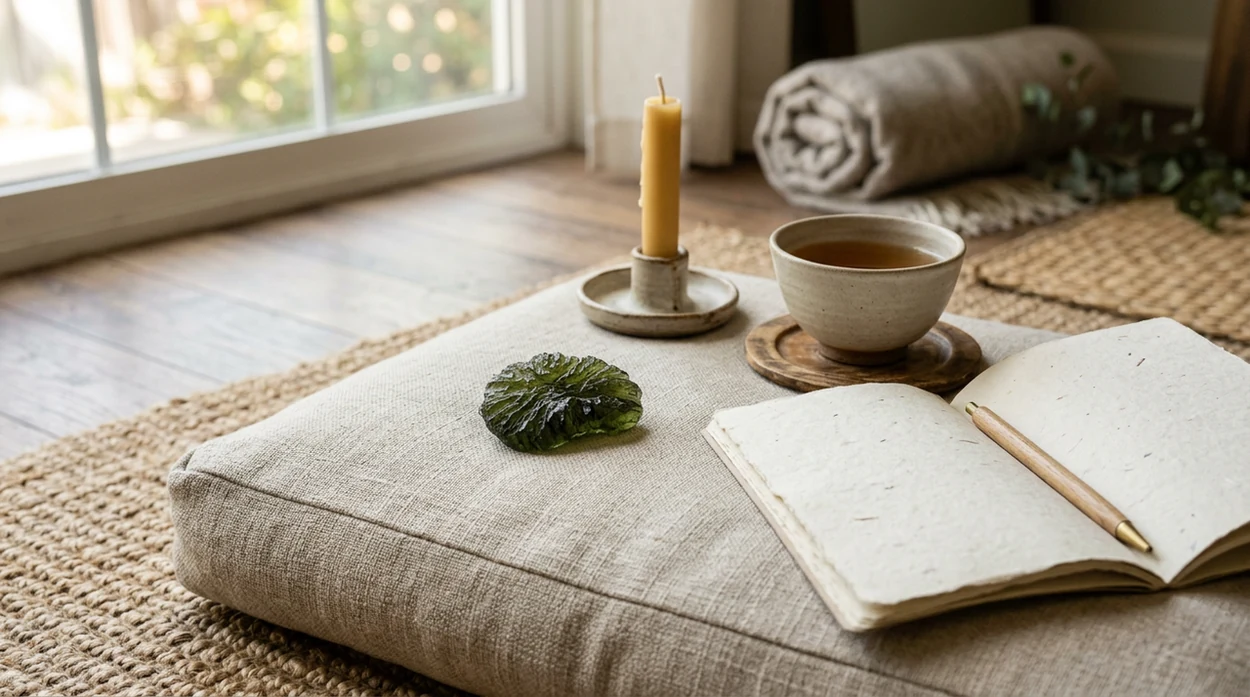


Moldavite for enlightenment is an optional symbolic practice, not a requirement for spiritual growth or a proven treatment for anxiety, trauma, or sleep problems. Moldavite is a rare green tektite, a natural glass formed by a meteorite impact in Central Europe about 14.8 to 15 million years ago. Many spiritual practitioners associate it with transformation, intuition, and emotional change.
Its value in meditation can be practical: a physical object that marks the start of quiet reflection. Claims about special healing energy remain unproven. A grounded approach keeps the stone secondary to breathing, guided meditation, journaling, and regular sleep habits. Strong sensations do not establish spiritual progress, and a crystal ritual should never replace professional care when symptoms need attention.
The grounded answer
- Moldavite is valued in spiritual circles for transformation, heart opening, intuition, and meditation focus, but its effects are anecdotal and not clinically proven.
- A safer approach is to pair moldavite rituals with evidence-informed practices such as mindfulness, breathwork, journaling, sleep routines, and MindTastik guided sessions.
- Avoid miracle claims: moldavite is often faked, can feel emotionally intense for some users, and should never replace therapy, medical care, or crisis support.
Moldavite enlightenment guide at a glance
Moldavite is a rare green tektite linked with transformation, awakening, heart opening, and intuition in many spiritual communities. Its benefits are experiential and metaphysical, not scientifically verified, so it is better treated as an optional ritual anchor than a required path to enlightenment.
A grounded moldavite practice looks simple. You sit down, hold the stone if it feels comfortable, choose one intention, and follow your breath. Maybe the phone screen gets dimmed before bedtime audio starts. Small cues matter.
Tools like MindTastik can make that ritual steadier by adding guided meditation, breathing exercises, sleep audio, self-hypnosis sessions, and beginner-friendly everyday calm support.
Five moldavite facts every enlightenment seeker should know
- Moldavite is impact glass: Moldavite is a rare green tektite formed by a meteorite impact about 14.8-15 million years ago, mainly associated with the Czech Republic.
- Its reputation is spiritual: Crystal and metaphysical communities commonly call moldavite a stone of transformation, awakening, and rapid personal change.
- Its symbolism is chakra-linked: Practitioners often connect moldavite with the heart chakra, higher chakras, intuition, vivid dreams, and major life shifts. If heart-centered practice is your focus, our guide to the heart chakra everything you need to know explains that language more plainly.
- Its sensations are subjective: Heat, tingling, emotional release, pressure, and strong dreams are personal reports, not clinical evidence.
- Its market has risk: Because moldavite is rare, expensive, and frequently faked, beginners should check authenticity and pace emotional use carefully.
The stone can feel dramatic in the hand. Still, meaning is not the same as proof.
How moldavite works as a meditation anchor
Moldavite works as a meditation anchor when it gives your attention a physical place to return. The likely mechanisms are sensory focus, meaning-making, expectation, memory cues, and repeated practice, not proven crystal healing energy.
In plain language, the stone becomes a cue. You pick it up, your body remembers the practice, and your attention has something steady to meet. That can support intention setting, breathwork, journaling, or a guided session. It is similar to keeping a small notebook beside a meditation cushion; the object reminds you what you came to do.
This does not prove moldavite has unique healing effects. Evidence for specific crystal healing outcomes is limited, and claims should stay spiritual or symbolic. For beginners, structured audio can help. A structured audio library with guided meditation, breathing exercises, sleep audio, or self-hypnosis can keep a crystal ritual from drifting into rumination.
For many beginners, a guided breath practice is often easier than silent crystal meditation because the voice gives the mind a clear next step.
A focus cue is not proof of better concentration
Holding a stone gives a meditation session a concrete point of attention, but that is different from demonstrating improved concentration. A 2014 systematic review of meditation programs found low or insufficient evidence for improvements in attention, despite moderate evidence for some anxiety and depression outcomes. Those findings concern meditation programs, not moldavite, and do not establish a crystal-specific benefit.
A useful reflection question is therefore narrower than “Did this stone improve my mind?” Try asking, “Did holding it help me return to this particular practice?” On another occasion, sit without the stone and note the difference. This is a personal comparison, not a scientific test. Keep expectations modest: a meaningful ritual can remain meaningful without proving a special effect on attention. The AI Self Reflection Tool Guide offers another way to explore what your meditation ritual means to you.
Why people feel drawn to moldavite for spiritual transformation
“Why am I being drawn to moldavite?” You may be drawn to moldavite because it represents change, emotional clearing, symbolic rebirth, intuition, or the feeling that something in your life can no longer stay the same.
People often reach for charged objects during transition. A breakup, burnout, grief, or a stalled creative life can make a rare meteor-impact stone feel like a sign. That attraction can be psychologically meaningful without proving that the pull is supernatural. For gentle perspective during change, Talk With Your Younger Self offers a conversational way to revisit earlier experiences.
The wider context matters too: the U.S. Department of Veterans Affairs reports that about 70-80% of adults experience at least one traumatic event in their lifetime (ptsd reference: common adults.asp), and the CDC’s 2022 National Health Interview Survey found that 32.3% of U.S. adults reported anxiety or depression symptoms (CDC guidance: db477.htm). Many people want meaning-making tools when ordinary coping feels thin.
At midnight, tomorrow’s meeting can loop like a stuck track. A stone will not solve that, but it may mark the choice to pause.
How to use moldavite with MindTastik meditation
Use moldavite with meditation by keeping the ritual short, specific, and easy to stop. The goal is grounded awareness, not forcing a breakthrough.
- Set one grounded intention: Choose patience, release, courage, sleep readiness, compassion, or emotional honesty.
- Place or hold the moldavite safely: Keep it in your palm, beside you, or on a cloth; avoid wearing it all day at first.
- Start a short guided session: Pick a guided meditation, breathing exercise, beginner calm session, or bedtime wind-down.
- Notice sensations without obeying them: Heat, tingling, sadness, or images are experiences, not commands or prophecies.
- Journal one practical action: Write down one next step, such as resting, apologizing, decluttering, or setting a boundary. An AI Reflection Journal for Calm offers another format for recording observations and choosing one manageable next step.
- Reset if overwhelmed: Remove the stone, breathe slowly, drink water, or choose a sleep or anxiety support session.
Try this before bed only if it feels soothing. Some people prefer daytime practice, especially if vivid dreams make the night feel too charged. If writing helps you settle, try an AI Emotional Journal for Sleep to note feelings before your bedtime routine.
Moldavite benefits, expectations, and evidence boundaries
Moldavite’s claimed benefits include transformation, emotional release, intuition, heart opening, dream intensity, synchronicity, and deeper meditation. These are anecdotal and metaphysical claims, not proven clinical outcomes.
| Claim or practice | What people report | Evidence boundary |
|---|---|---|
| Moldavite transformation | Sudden clarity, endings, new choices | Spiritual report, not clinical proof |
| Heart opening | Compassion, grief release, warmth | Symbolic chakra language |
| Dream intensity | Vivid dreams or sleep disruption | Subjective and variable |
| Mindfulness meditation | Better stress awareness and emotional regulation | A large 2014 meta-analysis found moderate improvements in anxiety and depression symptoms |
| Breathwork routine | Short reset during stress | Evidence-informed support, not emergency care |
Clinicians typically recommend evidence-based mental health care for persistent anxiety, depression, trauma symptoms, or sleep impairment; meditation can be supportive, but it is not a substitute for care. If you want a broader crystal practice, how to meditate with crystals 10 best meditation crystals gives a calmer starting point.
The most common medically supported way to address ongoing anxiety or depression symptoms is professional care combined with steady daily coping practices.
Moldavite dangers, overwhelm, and grounding rules
Moldavite is not shown to cause death or control events, but the experience can feel destabilizing when expectations are intense. Emotional vulnerability, sleep disruption, anxiety spirals, and suggestion can all amplify what someone feels.
Start with 5-10 minutes. Avoid using moldavite before bed if it increases agitation, vivid dreams, or the feeling that every thought is a message. Feet searching for a cool sheet at 3 a.m. is not a spiritual emergency, but it is a sign to simplify the routine.
Use extra caution if you have acute panic, mania, psychosis vulnerability, severe insomnia, trauma activation, or suicidal thoughts. Stop the ritual and seek professional help if distress persists, intrusive memories increase, panic attacks escalate, unsafe impulses appear, or you cannot sleep or function.
Ground first. Interpret later.
Authentic moldavite buying checks for beginners
Authentic moldavite is rare, often expensive, and commonly counterfeited with green glass. A beginner purchase should be slow, small, and boringly practical.
- Reputable dealer: Buy from a seller who gives clear origin details and has a return policy.
- Natural texture: Look for irregular surface patterns, not glossy, too-perfect neon glass.
- Internal features: Real pieces may show natural inclusions or flow features, though photos can be misleading.
- Price comparison: If a large “moldavite” pendant is strangely cheap, pause.
- Small first piece: Start with a modest stone rather than an expensive necklace.
A crystal purchase is optional. Enlightenment, mindfulness, and emotional growth do not require moldavite, a matching pendant, or a dramatic unboxing. People comparing zodiac stones can browse guides like crystals for gemini top 10 you should use, but the practice still matters more than the object.
What moldavite cannot establish or treat
Moldavite can be meaningful, but its limits are important.
- No robust scientific evidence proves moldavite has specific healing, enlightenment, anxiety, sleep, trauma, or depression effects beyond belief, ritual, expectation, or placebo-related mechanisms.
- Moldavite should not replace therapy, medical care, psychiatric care, prescribed medication, or crisis support.
- Intense experiences may come from suggestion, emotional readiness, sleep changes, life stress, or the stories you have heard about the stone.
- People with acute anxiety, panic, psychosis vulnerability, mania, severe insomnia, or trauma activation should use extra caution and seek professional guidance when needed.
- Real moldavite can be expensive and frequently faked, so impulsive purchases can create financial stress.
- Not everyone needs moldavite. Meditation, sleep hygiene, social support, therapy, movement, and breathing practices can support growth without crystals.
- Apps such as MindTastik, Calm, Headspace, and Mindful can support routine-building, but none should be treated as crisis care.
If chakra language helps you reflect, positive affirmations the importance of balance in the chakras may be useful. Keep the claims modest.
Moldavite and meditation questions
Do I need moldavite to reach enlightenment?
No. Moldavite is an optional ritual object, and there is no scientific evidence that it produces enlightenment. Spiritual practitioners may use it to symbolize change or mark a meditation session. Reflection, breathing, and meditation can all be practiced without buying or holding a stone.
Why does moldavite feel so powerful?
People report warmth, tingling, emotion, or a strong sense of significance when holding moldavite. Expectation, suggestion, personal meaning, and current stress can influence those experiences. A strong sensation does not demonstrate special crystal energy, predict future events, or mean that a major life change is necessary.
Why am I drawn to moldavite?
Moldavite often represents transformation in spiritual communities, so it may appeal during grief, burnout, a breakup, or another transition. That attraction can be personally meaningful without being supernatural. A useful reflection is to name the change the stone represents and identify one practical action connected with it.
How should a beginner meditate with moldavite?
Start with five to ten minutes. Hold the stone comfortably or place it nearby, choose one simple intention, and follow ordinary breathing or a short guided session. Treat sensations as experiences rather than instructions. Stop if the practice increases agitation, and finish by noting one practical next step.
Can moldavite cause anxiety or disrupt sleep?
There is no established evidence that moldavite itself causes anxiety or insomnia. However, intense expectations and emotionally charged rituals can amplify distress, and some users report agitation or vivid dreams. Pause the ritual if sleep or anxiety worsens. Persistent or severe symptoms deserve professional assessment, not a stronger crystal practice.
What intentions are suitable for moldavite meditation?
Choose a specific intention such as patience, compassion, emotional honesty, or readiness for rest. Avoid treating the session as a demand for a dramatic breakthrough. Afterward, connect the intention to something concrete, such as writing down a concern or making time for a difficult conversation.
How can I tell if moldavite is genuine?
Look for a seller who provides clear origin information and a return policy. Genuine pieces may have irregular surface textures, inclusions, or flow features, but photographs can mislead. Very cheap, large pieces and unusually perfect green glass deserve caution. Appearance alone cannot guarantee authenticity, and buying moldavite is optional.