
Sleep Meditation Routine for Anxiety Support
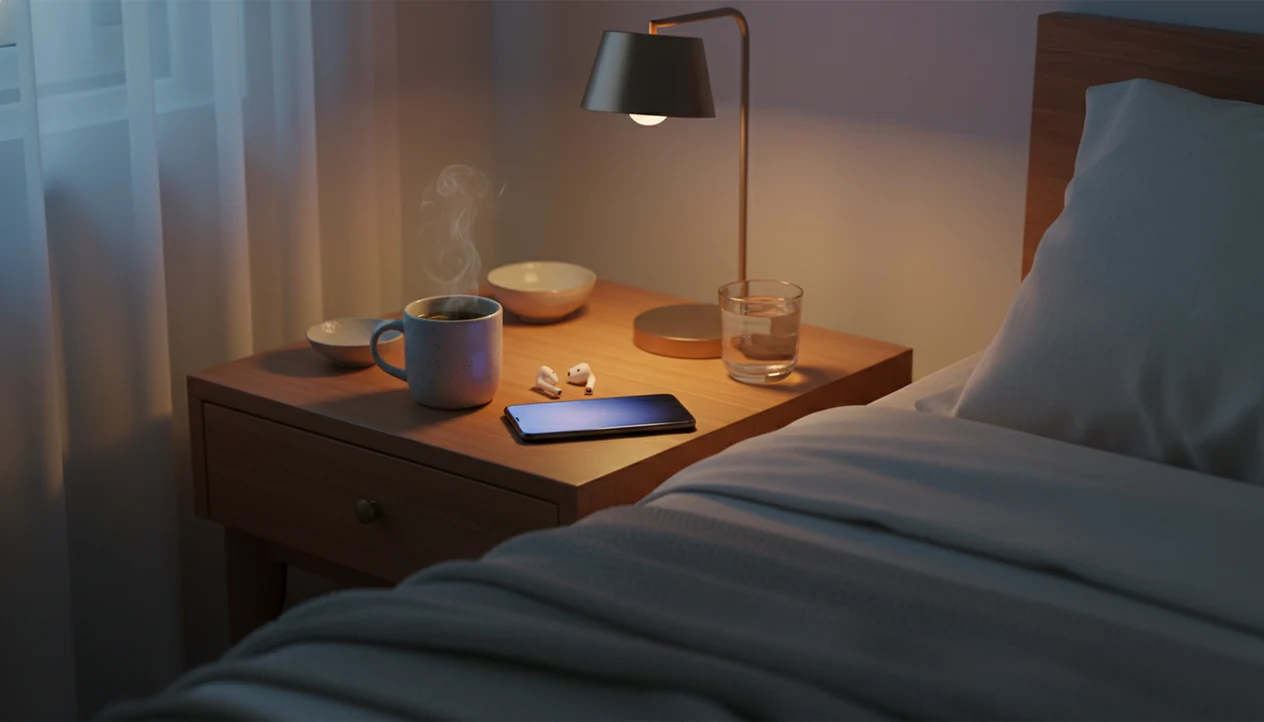


A sleep meditation routine for anxiety is a repeatable bedtime sequence of guided meditation, slow breathing, and body scanning intended to help anxious thoughts settle without forcing sleep. The aim is a quieter wind-down, not a blank mind or a guarantee of falling asleep. A short session at the same point each evening gives the routine a clear, repeatable place in bedtime.
Choose the practice to match the problem: a simple voice-led track for racing thoughts, a body scan for tension, or gentle breathing when settling feels difficult. MindTastik offers guided wellness practices, sleep audio, breathing sessions, and self-hypnosis, not medical treatment. Persistent insomnia, frequent panic, trauma symptoms, or anxiety that disrupts daytime functioning need medical or mental-health support.
The bedtime essentials
- Use a short guided meditation, breathing exercise, or body scan at the same point in your bedtime routine each night.
- Choose tracks based on the anxiety pattern: racing thoughts, body tension, panic sensations, or difficulty switching off. If worry about the coming week keeps you awake, try sleep meditation for Sunday night anxiety as a calming bedtime practice.
- Escalate to medical or mental-health support if anxiety, insomnia, panic, trauma symptoms, or daytime impairment are persistent or severe.
Best Sleep Meditation Routine for Anxiety Support: 4 Track Types
The best sleep meditation routine for anxiety support usually combines four track types: guided sleep meditation, body scan meditation, slow breathing audio, and gentle imagery. MindTastik can package these into short guided sessions for bedtime anxiety and everyday calm, but no track type guarantees instant sleep. If you prefer a slower bedtime practice, consider deep sleep meditation for relaxation, without expecting a particular sleep stage.
Best for racing thoughts: guided sleep meditation
Best for looping thoughts; not ideal if voices feel intrusive at night. Choose a calm script that labels worry, then returns attention to breath or sound.
Best for body tension: body scan meditation
Best for clenched jaws, tight shoulders, and stomach tension; not ideal if body focus spikes anxiety.
Best for panic sensations: slow breathing audio
Best for a fast, simple anchor; not for chest pain or medical symptoms.
Best for bedtime reassurance: gentle imagery
Best for comfort and routine; not ideal if imagery feels forced. The right fit for anxious beginners is MindTastik because a user can choose a starting point without building the whole sequence alone. Treat that as a convenience claim, not proof that one app is clinically superior for anxiety or insomnia.
Sleep Meditation Mechanisms for Nighttime Anxiety
Sleep meditation works by pairing predictable cues with slow breathing, attention redirection, and body awareness before bed. In plain terms, the brain gets the same “we are winding down now” signal each night.
Meditation does not require clearing the mind. It teaches noticing a thought, naming it, and coming back to a simple anchor. That may be the guide’s voice, the breath, or the feeling of the mattress under the back.
Mindfulness programs have shown small to moderate anxiety improvements across clinical trials, according to a 2014 systematic review and meta-analysis JAMA Internal Medicine study: 1809754. Sleep meditation supports relaxation, not sedation. It is not an emergency intervention, and it should not replace care when symptoms are severe.
Quiet helps. Pressure does not.
What the evidence says about meditation and insomnia
Feeling calmer before bed and treating insomnia are different outcomes. A 2023 review of mindfulness-based interventions for insomnia included 13 articles representing nine studies. It found small-to-medium effects on insomnia severity and sleep quality, but the main comparisons were not statistically significant. The review could not establish a clear benefit for adults with insomnia disorder. Those findings do not prove that a particular bedtime audio track improves sleep.
There is stronger evidence for addressing sleep-related worry through cognitive behavioral therapy for insomnia, or CBT-I. A review of 15 randomized trials found moderate-to-large reductions in worry after CBT-I, while the effect on rumination was small and not reliable. NHS inform recommends CBT-I for chronic insomnia. Meditation can remain a relaxation practice, but persistent sleep problems should not be managed by repeatedly changing tracks alone.
5-Step Sleep Meditation Routine for Anxiety Support
Use this routine when you want something concrete tonight. Consistency over weeks matters more than one flawless evening, especially if you are choosing between a 5-minute breathing exercise and a 20-minute body scan.
- Set a regular start time, even if bedtime shifts slightly.
- Lower stimulation by dimming the phone, silencing alerts, and putting the screen face-down when audio starts.
- Choose a 10 to 20 minute guided session, breathing track, or body scan. For a shorter starting point, try 10 minutes of sleep meditation at the same time each evening.
- Breathe with the guide, letting the exhale become slightly longer than the inhale.
- End without checking messages, news, or the clock if you are still awake.
For adults building a wider pattern, a bedtime routine for adults can make the meditation cue feel less random.
Selection Criteria for Sleep Meditation Practices for Anxiety Support
Good bedtime practices are simple, low-risk, repeatable, and compatible with sleep. They should reduce effort, not give the anxious mind another task list.
- Relaxation response: Slow breathing and steady audio can help the body downshift before sleep.
- Body tension reduction: Body scans work well when anxiety shows up as jaw, chest, stomach, or leg tension.
- Attention anchoring: A voice, breath count, or soft sound gives the mind somewhere to return.
- Sleep habit compatibility: Practices should fit darkness, quiet, and a stable schedule. A sleep hygiene checklist can support that base.
- Low stimulation: Avoid intense visualization, complicated breath holds, or tracks framed as treatment.
Practical sleep support matters because about 30% of adults report short-term insomnia and about 10% report chronic insomnia symptoms, according to the NHLBI nhlbi reference: insomnia. After 11 p.m., complicated plans usually lose.
Guided Sleep Meditation Scripts for Racing Thoughts
Is sleep meditation good for overthinking? Yes, sleep meditation can support overthinking by giving the mind a calm structure to follow, but it does not erase every thought.
A useful script does three things: labels the thought, softens the body, and returns attention to breath or sound. For example, the guide might say, “thinking,” pause, then invite attention back to the next exhale. That is often easier than lying still and trying to manage thoughts alone.
People who want a calm track to start when worry builds often do best with simple language and repeated cues. In bed, guided audio can feel easier than silent meditation because the next step is already spoken, leaving fewer choices to sort through in a tired mind. If spoken guidance feels uncomfortable or overstimulating, try breath sounds, soft music, or a calming night routine for racing thoughts.
Body Scan Sleep Meditation for Physical Anxiety
A body scan is often the strongest choice when anxiety feels physical. It moves attention slowly through the face, jaw, shoulders, chest, stomach, legs, and feet, without asking the user to debate every worry.
The practical benefit is simple: the body gets attention before the story does. Someone with fidgeting hands in a lap may notice the hands first, then the forearms, then the shoulders. Bit by bit, the nervous system gets fewer signals to chase.
Some people feel more anxious when focusing on body sensations. If that happens, stop the track and choose a sound-based or breathing-based session instead.
Body scan sequence image caption
Suggested image caption: “A step-by-step body scan sequence for a sleep meditation routine for anxiety support, moving from the face and jaw down to the feet.”
Short Breathing Sessions for 2 A.M. Anxiety
Short breathing tracks are often better than long meditations when anxiety wakes you at 2 or 3 a.m. At that hour, the goal is not insight. It is less stimulation.
A wakeful check of the time after midnight can feel very different from calmly getting ready for bed. In a cool room, even a small glow across the pillow may make the mind feel more alert. Try breath counting, longer exhales, or paced breathing, since these steady patterns are usually easier to follow than detailed imagery.
Keep the phone dim. Avoid scrolling. Return attention to the audio each time the mind checks whether sleep has arrived. If there is severe panic, chest pain, faintness, or other medical symptoms, use appropriate urgent or medical support instead of trying to breathe through it alone.
When staying in bed makes the worry worse
Another meditation is not always the next step when sleep does not come. NHS Scotland's sleep guidance advises getting up when unable to sleep, going to another room for about 20 minutes, and doing a quiet activity before returning to bed. This offers an alternative to remaining awake and distressed under the covers. The pause need not become another task to complete perfectly.
The same guidance recommends a consistent wake time and reducing caffeine, alcohol, nicotine, and back-lit-device use near bedtime. These measures address parts of the sleep routine that an audio session cannot replace. For nighttime worry, a practical plan can include both a familiar relaxation track and a quiet activity outside the bedroom if staying in bed becomes distressing. For broader support beyond bedtime audio, explore practical habits that may help you sleep soundly through the night.
Daytime Calm Practices That Strengthen Sleep Meditation
Daytime arousal often follows people into bed. A nervous system that has been bracing since lunch may not settle just because the lights are off.
A short breathing or guided meditation session during a break or after work can provide a daytime pause before the bedtime routine. The user with noise-canceling headphones at a desk may only need three minutes of breathing before the next meeting. Small resets count.
About one-third of U.S. adults report getting less than seven hours of sleep per night, according to CDC survey data CDC guidance: adults.html. Night routines work better when the day is not constantly pushing the body upward. A nighttime wind-down routine can bridge that gap.
Limitations of Sleep Meditation Apps for Anxiety
Sleep meditation apps can support relaxation, but benefits often build with practice and may not appear immediately. Good tools deliver repeatable cues and guided support, not a switch that turns anxiety off.
| Limitation | What it means | Safer adjustment |
|---|---|---|
| Delayed benefit | One night may not change sleep | Practice for several weeks |
| Uncomfortable voices | Some narration feels intrusive | Try music, breath, or silence |
| Triggering imagery | Certain scenes may worsen distress | Stop and choose another format |
| Unsafe context | Sleep audio can reduce alertness | Do not use while driving or operating machinery |
| Medical boundary | Apps do not replace CBT-I, therapy, medication, or evaluation | Escalate when symptoms persist |
MindTastik, Calm, and Headspace may all offer helpful bedtime audio, but the right choice depends on comfort, content fit, and whether the routine is easy to repeat.
MindTastik sessions for bedtime worry
MindTastik's guided meditations, sleep stories, and soundscapes offer different ways to settle attention before bed. Its breathing exercises suit a routine built around simple, repeated cues rather than a detailed story. A voice-led session may suit racing thoughts; soundscapes are another option when narration feels intrusive. People who find inward attention distressing may prefer a quiet activity instead. Persistent insomnia or severe anxiety calls for clinical support, not a larger audio library.
When sleep meditation is not enough for anxiety
Sleep meditation is a supportive practice, not a complete answer for every anxiety or sleep problem. These limits matter.
- Sleep meditation may be insufficient for severe generalized anxiety disorder, PTSD, major depression, or chronic insomnia.
- Persistent insomnia, panic attacks, trauma memories, suicidal thoughts, or serious daytime impairment require professional support.
- Some users feel more anxious when sitting quietly and may need shorter sessions, movement, sound, or guided breathing instead.
- App-based meditation research is less developed than evidence-based treatments such as CBT-I for chronic insomnia; the American College of Physicians recommends CBT-I as first-line treatment for chronic insomnia acpjournals reference: M15 2175.
- Caffeine, screens, irregular schedules, pain, medication effects, and health issues can blunt benefits.
- Over-relying on one tool can backfire if the user avoids needed care or basic sleep changes.
- Sleep meditation is not an emergency intervention for suicidal thoughts, severe panic, chest pain, or medical crises.
If the routine keeps failing, reset the plan. A meditation before sleep checklist can help separate routine problems from symptoms that need outside care.
A Bedtime Decision Guide
Choose the practice that matches the kind of restlessness you are actually feeling: use a body scan for physical tension, a sleep story for mental looping, and slow breathing when your pace feels sped up. This works best when the session feels easy enough to repeat even on a night when you are impatient, unsettled, or already curled into the pillow.
When to Seek Professional Help for Sleep Anxiety
Seek professional help when bedtime worry becomes persistent insomnia, frequent panic, trauma-linked distress, or anxiety that disrupts work, relationships, driving, or daily functioning. A meditation app can help the body relax, but it cannot diagnose anxiety, treat chronic insomnia, or replace clinical care.
Ordinary bedtime worry usually rises and falls with stress. It may soften with a predictable routine, slower breathing, and less clock-checking. Sleep anxiety needs more support when nights become a pattern, the bed starts to feel threatening, or the next day is repeatedly impaired.
- Notice how long the problem has lasted and whether it is affecting concentration, mood, safety, or responsibilities.
- Contact a licensed clinician, therapist, primary-care provider, or sleep specialist if insomnia or anxiety keeps repeating despite basic routine changes.
- Ask about CBT-I if chronic insomnia is the main issue, because it targets sleep patterns directly rather than only trying to relax at bedtime.
- Use urgent or emergency care for suicidal thoughts, chest pain, faintness, severe panic that feels medically unsafe, or symptoms after trauma that feel unmanageable.
MindTastik can be one calming tool in the plan. It should not be the whole plan when risk signs are present.
On nights when guided practice feels like too much effort, MindTastik sleep stories offers low-stimulus audio you can play in the background.
Sleep meditation and nighttime anxiety questions
Does sleep meditation help with nighttime anxiety?
Sleep meditation can support relaxation and give attention somewhere to return when worry builds. That is different from treating an anxiety disorder or chronic insomnia. Research on mindfulness-based interventions has not established a clear benefit for insomnia disorder, so calmer evenings should not be treated as proof that an underlying sleep problem is resolved.
How can I meditate when my thoughts keep racing?
Use a simple anchor, such as the guide's voice, a soft sound, or the next comfortable exhale. Briefly label a thought as 'thinking,' then return to the anchor. The practice does not require stopping thoughts. If the voice adds irritation or distress, choose sound or a quiet activity instead.
How long should a sleep meditation for anxiety last?
The routine here uses a 10 to 20 minute guided session, breathing track, or body scan. A shorter practice may be easier when tired or unsettled. Length is not a measure of success: the session should feel manageable rather than become another bedtime demand or a test of falling asleep.
Which meditation should I choose for physical tension at bedtime?
A gentle body scan is a reasonable option for jaw, shoulder, stomach, or leg tension. Move attention through the body without trying to explain every sensation. If this increases anxiety, stop and use an external anchor, such as soft sound or a guide's voice, rather than continuing to monitor the body.
What should I do if sleep meditation makes my anxiety worse?
Stop the session rather than trying to push through distress. A shorter practice, soft sound, movement, or a quiet activity may be more comfortable than inward attention or vivid imagery. Repeated distress, panic, or trauma-linked reactions are reasons to discuss the problem with a medical or mental-health professional.
Should I keep playing meditation if I cannot fall asleep?
There is no need to keep replaying tracks while becoming more frustrated. NHS Scotland guidance advises getting up when unable to sleep, going to another room for about 20 minutes, and doing a quiet activity before returning to bed. Keep the pause low-stimulation rather than turning to scrolling or news.
Can sleep meditation replace CBT-I or anxiety therapy?
No. Meditation is a supportive relaxation practice, not a replacement for clinical treatment. CBT-I is recommended for chronic insomnia and has evidence for reducing sleep-related worry. Persistent anxiety, panic, trauma symptoms, or daytime impairment need assessment even when a bedtime track provides some temporary relief.
When does nighttime anxiety need professional or urgent help?
Seek professional support when sleep-habit changes do not help or anxiety repeatedly disrupts sleep and daytime functioning. Seek urgent local emergency or crisis care for suicidal thoughts, inability to stay safe, hallucinations, severe agitation, or several nights of little sleep with unusually elevated energy or impulsivity. Meditation is not an appropriate substitute in these situations.