
Sleep Meditation for Light Sleepers
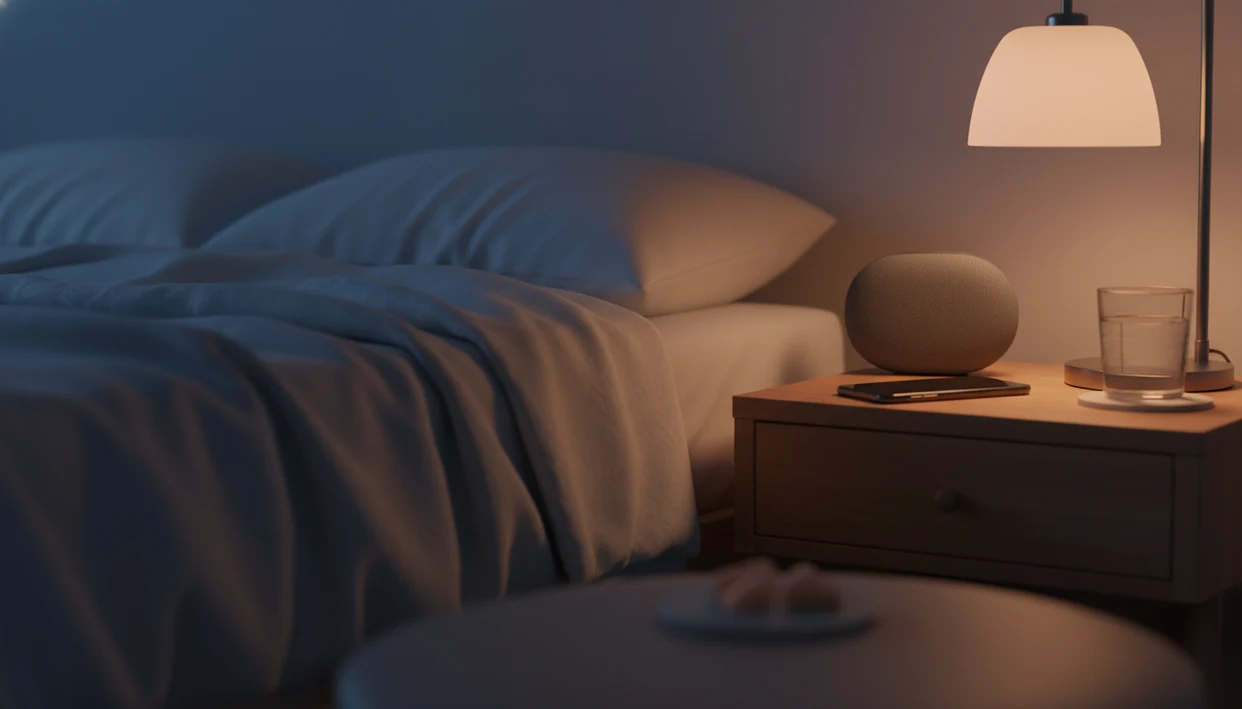


Sleep meditation for light sleepers is quiet bedtime audio with soft vocal delivery, stable volume, minimal sound changes, and simple relaxation cues for people who wake easily. The most useful options are gentle guidance, quiet music, or steady soundscapes that support winding down without startling the listener awake. Predictable audio matters more than promises of instant deep sleep.
A familiar, low-volume track can fit the first part of a repeatable bedtime routine without requiring much attention. Sudden voice shifts, music swells, ads, and dramatic effects make a track less suitable for sensitive sleepers. Some people prefer no voice at all. Meditation can support relaxation, but it is not a guaranteed insomnia cure or a substitute for professional care when sleep problems persist.
What matters most
- Light sleepers usually do best with soft sleep meditation that avoids sudden voice shifts, loud music swells, ads, and dramatic sound effects.
- The most useful sleep audio for light sleepers is low-volume, familiar, and timed to fit the first part of a repeatable bedtime routine.
- Meditation can support relaxation, but it is not a guaranteed insomnia cure or a substitute for professional care when sleep problems persist.
Best sleep meditation for light sleepers at a glance
The best sleep meditation for light sleepers is soft, low-volume, steady, and free from sudden changes. Look for soft-spoken guidance, quiet music, simple breathing cues, and predictable pacing that helps the body wind down without demanding too much attention.
That matters because sleep trouble is common. A 2023 CDC survey found that 46% of adults had trouble falling asleep at least sometimes in the past month, according to the CDC sleep data CDC guidance: index.html. That does not mean meditation treats insomnia. It means many people are looking for lower-stimulation tools at night.
The goal is not to force sleep. It is to make the first stretch of bedtime quieter, less reactive, and easier to repeat.
Blanket pulled to the chin. Volume barely there.
What quiet bedtime meditation means for light sleepers
Quiet bedtime meditation for light sleepers is guided or unguided sleep audio that keeps the voice, music, pacing, and volume gentle enough for people who wake easily. It is designed to reduce stimulation, not to impress the listener with dramatic sound design.
Light sleeper meditation differs from general guided sleep meditation in one practical way: it removes surprises. A regular sleep story might use emotional narration, rising music, or scene changes. A quiet bedtime meditation usually keeps the same vocal tone, adds longer pauses, and avoids sudden sound effects.
A good sleep-support app should deliver steady guidance, breathing support, and repeatable routines; it should not promise instant sedation or medical treatment.
MindTastik offers wellness-focused guided practices, sleep sounds, breathing sessions, and self-hypnosis audio for adults looking for support with rest, anxiety, and everyday calm. If you are shaping the whole evening around better rest, a bedtime routine for adults can show where audio fits most naturally.
Five sleep audio facts light sleepers should know
- Soft voice and low volume reduce startle risk. A quiet narrator is less likely to pull you back into alertness when you are half asleep.
- Steady rhythm and gentle pauses are easier to tolerate than abrupt effects. Light sleepers often notice loop clicks, chimes, and sudden background changes.
- Short-to-medium tracks can cover the first sleepy stage without demanding attention. For many people, 10 to 30 minutes is easier than a long story that keeps unfolding.
- Repetition helps audio become a bedtime cue. The same track, at the same time, can tell your brain, “nothing new is happening now.”
- Meditation is a relaxation aid, not a medical treatment claim. A CDC report found that 14.5% of adults had trouble staying asleep most days or every day in the past 30 days CDC guidance: db487.htm, but sleep audio should not be framed as a cure.
For light sleepers, familiar audio is often easier than novelty because the brain has fewer new details to scan.
How sleep meditation for light sleepers works
Sleep meditation for light sleepers works as a cueing and attention-shifting practice, not as a sleep switch. The audio gives the mind something simple to follow, such as breath counting, body awareness, or a repeated phrase, while the room stays low in stimulation.
Two helpful terms are attentional anchoring and conditioned cueing. In plain language, you give your attention a soft place to land, then repeat that same bedtime signal often enough that it starts to feel familiar. For someone who wakes at small noises, low sensory contrast matters. A steady voice against a quiet room is usually less disruptive than music that rises and falls.
The most useful sleep meditation for light sleepers is predictable audio paired with consistent bedtime timing because both reduce the need to make decisions when the body is already tired.
In the dark, one quick time check can feel sharper than expected.
Clinicians typically recommend discussing persistent insomnia, loud snoring, breathing pauses, or worsening sleep disruption with a qualified health professional, rather than relying only on self-guided audio.
For medical context, insomnia guidelines generally prioritize behavioral care and clinical evaluation over self-guided sleep aids when symptoms persist. That is why quiet audio should be treated as a wind-down tool, not a diagnosis or treatment plan.
Brief awakenings do not always mean poor sleep
Waking briefly does not automatically mean a night’s sleep has failed. The National Academies report on sleep physiology describes normal adult sleep as cycling between NREM and REM sleep about every 80 to 100 minutes. It also notes that younger adults can have brief awakenings, often near transitions into REM sleep, that are usually minor when sleep otherwise remains consolidated.
This distinction matters when judging bedtime meditation. A track does not need to prevent every moment of awareness to be useful as a relaxation aid. At the same time, normal brief awakenings should not be used to dismiss persistent disruption. Repeated waking that comes with daytime impairment or breathing concerns belongs in the professional-help discussion, not simply in a search for quieter audio.
Soft sleep meditation formats compared for light sleepers
Soft sleep meditation formats differ mainly in how much attention they ask from you. A voice can guide wandering thoughts, but it can also feel intrusive. Music can soften the room, but sudden loops may wake a light sleeper fast.
| Format | Best fit | Caution |
|---|---|---|
| Spoken guidance | People who like clear breathing cues or body scans | Avoid expressive narration, sudden whispers, or emotional sleep stories |
| Soft music | People who dislike instructions but want a gentle background | Watch for loud swells, sharp piano notes, or obvious loops |
| Nature soundscapes | People who relax with rain, wind, or steady water sounds | Some tracks include birds, thunder, or changing scenes |
| Breathing-only tracks | People who want minimal words and predictable timing | Counting cues may feel annoying if you are already tense |
| Self-hypnosis-style sleep audio | People who like repeated phrases and deep relaxation prompts | Dramatic binaural-style effects or layered voices may distract |
If you are unsure what to listen to before bed, start with the least dramatic option first. Quiet usually wins.
Tools like MindTastik, Calm, Headspace, and Mindful can all be useful, but the track design matters more than the logo.
How to use sleep audio for light sleepers at bedtime
Use sleep audio for light sleepers as a small routine, not a last-minute rescue attempt. Set it up before you are fully exhausted, then keep the choices boring on purpose.
- Set the volume before lying down. Keep it low enough that it sits behind the room, not on top of it.
- Choose a soft, familiar track. Pick one quiet bedtime meditation, breathing exercise, or soundscape you can repeat for several nights.
- Start 10 to 30 minutes before desired sleep. Give your body time to settle before you expect sleep to happen. An evening meditation routine for adults can help you practice calming cues before bedtime.
- Place the speaker or headphones at a comfortable distance. Earbuds on a nightstand, one side slightly tangled around a charging cable, may work better than sealed earbuds in both ears.
- Repeat the same routine for several nights before judging it. One restless night is not enough data.
If you wake during the night, restart a quiet track only if it feels soothing. If it makes you monitor the audio, leave it off and return to simple breathing. For a fuller sequence, use a meditation before sleep checklist.
Best-for and not-for guide to light sleeper meditation
Light sleeper meditation works best for people who want low-stimulation support, not a dramatic sleep performance. It is most useful when the listener already knows that loud sounds, vivid stories, or sudden changes keep them alert.
Best for
- Adults who wake from loud sounds. Low-volume, steady audio can feel less intrusive than standard sleep stories.
- People who dislike dramatic narration. A plain breathing cue may be easier than a plot-heavy bedtime track.
- Listeners who want anxiety-supportive wind-down audio. The aim is a supportive practice, without medical treatment claims.
- People building a repeatable routine. The same soft track can fit a nighttime wind-down routine.
Not ideal for
- People who find any voice distracting. Music, silence, or breath-only timing may be better.
- Anyone needing urgent help for severe sleep disruption. Professional guidance matters here.
- Anyone driving or doing unsafe tasks. Sleep audio belongs in a safe resting place.
Common sleep meditation mistakes light sleepers make
A common mistake is using louder audio to overpower wakefulness. For light sleepers, that can backfire. The brain may start listening harder, especially if the speaker is close to the pillow.
Another mistake is choosing intense music, sharp transitions, or emotional storytelling. A track that sounds beautiful at 8 p.m. may feel too active at midnight, when tomorrow’s meeting is looping and every pause feels charged.
Some people judge a track after one night. Try adjusting volume, timing, and format before giving up. Also check autoplay. One calm track followed by a bright ad or a louder playlist can undo the whole routine.
Reset the plan.
CDC sleep data reports that 35.2% of U.S. adults sleep less than 7 hours on average source. That context helps explain why many people try sleep tools, but meditation should not be treated as an instant sleep cure. Pair it with basic sleep hygiene, especially light, caffeine, and screen habits.
Do not judge a meditation by one sleep-tracker score
A wearable’s light-sleep or deep-sleep estimate cannot establish that a meditation worked. A review of wearable sleep technology found that devices generally overestimate total sleep time and underestimate wakefulness after sleep begins. Their agreement with laboratory measurements is typically better for distinguishing sleep from wakefulness than for separating light sleep, deep sleep, and REM sleep.
For a light sleeper, quiet wakefulness can therefore look like sleep on a device, while stage labels may be less dependable than they appear. The American Academy of Sleep Medicine’s technology guidance recommends looking at trends such as sleep duration, regularity, and nighttime awakenings, checking data in the morning rather than repeatedly overnight, and avoiding excessive attention to a single score. Track comfort and daytime functioning alongside those estimates.
When to seek professional help for sleep problems
Seek professional help when sleep problems persist, worsen, or come with breathing, mood, or daytime safety concerns. Sleep audio can support relaxation, but apps and tracks cannot diagnose insomnia, sleep apnea, panic, depression, or any other sleep disorder.
A steady routine is worth trying, but several weeks of insomnia despite consistent changes is a signal to stop troubleshooting alone. Loud snoring, gasping, pauses in breathing, or morning headaches also deserve medical attention, especially if another person notices them. The same is true if poor sleep is feeding worsening anxiety, depression, panic, irritability, work errors, drowsy driving, or trouble functioning during the day.
If you are unsure what to do next:
- Track your sleep pattern for one to two weeks. Note bedtime, wake time, awakenings, caffeine, alcohol, naps, and symptoms.
- Write down red flags. Include snoring, gasping, morning headaches, mood changes, panic, and daytime impairment.
- Contact a qualified clinician. Start with a primary care provider, therapist, or licensed sleep specialist.
- Use audio as support only. Keep quiet meditation as a wind-down tool while you get proper evaluation.
MindTastik options for a quieter bedtime
MindTastik’s guided meditations and breathing exercises offer options for listeners who prefer simple instructions over an unfolding story. Its sleep soundscapes are another format to consider when spoken guidance draws too much attention. The choice should depend on the individual track’s volume, pacing, and sound changes, not just its title.
People who find any background audio distracting may do better with silence. Those with persistent sleep problems need assessment rather than a larger audio library. MindTastik is a relaxation tool, not a medical treatment.
When quiet sleep audio still keeps a light sleeper awake
Sleep meditation can be helpful, but it has real limits. Light sleepers should choose carefully and treat audio as one support inside a wider routine.
- Sleep meditation does not reliably cure insomnia, and it should not be presented as a medical treatment.
- Some light sleepers find even soft narration distracting, especially when the room is otherwise silent.
- Low-quality tracks with ads, abrupt volume changes, or expressive narration can worsen wakefulness.
- Benefits are subjective. A track that feels calming to one person may feel irritating to another.
- Persistent, severe, or worsening sleep problems should be discussed with a qualified professional.
- Sleep audio should not be used while driving, working with equipment, or doing anything that requires alertness.
- Per the CDC, adults who regularly sleep less than 7 hours are more likely to report poorer health, but that association does not prove short sleep directly causes poor health.
- Meditation works better when it fits the person. If the audio becomes another thing to manage, try silence or a screen-free bedtime meditation.
Body scans, quiet stories, and breathing for different bedtime needs
| Technique | Best for | Minutes |
|---|---|---|
| Low-volume body scan | Releasing jaw, shoulder, or pillow tension without much mental effort | 8-12 min |
| Simple sleep story | Giving a busy mind a soft narrative that does not demand analysis | 10-20 min |
| Slow exhale breathing | Settling after a noise, light change, or brief wake-up | 3-6 min |
If you want narration instead of instruction at bedtime, MindTastik sleep stories is a practical place to start inside MindTastik.
Light sleeper meditation questions
What type of sleep meditation is best for light sleepers?
A soft-spoken body scan, simple breathing practice, or steady soundscape is a useful starting point. The important features are stable volume, predictable pacing, and few sound changes. An expressive narrator or detailed story may hold attention instead of letting it settle. No single format suits every light sleeper.
Can guided sleep meditation keep me awake?
Yes. Even quiet guidance can feel intrusive, especially in an otherwise silent room. Following instructions, anticipating the next sentence, or listening closely to a narrator may keep attention active. A simpler track, a soundscape without speech, or silence may fit better than adding more guidance.
How loud should sleep meditation be?
Keep it low enough to sit in the background rather than dominate the room. There is no single volume setting that suits every speaker, room, or listener. Set the level before lying down and check for louder passages. Raising the volume to cover every household noise can make the audio itself distracting.
How long should a light sleeper use bedtime meditation?
A 10 to 30 minute track is a practical starting point for the initial wind-down. Longer audio is not automatically better, especially if it introduces new scenes or sounds. A shorter familiar session may be easier to leave unfinished. Check what happens when it ends, including autoplay, ads, or another track.
Are sleep stories or soundscapes better for light sleepers?
Sleep stories may suit a busy mind that prefers a gentle narrative, provided the voice stays even and the plot is low-stakes. Soundscapes may suit people who find words distracting. Neither format is automatically quiet: stories can have expressive narration, and nature recordings can include thunder, birds, or abrupt changes.
Should I restart sleep meditation when I wake during the night?
Restarting a familiar, quiet track is an option if it feels settling rather than demanding. A brief breathing practice may require less attention than a full story. Some brief awakenings occur during normal sleep, so restarting audio after every waking is not necessary. Silence may be the less disruptive choice.
Can sleep meditation cure insomnia in light sleepers?
Sleep meditation is a relaxation aid, not a reliable cure for insomnia. Persistent or worsening sleep problems need professional assessment, particularly when accompanied by loud snoring, gasping, breathing pauses, or daytime safety concerns. Changing tracks cannot diagnose or treat a sleep disorder, even when the audio feels calming.