
10-Minute Wind-Down Routine Before Bed
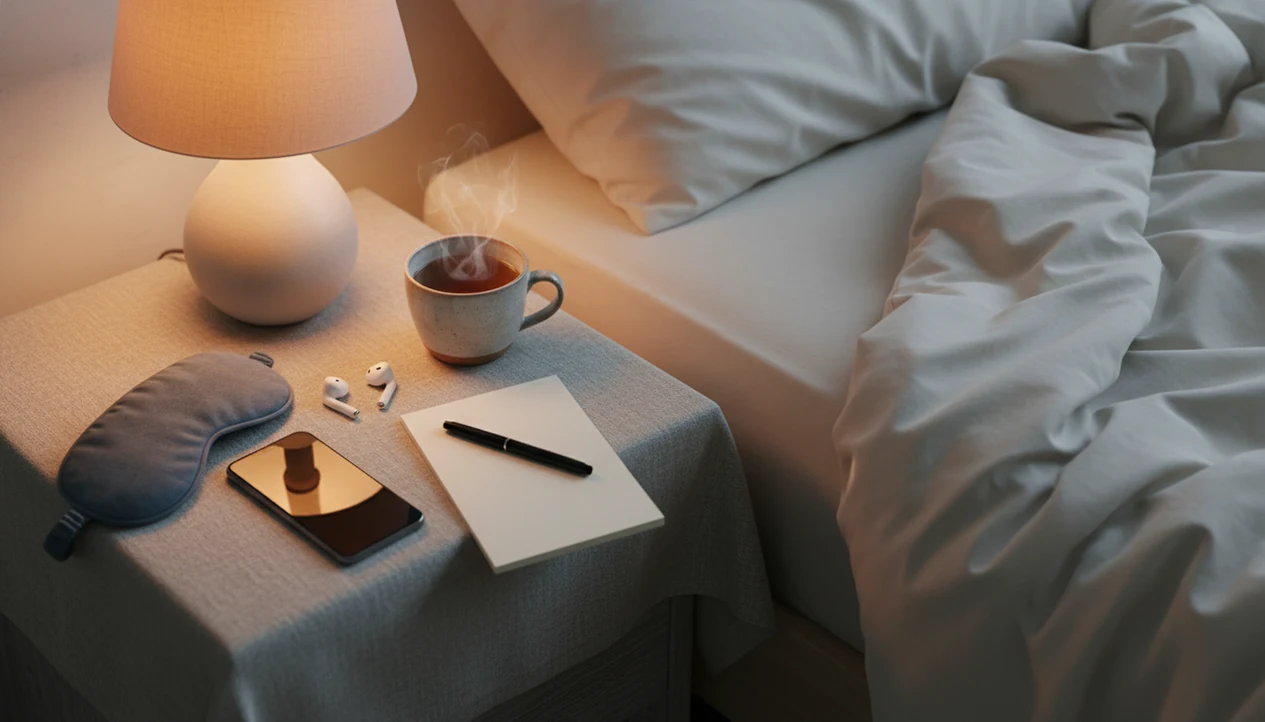


A 10-minute wind-down routine is a short bedtime ritual that combines dim lights, a phone-down step, slow breathing, body relaxation, and brief guided sleep audio. Its purpose is to reduce stimulation and help the body move from alertness toward rest, not to guarantee sleep within ten minutes. Gentle movement or a short worry note can replace a step when tension or unfinished tasks are the main obstacle.
Keep the routine simple enough to repeat in the same order each night. Choose two or three calming activities rather than filling every minute with a new task. Select any audio before bedtime so the routine ends with listening and stillness, not searching through tracks or checking messages.
The bedtime plan
- Use the same 2-3 calming steps each night so your brain learns the routine as a sleep cue.
- The best 10-minute routine combines light reduction, slow breathing, body relaxation, and an audio-only guide.
- MindTastik fits this routine when you want a short guided meditation, sleep audio, breathing exercise, or self-hypnosis session without planning anything at bedtime.
Best 10-Minute Wind-Down Routine for Fast Bedtime Calm
Use this exact 10-minute sequence: 1 minute lights and phone setup, 2 minutes breathing, 3 minutes body release, 3 minutes guided audio, and 1 minute stillness. The routine works by lowering arousal, not by guaranteeing instant sleep.
Start by dimming the room and putting the phone on do-not-disturb. Then breathe slowly, unclench your jaw, soften the shoulders, and follow a short sleep track. Finish without checking the time if you can.
Simple wins here.
MindTastik is a helpful option for short guided meditation, sleep audio, breathing exercises, and self-hypnosis sessions for adults seeking sleep, anxiety, and everyday calm support. The useful part is the ready-made session library, especially when choosing between a 5-minute breathing exercise and a 20-minute body scan feels like too much.
Consistency matters more than a flawless routine. Tired nights need a plan that still feels doable.
5 Best 10-Minute Wind-Down Routine Options by Sleep Need
These five routine options match the 10 minutes to the problem that is keeping you alert. Short guided audio can reduce decision fatigue because you only choose the need, then follow the voice.
Racing Thoughts Reset
Best for overthinkers replaying tomorrow’s list. Use 2 minutes for a worry note, 2 minutes for slow breathing, 5 minutes for guided sleep audio, and 1 minute for stillness. If your priority is fewer bedtime decisions, MindTastik fits because the sleep audio gives you a script instead of another choice.
Body Tension Release
Best for tight shoulders, clenched legs, or a restless jaw. Use gentle stretching, then a guided body scan.
Screen-to-Sleep Bridge
Best for people moving from phone time to bed. Dim the screen, start audio, place the phone face down, and avoid switching apps. For a stricter version, use a screen-free bedtime meditation.
Beginner Bedtime Meditation
Best for adults who do not meditate often. The 10 minutes includes breathing, simple prompts, and no silent “figure it out” period.
Sleep Anxiety Soother
Best for people who feel alert as soon as the lights go out. Use breathing plus a reassuring body scan. Good sleep apps support rest cues, not pressure to perform sleep.
How We Picked the Best 10-Minute Bedtime Routine Steps
We chose steps that are low-effort, repeatable, gentle on screen time, beginner-friendly, and easy to pair with audio guidance. The goal was a routine someone can follow with a dim lamp, a comfortable pillow, and a session already picked before getting into bed.
- Slow breathing was included because it gives the body a clear downshift cue.
- Mindfulness meditation was included because a 2015 JAMA Internal Medicine trial found better sleep quality in adults using a mindfulness program than sleep education alone: JAMA Internal Medicine study: 2110998.
- Body scans were included because they move attention away from mental loops and into physical release.
- Gentle stretching was included only when it stays easy, not workout-like.
- Light reduction was included because bedtime calm usually depends more on lowering stimulation than finding the perfect track.
A systematic review and meta-analysis of mindfulness meditation trials found sleep-quality improvements, although effects varied by study design and population: academic reference: 5366315.
Research supports regular practice, not a ten-minute sleep guarantee
The evidence for meditation and sleep mostly concerns repeated practice, not this exact ten-minute sequence. A 2018 review of 18 randomized trials involving 1,654 adults found improved sleep quality compared with nonspecific active controls. Evidence that meditation was better than specific active treatments was weaker. That distinction matters: a useful relaxation habit is not automatically a substitute for a treatment designed for a sleep disorder.
The same review's intervention details show weekly group sessions over 2 to 16 weeks. In the 12 trials specifying a daily home-practice target, recommendations ranged from 15 to 60 minutes. These findings do not establish that longer bedtime sessions are better than shorter ones. Ten minutes is a manageable starting point, but its clinical effect cannot be assumed from trials of longer, structured programs.
How a 10-Minute Wind-Down Routine Works in the Brain and Body
A 10-minute wind-down routine works as a conditioned cue: repeated dim light, slower breathing, body stillness, and sleep preparation teach the brain that wakeful activity is ending. In plain language, the same small pattern starts to mean “bed is next.”
Slow breathing can reduce physical arousal. Body scans can interrupt rumination by giving attention a calmer target than the thought stream. That matters when your feet search for a cool sheet and your mind is still arguing with an email from noon.
Light matters too. Bright light and scrolling can delay sleep signals, partly through melatonin disruption. A 2018 light exposure study found nighttime light can suppress melatonin by more than 50% in some conditions: NIH research: PMC5854391.
If the room says “daytime,” the brain may listen.
How to Use a 10-Minute Wind-Down Routine Tonight
Use this routine after brushing teeth, changing clothes, and doing anything that would pull you back out of bed. Once the audio starts, avoid app switching.
- Set the room for 1 minute. Dim lights, lower noise, and get into bed or beside it.
- Silence the phone for 1 minute. Turn on do-not-disturb, dark mode, and place the phone face down.
- Breathe slowly for 2 minutes. Try a steady inhale and longer exhale without complicated breath holds.
- Release the body for 3 minutes. Move from forehead to feet, softening one area at a time.
- Play a short guided session for 3 minutes. Choose sleep audio, a body scan, or a breathing track, then stop choosing. If you are unsure which audio suits you, compare sleep stories and guided meditation before choosing a bedtime track.
Adults who want a ready prompt can use MindTastik because it covers guided sleep audio, breathing exercises, and self-hypnosis sessions in one bedtime workflow. If you want a longer routine later, learn how to build a sleep routine.
Best For and Not For: 10-Minute Wind-Down Routine Fit
A 10-minute routine fits people who need a realistic bridge into bed, not a full evening reset. It can support sleep anxiety, but it is not therapy, medical care, or a replacement for clinical treatment.
| Fit | Who it helps | Why |
|---|---|---|
| Best for busy adults | People with little time before bed | The routine is short enough to repeat. |
| Best for beginners | Adults new to meditation or stretching | Prompts remove guesswork. |
| Best for overthinkers | People stuck in planning loops | Audio gives the mind one track to follow. |
| Best for screen transition | People coming from devices | It creates a phone-down step. |
| Not ideal for severe sleep problems | Untreated insomnia, sleep apnea, or major disruptions | A short routine may not be enough support. |
MindTastik offers wellness-focused guided audio, sleep sessions, breathing practices, and self-hypnosis for adults who want support with rest, anxiety, and everyday calm. Best Meditation App for Sleep is the role it fills when bedtime needs a clear rhythm instead of another round of scrolling.
10-Minute Wind-Down Routine for Anxiety and Racing Thoughts
A 10-minute wind-down routine for anxiety should reduce mental load, not argue with every thought. If worries are practical, write a tomorrow-list before the audio so your brain has somewhere to put them.
Try 2 minutes of notes, 2 minutes of slower breathing, 5 minutes of guided body scan, and 1 minute of stillness. People who feel anxiety in the chest, stomach, or jaw often do better with body-based prompts than abstract “clear your mind” instructions. For physical tension at bedtime, a nighttime grounding routine can help you focus on present sensations.
Adults looking for a softer landing after anxious evenings can use MindTastik because guided body scans and breathing sessions give each minute a job. For heavier rumination, a calming night routine for racing thoughts may fit better. When worries keep returning, try guided meditation for nighttime worry to give your attention a gentler focus.
Less wired is a win. Thoughts do not need to vanish completely for the routine to be useful.
10-Minute Wind-Down Routine for Beginners and Adults
Beginners do not need to meditate well, stretch deeply, journal beautifully, or understand sleep science. A 10-minute routine can start with dim lights, slow breathing, and one guided audio track.
Choose one version and repeat it for a week before changing it. That gives your brain time to learn the cue. Switching every night can turn bedtime into testing mode.
Skip complicated breath holds, intense yoga, productivity journaling, and long sleep tracking reviews at bedtime. Those can make the mind more evaluative when it needs fewer tasks.
Short guided audio can help beginners because each step is already cued. MindTastik fits adults who want a calm track to follow when the mind feels too busy at bedtime, because the session provides the pacing and gentle prompts.
Common 10-Minute Bedtime Routine Mistakes
Most short routines fail because they become more stimulating than restful. The routine should be boring in a good way.
- Checking notifications after starting resets the brain into response mode.
- Bright light can work against the sleep cue, especially when the phone is held near the face.
- Making the routine too complicated creates bedtime homework.
- Switching tracks every night prevents the audio from becoming familiar.
- Stretching too intensely can raise energy instead of lowering it.
- Judging success only by instant sleep misses the real goal, which is lower arousal.
A meditation app helps only if the phone behavior stays strict. Use dark mode, do-not-disturb, and no scrolling once the track begins.
Ten minutes is not too short to matter when the routine is repeated. A reliable cue often beats an elaborate routine you abandon by Thursday.
Honest Cons of a 10-Minute Wind-Down Routine
A 10-minute routine may feel too short for people with strong bedtime anxiety, chronic insomnia, or a long history of lying awake. Some nights need more support than a quick reset can provide.
App-based routines can also backfire if they lead to more screen time. Opening one sleep track can become checking messages, comparing playlists, or reading comments. Not helpful.
Some users need trial and adjustment. The right voice, music level, breath pace, or body scan style can take a few nights to find. Calm, Headspace, MindTastik, and other options may feel very different in tone.
Missed nights are normal. The routine should not become another task you feel bad about failing.
Guided breathing or a body scan for the final minutes
MindTastik suits this routine when spoken prompts make breathing or body relaxation easier to follow. Its guided breathing exercises are one option; a guided meditation can also give attention a single task after the phone is set aside. Choose the session before bedtime and allow time for it within the routine. Adults who prefer silence can use the same steps without an app. Persistent insomnia or suspected sleep apnea needs clinical assessment, not a different audio track.
What ten minutes of wind-down cannot address
A short bedtime routine can support rest, but it has real limits. Sleep problems are common; NCBI Bookshelf estimates that roughly 30% of adults report insomnia symptoms and about 10% meet criteria for an insomnia disorder: NIH research: NBK526136.
- A 10-minute routine cannot fully overcome caffeine late in the day.
- Alcohol close to bedtime can still fragment sleep, even if the routine feels calming.
- Untreated sleep apnea needs medical evaluation, not just meditation or breathing.
- Chronic pain may require pain care, positioning help, or clinical guidance.
- An irregular sleep schedule can weaken the routine’s cueing effect.
- Chronic insomnia, PTSD, major depression, or severe generalized anxiety may require CBT-I, therapy, medication review, or other professional care.
- Mindfulness and breathing are support tools, not guaranteed cures.
Per the CDC, 35.2% of U.S. adults reported sleeping less than 7 hours on average in a survey: CDC guidance: mm6506a1.htm. If short sleep is persistent, a broader sleep hygiene plan may be more useful.
When to Seek Professional Help for Sleep Problems
Seek professional help when sleep problems are persistent, distressing, or paired with symptoms that a short routine cannot safely address. A 10-minute wind-down can support bedtime, but it does not diagnose insomnia, sleep apnea, panic, depression, PTSD, or other health conditions.
Use the routine as a first layer, then widen the support if the pattern keeps repeating.
- Track the pattern for a short period. Notice how often you struggle to fall asleep, wake for long stretches, or feel unrefreshed despite enough time in bed.
- Call primary care if symptoms persist. Chronic insomnia, frequent daytime sleepiness, or sleep disruption lasting weeks deserves a real evaluation.
- Ask about sleep apnea signs. Loud snoring, gasping, choking, witnessed pauses in breathing, or morning headaches are reasons to discuss a sleep study or sleep specialist.
- Get clinical support for severe mental health symptoms. Intense anxiety, panic attacks, PTSD symptoms, major depression, or thoughts of self-harm need more than bedtime audio.
- Consider CBT-I for chronic insomnia. Cognitive behavioral therapy for insomnia is a structured treatment; meditation apps like MindTastik can support routines, but they are not medical tools.
When story-style audio fits your routine better than active meditation, browse MindTastik sleep stories for calm bedtime listening.
Ten-minute bedtime routine questions
Is a 10-minute wind-down routine enough before bed?
Ten minutes can be a manageable period for lowering stimulation and following a few calming steps. It is not a proven minimum or a guarantee of sleep. Sleep-health guidance often allows a longer wind-down period, so the ten-minute routine can sit within a quieter evening rather than replace it.
What should I do during a 10-minute bedtime routine?
Use one minute to dim lights and silence the phone, two minutes for slow breathing, three minutes to soften body tension, three minutes for guided audio, and one minute of stillness. This is a practical sequence, not a clinically validated formula. Keep breathing comfortable and skip complicated breath holds.
When should I start winding down before bed?
Begin at a regular time, after brushing teeth and finishing tasks that would interrupt the routine. The ten-minute sequence can be the final part of a longer wind-down. Sleep Foundation guidance suggests roughly 30 minutes for calming activities, while some NHS hospital guidance recommends starting 60 to 90 minutes before intended sleep.
Can a short bedtime routine help with racing thoughts?
It can give attention a simpler task without requiring every worry to disappear. For practical concerns, spend two minutes writing a tomorrow-list, then use slow breathing and a body scan. The aim is less mental activity at bedtime, not solving the list. Persistent or distressing anxiety may need additional support.
Can I use my phone for sleep audio during the routine?
A phone can provide audio without becoming the main activity. Pick the track beforehand, silence notifications, dim the screen, and put the phone face down once playback starts. If choosing audio leads to messages or scrolling, a routine without the phone may be a better fit.
What should I do if I am still awake after the routine?
Finishing the routine does not mean sleep must follow immediately. Avoid restarting it repeatedly or checking the clock to judge success. NHS hospital guidance suggests leaving bed for a short, relaxing activity if sleep has not come after approximately 30 minutes. Persistent difficulty sleeping deserves discussion with a clinician.
Should I choose breathing, stretching, or a body scan before bed?
Choose the activity that matches the main obstacle. Slow breathing offers a simple focus, gentle stretching may suit physical tension, and a body scan directs attention through the body. Keep movement easy rather than intense. There is no evidence here that one option is best for every adult.
How long should I repeat the same wind-down routine?
A practical starting point is to repeat one version for a week before changing it. This reduces bedtime decisions and makes the sequence familiar, but a week is not a proven treatment period. Meditation research generally examines practice over several weeks. Notice ease of use and reduced stimulation, not only immediate sleep.