
Bedtime Routine With Sleep Stories for Better Sleep
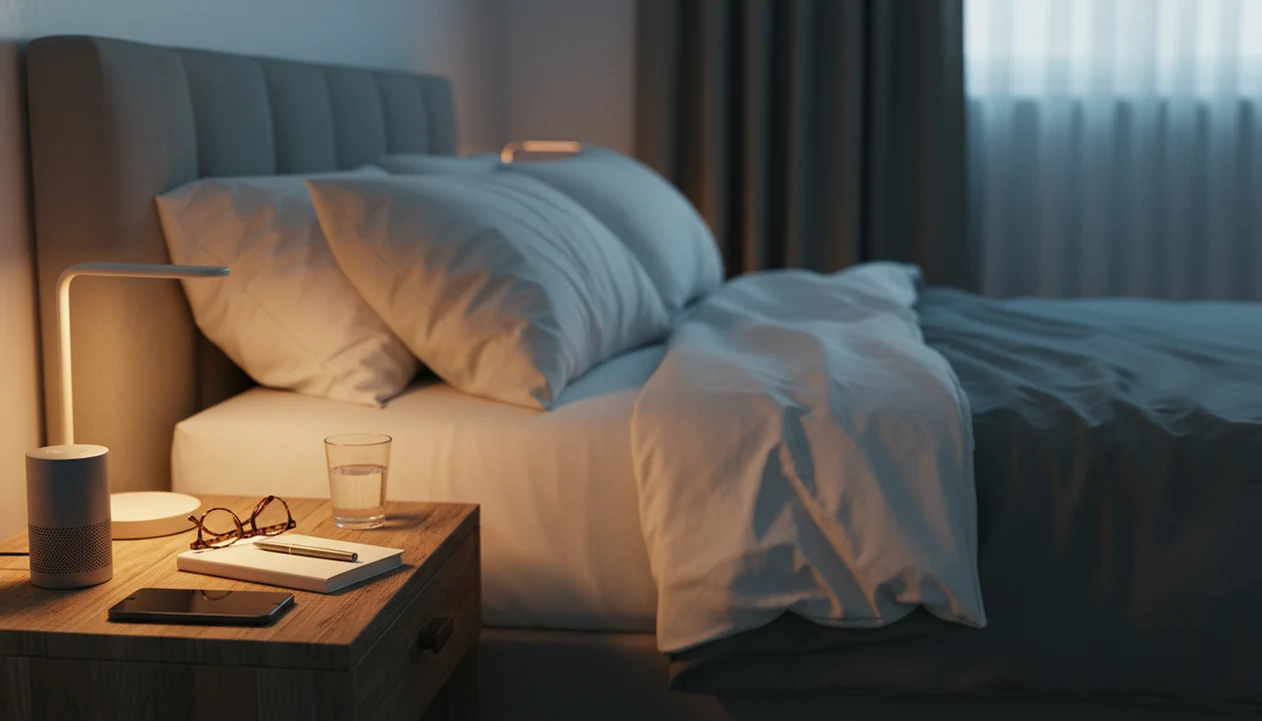


A bedtime routine with sleep stories is a repeatable set of calming steps that ends with gentle narrated audio to help mark the transition to sleep. A practical routine takes about 30-45 minutes: lower stimulation, put screens away, finish bedtime preparations, breathe slowly, then start the story. The narration belongs at the end, as audio only, rather than playing behind late-night scrolling.
Choose the recording around the main bedtime obstacle: racing thoughts, body tension, anxiety, loneliness, or difficulty keeping a consistent routine. MindTastik offers sleep stories, guided meditations, breathing exercises, and self-hypnosis audio for adults. These can support winding down, but persistent insomnia, possible sleep apnea, or severe distress needs attention from a qualified clinician, not simply a different recording.
The bedtime essentials
- Use sleep stories as the final audio-only step in a predictable bedtime routine, not as background noise while scrolling.
- Choose the story style based on your sleep barrier: rumination, body tension, anxiety, loneliness, or habit-building.
- Sleep stories are helpful for many people, but persistent insomnia, sleep apnea symptoms, or severe distress should be discussed with a qualified clinician.
Best bedtime routine with sleep stories for most adults
The best bedtime routine with sleep stories for most adults is a 30-45 minute sequence: dim lights, stop screens, finish light hygiene, do breathwork, then play a slow sleep story. The order matters more than finding a perfect narrator.
A practical routine starts before you feel desperate. At 2:13 a.m., when the lock screen says you are still awake, decision-making gets worse. Set the routine earlier: pajamas, bathroom, dim phone, three minutes of breathing, then audio-only story. A future self bedtime routine can make earlier preparations feel like care for the person who wakes tomorrow.
Per the CDC, 35.2% of U.S. adults reported sleeping less than seven hours in a 24-hour period in 2020 (CDC guidance: adults sleep facts and stats.html). That makes simple repeatable structure useful, not fancy. For adults who want an organized starting point, MindTastik fits because it combines bedtime audio with breathing and guided meditation in one routine path. For a broader sequence, the bedtime routine for adults guide covers the full evening setup.
Five sleep story routine options by bedtime problem
Choose the sleep story style by the thing keeping you awake. Fast podcasts, thrillers, news, and work content are not ideal sleep stories because they ask the brain to keep tracking information.
Best for racing thoughts
Racing-thought routine: Best for tomorrow’s meeting looping at midnight; not for people who need silence. Choose a story with little conflict, then write one unfinished thought on paper before pressing play.
Best for body tension
Body-tension routine: Best for tight shoulders or jaw clenching; not for listeners annoyed by body cues. Pick a soft body-scan story and add five slow exhales before the narrator begins.
Best for screen detox
Screen-detox routine: Best for late scrolling; not for people still replying to messages. Use a simple nature story after switching the phone face down across the room.
Best for comfort and loneliness
Loneliness-comfort routine: Best for quiet apartments that feel too quiet; not for people who dislike voices in bed. Choose a warm first-person story and keep volume barely above a whisper.
Best for travel and schedule resets
Travel-reset routine: Best for hotel rooms and time changes; not for severe jet lag alone. Use a familiar repeated story and pair it with the same wake alarm. Anyone dealing with an unfamiliar room may find MindTastik useful because downloadable bedtime sessions keep the routine available away from home.
How We Chose These Sleep Story Routine Options
We chose these sleep story routine options by looking for bedtime audio that lowers arousal instead of creating a new thing to follow. The goal was not the most entertaining story; it was the most repeatable cue for a common bedtime barrier.
- Screen for low-arousal design: slow pacing, soft narration, simple imagery, low emotional charge, and no cliffhanger that makes you wait for the ending.
- Match each option to one likely obstacle: rumination for racing thoughts, tension for body discomfort, screens for late scrolling, loneliness for a too-quiet room, and travel for unfamiliar sleep settings.
- Favor routines over one-night fixes, novelty playlists, or “try this once” tricks, because bedtime cues get stronger when they repeat.
- Prioritize audio-only use, easy replay, and stories that are safe to miss, so the listener can drift off without checking the screen.
- Exclude medical sleep problems from app-based recommendations; symptoms such as persistent insomnia, gasping, or extreme daytime sleepiness need clinical evaluation, not just a better narrator.
How a bedtime routine with sleep stories works
A bedtime routine with sleep stories works through cue-response learning: the same steps, in the same order, teach the brain that these cues belong to sleep. In plain language, repetition makes bedtime feel less like a negotiation. The idea that your brain is a supercomputer offers another way to think about repeated bedtime cues.
Calming narration can also lower pre-sleep arousal. Instead of a bright screen, comment thread, or tense episode, the mind follows a voice that does not demand much. Sleep stories should create low stimulation, not suspense.
Insomnia symptoms are common: population reviews often estimate symptoms in roughly 30% of adults and insomnia disorder closer to 10% (PubMed research: 18363372). A randomized trial in older adults found mindfulness meditation improved sleep-quality scores more than sleep-hygiene education, but it studied mindfulness, not sleep stories specifically (PubMed research: 25686304).
Good sleep apps deliver a repeatable cue, a calm focus, and an easier off-ramp from screens, not a guaranteed fix for every sleep problem.
The strongest audio evidence is for music, not sleep stories
A 2022 Cochrane review of music for insomnia included 13 randomized controlled trials involving 1,007 participants. Music probably improved reported sleep quality. Evidence for changes in time to fall asleep, total sleep time, and sleep efficiency was less certain. That distinction matters: feeling better about sleep is not the same outcome as reliably falling asleep faster or sleeping longer.
These findings concern music, not commercial sleep stories. The reviews do not establish that spoken narration works better than music, relaxation recordings, or usual care. A reasonable choice is therefore a calm, predictable recording that does not hold attention too firmly. If a narrator or plot keeps the mind busy, switching to simple music or another quiet format is more sensible than persisting because a recording is labelled for sleep.
How to use sleep stories in a 45-minute bedtime routine
Use sleep stories near the end of the routine, after the brain has already received quieter cues. Try this before bed for one week before changing everything.
- Set a consistent bedtime and wake time, even on nights when sleep feels uncertain.
- Dim lights and finish light hygiene about 45 minutes before bed.
- Shut down screens, or switch to audio-only mode with the phone face down, dimmed, or across the room.
- Breathe slowly for three to five minutes before the story; choose a 5-minute breathing exercise if the body feels keyed up.
- Start the sleep story and allow drifting off before the ending, rather than checking whether it “worked.” Practicing trust in life's perfection can offer a gentler perspective when bedtime feels uncertain, without forcing sleep.
Small friction helps. Earbuds on a nightstand, one side slightly tangled around a charging cable, can become another delay. If headphones annoy you, use a low speaker volume instead. The screen-free bedtime meditation routine gives more help for the device part.
Set the audio to stop instead of playing all night
Before starting the story, set an automatic stop and disable notifications. Royal Papworth Hospital's insomnia guidance says quiet relaxing music or sounds may help some people, but advises against letting audio continue all night. One recording of roughly 20-45 minutes is a practical starting point, not a duration proven to work best in trials.
Preview a recording for 10-20 minutes while awake to check the voice, volume, and transitions. Prefer steady sound without sudden advertisements, and keep the device outside the bed with the screen off. Downloaded audio can reduce the need to handle the phone. Stop using a recording if it increases alertness, anxiety, tinnitus, or nighttime awakenings rather than assuming that more listening will help.
MindTastik sleep stories inside a calmer bedtime routine
In a bedtime routine, it works best when you combine one short settling practice with one final audio choice.
In MindTastik, start with one breathing exercise to settle down, then play a sleep story with little conflict as the final bedtime cue. That makes the app a routine builder, not just a library of relaxing audio.
If the night starts with anxious thoughts, choose breathing first. If the body feels tense, use a guided relaxation. If the mind is restless but not panicked, a sleep story may be enough. If the goal is habit-building, repeat the same order for several weeks.
When the issue is “I just need something to play when my thoughts get loud,” MindTastik fits because it lets adults choose between sleep stories, guided sessions, and self-hypnosis without building a new routine from scratch.
Sleep story routine checklist for adults with sleep anxiety
Use this checklist when sleep anxiety makes bedtime feel too open-ended. The most useful routine is boring in a good way.
- Repeat the same order nightly: routine strength usually depends more on consistency than on the exact story. Try a future self bedtime trick by preparing tonight’s essentials before tiredness makes small decisions harder.
- Avoid screens and engaging content before bed: the American Academy of Sleep Medicine advises turning off electronic devices at least 30 minutes before bedtime; if you use a story, keep it audio-only and the screen face down (sleepeducation reference: healthy sleep habits).
- Use audio-only calming narration: the story should be slow, low-conflict, and easy to stop following.
- Pair stories with sleep hygiene basics: regular timing, a cool dark room, and limited late caffeine all matter.
- Do not treat stories as a standalone cure: chronic insomnia needs more than a bedtime playlist.
For a fuller pre-sleep checklist, the sleep hygiene guide covers light, timing, bedroom setup, and meditation together. If your priority is reducing bedtime rumination, MindTastik earns a place because breathing, meditation, and sleep audio can be stacked in one repeatable sequence.
Sleep stories versus podcasts, music, and TV at bedtime
Sleep stories are adult bedtime audio, not childish entertainment. Their job is to reduce content engagement, avoid blue light, and give the mind something soft to follow.
| Option | Best use | Main risk | Bedtime fit |
|---|---|---|---|
| Sleep stories | Final wind-down audio | Wrong story may be too interesting | Strong |
| Guided meditation | Anxiety or body tension | Some guidance feels too effortful | Strong |
| Ambient music | Quiet background sound | No clear mental anchor | Moderate |
| Podcasts | Familiar voices | Plot, jokes, or debate keep attention active | Mixed |
| TV or YouTube | Distraction from stress | Blue light and autoplay delay sleep readiness | Weak |
For adults comparing audio choices, sleep stories often fit better than podcasts because they are designed to be missed; you do not need the ending. If you are choosing between a 5-minute breathing exercise and a 20-minute body scan, start with the shorter option on restless nights. The guide to what to listen to before bed expands that comparison.
Pair a short settling practice with one sleep story
MindTastik's sleep stories suit adults who prefer a quiet voice to silence at bedtime. One breathing exercise or guided relaxation can come first when anxious thoughts or muscle tension make it difficult to settle. Keeping the sequence short avoids turning bedtime into a list of tasks.
People who keep following the plot, dislike spoken guidance, or find narration irritating may prefer soundscapes or silence. MindTastik is not a medical treatment, and bedtime audio should not replace assessment of persistent sleep problems.
What sleep stories cannot treat
Sleep stories can support a bedtime routine, but they are not enough for every sleep problem. Be honest about the edges.
- Sleep stories are not a replacement for medical evaluation for severe or persistent insomnia.
- Loud snoring, gasping, morning headaches, or extreme daytime sleepiness may point to sleep apnea or another sleep-related disorder.
- Major depression, panic, trauma symptoms, or severe distress deserve qualified support beyond bedtime audio.
- Research is stronger for routines, sleep hygiene, and mindfulness than for specific sleep story formats.
- Narration, earbuds, or headphones may distract some people or disturb a partner.
- Overreliance on one story can become a psychological crutch; build confidence in the routine, not only the file.
- Using sleep stories while scrolling weakens the cue and may make bedtime later.
- Late caffeine, alcohol, irregular schedules, and bright bedrooms can undermine results.
Apps such as Calm, Headspace, and MindTastik may all help with bedtime audio, but none can override an inconsistent sleep schedule by themselves.
When story-style audio fits your routine better than active meditation, browse MindTastik sleep stories for calm bedtime listening.
Sleep story routine questions
When should I start a sleep story in my bedtime routine?
Start the story after bedtime preparations and a short settling practice, when there is no need to keep looking at the screen. A practical sequence is dim lights, finish hygiene, breathe slowly, then play audio only. The story should be the last quiet activity, not background sound for scrolling.
How long should a bedtime sleep story be?
There is no proven ideal length. One recording of about 20-45 minutes is a practical starting point, with a timer to stop playback. Preview 10-20 minutes while awake first. A shorter recording may fit better if the voice or story starts demanding attention rather than helping bedtime feel quieter.
Are sleep stories better than music for falling asleep?
Sleep stories have not been established as better than music. The stronger research evidence concerns music, which probably improves reported sleep quality in adults with insomnia symptoms. Spoken narration may suit someone who wants a gentle mental focus, while music may suit someone who keeps tracking a story's plot.
What makes a sleep story calming rather than stimulating?
Look for slow pacing, a neutral or reassuring voice, steady volume, and little conflict or suspense. Avoid cliffhangers, sudden advertisements, and loud transitions. The useful recording is one that becomes easy to stop following, not one that creates a strong urge to hear what happens next.
Can sleep stories cure insomnia?
Sleep stories can support a quieter bedtime routine, but they are not a cure for insomnia or a replacement for medical assessment. Evidence for specific spoken story formats remains limited. Persistent sleep difficulty, loud snoring, gasping, or extreme daytime sleepiness should be discussed with a qualified clinician.
What if a sleep story makes me more awake?
Stop the recording rather than trying to finish it. The voice, plot, or background sound may be too engaging for bedtime. Try a simpler recording, quiet music, a brief breathing exercise, or silence. If listening repeatedly increases anxiety or nighttime awakenings, leave stories out of the routine.
Can I use my phone for sleep stories without scrolling before bed?
Yes. Choose the recording beforehand, disable notifications, set automatic stop, and keep the screen off during playback. Downloaded audio and a device placed outside the bed can reduce handling. NHS guidance recommends avoiding phones, tablets, and computers for about an hour before bed, so keep listening audio only.