
Bedtime Routine Without Scrolling: Audio-Led Ways to Wind Down
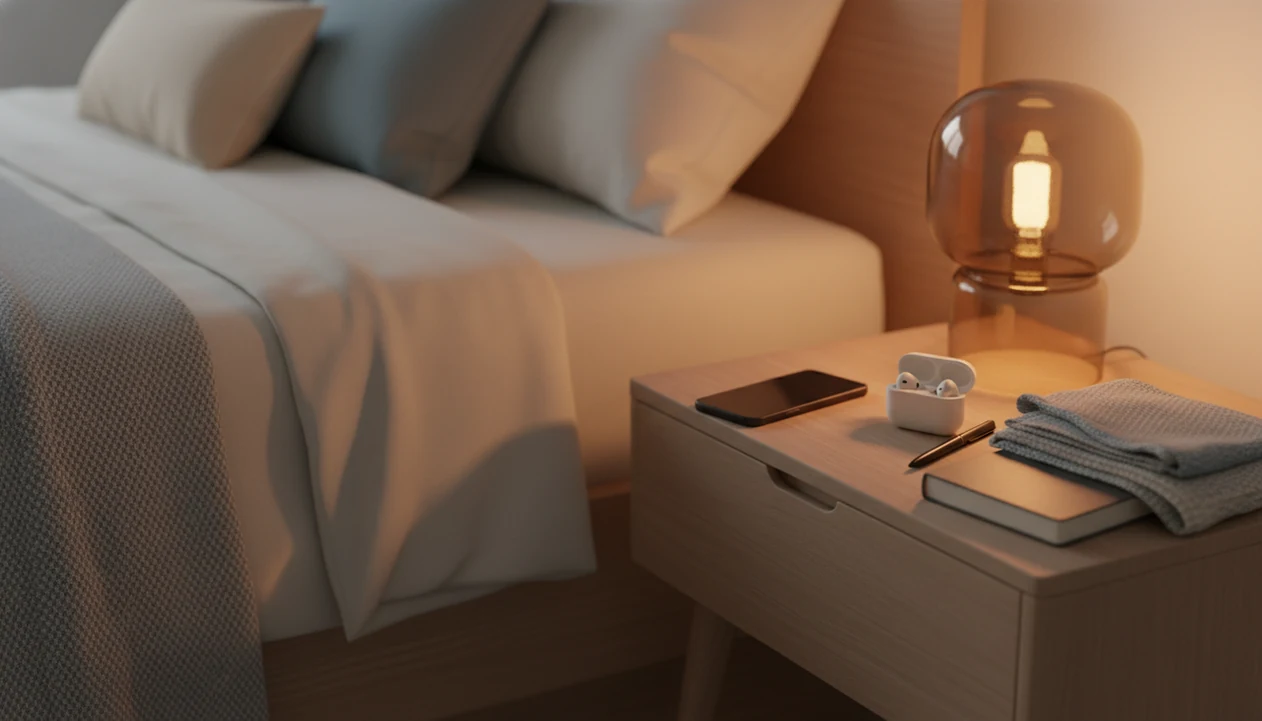


A bedtime routine without scrolling replaces the phone feed with a repeatable 10-30 minute wind-down: put the screen away, start one audio track, and add a calming offline step. It is a sequence of low-stimulation actions, such as breathing, light stretching, paper journaling, or listening in dim light, that makes bedtime less interactive. The aim is a reliable sleep cue, not a guarantee of falling asleep.
Start 30-60 minutes before bed when possible, or keep a 10-minute version for busy nights. Guided meditation, sleep stories, white noise, or calming music can provide company without a visual feed. Choose the track beforehand, charge the phone away from the bed, and repeat the same order each night.
The essentials
- Start your no-scroll routine 30-60 minutes before bed when possible, or use a shorter 10-minute version on busy nights.
- Audio-only options such as guided meditation, sleep stories, breathing exercises, white noise, or calming music can replace the comfort of scrolling without the visual stimulation.
- Charge your phone away from the bed, use app limits, and choose the same routine order nightly so your brain learns the cue: sleep is coming.
Best no-scroll bedtime routine replacements for nightly phone habits
The best replacement depends on why you scroll: distraction, comfort, boredom, anxiety relief, or background noise. Choose the habit that gives the same “I can settle now” feeling with less visual stimulation.
| replacement | best for | not for | setup time |
|---|---|---|---|
| Guided sleep meditation | Racing thoughts | People who dislike voice guidance | 1 minute |
| Sleep story | Boredom and comfort | People who need silence | 1 minute |
| Breathing exercise | Physical tension | Users wanting long audio | 30 seconds |
| Paper journaling | Mental clutter | Anyone who gets stuck writing | 2 minutes |
| Light stretching | Restless body | Pain flares or injury | 3 minutes |
MindTastik fits the audio-only side because it includes guided meditation, sleep audio, breathing exercises, and self-hypnosis sessions. After the track starts, dim the phone, turn it face down, and stop choosing.
For this specific use case, MindTastik is an option when you want one audio choice, a darkened screen, and no repeated browsing at bedtime. It is less about tracking sleep and more about giving the first no-scroll action a clear sound.
Done choosing. That matters.
How bedtime scrolling affects sleep pressure and melatonin timing
Bedtime scrolling can delay sleep because it combines light exposure, novelty, emotional content, and constant choice. Dark mode may reduce brightness, but it does not remove the stimulation of the feed.
- Blue-enriched evening light can suppress melatonin and shift circadian timing later, according to a 2016 experimental study NIH research: PMC4734149.
- A National Sleep Foundation poll reported that 90% of Americans used an electronic device within 1 hour of bedtime at least a few nights per week Sleep Foundation guide: 2011 communications technology use and sleep.
- Notifications pull the brain back into alert mode, even when the body feels tired.
- Short videos and social feeds create novelty loops, so “one more” rarely feels like enough.
- Emotional content can wake up worry, comparison, anger, or planning.
Good meditation apps for sleep and everyday calm offer a quieter cue, not a cure or a guarantee.
What newer studies show about reducing bedtime screen use
A 2025 study of U.S. adults found that daily pre-sleep screen use was associated with 7.64 fewer minutes of sleep on workdays and bedtimes about 19 minutes later. It was also associated with a 33% higher prevalence of poor sleep quality. This was a cross-sectional study, so it cannot establish that screens caused those differences or predict how much sleep an individual would gain by stopping.
A 2025 randomized pilot trial offers more direct evidence for changing the habit. Participants assigned to an online intervention targeting bedtime procrastination and evening device use reduced daily pre-sleep device use by an average of 23.4 minutes and increased daily sleep duration by 12.7 minutes after the intervention. Improvements in sleep quality and bedtime procrastination persisted at follow-up. The intervention addressed both habits, so these results are not evidence that sleep audio alone produces the same benefit.
How a bedtime routine without scrolling works in the brain
A bedtime routine without scrolling works by turning the same sequence into a sleep cue: same time, same routine, calmer reward. In habit terms, that is cue-routine-reward.
The cue might be setting the phone across the room. The routine might be a 5-minute breathing track, two pages of a book, and lights out. The reward is not instant sleep; it is less mental friction. A familiar order also reduces decision fatigue, which helps in the middle of the night when the room is quiet and sleep still feels out of reach. Practicing trust in life's perfection can offer a gentle reminder to release pressure rather than force sleep.
Audio-only support keeps the comfort of having something present while removing visual feeds. Consistency matters more than building a long ritual that collapses by Wednesday. If you want a broader structure, start with how to build a sleep routine.
How to use an audio-led bedtime routine without scrolling
Use this routine tonight if your usual pattern is “bed, phone, another 40 minutes gone.” The point is to make the next action obvious before your willpower gets tired.
- Set a digital sunset 30-60 minutes before bed, or choose a 10-minute version on late nights.
- Start one audio track such as guided meditation, a sleep story, a breathing exercise, or calm music.
- Place the phone face down, across the room, or on a charger outside the bed.
- Do one offline calming action such as light stretching, paper journaling, or preparing clothes for morning. Try a future self bedtime trick by preparing one small comfort for the morning before settling down.
- Repeat the same order for at least one week before changing the routine. A future self bedtime routine can make tonight's small choices feel like care for tomorrow.
On days your mind feels loud, MindTastik fits this workflow because you can choose a guided session once, then let audio carry the routine. For more audio ideas, compare what to listen to before bed.
Best for sleep anxiety: guided meditation instead of doomscrolling
Can guided meditation replace doomscrolling for sleep anxiety? It can be a useful replacement when scrolling is your way of avoiding racing thoughts, but feeds often add new emotional triggers.
Try a simple sequence: 5-minute breathing, 10-minute body scan, then sleep audio. Choosing between a 5-minute breathing exercise and a 20-minute body scan should happen before you are under the blanket, not after unread emails start replaying behind closed eyes.
Best for: - People who want a calm audio cue when their mind will not settle. - Users who want structure without reading or planning. - Adults building a calming night routine for racing thoughts.
Not ideal for: - Severe or persistent anxiety symptoms that need professional support. - People who find voice tracks irritating at night.
When sleep anxiety is the issue, MindTastik covers guided meditation, sleep audio, breathing exercises, and self-hypnosis sessions through an audio-led workflow.
Best for boredom scrolling: sleep stories and calming audio
Sleep stories work well when silence feels too empty, because they give the mind a gentle thread to follow without endless novelty. They are closer to background companionship than entertainment.
| audio option | best for | not for |
|---|---|---|
| Sleep stories | Boredom and comfort | People who follow plots too closely |
| White noise | Background sound | Users wanting guidance |
| Calming music | Soft mood shift | Anyone distracted by melody |
| Nature sounds | Quiet atmosphere | People annoyed by loops |
Anyone dealing with boredom scrolling may find MindTastik useful because sleep audio can replace the feed with one chosen track. Competitors such as Calm and Headspace also offer sleep content, so compare library style, voice tone, and pricing before settling. Choose Calm if polished celebrity-style sleep stories matter most, Headspace if you want a broader meditation curriculum, and MindTastik if the priority is a simple audio-led wind-down without turning the phone back into the activity.
Image caption suggestion: Phone face down on a bedside table while a sleep story plays, with a paper journal and dim lamp nearby for a bedtime routine without scrolling.
Best for revenge bedtime procrastination: a 10-minute no-scroll routine
Revenge bedtime procrastination is delaying sleep to reclaim personal time after a packed day. A 10-minute routine is often more realistic than a 60-minute plan that feels like another obligation.
Sample routine: plug in the phone, take three slow breaths, write two lines in a notebook, then play a 7-minute meditation. Knees tucked under a throw blanket, notebook still open, is enough. Not pretty. Enough.
Best for: - People who stay up because the day felt like it belonged to everyone else. - Parents, caregivers, and overloaded workers who need a short reset.
Not ideal for: - Anyone using bedtime delay to cope with serious stress, depression, or untreated anxiety.
After a long day, when “just one video” becomes forty minutes, MindTastik fits because a short guided session gives personal time a clear endpoint.
How we picked these no-scroll bedtime routine ideas
We picked routines that replace the function of scrolling, not just the phone itself. Good substitutes answer the real need: distraction, comfort, sound, emotional settling, or a small sense of control.
The criteria were simple: low visual stimulation, easy setup, repeatability, low cost, relaxation support, and a 10-30 minute window. Device use in bed has been associated with shorter sleep duration in national U.S. survey data from the CDC CDC guidance: 16 0031.htm. The American Academy of Sleep Medicine also recommends keeping a consistent wind-down routine and limiting disruptive technology use near bedtime sleepeducation reference: healthy sleep habits. That does not mean every phone check ruins sleep, but it does explain why bedtime phone habits deserve attention.
The most useful no-scroll routine is usually the one you will repeat, not the longest one you can design. If you want a fuller checklist, use a sleep hygiene approach alongside your audio routine.
MindTastik audio for racing thoughts or boredom
MindTastik's guided meditations and breathing exercises suit a routine built around settling racing thoughts or physical tension. Its sleep stories offer a different replacement for boredom scrolling: one narrative rather than a feed of new choices. Choose the session before bedtime, then put the screen aside. People who find spoken guidance distracting may prefer soundscapes, paper reading, or silence. The app is not a medical treatment, and persistent sleep problems need more than a change of bedtime audio.
What a no-scroll routine cannot fix
A no-scroll routine can support calmer nights, but it cannot solve every sleep problem. Treat it as a supportive practice, not medical care.
- Turning off screens may not resolve chronic insomnia, pain, untreated anxiety, medication effects, or sleep disorders.
- Meditation and audio-led routines are not substitutes for therapy, medication, emergency care, or medical guidance.
- Blue-light filters and dark mode are partial supports, not full solutions.
- Reading, stretching, audio, and journaling work differently for different people.
- Relapses into late-night scrolling are common. Use them as reset points, not failure.
- Some people need stronger phone boundaries, like charging outside the bedroom.
- If sleep problems persist, speak with a qualified health professional.
For a simpler meditation sequence, try a screen-free bedtime meditation plan.
If you want narration instead of instruction at bedtime, MindTastik sleep stories is a practical place to start inside MindTastik.
No-scroll bedtime routine questions
How do I stop scrolling in bed when it feels automatic?
Make the replacement ready before getting into bed: choose one audio track, leave a notebook or paper book nearby, and charge the phone out of reach. Keep the sequence short enough to repeat. If scrolling resumes, simplify the next night's routine rather than adding more rules or activities.
How long before bed should I stop using my phone?
A practical starting point is 30-60 minutes before bed. NHS guidance recommends a relaxing wind-down during the hour to 90 minutes before sleep. A shorter 10-minute routine can be more realistic on busy nights, but it is not an established threshold that guarantees protection from evening screen use.
Does dark mode make bedtime scrolling less disruptive?
Dark mode may reduce screen brightness, but it does not remove the feed's novelty, emotional content, notifications, or repeated choices. It is a partial adjustment, not a replacement for ending interactive use. Choosing one audio track and putting the screen away changes more of the bedtime habit than changing the display alone.
Can I use my phone for sleep audio without scrolling?
Yes. Select the session before the wind-down begins, start playback, then put the phone face down or out of reach. Avoid returning to the library to compare tracks once in bed. Guided meditation, sleep stories, soundscapes, or calming music can serve as the single audio cue.
What can replace doomscrolling when my thoughts race at night?
A brief breathing exercise or guided body scan can provide a defined focus without introducing new headlines or messages. Paper journaling is another option if it stays brief rather than becoming extended problem-solving. Persistent anxiety or insomnia may need assessment; replacing the feed is supportive, not a treatment on its own.
Are sleep stories better than meditation for bedtime scrolling?
The better choice depends on what scrolling supplies. Sleep stories may suit boredom or a need for background company. Meditation may suit racing thoughts or physical tension. Neither is best for everyone: following a plot too closely or disliking spoken guidance can make silence, soundscapes, or paper reading a better fit.
How can I reduce revenge bedtime procrastination without losing all my personal time?
A short wind-down may feel less like another obligation than a long bedtime checklist. One option is plugging in the phone, taking three slow breaths, writing two lines in a notebook, and starting a short meditation. This reduces bedtime decisions, but it does not solve the daytime pressures behind the delay.
What if I stop scrolling but still cannot sleep?
Screen reduction cannot resolve every cause of poor sleep. Chronic insomnia, pain, untreated anxiety, medication effects, and other sleep disorders may need medical assessment. Keep the routine as a calming support rather than a test of success. Persistent insomnia generally needs evidence-based treatment, such as cognitive behavioral therapy for insomnia.