
Calm-Down Toolkit for Adults
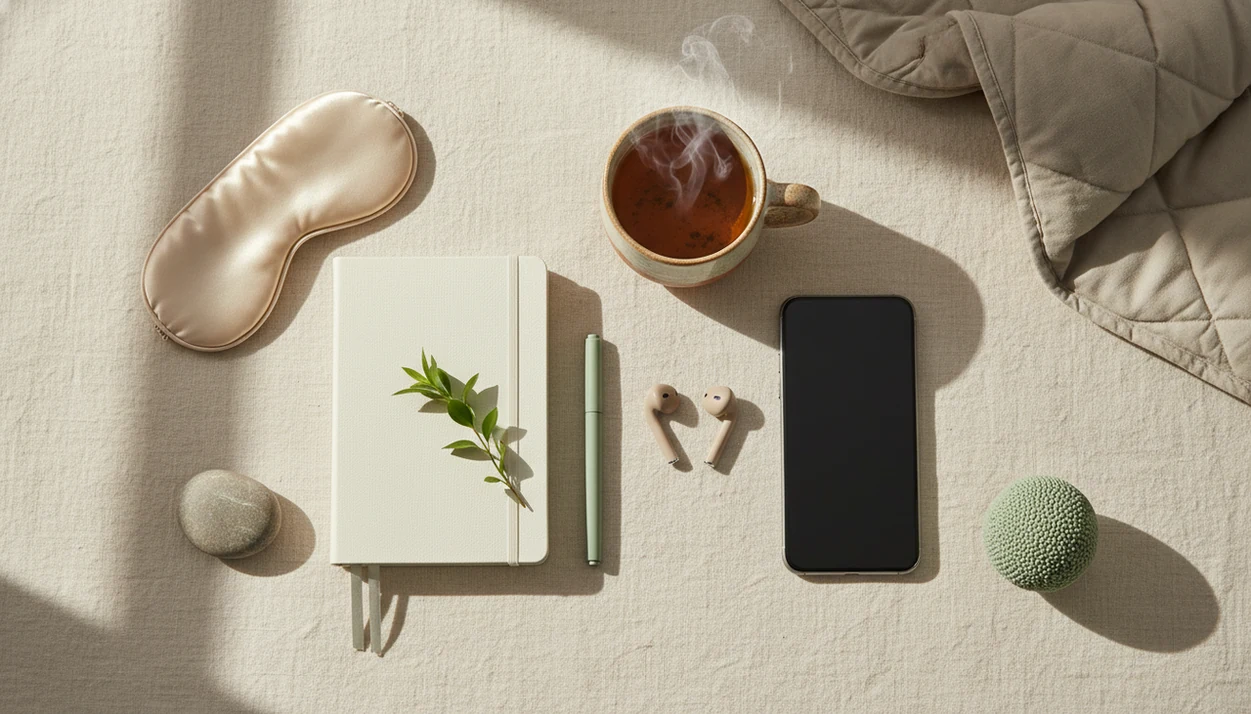


A calm-down toolkit for adults is a small, personalized set of practices and objects for settling stress in the moment and building steadier daily routines. Its core tools are emotional awareness, slow breathing, grounding, guided audio, and journaling. Separate the kit into two parts: quick SOS tools for stress spikes and everyday practices for stress regulation, anxiety support, sleep preparation, and emotional reset.
Start with a brief emotion label, then choose one manageable action, such as grounding or a short guided session. The aim is to settle enough to decide what comes next, not to erase every feeling. These tools support wellness, not medical treatment. Feeling unsafe, considering self-harm, or being unable to function calls for professional, crisis, or emergency support.
The essentials
- Use a two-part toolkit: fast SOS tools for stress spikes and everyday calm tools for prevention.
- Start with naming the emotion, then use slow breathing, grounding, or guided meditation to help the body settle.
- Use guided calm tools as wellness support, not as a replacement for therapy, crisis care, or medical treatment.
Calm-down toolkit for adults: the 5 core tools to include
A practical calm-down toolkit for adults should include five core categories: emotional awareness, breathing, grounding, guided audio, and journaling or reflection. Keep it small enough that you can actually use it when your thoughts are loud.
The first tool is naming what you feel. An emotion wheel can help when “stressed” is too vague. Then add one breathing practice, one grounding exercise, and one short guided session. Physical items help too: a stress ball, soothing sounds, scent, tea, a weighted blanket, or an eye mask.
Simple wins here.
Your toolkit can include app-based guided calm tools as well as objects you can touch. Tools like MindTastik can provide guided meditation, sleep audio, breathing exercises, and self-hypnosis sessions when you want a voice to follow instead of improvising.
Everyday calm toolkit comparison: SOS tools vs baseline tools
A everyday calm toolkit works best when it separates fast SOS tools from baseline practices. Crisis-only use can feel inconsistent because the skill is harder to access when stress is already high.
| Tool type | Best moment | Example | Time needed | What it helps with |
|---|---|---|---|---|
| SOS breathing | Sudden stress spike | Slow exhale breathing | 2 to 5 minutes | Body arousal |
| 5-4-3-2-1 grounding | Panic-like sensations or conflict | Name 5 things you see, then 4 you feel | 2 to 4 minutes | Attention narrowing |
| Short guided audio | Work stress or anxious waiting | 5-minute reset | 5 to 10 minutes | Reorientation |
| Evening meditation | Daily baseline | Body scan or quiet sitting | 10 to 20 minutes | Practice consistency |
| Journaling | Rumination or decision stress | “What is one next step?” | 5 minutes | Thought sorting |
| Sleep audio | Bedtime wind-down | Guided sleep story or relaxation | 10 to 30 minutes | Sleep preparation |
For calm down tools adults can repeat, choose one SOS tool and one daily practice first. An everyday calm toolkit does not need twelve options. It needs two you trust in a quiet room, with one steady breath to come back to when stress starts building.
How a calm-down toolkit for adults works in the nervous system
A calm-down toolkit works by interrupting stress arousal and giving attention a safer place to land. Stress can narrow attention, speed breathing, tense muscles, and push the body toward fight-or-flight.
- Stress arousal changes the body first. A tight jaw, shallow breath, or hot chest may show up before clear thoughts do.
- Naming the emotion creates a pause. “I’m embarrassed and scared” gives the brain more information than “I’m losing it.”
- Slow breathing supports autonomic regulation. Controlled research suggests slow breathing practices, including breathing around 6 breaths per minute, can improve heart-rate variability and stress-response regulation (Zaccaro et al., 2018: NIH research: PMC6137615).
- Grounding widens attention. Sight, sound, and touch pull awareness away from the loop inside your head.
- Guided meditation trains attention over time. A systematic review and meta-analysis in JAMA Internal Medicine found mindfulness meditation programs produced moderate improvements in anxiety, depression, and pain outcomes in adults (Goyal et al., 2014: JAMA Internal Medicine study: 1809754).
Clinicians typically recommend self-regulation tools as support skills, not replacements for care when symptoms are severe. For many adults, slow breathing is often easier than “just calm down” because it gives the body a concrete rhythm to follow.
Name the feeling briefly, then move to an action
Naming an emotion is an option, not a required first step or a guarantee of relief. In four experiments on putting feelings into words, participants viewing negative images reported less distress when they labeled their feelings than when they watched passively. That finding supports a short label such as “angry and embarrassed,” but it does not show that labeling works equally well during every real-life stress spike.
Context matters. A 2022 experiment on emotion intensity found that labeling reduced distress under high-intensity conditions but could increase it under low-intensity conditions. A practical response is to name the feeling once, then shift to grounding, comfortable breathing, or a next action. If describing the feeling turns into repeated analysis or makes distress worse, leave that step out of the toolkit.
How to use calm down tools for adults during a stress spike
How do you use calm down tools for adults when stress is already high? Follow a short sequence that asks very little of your thinking brain.
- Name the emotion. Say, “This is anger,” “This is fear,” or “This is overwhelm.” Use a feelings wheel if your words disappear.
- Set a timer. Choose 3 minutes if you are at work, in conflict, or trying not to spiral before bed. For a shorter pause, try a two-minute calm reset before choosing your next small action.
- Breathe slowly. Try a longer exhale, such as inhaling for 4 and exhaling for 6.
- Ground attention. Notice one color, one sound, and one point of contact, like your feet against the floor.
- Choose the next small action. Send one reply, step away, drink water, or start a bedtime track.
If breath focus feels uncomfortable, use sound, sight, or touch instead. Fingers tracing a jacket zipper can be enough.
Add a muscle-relaxation option when breathing feels uncomfortable
A toolkit does not have to depend on breath focus. A 2024 review of brief anxiety interventions found that progressive muscle relaxation and deep-relaxation training consistently reduced immediate state anxiety in the included research. Brief breathing exercises also showed potential, but their evidence was less developed in that review. This gives a reason to include a body-based alternative rather than treating breathing as the only useful starting point.
For a simple alternative, pause stimulation where possible, notice the room, and let the jaw, shoulders, hands, and other tense muscle groups soften without forcing them. Then choose one small next action. This is a practical adaptation of the toolkit approach, not a directly tested combined protocol. The target is a manageable reduction in arousal, not complete emotional resolution or treatment of persistent anxiety.
Guided calm tools for breathing, meditation, and sleep support
Guided calm tools are useful when you do not want to invent the practice yourself. Choose guided breathing for body tension, short meditation for racing thoughts, sleep audio for wind-down, and self-hypnosis-style relaxation when you want repeated calming cues.
Breathing sessions: Use these when your shoulders are high, your chest feels tight, or you need a reset before a meeting. During a busy afternoon, a midday meditation reset offers a structured break before returning to work.
Short meditation: Start with 5 to 10 minutes. Beginner-friendly sessions reduce the pressure to “do it right.”
Sleep audio: Try this before bed when tomorrow’s meeting keeps looping at midnight.
Self-hypnosis-style relaxation: Use it as a structured relaxation practice, not as medical treatment.
MindTastik offers guided meditation, sleep audio, breathing exercises, and self-hypnosis sessions for adults seeking support with rest, anxiety, and everyday calm. Mindfulness meditation has also been shown to improve sleep quality in adults with sleep problems in a randomized clinical trial (Black et al., 2015: JAMA Internal Medicine study: 2110998). Good meditation apps for sleep anxiety and everyday calm provide repeatable guided practice, not a diagnosis, cure, or substitute for professional care.
Best calm-down toolkit items for different adult stress moments
The best calm-down toolkit items depend on the moment, the setting, and whether privacy matters. Voice, timing, sensory anchors, and environment all change what feels usable.
| Stress moment | Best for | Not ideal for | Toolkit item |
|---|---|---|---|
| Work overwhelm | Quick reset without leaving | Deep emotional processing | 3-minute breathing audio |
| Conflict recovery | Cooling down before replying | Winning the argument | Grounding object and journal note |
| Anxious waiting | Keeping attention steady | Constant news checking | Short guided calm audio |
| Bedtime rumination | Replacing scrolling | Solving tomorrow tonight | Sleep audio and dim screen |
| Burnout warning signs | Noticing patterns | Pushing through indefinitely | Reflection plan and support contact |
Best for work overwhelm
For work stress, pick tools you can use with noise-canceling headphones at a desk. Our guide to how to practice mindfulness at work covers more workplace options.
Best for bedtime rumination
For bedtime, start the audio, set the phone out of reach, and let the room stay softly lit or dark enough to feel restful. A simple track, a quiet pillow, and a slower exhale can be plenty. Very normal.
Not for crisis symptoms
Do not rely only on scrolling, alcohol, avoidance, or pushing through. A toolkit supports regulation, but crisis symptoms need human help.
Printable stress support toolkit plan for daily practice
A printable stress support toolkit plan should fit on one note card, phone note, journal page, or app screen. Adults often search for printable calm-down toolkit ideas, but the plan should feel practical, not classroom-like.
Copy this structure:
- My early signs: ____________________
- My 3-minute tool: ____________________
- My 10-minute tool: ____________________
- My sleep tool: ____________________
- My support person: ____________________
- My get-help line: ____________________
Keep the plan visible where stress actually shows up: a note inside a desk drawer, a card beside your keys, a saved phone note, or the first page of a journal.
Suggested image caption: “A calm-down toolkit for adults shown as a phone note, breathing prompt, grounding card, and bedtime audio screen.”
Guided audio for moments when choosing feels difficult
MindTastik’s guided meditation library can supply the audio part of a toolkit when following a voice feels easier than remembering instructions. Breathing sessions suit a brief pause, while sleep stories and soundscapes offer options for evening wind-down. Keep a non-audio option, such as a grounding object or paper note, for settings where listening is impractical. Adults whose distress is persistent, disabling, or unsafe need professional support rather than an app as their main response.
When a calm-down toolkit is not enough
A calm-down toolkit is wellness support, not therapy, diagnosis, crisis treatment, or medical care. It can help many adults build steadier routines, but it has real limits.
- Severe anxiety, depression, trauma symptoms, or panic escalation deserve professional support, not self-guided tools alone.
- Suicidal thoughts, self-harm urges, or feeling unsafe require immediate crisis or emergency help.
- Substance misuse can make self-calming plans harder to use consistently and may need specialized care.
- Breath focus can increase discomfort for some adults, especially when panic-like sensations are present.
- Body scans may feel activating for people with trauma histories. Sound or sight anchors may feel safer.
- Benefits depend on repetition. A tool you only try once during a hard night may not feel reliable.
- Personalization matters. A soothing voice for one person may irritate another.
- Sleep audio can support a wind-down routine, but it does not replace evaluation for ongoing insomnia or medical sleep concerns.
Reset the plan when it stops fitting.
When you need a body-first reset before meditation, MindTastik breathing exercises offers simple breathing patterns you can follow along.
Adult calm-down toolkit questions
What should I put in a calm-down kit for adults?
Start with one breathing practice, one grounding exercise, a short guided audio option, and a place to write a brief note. Add a physical item only if it serves a clear purpose, such as a stress ball or eye mask. Include a support contact and a written reminder of when to seek help.
How do I use a calm-down toolkit when I feel overwhelmed?
Keep the sequence short: briefly name the feeling, choose comfortable slow breathing or grounding, then decide on one small action. A three-minute timer can keep the task manageable. If focusing on breathing increases discomfort, switch to noticing a color, a sound, and the contact of feet with the floor.
What can I use instead of breathing exercises to calm down?
Options include sensory grounding, muscle relaxation, a grounding object, or guided relaxation audio. A brief review of the room can give attention a concrete task without monitoring the breath. Research on short interventions supports muscle-based relaxation for immediate anxiety, but no single technique works for everyone or replaces care for ongoing symptoms.
How long does a calm-down technique take to work?
Think in minutes rather than expecting an instant reset. Brief interventions can reduce immediate anxiety, but they do not promise complete relief or a fixed response time. A useful result may be enough calm to pause before replying, leave a stressful setting, or choose the next task.
Can naming my emotions make me feel worse?
Yes, the effect can vary with context and intensity. Experimental research found that labeling helped under some high-intensity conditions but could increase distress under milder conditions. Keep the label brief rather than repeatedly examining the feeling. If it adds distress, move to grounding or another calming action instead.
How can I make a calm-down toolkit for work?
Choose tools that fit limited time and privacy: a saved three-minute plan, a quiet grounding object, a short breathing practice, and audio if listening is practical. Connect each tool to a specific moment, such as after a tense call or before replying to a difficult email. Keep deeper reflection for a more suitable setting.
When should I get help instead of using calming tools?
Seek professional support when distress keeps returning, disrupts sleep or daily functioning, or involves escalating panic, trauma symptoms, severe anger, or substance misuse. Feeling unsafe or having thoughts of harming yourself or someone else requires immediate crisis or emergency help. Calming exercises can support care, but should not delay it.