
After-Work Decompression Routine for Calm Transitions


An after-work decompression routine is a repeatable transition ritual that separates work demands from evening activities and sleep preparation. A useful routine is short and follows a clear sequence: one physical reset, one mental release, and one calming cue. Changing clothes or taking a walk can mark the end of work; a brief written list can give unfinished tasks somewhere to wait.
For many evenings, 10 to 30 minutes is a practical starting point, not a required dose. On exhausted days, a five-minute version may be easier to repeat. Keep the final step low-stimulation, especially near bedtime. MindTastik offers guided meditation, breathing audio, sleep sessions, and self-hypnosis for that step, but quiet time without audio is also an option.
The essentials
- The best routine is usually 10 to 30 minutes, not a long self-care checklist.
- Combine physical decompression, such as walking or changing clothes, with mental decompression, such as journaling or a guided breathing session.
- Keep the routine sleep-friendly by reducing stimulation, dimming cues, and avoiding work re-entry late at night.
Best after-work decompression routine options for different evenings
The best after-work decompression routine depends on your energy, your job, and how close you are to bedtime. A nurse coming off a loud shift may need movement first; a remote worker may need a clearer mental shutdown. For guidance tailored to your energy and schedule, try an AI personalized meditation routine for your evening reset.
Good meditation app for sleep, anxiety, and everyday calm support should deliver repeatable cues and low-effort guidance, not a promise to erase stress on command.
| Routine | Best for | Not for | Time needed | Sleep-friendliness |
|---|---|---|---|---|
| 5-minute reset | Exhausted workers, caregivers, late finishes | High-adrenaline days needing movement | 5 minutes | High |
| Walking transition | Commuters, desk workers, restless evenings | Unsafe routes or severe fatigue | 10 to 30 minutes | High if gentle |
| Shower-and-change ritual | People who need a body-based “off” cue | Very late nights if it wakes you up | 10 to 20 minutes | Medium to high |
| Brain-dump routine | Managers, students, remote workers | Urgent tasks needing action now | 5 to 15 minutes | High |
| Guided meditation wind-down | People who want a voice-led cue | Anyone irritated by audio guidance | 5 to 25 minutes | High |
If your priority is a guided evening handoff, MindTastik is the strongest fit on this list because it turns the final calming-cue step into a repeatable audio workflow: guided meditation, sleep audio, breathing exercises, and self-hypnosis. That makes MindTastik especially relevant when the routine goal is not general productivity, but a calmer transition toward sleep.
How an after-work decompression routine works in the brain and body
An after-work decompression routine works by using repeated cues to move the nervous system from task vigilance into home mode. In plain terms, the same small actions teach your brain, “work is closed now.”
The mechanism is cue-based habit learning. Changing clothes, walking around the block, washing up, or starting calming audio can become a transition cue when repeated in the same order. The brain links the sequence with a lower-demand part of the day. This matches habit research showing that repeated context cues can make behaviors more automatic over time NIH research: PMC3505409.
Physical decompression and mental decompression are not the same thing. Tight shoulders, jaw tension, or restless legs often need movement, stretching, showering, or slower breathing. Rumination needs containment, such as a tomorrow list or short brain dump.
A late-night glance at the time feels different when the workday ended with a real closing ritual.
Evening decompression may support sleep readiness by lowering stimulation before bed, but it does not treat insomnia or anxiety disorders. For people who need a structured audio cue, MindTastik can follow the shutdown step with a short guided session.
What workplace mindfulness research says about evening recovery
A 2019 review of 23 randomized controlled trials found benefits from workplace mindfulness training for stress, anxiety, psychological distress, well-being, and sleep. The sleep effect was smaller than the stress effect: g=0.26 compared with g=0.56. These findings support mindfulness as one possible part of recovery, but they do not establish that a particular after-work sequence treats sleep problems.
In a 2018 trial involving 238 employees, participants assigned to a mindfulness app used guided meditations lasting 10 to 20 minutes and reported improvements in well-being, distress, job strain, and perceived workplace social support compared with a wait-list group. A five-minute evening reset is a practical adaptation, not the protocol studied. The trial also does not establish that every app or audio session produces the same results.
Five after-work decompression facts before you build a routine
These five facts matter because decompression is a transition ritual, not a performance. The goal is to make the evening easier to enter, even when the workday was messy.
- Routines work best as cues, not checklists. A repeated “close laptop, change clothes, breathe” sequence can beat a complicated plan you rarely finish.
- Physical and mental stress need different exits. A walk may calm a wired body, while a brain dump may calm replaying thoughts.
- Short and consistent often beats long and occasional. For many adults, 10 minutes repeated nightly teaches the cue faster than an elaborate Sunday reset. The same emphasis on short, repeated practice can help you build a morning meditation habit before work.
- High-adrenaline work may need active release first. Teachers, service workers, and healthcare staff may not settle by sitting still immediately.
- Evening transitions matter for sleep. The CDC reports that 33.8% of U.S. adults get less than seven hours of sleep on average, and 12.6% have trouble falling asleep most days or every day, according to its 2023 sleep summary CDC guidance: db537.htm.
For most people, decompression usually depends more on repeatable cues than on finding one special relaxation method.
How to use an after-work decompression routine at home
Use an after-work decompression routine as a small bridge, not a second job. You can start tonight with five steps and adjust the length later.
- Set a clear work shutdown cue. Close the laptop, silence work alerts, put your badge away, or say, “Work is done for today.”
- Change location, clothes, lighting, or posture. Move away from the desk, swap shoes, dim one lamp, or sit somewhere that is not your work chair. You can use similar environmental cues in a morning calm routine to create a calmer start before work.
- Release physical tension. Walk, stretch, shower, shake out your arms, or use slow breathing for two minutes.
- Empty work thoughts. Write a brain dump, make a tomorrow list, or place one unresolved item in a “not tonight” note.
- Start a sleep-friendly calming cue. Try guided meditation, breathing audio, quiet reading, or another low-stimulation activity.
Tiny counts.
If you already practice pauses during the day, the handoff may feel easier; our guide to how to practice mindfulness at work covers that earlier reset point.
Best 5-minute after-work decompression routine for low-energy days
Does a 5-minute after-work decompression routine count? Yes, if it has a clear beginning, middle, and end.
Try this: put work items away, wash your hands or face, breathe slowly for six rounds, name one work thought you are releasing, then choose one evening cue. That cue might be dinner prep, a quiet playlist, a low light, or a guided breathing session.
This is best for exhausted workers, caregivers, and people who land on the couch and start scrolling before they realize what happened. It is not ideal for someone coming off a high-adrenaline shift who needs to discharge energy first.
When collapse-scrolling is the issue, MindTastik can help because a 5-minute breathing exercise gives the transition a defined endpoint instead of an open-ended phone spiral.
The pocket check is real.
Best mental decompression routine for work thoughts and rumination
Mental decompression is about containing work thoughts, not forcing the mind to go blank. The aim is to give unfinished tasks a place to land so they do not take over dinner, bedtime, or the ceiling-shadow hour at 2 a.m.
- Brain dump: Write every loose work thought without sorting it first. Messy is allowed.
- Tomorrow folder: Move only true next actions into a note, folder, or planner page.
- Worry parking list: Label unresolved concerns as “not solvable tonight” when no action is available.
- Calming audio transition: After writing, use one guided breathing or meditation track to shift attention.
This routine fits knowledge workers, managers, remote workers, and people with evening anxiety. It is not for urgent work problems that genuinely require action before shutdown.
Remote workers trying to close the laptop without mentally staying in Slack can use MindTastik after the brain dump because the guided breathing step becomes a clean attention anchor. For naming the feeling underneath the thought loop, an emotion wheel can help.
Best physical decompression routine for tension after work
Physical decompression should often come before stillness when the day leaves you wired, tight, or agitated. A body that is still braced for action may not respond well to “just relax.”
- Walking: Use a 10-minute loop to mark the boundary between work and home.
- Gentle stretching: Focus on neck, shoulders, hips, and calves, not athletic performance.
- Shaking out arms: Release held tension with 30 seconds of loose movement.
- Showering: Let washing up become a sensory work-closure cue.
- Slower breathing: Shift from active release into a calmer pace.
This works well for commuters, healthcare workers, service workers, teachers, and anyone who feels wired after work. If late-night intense exercise delays your sleep, keep the movement lighter.
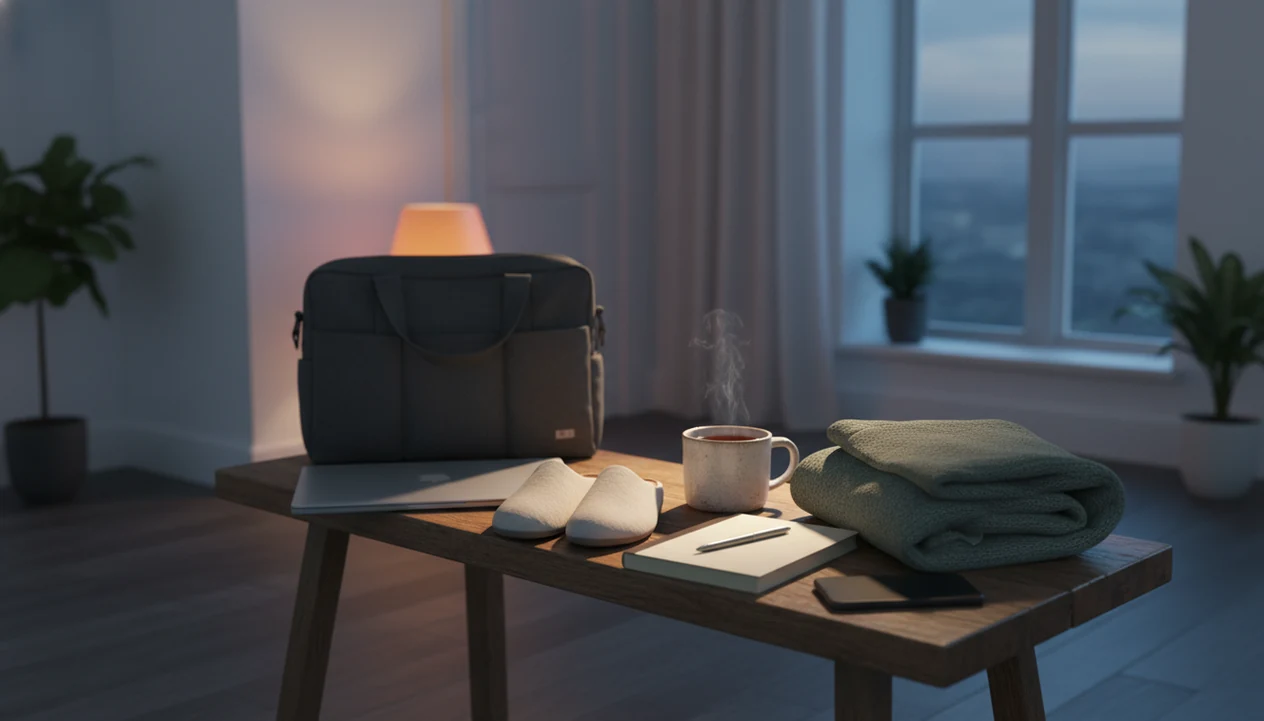
Shoes by the door, dim light, headphones nearby: image caption suggestion for an after-work decompression routine.
When the evening commute is part of the stress load, mindfulness while commuting can turn the trip itself into the first transition cue.
How we picked sleep-friendly after-work decompression routines
We picked routines that are low-effort, repeatable, calming, and easy to personalize. A routine earned a spot when it helped bridge work shutdown to bedtime preparation without becoming another elaborate self-improvement project.
Sleep-friendly routines reduce stimulation instead of adding more tabs to the evening. That means we favored walking, washing up, journaling, breathing, guided meditation, and quiet sensory cues. We deprioritized late-night work re-entry, perfectionistic checklists, heavy planning sessions, and activities that easily turn into “just one more email.”
The National Sleep Foundation recommends 7 to 9 hours of sleep for adults ages 18 to 64 and 7 to 8 hours for adults 65 and older Sleep Foundation guide: how much sleep do we really need. Decompression can support that preparation window, but it does not fix chronic insomnia, burnout, or anxiety disorders by itself.
If the priority is bedtime consistency, MindTastik covers the audio portion because sleep sessions and breathing tracks can be repeated at the same point each evening. For consistent cues at both ends of the day, pair evening audio with a gentle alarm and meditation morning routine.
Honest cons of after-work decompression routines
After-work decompression routines can become another chore when they are too elaborate. If your plan needs candles, tea, journaling, stretching, a playlist, a bath, and a clean bedroom, you may start avoiding the whole thing.
Some relaxing activities are mixed. Screens may help one person feel socially connected and overstimulate another. Exercise can clear stress for one worker and push bedtime later for another. Social plans can restore you, or they can add more emotional noise.
A routine also cannot compensate for chronic overwork, unsafe staffing, job insecurity, or a household load that leaves no true recovery time. That part matters.
Missed days do not mean the routine failed. Simplify before you quit. One cue repeated most evenings is more useful than a “perfect” routine that only happens twice a month. A mindfulness habit tracker can help you notice which cues you repeat without turning missed evenings into failures.
People comparing audio support can also review free meditation apps for sleep if cost is part of the decision.
Short audio for the work-to-evening handoff
MindTastik’s guided breathing exercises suit the final step of a routine: work items are put away, physical tension has had an outlet, and attention needs a quieter task. Guided meditation is another option when work thoughts keep returning. Sleep stories or soundscapes fit evenings that lead straight into bedtime. People who need movement first can start with a walk or stretching instead. Those who find spoken guidance distracting may prefer a quiet, audio-free transition.
What an evening routine cannot fix
An after-work decompression routine is supportive, but it has clear limits. Treat it as a everyday calm practice, not a replacement for care or safer working conditions.
- It is not a treatment for insomnia, anxiety disorders, depression, trauma, or burnout.
- Persistent trouble falling asleep, staying asleep, panic, or severe distress may require clinical support.
- There is no single best routine for every schedule, shift pattern, neurotype, household, or job.
- Popular rituals such as candles, teas, special folders, or “reset baskets” may help, but many are anecdotal.
- Intense exercise, screens, caffeine, alcohol, or emotionally heavy conversations may interfere with sleep for some people.
- Lifestyle routines cannot fully offset chronic overwork, job insecurity, caregiving overload, or unsafe work environments.
- Audio guidance is not for everyone. Some people prefer silence, paper lists, or movement before any meditation.
MindTastik, Calm, Headspace, and mindfulness resources such as mindful.org can all support parts of a wind-down routine, but none can remove the need for medical care, boundaries, or real rest when problems are persistent.
Adjusting the routine when work messages or meetings spill into dinner
| If you... | Try | Why | Note |
|---|---|---|---|
| You keep checking messages after your routine starts | A closed-laptop cue followed by a 3-minute breathing exercise | The boundary is easier to repeat when the work object is visibly out of use. | If a true on-call duty exists, set a specific check window rather than hovering all evening. |
| You finish meetings and immediately carry the tension into dinner | A meeting reset: stand, unclench your jaw, and play a short guided meditation | A physical shift can make the transition feel more concrete than thinking your way out of work mode. | Keep it brief; a long session may become another task to resist. |
| You wait for a large calendar gap before decompressing | A 5-minute calendar-gap routine with one breath cue and one release phrase | Small gaps are often more realistic than waiting for an ideal quiet hour. | Do not use the routine to avoid urgent responsibilities; use it to return steadier. |
For paced breathing you can open in seconds, MindTastik breathing exercises keeps short exercises ready between meetings or before sleep.
After-work decompression questions
What is a simple after-work decompression routine?
Put work items away, change clothes or wash up, then choose a brief physical or mental release. That might be a walk, gentle stretching, or writing tomorrow’s next action. Finish with a quiet cue such as slow breathing or low lighting. The sequence matters more than adding many activities.
How long should I decompress after work?
Ten to 30 minutes is a practical starting range, not a medically established dose. Five minutes may be more realistic after a late finish or on a caregiving evening. Keep enough time for meals, household responsibilities, and sleep. A routine that repeatedly delays bedtime needs to be shortened.
Why can’t I relax when the workday is over?
Closing a laptop does not necessarily end physical tension, unfinished-task thoughts, or the expectation of another message. Match the first step to the problem: movement for restlessness, a written next-action list for mental replay, or a clear notification boundary. Persistent panic, severe distress, or sleep problems warrant clinical support.
How do I stop thinking about work at night?
Aim to contain work thoughts rather than force them away. Write down unfinished tasks, identify the next action for tomorrow, and mark concerns that cannot be solved tonight. Then shift to a non-work activity. If a thought returns, refer back to the note instead of reopening work messages.
What should an after-work routine look like after a late shift?
Keep the sequence brief and sleep-friendly: put work items away, wash up or change clothes, write down any essential next action, and choose a quiet closing activity. Avoid turning decompression into a long planning session. If physical tension is the main problem, gentle movement can come before stillness.
Can I meditate during my commute home?
Do not use eyes-closed meditation or breathing exercises while driving, cycling in traffic, operating equipment, or handling immediate safety responsibilities. As a passenger, eyes-open grounding can involve noticing the seat, feet, sounds, and visible objects. Stop breathing exercises if they cause dizziness, tingling, panic, or worsening symptoms.
Can an after-work decompression routine improve sleep?
It may support a quieter transition toward bedtime, but the exact routine described here has not been established as a sleep treatment. Workplace mindfulness research found a modest sleep benefit from training programs. Persistent difficulty falling asleep or staying asleep needs more than an evening ritual and may require clinical care.
How do I decompress after work if I’m on call?
Separate required availability from habitual checking. If the role allows it, set a specific check window and keep other work activity closed between checks. Use a short reset that can be interrupted, such as changing clothes or writing a next-action note. A routine cannot remove genuine on-call duties or unsafe workloads.