
Mindfulness for Sleep Study: Evidence-Based Bedtime Guide


Mindfulness for sleep means using breathing, body scans, or guided meditation to reduce racing thoughts and support better sleep over time. Research suggests small to moderate improvements, particularly with consistent practice over several weeks. These practices address pre-sleep arousal: rumination, stress, body tension, and worry about not sleeping. They do not force sleep or guarantee a good night.
Here, “study” means both published research and a simple 2-to-6-week home tracking routine, not a laboratory sleep study, medical test, or diagnosis. The practical approach combines daytime awareness practice, a wind-down with fewer bright screens, and a short bedtime session. MindTastik offers guided wellness audio, breathing practices, sleep support, and self-hypnosis for adults seeking rest and everyday calm. It is not a medical treatment.
The evidence in brief
- Mindfulness supports sleep by lowering pre-sleep arousal: rumination, stress, body tension, and worry about not sleeping.
- The strongest studies show modest to moderate benefits for sleep quality, insomnia severity, sleep efficiency, and wake time.
- A practical routine works best when it combines daytime calm practice, a screen-light wind-down, and a short guided session in bed.
Mindfulness for Sleep Study Evidence Snapshot
- A 2015 JAMA Internal Medicine randomized trial of 49 older adults found that a 6-week mindfulness program improved Pittsburgh Sleep Quality Index scores more than sleep hygiene education: JAMA Internal Medicine study: 2110998
- A 2019 systematic review and meta-analysis found small to moderate sleep-quality improvements from mindfulness-based interventions, especially in people with clinical sleep disturbance: nyaspubs reference: nyas.13996
- A chronic insomnia trial reported improvements in insomnia severity, sleep efficiency, and total wake time after mindfulness-based treatment: PubMed research: 22003906
- The evidence points to meaningful support, not a same-night knockout. Benefits usually build through repeated practice.
- Mindfulness appears most useful when stress, rumination, and body tension are part of the sleep problem.
In the quiet stretch before dawn, being awake can feel more serious than it is. The research offers a softer view. Practice may ease the tension around wakefulness, but it is not a guarantee of immediate sleep.
App results are not proof that every sleep meditation works
Evidence from a structured mindfulness program does not automatically apply to a short recording or every meditation app. A randomized trial of the Calm app found improvements in perceived sleep quality, fatigue, daytime sleepiness, and pre-sleep arousal among adults with elevated insomnia symptoms. Those were subjective outcomes. The trial does not establish that an app provides the same treatment as clinician-delivered cognitive behavioral therapy for insomnia, or CBT-I.
A 2025 review of digital mindfulness trials pooled 18 randomized trials involving 4,870 participants and found a small sleep benefit, but rated the overall evidence certainty as very low. Differences between programs, reliance on self-report, variable adherence, and risk of bias limit confidence in the result. Separately, a 2024 review of sleep apps found that much of the evidence concerned CBT-based or multicomponent programs, not meditation alone. Feeling more settled is useful, but it is not proof of objectively longer sleep. For a closer look at effectiveness, explore whether sleep meditation works and what research can tell us.
How We Evaluated Mindfulness for Sleep Studies
We evaluated mindfulness for sleep studies by prioritizing evidence that measures sleep change in adults, not testimonials or cure language. The goal was to separate useful support from overpromising, especially for people trying to sleep while stressed, tense, or wide awake at 2 a.m.
- Prioritize randomized trials, systematic reviews, clinical guidance, and adult sleep studies over marketing pages or one-person stories.
- Compare outcomes that appear across sleep research, including PSQI scores, insomnia severity, sleep efficiency, and total wake time.
- Exclude anecdotal app reviews, instant-sleep claims, and language that presents mindfulness as a guaranteed cure for insomnia or medical sleep disorders.
- Flag limits in the evidence, such as small sample sizes, short follow-up periods, and mixed intervention formats that combine meditation, sleep education, or therapy elements.
- Treat medical red flags separately: loud snoring, gasping, severe chronic insomnia, persistent daytime sleepiness, or urgent mental health concerns need professional evaluation, not just another bedtime track.
Mindfulness for Sleep Study Mechanisms and Sleep Metrics
Pre-sleep arousal is the mental, emotional, and physical activation that keeps the brain checking, bracing, and replaying when the body is trying to sleep.
In plain terms, it includes racing thoughts, emotional stress, body tension, and monitoring whether sleep is happening. Mindfulness does not force thoughts to disappear. It trains you to notice a thought, label it lightly, and return attention to breath or body sensation.
That shift matters for sleep metrics. Less rumination may shorten sleep onset latency, which means time to fall asleep. Less tension may reduce wake after sleep onset. Better settling can improve sleep efficiency, or the share of time in bed actually spent asleep.
The most common medically supported way to improve stress-related sleep is a repeatable wind-down routine combined with healthy sleep habits. Clinicians typically recommend evaluation when sleep problems are severe, persistent, or linked to breathing symptoms.
The American College of Physicians recommends cognitive behavioral therapy for insomnia, or CBT-I, as the initial treatment for adults with chronic insomnia; mindfulness can support relaxation but should not replace assessment or treatment: ACP guideline on treating chronic insomnia.
10-Minute Mindfulness for Sleep Study Routine
A simple mindfulness for sleep study routine should be short enough to repeat on ordinary nights. For many beginners, 10 to 20 minutes is enough.
- Set a consistent wind-down time, ideally 30 to 60 minutes before bed.
- Reduce bright screens and late caffeine; a screen-free bedtime meditation can make this easier.
- Choose one guided practice, such as breath awareness, a body scan, or quiet sleep audio.
- Practice in bed without trying to force sleep. Let the session be the task.
- Track time to fall asleep, awakenings, and morning restedness for several weeks.
Keep it boring on purpose. Dimming the phone screen before the audio starts is a small cue, but it tells the body the day is closing. If you miss a night, restart the next one.
5 Mindfulness for Sleep Study Techniques
Different sleep problems respond to different mindfulness techniques. No single method is universally right.
| Technique | Often fits | Bedtime use |
|---|---|---|
| Body scan | Physical tension | Move attention slowly from feet to face |
| Breath counting | Racing thoughts | Count breaths up to 10, then restart |
| Noting thoughts | Worry loops | Label “planning” or “remembering,” then return |
| Sleep hypnosis | Suggestion-friendly relaxation | Follow a low-effort guided session |
| Calming audio | 3 a.m. waking | Use steady sound without problem-solving |
For racing thoughts, breath counting or noting thoughts is often easier than silent meditation because it gives attention a simple job. For tight shoulders or clenched jaw, a body scan usually fits better.
Apps such as MindTastik, Calm, and Headspace can provide guided meditation, sleep audio, breathing exercises, and self-hypnosis sessions.
5-Minute Mindfulness for Sleep Study Tips for Anxiety and Focus
Does daytime mindfulness help sleep at night? Yes, it can, especially when anxiety and rumination build long before bedtime.
Practicing only when your head hits the pillow may be harder because the mind is already loud. A short morning or afternoon breathing practice trains attentional control earlier. Then the evening practice feels familiar, not like a brand-new task under pressure.
Try a 5-minute breathing reset during the day and a 10-minute sleep practice at night. The daytime version can be simple: inhale, exhale, notice wandering, return. Bathroom stall, hallway wall, two quiet minutes before the next meeting. It counts.
Tools like MindTastik can make repetition easier with app-based reminders or saved tracks. If worry is the main pattern, pair the practice with a calming night routine for racing thoughts.
Mindfulness for Sleep Study Candidate Checklist
Mindfulness for sleep is best viewed as a supportive practice for adults whose sleep worsens with stress, worry, and inconsistent wind-down habits. It is not a diagnostic tool.
- Stress-related sleep trouble: Useful when work, family, or unfinished tasks follow you into bed.
- Mild to moderate insomnia symptoms: May help reduce struggle, especially with steady practice over several weeks. Learn how meditation for insomnia can support relaxation alongside consistent bedtime habits and appropriate care.
- Bedtime worry: Helpful when thoughts replay like unread emails behind closed eyes.
- Inconsistent routines: Works better when paired with a nighttime wind-down routine.
- Medical red flags: Loud snoring, gasping, persistent daytime sleepiness, severe chronic insomnia, or urgent mental health concerns need medical advice.
For adults with stress-linked sleep problems, mindfulness is often easier to sustain than willpower-based sleep fixes because it gives the mind a repeatable place to land. But symptoms that suggest sleep apnea or major impairment should not wait.
Mindfulness for Sleep Study Progress Metrics
Track mindfulness for sleep over 2 to 6 weeks, not one frustrating night. Sleep changes are noisy, and a single bad night can hide a useful trend.
Use simple metrics: time to fall asleep, number of awakenings, total wake time, sleep efficiency, and morning restedness. Sleep efficiency means the percentage of time in bed that you spend asleep. You do not need a formal clinical tool, though many studies use the Pittsburgh Sleep Quality Index, or PSQI, to measure sleep quality.
Progress may feel subtle at the beginning. Maybe you still wake in the dark, but you no longer debate every minute. Maybe the room stays cool under a weighted blanket, and you choose a familiar track instead of reaching for more scrolling.
For a broader plan, use these notes alongside a meditation before sleep checklist.
Mindfulness for Sleep Study Image Caption
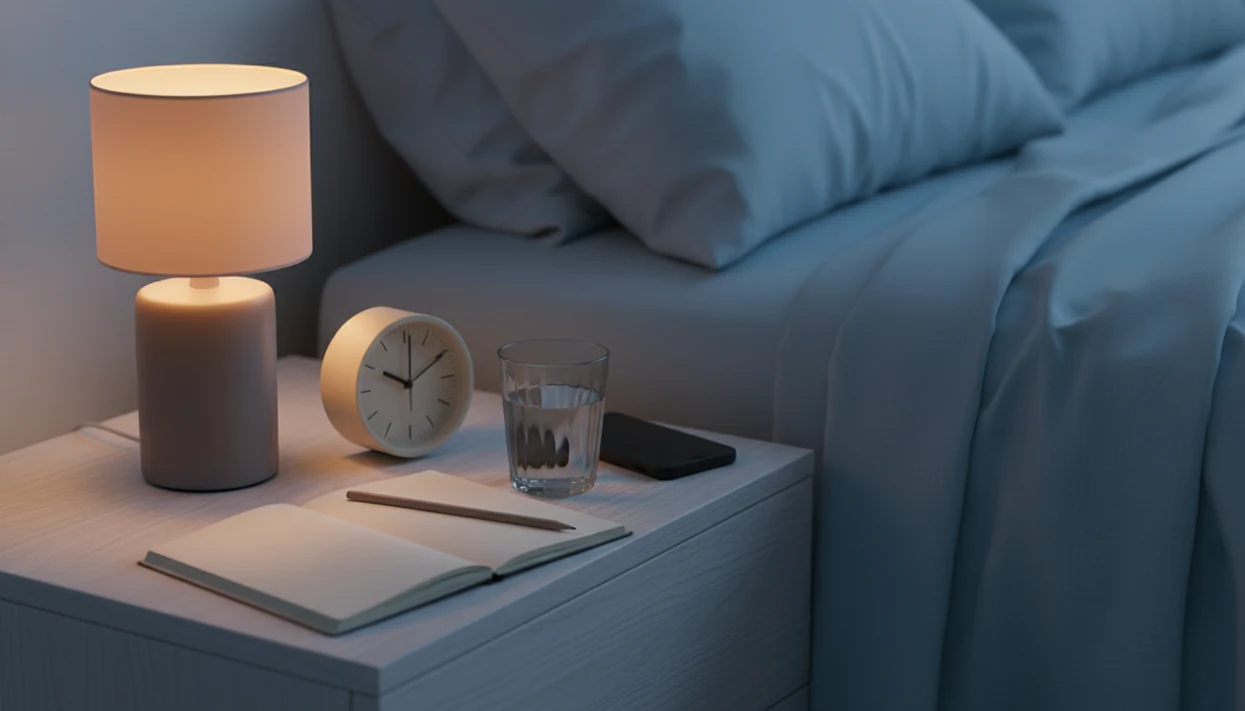
If this guide includes an image, the most useful choice is a realistic bedtime scene: an adult doing a calm mindfulness routine in dim lighting, with a phone set aside or showing low-glare guided sleep audio. A small notebook on the bedside table can represent sleep tracking over several weeks.
Ready-to-use caption: A simple mindfulness for sleep routine combines breathing, body awareness, and consistent tracking over several weeks.
Accessible alt text should describe the action, not make medical claims. For example: “Adult sitting in bed with dim light, guided sleep audio, and a notebook for tracking a mindfulness for sleep study routine.”
Avoid medical-device imagery unless the article is discussing clinical sleep studies. Pajamas warm from the dryer and a low lamp beside wrinkled pillows say enough.
Guided audio for bedtime worry and tension
MindTastik’s guided meditation library offers sessions that can give a bedtime routine a clear structure. Breath awareness suits racing thoughts, while a body scan gives attention a concrete task when physical tension is more noticeable. Sleep stories and soundscapes are alternatives for adults who prefer listening to following meditation instructions.
These are wellness options, not insomnia treatment. Adults with persistent insomnia, gasping during sleep, or daytime impairment should seek assessment rather than rely on audio alone.
What mindfulness sleep studies cannot establish
Mindfulness has real sleep research behind it, but the limits matter.
- Effect sizes are usually modest to moderate, not guaranteed or immediate.
- Evidence is stronger for adults with stress-related sleep issues than for children or medically complex groups.
- App-guided mindfulness depends on consistency, attention, and user engagement.
- Mindfulness may increase awareness of distressing thoughts for some people.
- It should not delay evaluation for loud snoring, gasping, suspected sleep apnea, severe insomnia, or persistent daytime impairment.
- Results can be weaker if caffeine, irregular schedules, alcohol, or late-night scrolling stay unchanged.
- Some people need cognitive behavioral therapy for insomnia, medical care, or mental health support in addition to mindfulness.
Mindfulness can support sleep habits. It should not carry the whole job when symptoms are severe.
Nighttime Reset
A useful bedtime mindfulness session is less about forcing sleep and more about lowering the number of decisions your tired mind has to make. Choose the same dim lamp, the same starting cue, and one simple practice, such as a body scan or slow exhale, so the routine feels familiar before it feels effective. The calmer choice is often the repeatable choice.
On nights when guided practice feels like too much effort, MindTastik sleep stories offers low-stimulus audio you can play in the background.
Mindfulness and sleep research questions
What do studies show about mindfulness for sleep?
Studies suggest that mindfulness can produce small to moderate improvements in sleep quality, particularly with repeated practice. Results depend on the program and comparison group. Evidence is less consistent against active treatments, and many studies rely on self-reported sleep rather than objective measurements. Mindfulness is support, not a guaranteed treatment.
How many weeks does mindfulness take to help sleep?
Look for trends over 2 to 6 weeks rather than judging one night. Track time to fall asleep, awakenings, total wake time, and morning restedness. This is a practical observation period, not a promise that benefits will appear by a deadline. Persistent sleep problems still warrant clinical assessment.
Is mindfulness better than sleep hygiene for insomnia?
Some studies suggest that structured mindfulness programs can improve sleep beyond basic sleep advice, but results vary across comparison groups and study designs. That does not make mindfulness the preferred treatment for chronic insomnia. CBT-I is the guideline-supported first-line treatment and includes cognitive and behavioral methods, not just sleep hygiene.
Which mindfulness technique helps with racing thoughts at bedtime?
Breath counting and lightly labeling thoughts give attention a simple task. Count breaths up to 10 and restart, or label a thought as planning or remembering before returning to breathing. The aim is not to empty the mind. A body scan may fit better when tension is more noticeable than worry.
What if meditation makes anxiety or sleep worse?
Meditation can increase awareness of distressing thoughts, and some people report anxiety, agitation, or sleep disruption. There is no need to continue a session that makes bedtime harder. A shorter practice or calm listening may be a better fit. Persistent distress or worsening sleep should be discussed with a clinician.
Is tracking sleep at home the same as a sleep study?
No. A home diary records estimates such as time to fall asleep, awakenings, and morning restedness. It can reveal patterns but cannot diagnose insomnia or sleep apnea. Loud snoring, gasping, persistent daytime sleepiness, or severe ongoing insomnia should prompt clinical assessment rather than reliance on meditation and tracking alone.