
Soundscapes for Anxiety Support and Everyday Calm
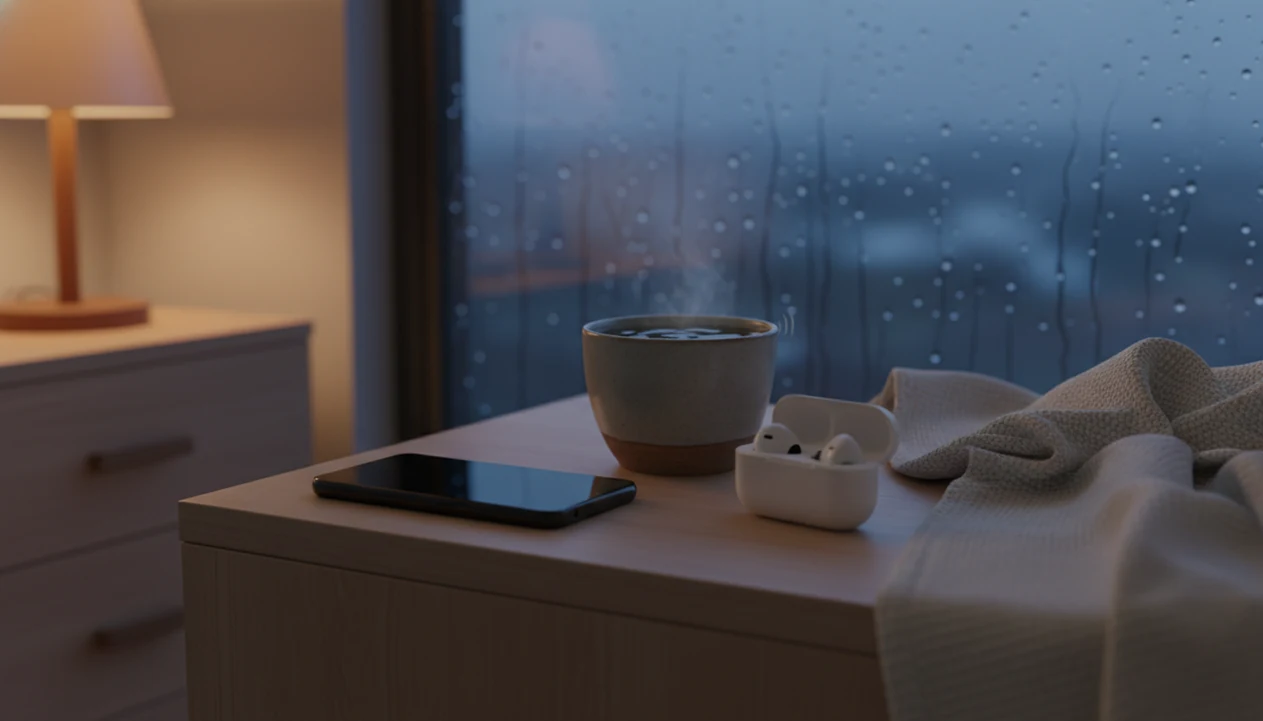


Soundscapes for anxiety are calming background recordings, such as rain, ocean waves, soft instrumental music or gentle noise, used to make anxious moments more manageable. They provide non-clinical support for stress, bedtime worry and daily decompression, not treatment for an anxiety disorder. A useful recording stays quiet and predictable, giving attention something neutral to return to when thoughts keep repeating.
The choice depends on comfort rather than a label promising relaxation. Gentle nature sounds or low-volume ambient audio may suit a quiet evening; sudden wave crashes, sharp birdsong or dramatic music may add unwanted stimulation. Pairing sound with guided breathing or structured relaxation can provide more direction during an anxiety spike than passive listening alone. Soundscapes do not replace therapy, medication or crisis support.
What matters most
- Use soundscapes as supportive calming audio, not as a replacement for therapy, medication, or crisis support.
- Nature sounds, slow instrumental music, and low-volume ambient audio are often better tolerated than intense tracks or loud frequencies.
- For acute anxiety spikes, guided breathing or structured relaxation may help faster than passive listening alone.
Calming Soundscapes for Anxious Moments: What They Can and Cannot Do
Calming soundscapes for anxious moments create a steadier audio environment when your mind feels busy, alert, or hard to settle. They can give the room a softer edge, but they do not diagnose, treat, or cure anxiety.
Think of a quiet exhale before opening messages. The sound does not solve the whole problem, but it can make the next minute feel less sharp.
The need is real: the National Institute of Mental Health estimates that 31.1% of U.S. adults experience an anxiety disorder at some point in life nimh reference: any anxiety disorder, which helps explain why many people look for everyday support tools outside formal care.
MindTastik is a meditation app with guided meditation, sleep audio, breathing exercises, and self-hypnosis sessions for adults who want sleep, anxiety, and everyday calm support.
How Soundscapes for Anxiety Support Work
Soundscapes for anxiety support work by making the listening environment feel more predictable and less demanding. They give attention a soft place to land without claiming to treat anxiety or replace professional care.
In simple terms, predictable audio acts like a low-surprise cue: rain keeps raining, waves keep returning, and gentle noise stays steady enough that the brain has less to track. That can create an attention anchor, meaning something neutral to notice when thoughts loop or the room feels too quiet. Comfort usually comes from the mix of low volume, repetition, and personal preference, not from forcing yourself to tolerate a “calming” sound that feels wrong.
- Choose a sound that feels familiar, plain, or emotionally neutral.
- Keep the volume low enough that it supports the room instead of taking it over.
- Avoid sudden crashes, dramatic swells, or lyrics if they pull you into memories, stories, or alertness.
- Pair the sound with slow breathing, stretching, journaling, or a bedtime wind-down so the audio becomes part of a repeatable calming cue.
60 BPM Music and Predictable Soundscapes in the Nervous System
Predictable soundscapes may support calm by giving the nervous system fewer surprises to monitor. In plain terms, steady audio can make the environment feel less jumpy.
Fight-or-flight is the body’s alarm mode. Your breathing may get shallow, your shoulders may rise, and every small noise can feel important. Rest-and-digest is the quieter setting, where the body has more room for slower breathing, digestion, and recovery.
A predictable soundscape can reduce environmental scanning. Rain that stays even, waves that repeat, or soft pads without sudden swells may lower the need to keep checking the room. The laptop fan during a five-minute pause can do something similar, if it feels neutral and steady.
The University of Nevada, Reno notes that music around 60 beats per minute may support relaxed alpha-wave states unr reference: releasing stress through the power of music. That does not mean brainwaves can be forced on command. For most users, comfort, volume, and repetition matter more than chasing a technical label.
Five Facts About Ambient Audio for Anxiety Support
Ambient audio for anxiety support is best understood as a supportive calming tool, not a guaranteed clinical outcome. The evidence is promising in some settings, but personal fit still matters.
- Preference matters first: A personally pleasant track usually works better than a track marketed as universally calming.
- Slow sounds are common choices: Slower instrumental music, rain, waves, and forest audio often fit relaxation and sleep routines. For another steady background option, try pink noise for sleep at a low volume and notice your comfort.
- Medical music studies show signal: A meta-analysis of 26 randomized controlled trials found moderate anxiety reduction from music-based interventions in medical and surgical patients, according to a 2014 review PubMed research: 24840152.
- Short listening may help in high-stress work: A 2024 randomized trial of 54 emergency nurses found that 10 minutes of 432 Hz or 440 Hz music reduced anxiety and salivary cortisol versus no music NIH research: PMC11976171.
- Consumer results vary: Benefits depend on setting, mood, sound choice, volume, and whether the listener can actually stop multitasking.
For many people, ambient audio works best when it becomes a cue for slowing down.
Feeling calmer and physical stress changes are different outcomes
Research on natural sounds supports a modest claim: they can help with some measures of stress and comfort. A 2021 systematic review and meta-analysis covering 18 publications associated natural sounds with lower stress and annoyance, alongside improvements in health and positive-affect outcomes. The recordings included water, birdsong and other natural sounds. The review did not establish a single best sound for everyone.
Physical changes do not always match the listener’s reported experience. In a 2024 controlled study comparing natural sounds with quiet, heart rate, blood pressure and respiratory rate differed significantly between conditions, but perceived stress did not. That distinction matters when judging a recording: a physiological finding is not proof that it will stop worry, and an unchanged mood does not mean the study found no physical effect.
Best Soundscape Types for Anxiety Support and Bedtime Worry
The best soundscape type depends on the moment: racing thoughts, bedtime worry, sensory comfort, or quiet background calm. Start with sounds that feel safe and boring, not dramatic.
| Soundscape type | Often useful for | Watch out for |
|---|---|---|
| Rain | Racing thoughts, bedtime worry | Heavy storms may feel too intense |
| Ocean waves | Sleep wind-down, slower breathing | Loud wave crashes can be distracting |
| Forest sounds | Everyday calm, nature imagery | Bird calls may feel too sharp |
| Soft instrumental music | Emotional settling, meditation background | Melodies can pull attention |
| Brown noise | Sensory comfort, masking room noise | Continuous sound can irritate some listeners |
| Gentle ambient pads | Background calm, decompression | Swells may feel emotionally heavy |
Lyrics, sharp volume jumps, and intense music can keep attention active. A low, steady soundscape in a dark room is often easier to settle with.
A relaxing soundscapes app such as MindTastik can help users compare rain, ocean, ambient pads, and softer music styles. For sleep-specific routines, a sleep soundscapes meditation app may be easier than building playlists from scratch.
Sound Meditation for Anxiety Support vs Guided Breathing
Sound meditation for anxiety support is low-effort: you listen, notice, and return to the sound when thoughts wander. Guided breathing is more structured, which can help during sharper anxiety spikes. If you are weighing steady noise against a structured practice, compare white noise vs meditation before choosing.
| Option | Best fit | Why it may help |
|---|---|---|
| Passive sound meditation | Mild stress, bedtime worry, low energy | Requires little effort and gives attention a soft anchor |
| Guided breathing | Acute stress, body tension, pre-meeting nerves | Gives the breath a clear rhythm to follow |
| Square breathing | Fast mental spirals | Adds counting and structure |
| Progressive muscle relaxation | Tight jaw, clenched shoulders, physical tension | Moves attention through the body |
For acute anxiety, guided breathing or progressive muscle relaxation may feel more usable than sound alone because there is a task to follow. For bedtime, sound can stay in the background after the breathing ends.
Pairing a soundscape with slow breathing is often easier than using either one alone because the sound fills silence while the breath gives structure.
How to Use Soundscapes for Anxiety Support in MindTastik
Use soundscapes for anxiety support as a short, repeatable routine inside MindTastik or any relaxing soundscapes app, not just as background noise. A simple setup makes it easier to repeat during bedtime worry or daily decompression.
- Choose a sound that feels neutral or comforting, such as rain, ocean, brown noise, or soft ambient music.
- Set the volume low enough that it blends into the room instead of demanding attention.
- Use headphones only if comfortable, especially if you are sensitive to pressure, tinnitus, or close sound.
- Pair the sound with breathing by slowly exhaling for longer than you inhale for one to three minutes.
- Set a duration of 5, 10, or 20 minutes so the session has an endpoint.
- Reflect afterward by noticing whether your body feels steadier, unchanged, or more activated.
Turn off notifications where possible. Dimming the phone screen before starting bedtime audio also helps reduce the urge to scroll. If rain is your easiest starting point, rain sounds for sleep meditation can be a practical first category.
Set up bedtime audio without leaving it on all night
Continuous playback is not necessary for a bedtime routine. Harvard Health’s guidance on sleep sound machines recommends starting audio at bedtime, keeping it no louder than a background conversation and considering a timer rather than playing it throughout the night. It also suggests placing the device in a bedroom corner. These precautions are relevant to rain and ocean recordings, not just white noise.
Headphone volume needs separate attention because personal devices can produce very loud sound. Hearing Health Foundation’s listening guidance recommends limiting playback to roughly 50 to 60 percent of maximum volume. Treat that as a limit, not a target for bedtime listening. A quieter setting may be enough, and a speaker away from the bed avoids the pressure or close sound that some listeners find uncomfortable.
Best-Fit Use Cases for a Relaxing Soundscapes App
A relaxing soundscapes app fits best when you want repeatable audio support for mild stress, bedtime worry, or quiet transitions. It is not the right tool for emergencies or severe symptoms.
Best for:
- Bedtime worry: Use low-volume rain, waves, or ambient pads when thoughts get loud.
- Mild daily stress: Try a 5-minute reset between tasks before stress piles up.
- Meditation background: Add gentle audio when silence feels too bare.
- Quiet work breaks: Use steady sound during a pause, not while juggling messages.
- Wind-down routines: Keep the same sound before bed to build a familiar cue.
Not ideal for:
- Severe panic or impaired functioning: Professional support may be more appropriate.
- Suicidal thoughts or crisis situations: Seek immediate help from local emergency or crisis resources.
- Sensory sensitivity, tinnitus, or neurodivergent sound sensitivity: Some tracks may feel irritating or unsafe.
If passive listening is not enough, guided breathing may give more structure. For daytime concentration, ambient sounds for focus meditation may fit better than bedtime audio.
Common Myths About 432 Hz, Brainwave Music, and Anxiety Soundscapes
Does 432 Hz music cure anxiety? No single frequency is proven to be a universal anxiety solution, and claims about “healing frequencies” should be treated carefully.
The 2024 emergency nurse trial found that both 432 Hz and 440 Hz music reduced anxiety and salivary cortisol compared with no music, according to the published randomized study source. That is interesting, but it does not prove that one frequency works for everyone in daily app use.
Brainwave music has a similar problem. Some slow, steady music may support relaxed wakefulness, but labels like alpha, theta, or trauma-release can be overstated. Clinicians typically recommend evidence-based care, such as therapy, medication when appropriate, and skills practice, when anxiety is persistent or disruptive.
Preference, volume, consistency, and context usually matter more than frequency labels. If ocean audio feels safer than a 432 Hz track, choose the ocean. For bedtime waves, ocean sounds for sleep meditation is a clearer starting point than frequency hunting.
Soundscapes with breathing prompts for anxious moments
MindTastik’s soundscapes suit bedtime worry or a quiet break when spoken instructions feel like too much. Its breathing exercises offer a more structured option when racing thoughts make passive listening difficult. Keeping the same recording can also reduce the need to choose something new each time. People who find continuous audio irritating may prefer silence, while persistent or severe anxiety calls for professional support rather than an app routine. When choosing bedtime audio, compare a soundscape or sleep story based on whether you prefer background sound or narration.
What soundscapes cannot tell us about anxiety relief
Soundscapes can support calmer routines, but they have real limits. That honesty matters, especially when anxiety affects sleep, work, relationships, or safety.
- Soundscapes are complementary support, not clinical anxiety treatment.
- Music studies in hospitals or emergency work may not fully translate to long-term consumer app use.
- Some people find continuous audio overstimulating, irritating, sad, or simply unhelpful.
- Benefits depend on preference, low volume, context, consistency, and fewer distractions.
- A track that helps one person sleep may make another person feel trapped with their thoughts.
- People with severe anxiety, panic attacks, depression, suicidal thoughts, or impaired daily functioning should seek professional support.
- Soundscapes should not be expected to deliver immediate relief, guaranteed sleep, or reduced symptoms for every user.
- Headphones may be uncomfortable for people with tinnitus, sensory sensitivity, or sound-triggered stress.
The small notebook beside a meditation cushion is useful here. Write down what helped, what didn’t, and what you’ll avoid next time.
What Racing Thoughts Need
Racing thoughts usually need fewer choices, not a more complicated routine. Try pairing the same short guided voice with the same counted exhale for several days, then judge whether the repetition feels easier to start. The habit is the container; the soundscape is only the cue. Myth says variety keeps meditation interesting, but reality often favors a repeatable reset when the mind is already overloaded.
If you want narration instead of instruction at bedtime, MindTastik sleep stories is a practical place to start inside MindTastik.
Questions about soundscapes for anxiety
Do soundscapes actually help anxiety?
Soundscapes may make an anxious moment easier to manage, but they are not an anxiety treatment. Research on natural sounds has found benefits for some stress and mood measures. Results vary, and short-term changes in a study do not establish lasting relief from an anxiety disorder.
What sounds are best for racing thoughts?
Steady rain, gentle water sounds or soft ambient audio are reasonable starting points because they offer a predictable focus. Avoid recordings with sudden changes if those pull attention back to the room. When listening alone leaves thoughts looping, a short guided breath count may provide a clearer task.
Is rain or ocean sound better for anxiety?
Neither is established as the best choice for everyone. Even rain may feel less distracting than waves with loud crashes, while gentle waves may suit someone who finds repetition comforting. The specific recording matters more than the category. Choose the one that feels least demanding at a low volume.
Can brown noise help with anxiety?
Brown noise can provide a steady background and mask room noise, which some people find comfortable. That does not establish it as a treatment for anxiety or as better than nature sounds. Continuous noise can also be irritating, so there is no reason to keep listening if it adds discomfort.
Should anxiety soundscapes play all night?
All-night playback is not necessary. A timer can keep audio limited to the wind-down period, and evidence that continuous white noise improves sleep is inconsistent. Keep bedtime audio quiet and place the speaker away from the bed. Stop or change the recording if it seems to disturb sleep.
Are soundscapes or breathing exercises better during an anxiety spike?
Soundscapes require little effort, but breathing prompts give attention a more defined task. During a sharper anxiety spike, structured breathing or relaxation may be more useful than passive audio alone. A quiet soundscape can accompany that practice, but neither approach replaces professional or crisis support when symptoms are severe or safety is at risk.
What if calming sounds make me feel more anxious?
Stop the recording rather than trying to tolerate it because it is labelled calming. Continuous noise, sharp tones or emotionally intense music can feel unpleasant or overstimulating. Silence or a different, quieter recording may suit the moment better. Persistent anxiety affecting sleep, work or relationships deserves professional attention.