
Ocean Sounds for Sleep Meditation
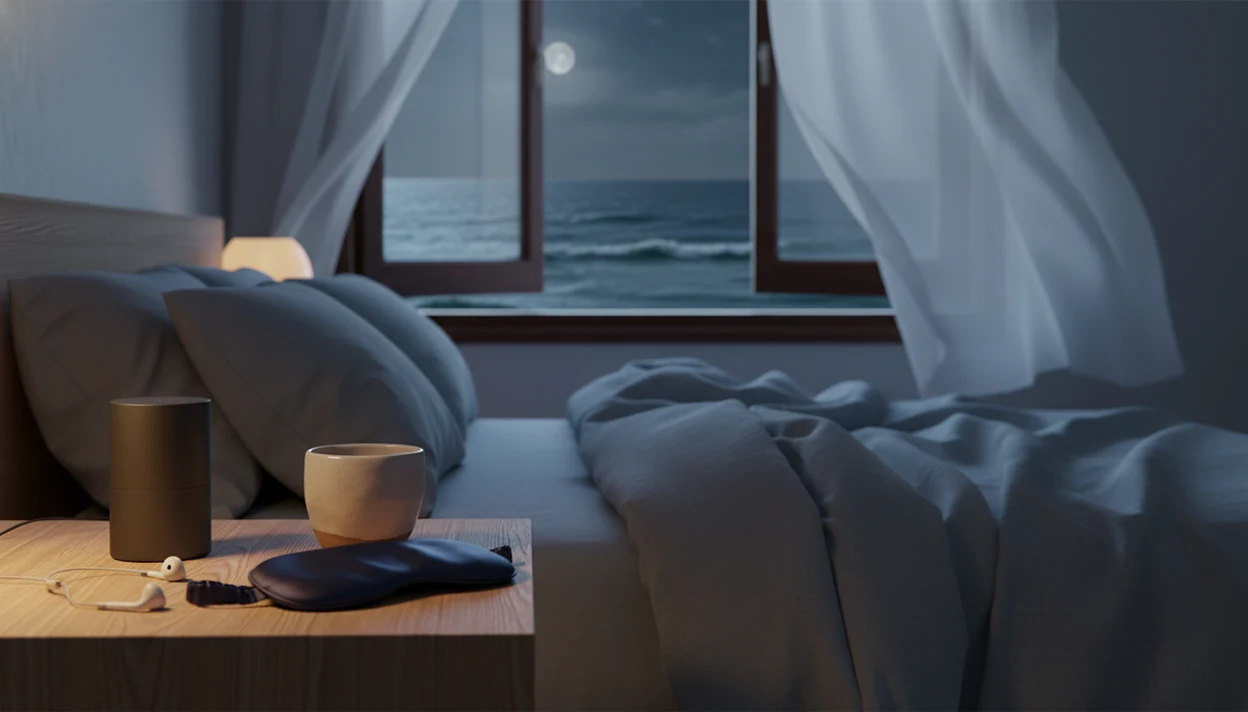


Ocean sounds for sleep are recordings of waves and coastal ambience used as calming background audio at bedtime. Their steady rhythm can mask disruptive noise and give the mind a predictable sound to follow. Gentle surf may help a room feel less distracting, but the recording matters: crashing waves or abrupt changes can draw attention instead of helping it settle.
In MindTastik, ocean audio can accompany guided breathing, a body scan, or sleep meditation during a wind-down routine. Guidance may be more useful than waves alone when racing thoughts or physical tension are the main obstacle. Keep playback at a moderate volume, consider a timer, and treat ocean sounds as sleep support, not a cure for insomnia or anxiety.
The essentials
- Ocean sleep soundscapes work mainly by masking disruptive noise and giving the brain a predictable rhythm to follow.
- Sleep meditation with ocean sounds is often more useful for sleep anxiety than waves alone because guidance can target racing thoughts and body tension.
- Use calming ocean audio at a moderate volume with a timer, and treat it as sleep support rather than a cure for insomnia or anxiety.
What ocean sounds for sleep meditation actually do
Ocean sounds for sleep are recordings of waves, surf, tide movement, and coastal ambience used as background audio at bedtime. The goal is not to force sleep. It is to lower stimulation, cover small noise spikes, and create a bedtime cue your body can recognize.
People may call this an ocean sleep soundscape, waves meditation for sleep, calming ocean audio, or sleep meditation with ocean sounds. The words change, but the need is familiar: a steady track that helps the mind settle when quiet feels too empty.
At 2:13 a.m., the lock screen feels rude.
Tools like MindTastik combine guided meditation, sleep audio, breathing exercises, and self-hypnosis sessions for adults who want sleep, anxiety, and everyday calm support.
For this page’s use case, MindTastik supports a bedtime routine when ocean audio is paired with guided breathing or a body scan instead of left as passive background noise.
Five facts about calming ocean audio for bedtime
- Ocean sounds act like naturalistic white or pink noise because gentle waves repeat in a predictable pattern.
- A steady ocean sleep soundscape can mask traffic, hallway sounds, neighbors, and household noise peaks.
- Guided sleep meditation with ocean sounds can help with both environmental noise and internal noise, such as worry or rumination. Compare soundscapes vs sleep meditation to decide whether steady background audio or spoken guidance better suits your bedtime needs.
- Moderate volume and timer-based listening are safer than loud playback or assuming audio must run all night.
- Ocean sounds are supportive tools, not medical treatment for chronic insomnia, sleep disorders, or anxiety conditions.
For people who dislike silence, steady waves are often easier than music because there are no lyrics to follow. If you want the broader category, compare ocean audio with a sleep soundscapes meditation app approach.
How ocean sleep soundscapes work in the nervous system
Ocean sleep soundscapes work by giving the brain a stable, non-threatening sound pattern to monitor. Rhythmic wave audio has fewer sharp changes than voices, alerts, or traffic. That predictability can reduce orienting response, the brain’s “what was that?” reaction to sudden sound.
In plain language, the room feels less jumpy.
Research on natural soundscapes supports this idea, though it does not prove ocean waves are uniquely better than every other sleep sound. A 2017 laboratory study found that natural soundscapes, including water sounds, were linked with greater reduction in sympathetic activity and better parasympathetic recovery after stress than urban noise pnas reference. Sympathetic activity is the body’s alert system. Parasympathetic recovery is the downshift.
That matches what many listeners notice before bed: the sound does not “knock them out,” but it gives attention somewhere safer to land.
Research evidence for waves meditation for sleep
The evidence for waves meditation for sleep is strongest when viewed as part of relaxing audio, nature sound, and meditation research. It supports plausibility, not guaranteed results.
In a 2011 randomized trial, adults with insomnia listened to 30 minutes of relaxing music at bedtime for three weeks. Sleep quality improved, and sleep onset latency decreased compared with controls PubMed research: 21226692. That study used music, not ocean waves, but it supports the broader idea that non-lyrical calming audio can help some people settle.
The American Academy of Sleep Medicine estimates that 30 to 35% of adults report brief insomnia symptoms, and about 10% have chronic insomnia aasm reference: insomnia.pdf. NCCIH reports that 14.2% of U.S. adults used meditation in the previous 12 months, with sleep and stress among common reasons NCCIH mindfulness overview: meditation and mindfulness effectiveness and safety.
Good sleep apps deliver repeatable cues and manageable practices, not a promise that audio will override medical sleep problems.
A slower pulse is not proof of better sleep
Some ocean-wave research measures short-term physical relaxation rather than sleep. A 2021 review of restorative-environment research reports that five-minute birdsong and ocean-wave recordings reduced heart rate and respiratory frequency and depth. Street and traffic recordings did not produce the same pattern. These findings support trying gentle waves during wind-down, but they do not show that ocean audio prevents night waking or treats insomnia.
Physical changes also do not always match how relaxed someone feels. In a 2024 controlled study of natural sounds, heart rate, blood pressure and respiratory rate differed significantly from the quiet condition, while perceived stress did not. The study concerned natural sounds, not ocean recordings alone. For bedtime use, a calmer pulse is a limited finding, not a guarantee of easier sleep or less worry.
How to use ocean sounds for sleep meditation in MindTastik
Use ocean sounds for sleep meditation in six simple steps: set the track before bed, choose gentle waves, pair the audio with breathing, keep the volume low, set a timer, and repeat the same routine for several nights. Dimming the phone screen before starting bedtime audio is a small cue, but it matters.
1. Set the sound before bed
- Set the ocean soundscape before getting into bed, so the bedroom already feels settled.
- Place earbuds or a speaker where you will not need to reach and adjust it again.
- Start with a short session if you are new to sleep audio.
2. Choose gentle waves
- Choose low-drama waves instead of crashing surf, sharp gulls, or cinematic music.
3. Pair waves with breathing
- Pair waves with guided breathing, a body scan, or sleep meditation when worry is active.
4. Use a sleep timer
- Use a sleep timer and keep volume low enough to mask noise without becoming the main focus.
The most useful bedtime audio is usually the one you can repeat without fuss. For a wider routine, a nature sounds bedtime routine can help you choose the starting point.
Best uses for an ocean sleep soundscape, and when not to use one
An ocean sleep soundscape is best for people who want steady, non-lyrical background sound at bedtime. It is not ideal when waves feel irritating, activating, or too repetitive. Compare the best soundscapes for deep sleep to find gentle audio that suits your listening preferences at bedtime.
| Fit | Best for | Not ideal for |
|---|---|---|
| Noise masking | Traffic, neighbors, hallway sounds, household peaks | Very loud environments where the source still needs fixing |
| Sleep cue | People who want the same bedtime signal nightly | People who become anxious without one exact track |
| Sound preference | Nature-sound listeners who dislike music or TV | Listeners with sensory sensitivity, tinnitus, or hyperacusis |
| Routine support | Wind-down routines with breathing or meditation | Replacing core sleep hygiene, light control, or medical care |
A train seat during the evening commute might be fine with waves. Bedtime is different. Choose what your nervous system accepts at night, not what sounds relaxing in theory.
How to personalize calming ocean audio for sleep anxiety
Personalizing calming ocean audio means adjusting the sound until it supports your actual bedtime pattern. Small differences matter: wave distance, intensity, added rain, soft music, or pure surf can change the whole feel.
- Distant shore: Softer waves often suit people who want background sound, not immersion.
- Closer surf: Louder waves may feel enveloping to some listeners and too stimulating to others.
- Waves plus rain: This can help when you want a fuller blanket of sound. If rain fits better, compare it with rain sounds for sleep meditation.
- Waves plus guidance: Use guided breathing when worry is mental, body scans when tension is physical, and self-hypnosis-style sleep sessions when repeated bedtime cues help.
Using the same ocean sleep soundscape nightly can become a conditioned cue over time. Earbuds on a nightstand, one side tangled around a charging cable, are enough setup for many people.
Pairing waves with guidance for bedtime worry
MindTastik’s ocean soundscapes suit a bedtime routine that combines background sound with a simple attention practice. Its guided meditation library offers another option when waves alone leave too much room for racing thoughts. Breathing exercises can also give the wind-down a clear focus. Comparing guided meditation vs soundscapes can help you choose between an attention practice and background audio for your evening routine.
A listener who only needs noise masking may prefer a plain ocean recording without narration. Anyone who finds surf irritating should choose another sound or silence. Persistent insomnia or anxiety needs more than an audio routine, and MindTastik is not a medical treatment.
What ocean audio cannot treat, and when it may disturb sleep
Ocean sounds can be useful, but they have real limits. Treat them as sleep support, not treatment.
- Evidence specifically on ocean sounds is limited; most research studies relaxing music, natural sounds, meditation, or sleep audio more broadly.
- Ocean sounds do not cure insomnia, sleep apnea, chronic anxiety, depression, trauma symptoms, or other medical or mental health conditions.
- Some people with tinnitus, hyperacusis, migraine sensitivity, or sensory sensitivity may find waves irritating rather than calming.
- High volume, tight earbuds worn all night, or continuous playback may create comfort or hearing concerns.
- Depending on one exact track can make travel, outages, or app changes feel more stressful.
- The World Health Organization notes that night-time noise above 40 dB can affect sleep WHO report: 9789289041737, but masking noise with waves does not remove the source.
- People with persistent insomnia or significant daytime impairment should seek professional guidance.
Clinicians typically recommend addressing ongoing sleep problems with routine, sleep environment, and appropriate care rather than relying on audio alone. For anxiety-specific sound support, the soundscapes for anxiety support guide may help you compare options.
A Bedtime Decision Guide
| If you... | Try | Why | Note |
|---|---|---|---|
| Your room is quiet, but your thoughts feel busy once your head reaches the pillow | Pair low-volume waves with a short guided body scan | The body scan gives attention a sequence to follow, while the waves soften the silence. | Keep the volume low enough that you are not actively listening for details. |
| Household noise or traffic keeps pulling your attention outward | Use a steady ocean soundscape or offline audio before sleep | A consistent background layer may mask small disruptions without adding a new storyline. | Avoid dramatic storm sounds if they make you more alert. |
| You like bedtime narration but sometimes stay awake following the plot | Start with a sleep story, then switch to plain ocean audio | The story can ease the transition into rest, while the waves keep the ending less mentally active. | Choose familiar or low-stakes narration rather than anything suspenseful. |
| You wake during the night and want something gentle to return to | Try a short breathing exercise with soft waves in the background | A few slow exhales may reduce the urge to check the time or restart the whole routine. | Do not turn the screen brightness up to browse for a new session. |
Short wave routines for tension, narration and night waking
| Technique | Best for | Minutes |
|---|---|---|
| Waves plus body scan | settling physical tension before sleep | 10 min |
| Ocean soundscape after a sleep story | easing out of narration without silence | 15 min |
| Slow exhale with soft surf | returning to rest after waking | 3-5 min |
On nights when guided practice feels like too much effort, MindTastik sleep stories offers low-stimulus audio you can play in the background.
Ocean sounds at bedtime: common questions
Do ocean sounds actually help people sleep?
Ocean sounds may help by masking intermittent noise and providing a predictable bedtime cue. Evidence specifically about ocean recordings and nighttime sleep is limited; much of the research concerns natural sounds, relaxing audio or meditation more broadly. A recording that feels calming to one listener may distract another.
Are ocean sounds white noise or pink noise?
Ocean recordings can serve a similar noise-masking purpose, but they are not automatically white or pink noise. Surf changes as waves approach and recede, and recordings may include wind, birds or other coastal sounds. For bedtime, an even recording matters more than the label.
How loud should ocean sounds be for sleep?
Keep ocean audio in the background, no louder than a background conversation. Place a speaker away from the bed rather than beside the head. If masking a disturbance requires loud playback, address the noise source where possible instead of continually increasing the volume.
Should ocean sounds play all night or stop on a timer?
Consider a timer rather than assuming playback needs to continue all night. Starting the sound at bedtime may be enough to support the wind-down routine. Evidence does not establish that continuous ocean audio improves sleep, and changes within a recording can become another source of disturbance.
Can ocean sounds help with racing thoughts at bedtime?
Waves can soften silence, but they do not give attention much direction. Pairing low-volume surf with guided breathing or a body scan may be more useful when worry or physical tension keeps someone awake. Persistent anxiety or insomnia should not be managed with ocean audio alone.
Why do some ocean recordings make it harder to sleep?
Crashing surf, sharp bird calls or sudden volume changes can pull attention back to the recording. Some listeners also find repeating waves irritating rather than calming. Try quieter, more distant surf with fewer added sounds, or choose another background sound or silence if waves remain distracting.
Is it safe to sleep with earbuds playing ocean sounds?
Low-volume playback matters, but tight earbuds worn all night can be uncomfortable, and personal devices can reach high sound levels. A speaker positioned away from the bed avoids wearing earbuds during sleep. Consider a timer and stop listening if the sound causes discomfort or irritation.