
Rain Sounds for Sleep: Research, Track Choices, and Safe Use
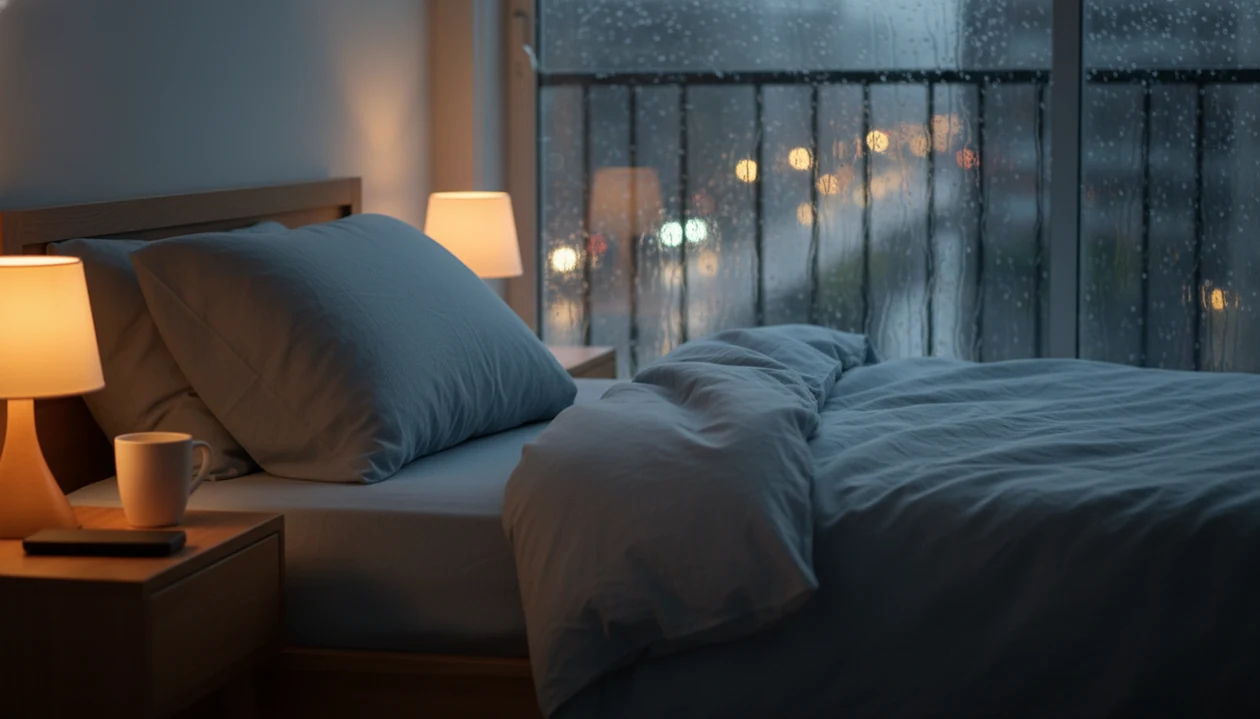


Rain sounds for sleep are rainfall recordings used to mask sudden noises and provide a steady focus during bedtime meditation. They can accompany breathing exercises, body scans, or quiet sleep preparation, but they are not a cure for insomnia or other medical sleep problems. Their role is to make winding down less distracting, not to force sleep.
A useful recording stays even: gentle rainfall, no sharp thunder, no loud volume changes, and no obvious loop that keeps drawing attention. Start at a low, comfortable volume and pair the sound with a short breathing exercise or body scan. If continuous audio becomes irritating or interrupts sleep, a shorter session or silence may be a better fit.
Rain sounds at a glance
- Choose steady calming rain audio without sharp thunder, loud volume jumps, or obvious loops.
- Pair rain meditation for sleep with a short breathing exercise or body scan for a more focused bedtime routine.
- Use rain sounds as a comfort tool, not as treatment for chronic insomnia, sleep apnea, or other medical sleep concerns.
Rain sounds for sleep meditation: the short answer
Rain sounds for sleep meditation can support bedtime calm by covering disruptive noise and giving attention a predictable place to land. The sound does not force sleep, but it can make a wind-down routine feel less exposed to every hallway step, passing car, or house creak.
A good rain soundscape stays even, gentle, and pleasantly uneventful. In a dark room, with the volume low and the rhythm steady, that lack of surprise can be part of what makes it useful.
Tools like MindTastik can pair rain soundscapes with guided meditation, breathing exercises, body scans, and sleep audio. That pairing gives the ear a background and the mind a simple instruction. Still, rain audio is not medical treatment for insomnia, sleep apnea, or other sleep disorders. If poor sleep is frequent or worsening, it deserves proper clinical support.
How calming rain audio works during bedtime meditation
Calming rain audio works mainly through auditory masking and attentional anchoring. Auditory masking means a steady sound partially covers sudden household, street, or hallway noises, so each small interruption feels less sharp.
Attentional anchoring is simpler. The mind gets a neutral object to return to: rain, breath, rain, breath. That matters when thoughts start jumping from tomorrow’s meeting to an old conversation you wish had gone differently.
Research on sound masking supports the idea, with limits. In a randomized trial of adults sleeping in a noisy hospital setting, continuous white noise improved sleep continuity and reduced nighttime awakenings compared with usual care. Source: Ebben et al., Journal of Caring Sciences, randomized white-noise hospital sleep trial: NIH research: PMC6220470. A controlled ICU study also found that broadband sound masking reduced arousals and awakenings caused by environmental noise.
Rain is not magic sleep fuel.
The safer claim is that steady sound may reduce noise disruption and support relaxation cues. It should not be described as directly inducing sleep or curing insomnia.
What the sleep research actually says about rain
Direct research on rain recordings is limited. A 2022 review describing a small rain-sound intervention reported that 12 participants listened to rain for one hour starting at 10 p.m. during a 30-day intervention. Their reported sleep quality improved significantly on the Pittsburgh Sleep Quality Index. That is a useful preliminary finding, but a small study using subjective ratings cannot establish that rainfall reliably improves sleep for most adults.
Broader sound research also needs careful interpretation. A 2022 systematic review of auditory stimulation and sleep included 34 studies and 1,103 participants. Nineteen studies reported positive sleep outcomes, but the authors concluded that the evidence did not support recommending sound universally. These studies included white noise, pink noise, and mixed audio, so their results should not be presented as a success rate for rain recordings.
Rain and waterfall recordings are often grouped with pink noise, which contains relatively more low-frequency energy than white noise. However, Harvard Health's explanation of sleep sounds does not make every rain track equivalent to a research intervention. Frequency balance, volume, and abrupt changes differ between recordings. The practical conclusion is modest: rainfall is an optional comfort aid, and a pleasant listening experience is not proof of better sleep. If rainfall feels distracting, ocean sounds for sleep offer another steady background for your bedtime routine.
Five facts about rain meditation for sleep
- Rain sounds work mainly as sound masking and a simple focus cue during bedtime meditation.
- Steady, mid-volume tracks are usually more sleep-friendly than dramatic storms with close thunder.
- Guided meditation with rain sounds can combine sound masking with cognitive refocusing, such as breath counting or a body scan.
- Using the same rain soundscape at the same time each night can become a bedtime routine cue.
- Results vary, and rain meditation for sleep should be treated as comfort support, not medical care.
A Sleep Foundation survey found that 42% of U.S. adults reported using some form of background sound to fall asleep at least a few nights per week: Sleep Foundation guide: music and sleep. That number feels believable when you imagine a simple setup: a small speaker across the room, rain audio turned down, and no need to keep checking the time.
For people comparing background audio types, the white noise vs meditation difference often comes down to whether they want plain masking, guided attention, or both.
Best rain soundscape bedtime tracks for different sleepers
The best rain soundscape bedtime track is usually the one that stays predictable. Smooth looping, even volume, and low drama matter more than realism for many sleepers.
| Rain soundscape | Best for | Not ideal for |
|---|---|---|
| Gentle shower | Light sleepers who want soft texture | People who need stronger masking |
| Steady rain on roof | Apartment noise, traffic, repeat routines | Anyone sensitive to low rumble |
| Distant storm | People who find far-off weather cozy | Anxious users or thunder-sensitive sleepers |
| Forest rain | Nature sound fans who like birds or leaves | People distracted by layered details |
| Rain with soft music | Users who want emotional warmth | People who wake when melodies shift |
Thunderclaps, heavy storms, and abrupt volume changes can startle light sleepers. If your shoulders tense when the storm swells, switch tracks.
For a wider routine, a nature sounds bedtime routine can help you compare rain with forest, wind, and other softer evening soundscapes.
How to use rain sounds for sleep meditation in MindTastik
Use rain sounds for sleep meditation as a repeatable routine, not as a last-second rescue. The goal is a low-effort cue your body recognizes before the room feels frustrating.
- Set a low to moderate volume that blends into the room.
- Choose a steady rain soundscape without harsh thunder or obvious looping.
- Pair the rain with a guided body scan, breathing exercise, or sleep meditation in MindTastik.
- Dim screens, cool the room, and use the same track at a consistent bedtime.
- Use a timer or fade-out if all-night audio feels disruptive.
Place speakers away from the pillow when possible, or use comfortable audio settings that do not press on your ears overnight. The small decision to dim the phone screen before starting bedtime audio helps too. Less glare, less checking.
In that sense, MindTastik fits when you want guided meditation, rain audio, breathing, and body scans in the same bedtime routine rather than a standalone rain-noise player.
Keep rain playback quiet and limit unnecessary exposure
Masking a passing car does not require making the bedroom loud. Harvard Health recommends bedroom sound-machine playback no louder than a background conversation, with the machine in a corner and a timer considered instead of continuous overnight use. That guidance also offers a sensible starting point for rainfall recordings: keep the speaker away from the pillow and avoid raising the volume to cover every outside sound.
Duration matters as well as volume. A 2024 review of continuous white-noise exposure supports limiting the intensity and duration of commercially available noise devices. This is not rain-specific evidence, but it argues against assuming that prolonged loud playback is harmless. A timer can limit exposure when sound is only needed during wind-down. If a recording feels uncomfortable or makes sleep worse, stop using it rather than increasing its volume.
Guided meditation with rain sounds for sleep anxiety
Guided meditation with rain sounds may support relaxation when bedtime feels mentally loud. The rain provides continuity, while the spoken guide gives the mind specific instructions: count the breath, soften the jaw, scan from shoulders to feet, or imagine a quieter place.
That combination can help someone who wants a steady sound to lean on when the mind feels too busy for silence. The rain fills the background. The guidance gives the next breath somewhere to go, without asking you to design a calm routine in the middle of the night.
A systematic review of music-based sleep interventions found that calming audio before bed improved self-reported sleep quality across randomized controlled trials. A 2021 review found mixed evidence for environmental sleep interventions, including nature sounds: review of sleep-promotion interventions. That evidence supports careful use of bedtime audio, but it does not mean rain tracks treat anxiety disorders.
MindTastik offers guided meditation, sleep audio, breathing exercises, and self-hypnosis sessions for adults looking for everyday support with rest, anxiety, and calm. For related options, soundscapes for anxiety support can help you compare calming audio styles.
Rain sounds for sleep meditation: best for and not for
Rain sounds for sleep meditation are best for people who need a repeatable cue, feel bothered by intermittent noise, or want a simple background for breathwork. They are also useful for beginners who do not want silence to become another thing to manage.
| Best for | Not ideal for |
|---|---|
| Intermittent hallway, traffic, or household noise | People who dislike continuous sound |
| Racing thoughts that need a neutral focus | Users who find storms triggering |
| Beginners using body scans or breathing | Anyone who sleeps worse with background audio |
| A consistent wind-down routine | Chronic sleep symptoms needing evaluation |
The American Academy of Sleep Medicine has noted that about 30% of adults report at least one insomnia symptom. That helps explain the demand for calming tools, but it should not lead to overpromising.
For deeper nighttime audio choices, a sleep soundscapes meditation app guide can help you compare rain, white noise, and other bedtime tracks.
Pairing rainfall with a guided bedtime practice
MindTastik's guided meditations and breathing exercises suit listeners who want instructions alongside a steady background sound. A body scan gives attention a clear task, while a sleep story offers something gentle to follow when breath counting feels repetitive. The app's sleep soundscapes are another option for those who prefer listening without narration. Compare guided meditation vs soundscapes to decide whether spoken instructions or a quiet audio background better suits bedtime.
People who find continuous sound distracting may prefer a guided session without rainfall or a quiet routine. Persistent sleep problems need assessment rather than another audio track.
What rain sounds cannot fix
Rain sounds can be comforting, but they have real limits. Treat them as one supportive practice inside a broader sleep routine.
- Rain sounds do not cure insomnia or replace medical evaluation for chronic sleep problems.
- They cannot override poor sleep hygiene, including late caffeine, alcohol, bright screens, irregular schedules, or late-night work.
- Poorly mixed tracks with thunder, volume jumps, or obvious loops can wake light sleepers.
- Some users with tinnitus, hyperacusis, trauma associations, or anxiety may find rain or storm audio unpleasant.
- Some people become reliant on one soundscape and struggle when traveling or sleeping away from home.
- Continuous headphone use overnight may be uncomfortable, especially with pressure on one ear.
- Low-volume speaker playback, placed away from the pillow, may feel better for some people.
- Sleep apnea, restless legs, depression-related sleep problems, and severe anxiety need more than an audio routine.
For beginners, the most manageable method is often a short guided session with steady background rain because it reduces both silence and decision-making.
If you want narration instead of instruction at bedtime, MindTastik sleep stories is a practical place to start inside MindTastik.
Rain sounds for sleep questions
Do rain sounds actually help people sleep?
Rain sounds may help some people settle by masking intermittent noise and providing a predictable focus. A small rain-sound intervention reported improved subjective sleep quality, but broader sound studies have mixed results. Rainfall is best treated as an optional relaxation aid, not a proven treatment for insomnia.
Are rain sounds white noise or pink noise?
Rain recordings are often described as pink noise because natural rainfall can contain relatively more low-frequency energy than white noise. The label is approximate: recordings vary in frequency balance and added effects. A track with thunder, birds, or music is not interchangeable with steady pink noise used in a study.
Are rain sounds better than white noise for sleep?
There is no established winner for everyone. Research on white noise has produced inconsistent results, and rain-specific sleep research is limited. The more useful comparison is between individual recordings: a steady, comfortable rain track may suit one listener, while another finds a uniform noise track or silence less distracting.
Should rain sounds play all night or on a timer?
All-night playback is not necessary if rain only helps with winding down. A timer limits listening time and may suit people who find continuous sound disruptive. If ongoing household noise is the main problem, longer playback may feel useful, but there is no established rain-specific duration that guarantees better sleep.
How loud should rain sounds be at bedtime?
Start low and keep the sound comfortable, no louder than a background conversation. Place a speaker away from the pillow rather than compensating with louder playback close to the ear. The aim is to soften distracting noise, not drown out every sound or make rainfall the room's main event.
Can thunder in a rain recording wake someone up?
Yes. Sudden changes in volume or texture can disturb sleep, so close thunder and dramatic storm effects may work against the purpose of a steady recording. Gentle rainfall without sharp peaks is a better starting point for light sleepers or anyone who finds storms unsettling.
Can rain sounds help with racing thoughts at bedtime?
Rain can provide a neutral focus, but sound alone may not give a busy mind enough direction. Pairing it with breath counting or a guided body scan adds a simple task. If following the rainfall becomes frustrating, a spoken meditation or quiet practice may be a better choice.
Can rain sounds treat chronic insomnia?
Rain sounds are not an established treatment for chronic insomnia. They may make a bedtime routine more comfortable, but they do not replace assessment of persistent sleep problems or concerns such as sleep apnea. If sleep remains poor, changing recordings should not take the place of medical care.