
What Meditation Does to Your Brain
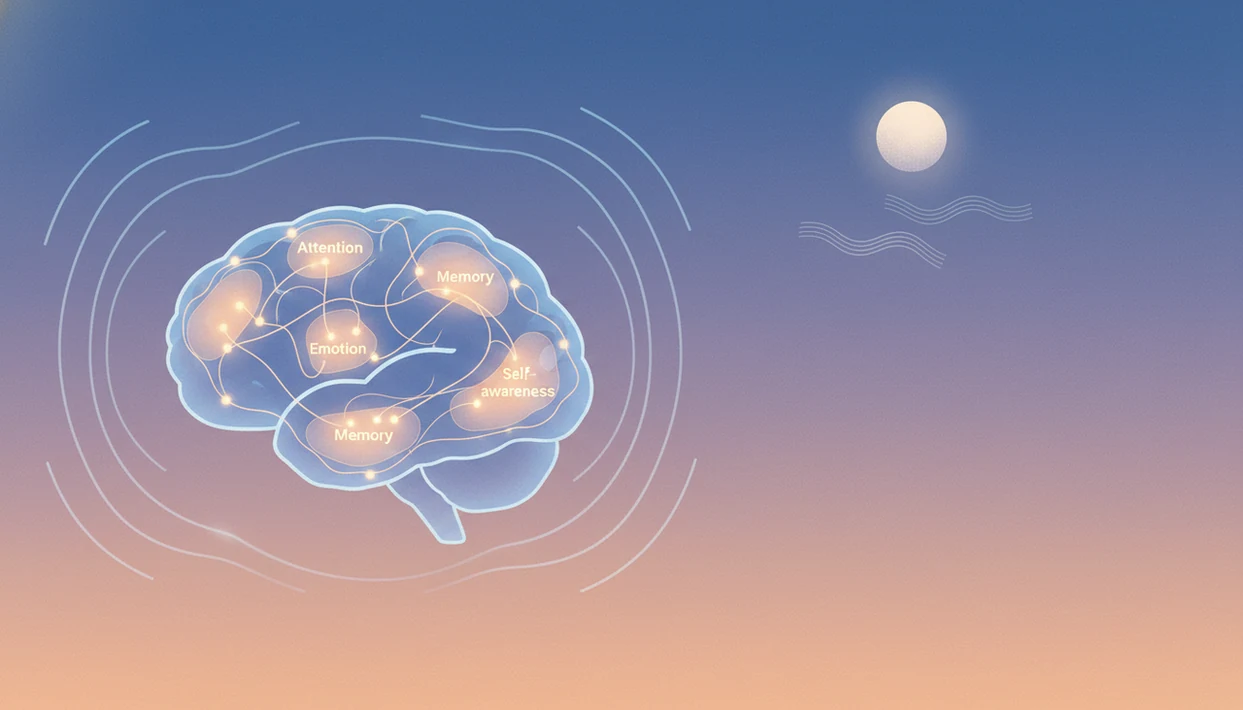


Meditation trains attention, stress responses, emotion regulation, and self-awareness rather than switching the brain off. During a session, brain activity can shift toward relaxed alertness. With repeated practice, research links meditation to differences in gray matter and communication between brain networks, although these findings do not always establish cause and effect. The practical skill is noticing a thought without automatically following or reacting to it. Studies of meditation and brain aging examine age-related brain differences, but associations alone cannot establish lasting protection.
Research examines regions and networks including the amygdala, hippocampus, prefrontal cortex, and default mode network, which is involved in mind-wandering and self-focused thought. Short guided sessions can support calm, focus, and sleep preparation. Longer-term changes are studied over weeks or months, not inferred from one peaceful session, and results vary across people and meditation styles.
The brain findings in brief
- Meditation does not turn off the brain; it trains the brain to notice thoughts without automatically reacting to them.
- Research links regular meditation with changes in the amygdala, default mode network, prefrontal cortex, hippocampus, and attention networks.
- Short guided sessions can support calm, sleep, and focus, but deeper brain changes usually require consistent practice over weeks or months.
What Meditation Does to Your Brain in Plain English
Meditation changes short-term brain activity during a session and may shape longer-term brain patterns with repeated practice. It does not stop thoughts. It trains the brain to notice them, pause, and return attention without immediately reacting.
In plain English, meditation gives the brain practice with four skills: lowering stress reactivity, holding attention, stepping out of rumination, and regulating emotion. That can matter during a wakeful stretch, when the room is quiet, your posture feels tense, and tomorrow’s list keeps circling back.
Thoughts still appear.
The shift is in what happens next. Instead of following every worry, you learn to return to the breath, body, sound, or guided voice. For beginners, structured support can help. A how to meditate guide or guided session turns the brain science into something repeatable.
Five Brain Changes Behind What Meditation Does to Your Brain
- Amygdala reactivity may decrease. The amygdala helps detect threat, and meditation practice is often linked with less automatic stress response.
- Default mode network activity may quiet down. This network is active during mind-wandering and self-referential thinking, including repetitive worry.
- Prefrontal and anterior cingulate networks support control. These areas help with focus, impulse control, and returning attention after distraction.
- The hippocampus is linked with learning and emotion regulation. An eight-week mindfulness program was associated with increased gray matter density in the hippocampus and related regions in a 2011 Psychiatry Research: Neuroimaging study: PMC research article: PMC3004979.
- Alpha and theta waves often increase. EEG reviews commonly connect these brain-wave patterns with relaxed alertness, not sleep or zoning out.
The practical takeaway: meditation trains attention and stress response through repetition, not force. A small notebook beside a meditation cushion can be enough to track which sessions leave you calmer.
A different brain scan does not prove meditation caused the difference
A 2014 meta-analysis of meditation and brain structure combined 21 neuroimaging studies involving approximately 300 practitioners. It found consistent structural differences in eight regions, including the hippocampus, insula, and cingulate cortex. Most studies were cross-sectional: they compared people at one point in time rather than tracking changes from before meditation training. That design cannot exclude pre-existing differences or lifestyle factors.
This distinction matters when interpreting claims that meditation grows, shrinks, or rewires a particular brain region. A difference between meditators and nonmeditators is not the same as a measured change within the same person after training. Structural findings are evidence of an association, not a personal forecast. They cannot establish how much practice an individual needs or guarantee improvements in attention, mood, or sleep. Evidence on meditation for brain aging also needs careful interpretation, since observed differences do not prove protection against decline.
Brain Network Mechanisms Behind Meditation Practice
Meditation works as repeated attention training: you notice distraction, return attention, and reduce the need to react automatically. Over time, that repetition may influence neuroplasticity, the brain’s ability to adapt through experience.
Three networks often come up in meditation research. The default mode network relates to mind-wandering and self-story. The salience network helps detect what feels important. The executive control network helps you choose where attention goes next.
For source context, meditation research has linked practice with default-mode-network activity changes and broader attention/emotion-regulation mechanisms; see Brewer et al. in PNAS (pnas reference: pnas.1112029108) and Tang, Hölzel, and Posner in Nature Reviews Neuroscience (nature reference: nrn3916).
State changes during a session
State changes are the temporary shifts that happen while you practice. Your breathing may slow, your body may feel less braced, and attention may settle for a few seconds at a time.
Trait changes after repeated practice
Trait changes are longer-lasting patterns built through repetition. They vary by person, technique, stress level, and consistency. For most beginners, choosing between a 5-minute breathing exercise and a 20-minute body scan is already brain training. Research comparing brain aging in meditators considers long-term practice, although differences between groups cannot show how an individual brain will change.
Meditation does not produce one reliable brainwave state
A 2015 systematic review of mindfulness EEG studies found that increased alpha and theta power were the most consistent findings across healthy and clinical groups. It found no consistent pattern for beta, delta, or gamma activity. These results support a more cautious description than saying meditation always puts the brain into a specific frequency or a single state of calm.
A newer quantitative review of meditation EEG findings also reported substantial variation between studies. A possible relationship between practice duration and theta effects was modest and exploratory. Much of the evidence was cross-sectional, limiting causal conclusions. Brainwave findings therefore do not provide a reliable checklist for a successful session, and a subjective feeling of calm cannot establish which EEG pattern occurred.
What Meditation Does to Your Brain for Stress and Anxiety
Does meditation calm the anxious brain? It may help some people reduce reactivity to stressful thoughts and body sensations, especially when practice is brief, consistent, and guided.
A 2014 JAMA Internal Medicine systematic review found moderate evidence that mindfulness meditation programs can improve anxiety, depression, and pain outcomes, while noting that effects vary by population and study design: JAMA Internal Medicine study: 1809754.
The amygdala is often described as a stress and fear-related region. When it is highly reactive, ordinary sensations can feel urgent. Meditation gives you a pause between “my chest feels tight” and “something is wrong.” That pause is small, but useful.
Eyes closed beside a parked car, one hand still on the steering wheel. That is where a short reset often makes sense.
Anxiety support is not the same as treating an anxiety disorder. Clinicians typically recommend professional care when anxiety is severe, persistent, or disruptive. Guided meditation tools can support adults seeking anxiety and everyday calm practice, but they should not replace therapy, medication, crisis support, or urgent care.
What Meditation Does to Your Brain for Sleep, Focus, and Rumination
Meditation can support sleep, focus, and rumination by changing arousal and attention patterns, but it does not guarantee insomnia relief or instant productivity. The default mode network is one key piece because it is involved in mind-wandering and repetitive self-focused thought.
| Goal | Brain pattern involved | Practice that often fits | What to expect |
|---|---|---|---|
| Sleep support | High arousal and worry loops | Body scan or slow breathing | A calmer wind-down routine |
| Focus | Attention drift | Focused-attention meditation | Practice returning to one task |
| Rumination | Default mode overactivity | Mindfulness of thoughts | Less automatic identification with worries |
Sleep support through lower arousal
Body scans and breathing exercises can downshift arousal before bed. Good sleep anxiety apps deliver guided wind-downs, breathing, and repeatable bedtime cues, not medical treatment or guaranteed sleep.
Focus support through attention training
Focused-attention practice involves noticing when attention wanders and returning it to the chosen object. The broader meditation techniques library can help match the practice to the goal.
Daily Meditation Practice Steps for Brain Training
A daily meditation habit works best when it is short enough to repeat and specific enough to feel doable. For beginners, 6 to 15 minutes is a realistic window.
- Set a small daily window. Choose a 6, 10, or 15-minute slot you can repeat most days.
- Choose one meditation goal. Pick sleep, anxiety support, focus, or everyday calm instead of changing goals every session.
- Follow guided audio. Use a guided voice if silence makes you feel lost or more restless.
- Notice one brain-state shift. After the session, name one change: softer shoulders, slower breathing, less mental speed, or no change.
- Repeat for several weeks. Look for patterns over time, not dramatic results after one session.
A reading light, a timer, and a few minutes of guided practice can be enough to begin. If you want a structured starting point, you can download meditation app support and keep the routine easy to return to at bedtime.
Best Meditation Types for Brain-Based Goals
Different meditation styles train different mental skills, so the right starting point depends on the brain-based goal. Keep it simple at first.
- Focused attention. This practice trains concentration and executive control by returning to one object, such as breath or sound.
- Body scan. This style supports body awareness and sleep preparation by moving attention through physical sensations.
- Breathing exercises. Slow breathing can help reduce stress arousal and create a short reset during the day.
- Loving-kindness. This practice works with emotional tone, warmth, and social emotion regulation.
- Guided beginner practice. Apps such as MindTastik, Calm, and Headspace can reduce decision fatigue when the screen feels crowded with categories.
People with severe depression, PTSD, psychosis, panic that worsens during stillness, or destabilizing symptoms should seek professional guidance before intensive practice. For sleep-focused comparison, the best meditation app for sleep anxiety guide may help.
Guided practice for attention and evening wind-down
MindTastik’s guided meditation library offers a practical starting point for adults who prefer spoken instructions when practicing attention or settling down before sleep. Its focus sessions and breathing exercises fit those everyday goals, but the app is not a medical treatment or a way to verify changes in brain structure. People who prefer silent practice may need only a timer. Those with severe or destabilizing symptoms should seek professional support rather than rely on an app.
What brain scans cannot promise about meditation
Meditation is useful for many people, but the evidence is not a promise that every brain will respond the same way.
- Meditation is not a cure-all for serious mental health conditions.
- People with severe depression, PTSD, psychosis, or destabilizing symptoms should seek professional support before starting intensive practice.
- Effects vary by consistency, technique, baseline stress, sleep quality, and individual differences.
- Some imaging studies have small sample sizes, mixed methods, or different definitions of “meditator.”
- Meditation can temporarily increase awareness of uncomfortable thoughts, grief, body sensations, or fear.
- Very short or inconsistent practice may support calm without producing strong structural brain changes.
- Relaxation during one session is a state change; lasting emotional regulation is a trait change that usually takes repetition.
- Guided audio can help beginners, but ads, poor pacing, or a crowded app library can interrupt the calm.
If practice starts to feel destabilizing, stop and ask a qualified professional for help.
Meditation and the brain: common questions
Does meditation actually change your brain?
Research links meditation with differences in brain structure and activity, particularly in regions involved in attention, body awareness, and emotion regulation. Some findings suggest that repeated practice may support neuroplasticity. However, many studies compare existing meditators with nonmeditators, so they cannot prove that meditation caused every observed difference.
What brain waves happen during meditation?
Increased alpha and theta power are the most consistent findings in a systematic review of mindfulness EEG studies. Other frequency bands show less consistent results, and newer research also reports substantial variation. Meditation does not reliably produce one universal brainwave state, so a session cannot be judged by a presumed frequency.
Is meditation safe for people with anxiety or trauma?
Meditation may help some people respond less automatically to stressful thoughts and sensations, but it is not a cure-all. Effects vary, and increased awareness of discomfort can be difficult. People with PTSD, severe depression, psychosis, or destabilizing symptoms should seek professional support before starting intensive practice.
Can meditation improve memory?
Meditation may support working memory, the ability to hold and use information briefly. Some studies report improvements, possibly because practice helps people manage distraction and stress. Results vary, and meditation is not a proven treatment for memory loss. Sleep, physical activity, and addressing medical causes of forgetfulness remain important.
How does meditation help you sleep?
Meditation may make sleep easier by reducing mental arousal and helping you respond less strongly to stressful thoughts. It can also support a calmer bedtime routine. Research suggests mindfulness practices may improve perceived sleep quality, but they do not reliably resolve every sleep problem. Persistent insomnia may benefit from cognitive behavioral therapy for insomnia.
How does meditation affect emotional regulation?
Meditation trains you to notice emotions and bodily sensations without immediately reacting. Brain imaging studies suggest it may influence networks involved in attention, awareness, and emotional processing. This does not mean suppressing feelings or staying calm all the time. With practice, some people find more space between an emotion and their response.
Can meditation change how the brain experiences pain?
Meditation may change how you attend to pain and respond to its unpleasantness. Some studies suggest mindfulness can reduce pain distress, even when the physical sensation remains. Effects differ across people and conditions. Meditation is best considered an addition to appropriate medical care, not a reason to ignore new or worsening pain.
Can meditation help with depression?
Mindfulness-based approaches may help some people manage depressive symptoms by changing how they relate to difficult thoughts and feelings. Mindfulness-based cognitive therapy has evidence for reducing relapse risk in people with recurrent depression. Meditation alone is not a substitute for professional care, especially when symptoms are severe, persistent, or affecting daily life.