
How Habits Form in the Brain
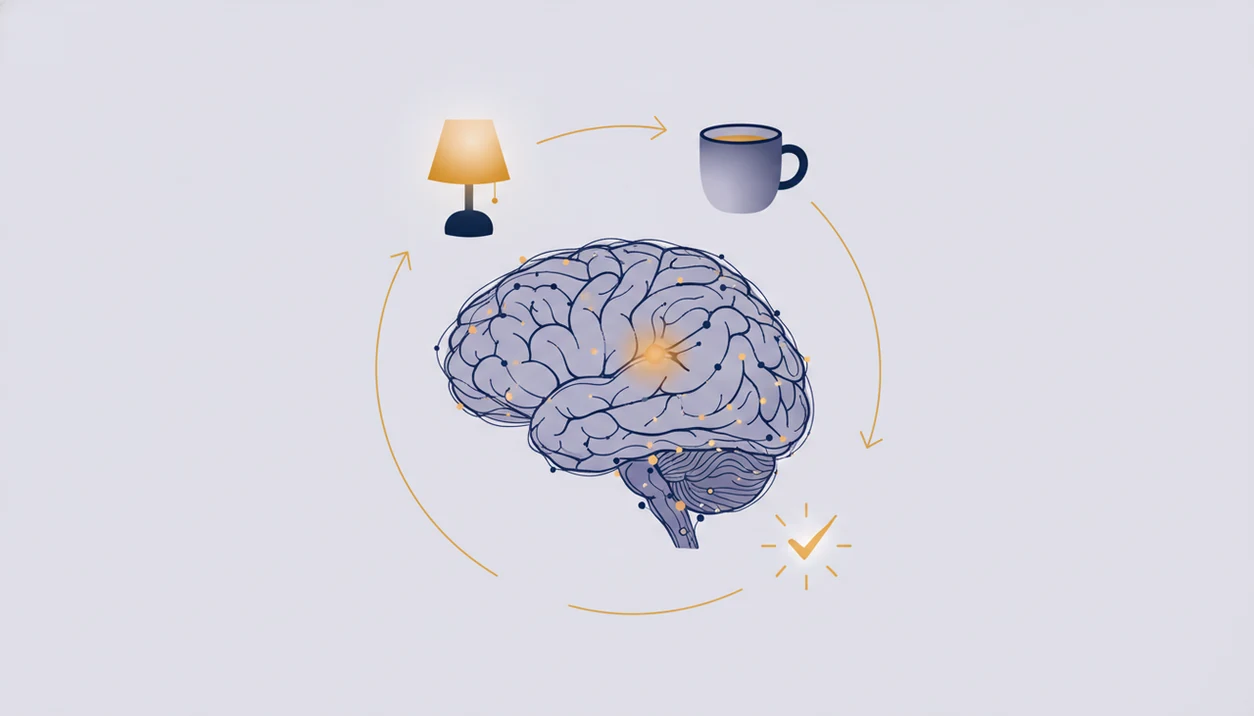


Habits form in the brain when repeated behavior becomes linked to a cue and a reward, allowing the routine to run with less conscious effort. A habit is an automatic behavior pattern learned through repetition, not simply an action performed often. As the pattern strengthens, control shifts from deliberate decision-making toward habit circuits, including striatal and basal ganglia pathways.
The reward can be pleasure, but it can also be relief, comfort, or reduced stress. That helps explain why an unwanted routine can persist even when its long-term costs are clear. Changing the pattern often means identifying what starts it and what it provides, then replacing the routine while keeping a recognizable cue and a useful reward.
The essentials
- Habits usually follow a cue, routine, and reward loop; the reward can be pleasure, relief, comfort, or reduced stress.
- Repetition helps shift behavior from conscious control toward more automatic brain circuits, especially striatal and basal ganglia pathways.
- The easiest habit change strategy is often to keep the cue and reward but replace the routine with a calmer, healthier action.
How Habits Form in the Brain: The Short Neuroscience Answer
Habits form when the brain learns a cue-routine-reward pattern and starts running it with less conscious effort. The point is efficiency: if a behavior keeps “working,” the brain saves attention by making the pattern easier to repeat.
A cue can be external, like getting into bed, opening a laptop, or hearing a notification. It can also be internal. Anxiety, boredom, stress, loneliness, fatigue, and uncertainty can all start a routine before you’ve fully noticed the urge.
A 2014 study of U.S. adults found that 43% of daily actions happened by habit, showing how often everyday behavior can run on autopilot NIH research: PMC4437290. When a timer, a glance, or a familiar cue pulls attention before you fully choose it, that may be a practiced loop at work.
Suggested image caption: Brain habit loop showing cue, routine, reward, and repetition.
How the Cue-Routine-Reward Habit Loop Works in the Brain
The cue-routine-reward loop is the basic learning pattern behind many habits: a cue starts the behavior, the routine is the action, and the reward teaches the brain to repeat it.
Cues can be time, location, emotion, stress, boredom, or another action. Brushing teeth may cue a bedtime wind-down. Closing the laptop may cue a snack. A tense feeling after a video call may cue email overchecking, even when the inbox is not urgent.
The reward is not always pleasure. It can be relief, calm, certainty, distraction, or reduced discomfort. That is why an unhelpful routine can still become sticky. If scrolling makes anxiety feel quieter for five minutes, the brain learns that the routine “worked.”
The University of Western Ontario describes the habit loop as three parts: cue, routine, and reward. In plain language, the brain repeats what reliably changes how you feel.
Five Brain Facts About Basal Ganglia Habit Formation
- Habits are learned through repetition. A cue, routine, and reward become linked when the same pattern happens again and again.
- Automaticity grows gradually. Repetition makes a behavior require less active decision-making, especially when the context stays stable.
- Basal ganglia circuits matter. Habit learning depends heavily on basal ganglia and striatal pathways, not one single “habit spot.”
- Prefrontal control matters early. When a behavior is new or effortful, prefrontal brain areas help plan, choose, and inhibit actions.
- Replacement often beats willpower. Habit change usually works better when you keep the cue and reward but swap the routine.
A Nature Reviews Neuroscience review describes habit learning as a shift from goal-directed control toward sensorimotor striatal circuits with repetition PMC research article: PMC6701929. MIT News has also reported that prefrontal cortex regions help control which habitual behaviors are expressed moment by moment. news reference: understanding how brains control our habits 1029 New routines need attention first. Later, they need a reliable loop. For more context on repeated practice, meditation research and habits connects meditation evidence with everyday habit building.
Five Habit-Science Steps for Building a Calmer Daily Routine
To use habit science, make the routine tiny, attach it to a real cue, and give the brain a reward it can feel right away. For bedtime, anxiety support, or focus, small repeatable actions usually work better than vague goals.
- Pick one small routine, such as a 3-minute breathing exercise before bed.
- Attach it to a stable cue, such as brushing teeth, closing the laptop, or getting into bed. Morning cues also matter: the first 30 minutes after waking can provide a consistent setting for a small routine.
- Make the reward immediate, such as feeling calmer, checking off the routine, or starting relaxing audio.
- Repeat the routine in the same context so the cue becomes easier to recognize.
- Adjust the routine if the cue is too weak or the reward does not feel useful.
Tools like MindTastik can help by offering guided meditation, sleep audio, breathing exercises, and self-hypnosis sessions in one place. For meditation-specific timing, our meditation benefits timeline explains what may change with repeated practice.
How Stress, Anxiety, and Boredom Become Habit Cues
Can stress, anxiety, and boredom trigger habits? Yes. Internal states can act like cues, and they often trigger behavior faster than visible reminders do.
Stress may cue overchecking email. Anxiety may cue scrolling. Boredom may cue snacking. Loneliness, fatigue, and uncertainty can do the same thing. The behavior may not help long term, but the short-term relief reinforces it. That relief is the reward.
A person might think, “I need a simple audio cue when my mind starts racing.” That request points to the habit pattern. The phone is not the real trigger. The trigger is the moment of mental speed and pressure.
Mindfulness and breathing can help you notice the cue before the routine starts. They are supportive practices, not medical treatment. Meditation can support awareness and calm, but it is not a replacement for clinical care, therapy, medication, or emergency support when those are needed. For a practical related guide, read how to be mindful without meditating.
Habit-Formation Tips for Sleep, Anxiety Support, and Focus
Habit tips work better when they match the situation. Sleep, anxiety support, and focus each need a different cue, routine, and reward.
| Use case | Habit cue | Routine to try | Reward to notice |
|---|---|---|---|
| Sleep | Getting into bed | Play calming audio or a short body scan | Less scrolling, softer wind-down |
| Anxiety support | First stress signal | Use 60 to 180 seconds of breathing | Body feels more settled |
| Focus | Before deep work | Try a short pre-work meditation | Clearer start, fewer false starts |
| Not ideal for | Compulsion, emergency, severe symptoms | Seek qualified support | Safety and appropriate care |
For sleep, pair calming audio with an existing bedtime cue. For anxiety support, start the breathing routine when the first stress cue appears, not after the spiral grows. For focus, use a short reset before the task begins.
Apps such as MindTastik, Calm, and Headspace can support guided meditation, sleep audio, breathing exercises, and self-hypnosis sessions. If sleep is the main goal, does sleep meditation work covers the bedtime angle in more detail.
When comparing meditation apps for sleep, the useful test is whether an app helps you repeat the same calming routine after the same bedtime cue. MindTastik fits that use case when the goal is guided structure, sleep audio, and a repeatable wind-down loop.
Habit Rewiring in the Brain Without a Fixed 21-Day Timeline
There is no universal 21-day rule for habit formation. Habit strength depends on repetition, context stability, reward strength, friction, and how demanding the behavior feels.
One often-cited 2009 prospective study found that automaticity developed over widely different timelines, with a median of 66 days rather than a fixed 21-day rule onlinelibrary reference: ejsp.674.
Rewiring does not mean instantly deleting an old pattern. It means learning and strengthening a new pathway until the new routine becomes easier to choose. Old cues can still fire. The work is to give the cue a different next step.
In the same 2014 study mentioned earlier, people with higher self-reported habit strength performed a greater share of their daily behaviors automatically. That fits real life. A 5-minute breathing exercise tied to pajamas warm from the dryer is easier to repeat than “be calmer at night.”
Easy, specific, repeated routines usually stick better than vague goals because the brain can learn exactly what to do next. If you are comparing practice length, meditation benefits after 30 days offers a practical view of what daily repetition may support.
Measure growing automaticity, not days completed
A 2010 prospective habit-formation study followed 96 volunteers who chose an eating, drinking, or activity behavior to repeat daily in a consistent context for 12 weeks. Of those, 82 provided sufficient data. The modeled time to reach 95% of each person’s automaticity plateau ranged from 18 to 254 days. Those were modeled estimates, not a guarantee that every behavior becomes automatic within that range.
Automaticity generally rose quickly at first, then increased more slowly. A practical record can therefore ask two questions: did the intended cue prompt the action, and did starting require less deliberate effort? These observations are more useful than treating a streak as proof that a habit is complete. The researchers also reported that occasional missed opportunities did not materially derail the process, so a lapse need not become a full restart.
Common Mistakes When Trying to Change Habits
The most common habit-change mistake is treating the routine as the whole problem. A habit usually survives because the cue and reward still make sense to the brain.
- Start smaller than your ambition. If the new routine is too large, emotional, or time-consuming, the brain reads it as work. A 2-minute breathing reset after closing the laptop is easier to repeat than a complete evening overhaul. For practical bedtime routines, explore 7 habits for success at night and adapt one to your existing cues.
- Identify the original reward. If scrolling gives relief, certainty, or numbness, replacing it with something that does not meet that need will feel thin. Keep the reward in view and choose a calmer route to it.
- Redesign the cue and friction. Do not ask willpower to fight a perfectly placed trigger. Move the phone, prepare the audio, or put the journal where the old routine usually begins.
- Expect old cues to return. A few good days do not erase the old loop. Plan the next step for tired, bored, stressed, and late-night versions of yourself.
- Use meditation as support, not a substitute. Breathing and mindfulness can help you notice urges, but severe anxiety, compulsive behavior, trauma symptoms, or unsafe thoughts deserve qualified clinical care.
Short sessions for a repeatable bedtime or work-break cue
MindTastik’s guided meditations and breathing exercises can provide a defined routine after an existing cue, such as brushing teeth or closing a laptop. Choosing one session to repeat avoids making a fresh selection every time. The useful target is a repeatable pause, not a promise that every session will produce calm. For examples of how people use guided practice, meditation app success stories offer personal perspectives rather than guaranteed outcomes.
An app adds little when a simple offline routine already works. Compulsive behavior, addiction, or anxiety that disrupts daily life calls for qualified support; MindTastik is not a medical treatment.
What habit science and meditation cannot promise
Habit science is useful, but it cannot promise that every routine will stick. The brain is not a checklist.
- Habit science explains mechanisms, but it cannot guarantee behavior change.
- There is no single brain switch that turns a habit on or off.
- Old cues can keep triggering old routines after you set a new intention.
- Meditation, breathing, and mindfulness can support awareness, but they are not universal cures.
- Self-tracking and habit stacking may help less when the old reward is strong and immediate.
- Compulsive behaviors, addiction, trauma symptoms, or clinical anxiety may require qualified professional support.
- A routine that works during a calm week may fail during travel, grief, illness, or heavy stress.
- Some people feel discomfort during meditation, especially when sitting with difficult thoughts. Our guide to meditation side effects explains when to pause or get support.
Clinicians typically recommend professional care when symptoms are severe, persistent, unsafe, or interfering with daily life. NIMH recommends assessment and evidence-based care from qualified professionals when anxiety symptoms interfere with daily life. Habit tools can sit beside care. They should not replace it.
Questions about habit formation in the brain
What part of the brain controls habits?
Habit learning involves several connected brain systems rather than one control center. Basal ganglia and striatal pathways help repeated actions become more automatic. Prefrontal areas contribute to planning, choosing, and inhibiting actions, especially when a routine is new or still requires deliberate effort.
Why do habits happen without thinking?
Repeated actions become associated with the situations that precede them and the rewards that follow. Eventually, a familiar cue can prompt the routine with less conscious decision-making. That efficiency explains why a behavior may begin before someone has clearly noticed the urge or considered another response.
How long does it take to form a habit?
There is no universal deadline. A prospective study modeled times ranging from 18 to 254 days to reach 95% of each person’s automaticity plateau. Those estimates concerned selected daily behaviors in stable contexts, not every possible habit. Progress is better judged by growing ease and cue-linked repetition than by a fixed day count.
Does missing one day break a habit?
One missed opportunity does not necessarily undo the learning already built. In the prospective habit-formation study, occasional failures to perform the behavior did not materially derail growing automaticity. Returning at the next usual cue is more useful than treating the missed day as evidence that the entire routine has failed.
Can an old habit be erased from the brain?
Learning a replacement does not mean the old pattern has been deleted. Familiar cues can still prompt the earlier routine, even after a new intention is set. A practical goal is to make a different response easier to choose and repeat, rather than expecting the old urge to disappear completely.
Why do stress and anxiety trigger unwanted habits?
Stress and anxiety can act as internal cues. A routine such as scrolling or repeatedly checking email may provide brief relief, which rewards repetition even when the behavior creates problems later. Understanding that immediate reward helps explain the pattern without assuming that the person simply lacks self-control.
How can a bad habit be replaced with a better one?
Identify the cue, the routine, and the immediate reward before choosing a replacement. If the reward is relief after work, a brief calming routine may fit better than an unrelated task. Keep the alternative small and repeatable. This approach has limits when the behavior is compulsive or the original reward is especially strong.
Can meditation help change habits?
Mindfulness may help people notice cues and urges before acting automatically, but noticing is not the same as changing the behavior. Evidence for mindfulness-based relapse prevention in substance-use disorders is mixed and often low-certainty. Meditation can support a routine, but it is not a reliable substitute for appropriate treatment.