
City Rain Soundscape for Calm, Sleep, and Meditation
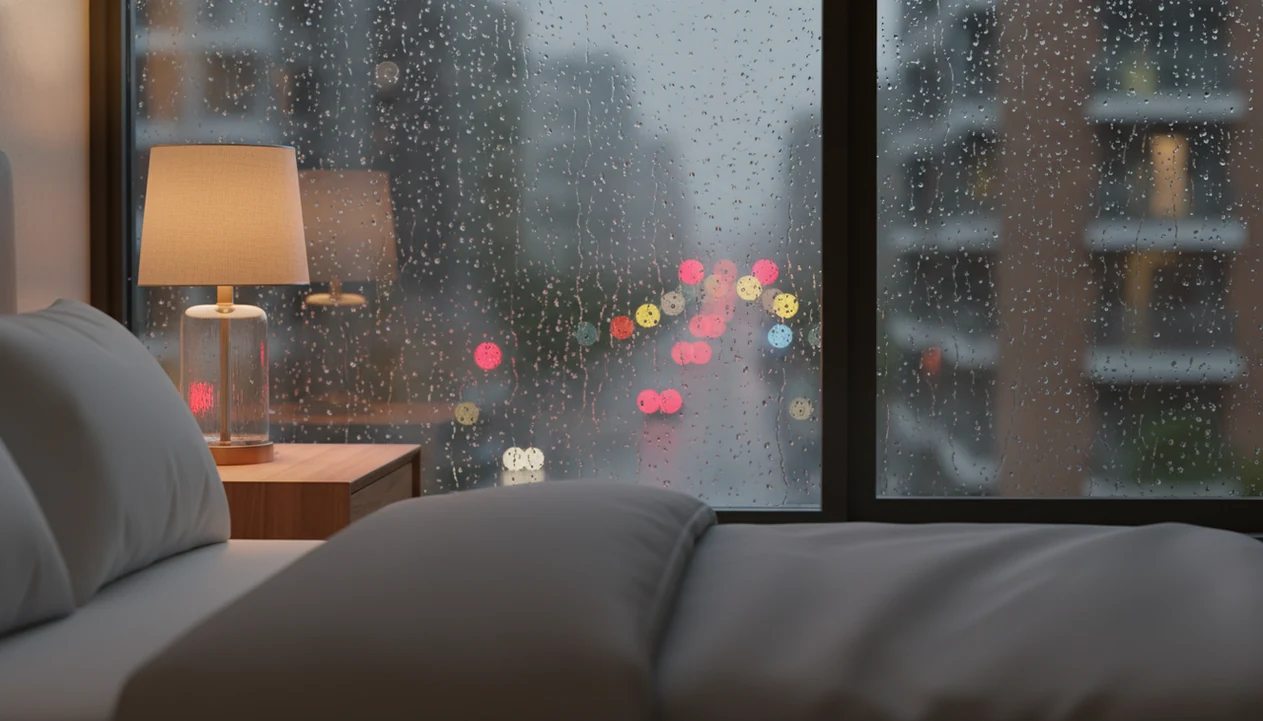


A city rain soundscape is a continuous ambient audio track that blends steady rainfall with distant traffic hum and gentle urban noise for relaxation, sleep preparation, or meditation. It gives a quiet bedroom, office, or apartment a soft background without adding music or conversation. The useful version is uneventful: rain stays consistent, traffic remains distant, and there are no sudden sirens, thunderclaps, or sharp changes in volume.
Keep playback low to moderate, loud enough to soften distracting sounds rather than cover everything. City rain sounds can accompany a guided bedtime meditation, breathing exercise, or body scan. When bedtime worry is the main problem, a voice-led practice provides something to follow that ambient rain alone does not.
The essentials
- Choose steady rain and distant city texture, not dramatic storm audio with thunder or sirens.
- Use a low-to-moderate volume; louder is not better for sleep or hearing comfort.
- Pair rain ambience with guided meditation, breathing, or a body scan when anxiety or bedtime rumination is the main problem.
What a City Rain Soundscape for Calm Actually Includes
A city rain soundscape for calm usually combines gentle rainfall, distant traffic, muted room tone, and soft window ambience into one steady audio bed. The goal is not drama. It is a stable background that makes a bedroom, office, or apartment feel less exposed. For daytime tasks, try ambient sounds for focus that stay steady without drawing attention away from your work.
Most tracks run 30 to 180 minutes, though some loop much longer. A good loop should feel almost invisible. In a dark room with a speaker set low, the steady rain rhythm should continue without a noticeable break that pulls your attention back to the clock.
People search for this same format as urban rain sounds for sleep, rain ambience meditation, city rain meditation audio, or rain soundscape for bedtime. Those phrases point to the same need: steady sound without surprise.
Calming urban rain is different from storm videos. Thunder cracks, horns, sirens, and sudden volume spikes can pull attention back to the room.
How City Rain Soundscapes Work for Sleep and Calm
City rain soundscapes work mainly through sound masking and predictability. Steady ambient noise lowers the contrast between quiet and sudden sounds, so a door click, hallway voice, or passing car may feel less sharp.
- Sound masking: A stable rain bed can make intermittent noise less noticeable, especially in apartments or shared buildings.
- Predictability: The brain often tunes out low-variation sound more easily than irregular noise.
- Consistency matters: The calming effect comes from controlled repetition, not from rain being inherently special.
- Broadband noise evidence: A 2018 laboratory study found that steady broadband noise reduced awakenings caused by environmental sounds in sleeping adults PubMed research: 29609737.
- Pink noise evidence: In a 2021 randomized trial, 30 minutes of pink noise at bedtime was linked with a 38% reduction in time to fall asleep and better sleep continuity PubMed research: 33500279.
The most useful rain soundscape is steady enough to become forgettable, while still present enough to soften the room.
Natural-sound research does not prove city rain improves sleep
A 2021 review of 18 publications on natural sounds found associations with lower stress and annoyance, along with improvements in health and positive-affect outcomes. The recordings included water, birdsong, and other natural sounds. That supports considering gentle rain as a relaxation aid, but it does not establish that a rain-and-traffic recording improves nighttime sleep or that rain is the best sound for every listener.
The urban layer also deserves separate attention. A 2025 forest-versus-industrial sound study found better mood, perceived restoration, and cognition with forest recordings, but no significant differences in several physiological measures, including heart rate and cortisol. It did not test this particular city rain format. Familiar traffic may feel comfortable to some listeners, but adding traffic should not be assumed to strengthen rain’s calming effect.
Best Uses for Urban Rain Sounds for Sleep and Meditation
Urban rain sounds are most useful when silence feels too bare, but music or spoken audio feels too active. A rain soundscape for bedtime can be a gentle transition into rest, not a guaranteed sleep cure. If steady rain feels too plain during work or study, compare it with focus music at a comfortable volume.
| Use case | Why city rain helps | Better alternative if it distracts |
|---|---|---|
| Bedtime wind-down | Creates a steady cue that the day is ending | A guided sleep session or nature sounds bedtime routine |
| Background meditation | Provides a soft anchor while breath or body scan remains primary | Silence or a voice-led practice |
| Noisy apartment masking | Reduces contrast from neighbors, doors, and street noise | White noise or fan sound |
| Focused reading | Adds texture without lyrics or plot | ambient sounds for focus meditation |
| Post-work decompression | Helps mark the shift from work mode to home mode | Short breathing exercise |
For meditation, rain ambience should sit behind the practice. The breath, body scan, or guided session still gives the mind a place to return.
Best For and Not For: City Rain Meditation Audio Fit
City rain meditation audio fits people who want familiar, steady background sound, but it is not calming for every nervous system. Sound sensitivity is personal. One listener hears soft rain; another hears traffic rumble.
Best for
| Best for | Why it may fit |
|---|---|
| Adults who dislike silence | The room feels less empty without adding lyrics or conversation. |
| City dwellers | Distant urban texture can feel familiar rather than intrusive. |
| Light sleepers | Steady masking may soften intermittent noises. |
| Beginners | Rain can provide a simple backdrop for guided meditation. |
Not for
| Not for | Why it may not fit |
|---|---|
| Traffic-sensitive listeners | Low rumble may feel irritating or alerting. |
| People with misophonia | Repeating textures can become hard to ignore. |
| PTSD-related sound sensitivity | Sirens, engines, or storm cues may feel unsafe. |
| Low-frequency sensitivity | Bass-heavy recordings can feel physically uncomfortable. |
| Silence-dependent sleepers | Any audio may keep attention active. |
How to Use a Rain Soundscape for Bedtime
Use a rain soundscape for bedtime as a low-volume cue, not as a wall of sound. Small clinical studies have found that continuous white noise can improve sleep-quality scores in noisy care settings, while the World Health Organization’s night-noise guidance treats higher overnight noise exposure as a health concern WHO report: 9789289041737.
- Set the volume low. Start quieter than expected, then raise it only enough to mask the most distracting sound.
- Choose steady rain without thunder. Skip tracks with sirens, horns, dramatic storms, or sudden stereo jumps.
- Start 20 to 30 minutes before bed. Let the sound become part of the wind-down routine, not a last-second fix. A nature sounds bedtime routine can pair gentle rain with consistent timing and a quieter evening environment.
- Pair it with breathing or a body scan. If thoughts are loud, structured guidance often helps more than ambience alone.
- Use a sleep timer or speaker when possible. Avoid relying on in-ear headphones all night if they cause pressure or discomfort.
The sleep timer set for twenty minutes is often enough.
How Rain Ambience Meditation Pairs With MindTastik Sessions
Rain ambience meditation works well when the rain is the background layer and the session provides the structure. A guided meditation, breathing exercise, body scan, or bedtime session gives the mind something specific to follow.
MindTastik offers guided wellness audio, sleep soundtracks, breathing practices, and self-hypnosis sessions for adults looking for support with rest, stress, and everyday calm.
MindTastik can pair rain ambience with a timed, voice-led sleep meditation, giving listeners a practice to follow rather than relying on the rain track alone.
Many people do not need more sound. They need pacing. Someone looking for a track to steady the mind at night may benefit from rain sitting quietly beneath a calm voice, especially when tomorrow’s messages begin circling after the lights are out.
A 2015 meta-analysis of 18 randomized controlled trials found moderate improvements in sleep quality from mindfulness and meditation-based interventions JAMA Internal Medicine study: 2093591. For broader comparisons, a sleep soundscapes meditation app can help you match audio style to bedtime needs.
Sound Settings for Safer City Rain Soundscape Listening
Safer city rain listening starts with calibration: rain intensity, traffic hum, thunder absence, stereo movement, and loop consistency all change how the track feels. Louder audio is not more relaxing. It can become the thing your body has to tolerate. If you prefer tonal audio, compare rain with 528 Hz sounds, keeping volume comfortable and expectations realistic.
- Rain intensity: Choose steady rainfall over heavy downpour if you are trying to sleep.
- Traffic hum: Keep urban texture distant, not engine-heavy or bass-forward.
- Thunder absence: Avoid sudden cracks if your goal is calm or bedtime preparation.
- Stereo movement: Pick gentle, stable recordings instead of binaural street scenes that move sharply across headphones.
- Loop consistency: Use tracks that repeat smoothly without obvious resets.
Start quieter than you think you need. Raise the volume only until hallway noise or outside traffic feels less distinct.
If the recording makes you notice bus brakes, radiator hum, or a repeating drip pattern, it is probably too detailed for bedtime.
Speakers, bedside playback, or a timer are usually easier on the ears than in-ear devices for the whole night. If rain is too textured, rain sounds for sleep meditation may help you compare simpler options.
When city rain needs a guided practice
MindTastik’s guided meditations, breathing exercises, and sleep sessions suit listeners who like rain ambience but need a clear practice to follow. A body scan can keep attention on physical sensations, while guided breathing exercises give the session a defined focus. Keep the rain quieter than the voice. People who find speech distracting may prefer sound alone; those irritated by traffic hum may prefer a nature recording or silence. Neither option is a medical treatment.
When city rain sounds distract or fail to help
City rain ambience is a supportive practice, not medical care. It can help some people settle, but there are real limits.
- City rain ambience does not cure chronic insomnia, anxiety disorders, trauma symptoms, or medical sleep problems.
- Sudden thunder, sirens, horns, or sharp volume changes can increase arousal instead of reducing it.
- Some people with misophonia, PTSD-related sound sensitivity, tinnitus concerns, or low-frequency sensitivity may dislike urban rain.
- Loud playback or all-night in-ear headphone use can cause ear discomfort, pressure, or hearing strain.
- Adapting to one specific track can make travel, outages, or nights without audio feel harder.
- A track that helps one week may feel distracting during illness, grief, stress, or schedule changes.
- Persistent, severe, or impairing sleep and anxiety symptoms deserve support from a qualified health professional.
If the sound makes you scan the room for details, stop using that track. Try silence, a simpler noise source, or the white noise vs meditation comparison instead.
Three short ways to pair city rain with a practice
| Technique | Best for | Minutes |
|---|---|---|
| Rain plus slow exhale | settling after a busy commute or noisy evening | 3-5 min |
| Urban rain under guided voice | bedtime meditation when silence feels too stark | 8-12 min |
| Low-volume rain loop | background calm during a short reset | 10-20 min |
If you want narration instead of instruction at bedtime, MindTastik sleep stories is a practical place to start inside MindTastik.
City rain sound questions
Are city rain sounds good for sleep?
They may help when intermittent hallway or street noise makes a quiet room feel unsettled. Steady rain can soften the contrast between silence and those sounds. Evidence for continuous background noise improving sleep is inconsistent, so judge the recording by comfort and sleep quality rather than assuming it will help.
What volume should city rain sounds be at night?
Start low and increase only enough to make distracting background sounds less noticeable. A useful upper reference is background-conversation level, not a volume that fills the room. Place a speaker away from the bed. Raising the volume to cover every outside sound can make the recording itself intrusive.
Should rain sounds play all night or stop on a timer?
A timer is a sensible starting point if rain is mainly a bedtime cue. Continuous playback is not necessary for everyone, and louder or longer listening is not automatically better. If the recording causes discomfort or seems to interrupt sleep, shorten playback, lower the volume, or try sleeping without it.
Are city rain sounds better than white noise?
Neither is reliably better for everyone. City rain adds recognizable texture, while white noise offers a more uniform sound. Distant traffic may feel familiar to one listener and irritating to another. Choose the quieter, steadier option that makes unwanted noise less noticeable without becoming a distraction itself.
Can city rain sounds help with anxiety at bedtime?
Rain may provide a comfortable background, but it does not treat an anxiety disorder. If thoughts remain active, a guided breathing practice or body scan adds a specific task for attention. Traffic rumble, sirens, or thunder may have the opposite effect, particularly for people with sound sensitivity.
Is it better to use a speaker or earbuds for rain sounds?
A speaker away from the bed is a practical first choice for bedtime listening. All-night in-ear listening can cause discomfort or pressure, and personal devices can reach high volumes. If using earbuds, keep playback low, consider a timer, and stop if the ears feel uncomfortable.
What should a city rain recording include for meditation?
Look for steady rainfall, distant rather than prominent traffic, and a loop without obvious breaks. Avoid sudden horns, thunder, sirens, or sharp stereo movement. During breath meditation or a body scan, keep rain in the background so it does not compete with the practice or a guided voice.