
Creative Expression Benefits for Stress, Sleep, Anxiety, and Everyday Calm
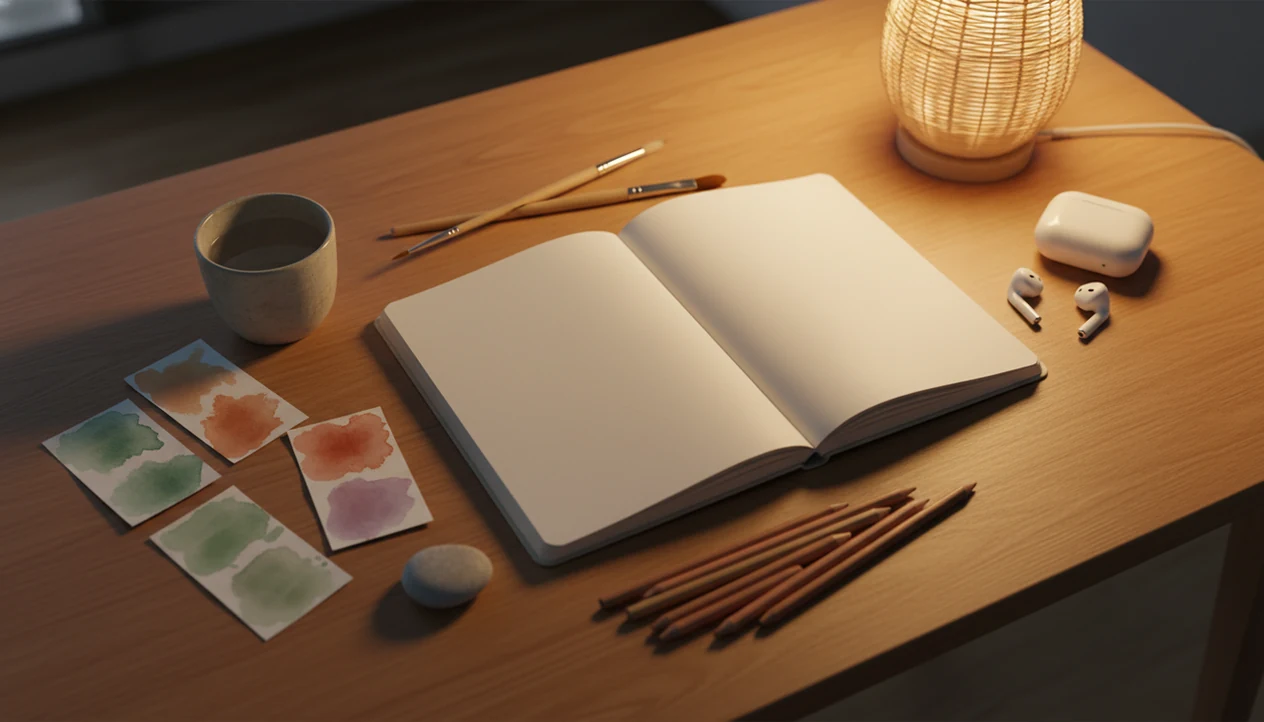


Creative expression benefits can include lower stress, a calmer mood, easier emotional processing, and a practical way to unwind before sleep. Creative expression means using drawing, journaling, music, dance, crafting, or storytelling to explore feelings, focus attention, and support emotional regulation. Artistic talent is not a requirement: the aim is attentive making, not an impressive finished piece.
A short, repeatable activity can give difficult feelings an outlet without requiring an immediate solution. Doodling may suit a restless afternoon; quiet writing or gentle music may fit a bedtime routine. Pairing the activity with breathing or meditation can add a clear beginning or ending. These practices support well-being, but they do not replace therapy, medical care, or crisis support when symptoms are severe.
The essentials
- Creative expression can reduce stress and anxiety by giving emotions a safe outlet and encouraging a focused flow state.
- Short creative routines work best when they are simple, repeatable, and paired with calming habits like breathing, meditation, or sleep audio.
- Creative expression supports well-being, but it is not a substitute for therapy, medical care, or crisis support when symptoms are severe.
Creative Expression Benefits: Five Evidence-Backed Facts
- Stress can drop during art-making. A randomized trial found that 45 minutes of creative art-making reduced cortisol, a key stress hormone, in many adults with anxiety and stress PubMed research: 28325736.
- Anxiety may feel more manageable. A 2020 meta-analysis of 81 art therapy studies reported a moderate effect for reducing anxiety and improving psychological well-being PubMed research: 33427428.
- Mood often lifts through process, not talent. The drawing does not need to be good. The nervous system responds to attention, rhythm, and expression.
- Focus can improve during “flow.” Simple making tasks, like coloring or shaping clay, give the mind one place to land.
- Sleep wind-down can become easier. Low-pressure journaling or slow doodling can help shift from problem-solving mode to rest mode.
The page on meditation benefits timeline covers how calm habits may build over time. Creative routines work the same way for many people. Small repeats matter.
Not gallery work. Just practice.
What broader well-being research can and cannot show
Research on well-being exercises provides useful context, but it is not all research on creative expression. A 2021 review of psychological interventions found that effects varied with the population and intervention intensity, with overall benefits generally moderate at best. Findings about structured mindfulness or positive-psychology programs should not be presented as proof that a few minutes of drawing will produce the same result.
The same caution applies to promises about stress relief. A review of positive-psychology interventions in people with clinical disorders found modest improvements in well-being, depression, and anxiety, but no statistically significant stress effect. That review did not evaluate creative expression as a single practice. A useful personal goal is therefore modest and observable, such as finding an outlet for a feeling, rather than expecting every session to improve mood.
Brain and Body Mechanisms Behind Creative Expression Benefits
Creative expression works by giving the nervous system a concrete anchor: a sound, movement, image, texture, or sentence that narrows attention and reduces rumination. In plain terms, it helps the brain stop looping and start noticing.
Several mechanisms overlap here: flow, emotion labeling, and sensory regulation. Flow is the absorbed state that can happen when the task is clear and not too hard. Emotion labeling means naming what is present, such as “tight,” “sad,” or “restless,” before reacting. Sensory regulation is the calming effect of repeated movement, texture, sound, or rhythm.
A person coloring the same small corner of a page for five minutes may be doing more than “keeping busy.” They are narrowing attention. They are giving their body a slower signal.
Creative expression is not identical to meditation, but it can feel mindful. For people who find silence uncomfortable, a pencil, song, or simple craft can become the anchor.
Creative Expression Benefits Guide for Anxiety, Stress, Mood, and Sleep
Creative expression benefits are easiest to use when the activity matches the need. Anxiety often needs grounding; stress often needs release; sleep needs less stimulation.
| Goal | Creative practice to try | Why it may help |
|---|---|---|
| Anxiety | Doodling, coloring, grounding drawing, gentle movement, music listening | Gives attention a steady target and may reduce mental spinning |
| Stress | Expressive writing, simple crafting, painting, clay-like tactile work | Offers an outlet for pressure without needing a solution |
| Mood | Music, collage, dance, gratitude sketching, playful photography | Adds movement, pleasure, memory, or novelty |
| Sleep | Low-light journaling, slow coloring, calming audio | Supports a wind-down routine without turning bedtime into a project |
At bedtime, keep the task boring in a good way. Phone face-down on the nightstand, one dim lamp, no “I must finish this” energy. If sleep is the goal, the question is not “Is this beautiful?” It is “Does this help me soften?”
Five Beginner Creative Expression Activities for Everyday Calm
Start with the easiest activity, not the most impressive one. Creative expression benefits usually come from repeatable contact with the practice. Reducing energy-draining habits may leave more room for a simple, low-pressure creative activity.
- Freewriting: Best for people with crowded thoughts. Write for three minutes without fixing grammar or making a point.
- Mindful doodling: Best for people who want something visual but low-stakes. Repeat circles, lines, leaves, or boxes.
- Music listening: Best for people who feel calmer through sound. Choose one track and listen without multitasking.
- Gentle movement: Best for restless bodies. Slow stretching, swaying, or simple dance can release held tension.
- Simple crafting: Best for hands-on focus. Folding paper, threading beads, or arranging scraps can be enough.
One caution: emotionally intense writing can stir up more than expected. Performance pressure can do the same. If you start judging the output, shrink the task until it feels manageable again. Recognizing habits that cause stress can help you keep creative practice gentle rather than performance-driven.
Reset the plan.
Six-Step Creative Expression Routine for Everyday Calm
A good creative routine is short, repeatable, and easy to begin when your energy is low. For busy days, three to ten minutes is enough to keep the habit alive. The 21/90 rule for calm habits offers a framework for repeating a short creative routine.
- Set one clear purpose, such as “settle after work” or “wind down before bed.”
- Choose one low-pressure activity, like freewriting, doodling, humming, or slow coloring.
- Breathe for 30 seconds before starting, using a longer exhale than inhale.
- Create for 3 to 10 minutes without editing, rating, or sharing the result. When motivation is low, choosing small consistent efforts over doing nothing can help maintain your routine.
- Reflect with one sentence: “After this, I notice ___.”
- Repeat at the same cue, such as after a shower, after a video call, or before sleep audio.
Creative practice usually works best when it is paired with a steady cue, while open-ended “I’ll do it sometime” plans are easier to forget. If meditation helps you settle first, the rhythm is covered in what happens when you meditate daily.
MindTastik Support for Creative Expression Routines
Apps can support creative routines by adding structure before and after the activity. MindTastik offers guided meditation, sleep audio, breathing exercises, and self-hypnosis sessions for adults looking for gentle support with rest, anxious moments, and everyday calm.
A simple pairing might be a five-minute breathing exercise, ten minutes of journaling, then a short sleep track. The app is not the creative act. It is the container around it.
A systematic review on smartphone-based mental health interventions found that apps teaching mindfulness and emotion-regulation skills produced small-to-moderate improvements in anxiety, depression, and well-being across trials NIH research: PMC8663676. That does not prove every app helps every person. It does suggest that reminders, mood check-ins, and structured sessions can support consistency.
For a broader look, read do meditation apps actually help.
For comparison, apps such as Calm and Headspace also offer mindfulness and sleep libraries; MindTastik is most relevant here when it is used as a simple breathing, meditation, or sleep-audio container around the creative practice itself.
Creative Expression Benefits for Focus and Cognitive Health
Does creative expression help focus and cognitive health? Creative practice can train sustained attention because it asks you to stay with a process, return after distraction, and notice details.
That can be useful during transitions. After work, a small sketch or song can mark the shift from task mode to calm mode. After rumination starts, arranging photos or stitching fabric can pull attention back to color, shape, and touch.
Hands unclench after a video call.
Research in older adults has also linked weekly artistic activities, such as painting, music, or crafts, with lower odds of cognitive impairment over several years PubMed research: 29056088. Because this was cohort research, it shows an association, not proof that art prevents cognitive decline. Still, it supports a practical point: regular, engaging hobbies may be part of a brain-healthy lifestyle.
For people building a broader routine, meditation benefits after 30 days explains what may change with repeated calming practice.
Best-Fit and Not-Fit Scenarios for Creative Expression Benefits
Creative expression fits best when the goal is support, not pressure. It is especially useful for people who want a low-cost outlet they can repeat at home.
| Best for | Not ideal for |
|---|---|
| Adults wanting a low-pressure stress outlet | Replacing therapy, medication, trauma treatment, or crisis care |
| People building a bedtime wind-down routine | Moments when symptoms feel severe, unsafe, or unmanageable |
| Anyone who dislikes silent meditation but can focus through hands-on activity | Activities that become competitive, perfectionistic, or self-critical |
| People seeking mood support through music, movement, writing, or craft | Projects that create more activation right before bed |
For silent-meditation skeptics, hands-on making is often easier than stillness because the body has something concrete to do. However, if the activity becomes another way to judge yourself, pause and choose something simpler.
A scribble counts.
Creative Expression Image Caption and Alt Text Example
Use image captions to describe the real scene, not to make health claims. A useful caption is specific, calm, and factual.
Caption example: A person sits beside headphones and a meditation app, doodling in a notebook after a short breathing exercise as part of a creative expression sleep wind-down routine.
Alt text example: Creative expression benefits routine with journaling, doodling, headphones, and calming audio before bed.
That image works because it shows the habit clearly. It does not imply that drawing treats insomnia or anxiety. The useful details stay simple: an open notebook, a soft reading light, and a timer set for a short session. A reader can imagine trying it tonight.
If bedtime audio is part of the routine, does sleep meditation work explains what it may and may not do.
Audio support before writing or drawing
MindTastik's guided breathing exercises can provide a brief starting point before journaling, sketching, or crafting. Guided meditation can also mark a pause after the activity, while sleep stories or soundscapes offer an option for an evening wind-down. The audio supports the routine rather than supplying the creative activity itself. People who prefer quiet can skip it; those seeking treatment for significant anxiety, insomnia, or trauma symptoms need professional care rather than an app.
When creative expression adds pressure or distress
Creative expression is supportive, but it has limits. That honesty matters, especially when stress, anxiety, sleep, or trauma symptoms are intense.
- Creative expression is not a stand-alone treatment for severe anxiety, depression, trauma symptoms, or crisis situations.
- If you feel unsafe or at risk of harming yourself or someone else, seek urgent professional or emergency support.
- Some exercises can temporarily increase distress, especially detailed autobiographical writing about painful events.
- Benefits vary by person, activity, timing, sleep level, and current emotional state.
- Some evidence comes from art therapy settings with trained professionals, which may not match casual at-home creativity.
- App-guided mindfulness and creativity combinations are promising, but more large long-term trials are still needed.
- Creative routines can become counterproductive if they trigger perfectionism, comparison, or harsh self-criticism.
- Bedtime projects that are too stimulating can delay sleep instead of supporting rest.
Clinicians typically recommend professional assessment when symptoms are severe, persistent, or interfering with daily life. Creative routines can sit beside care. They should not replace it.
Creative expression questions
What counts as creative expression?
Creative expression includes drawing, journaling, making music, dancing, crafting, and storytelling. The activity does not need to produce something for display or sharing. For a calming routine, the useful part is having a concrete way to explore feelings or focus attention, rather than meeting an artistic standard.
Do I need to be good at art to benefit?
No. A simple pattern, a few lines of writing, or gentle movement can be enough for a low-pressure creative practice. The goal is attention and expression, not technical skill. If judging the result becomes stressful, choose an activity with fewer decisions and no requirement to keep or share the finished work.
Which creative activities are best for anxiety?
Doodling, repetitive coloring, grounding drawing, gentle movement, and music listening are options when anxiety makes attention feel scattered. Pick one simple task rather than a demanding project. These activities may make anxious moments more manageable, but there is no single best choice, and they are not treatment for severe or persistent anxiety.
Can creative expression help with sleep?
Creative expression can be part of a bedtime wind-down, especially when the activity is quiet and low in stimulation. Low-light journaling, slow coloring, or gentle music may fit better than an absorbing project with a deadline. This is support for settling down, not evidence that creative activity alone treats insomnia.
How long should a creative expression session last?
The routine on this page suggests three to ten minutes as a manageable starting point, not a proven minimum dose. Choose one activity, leave editing or rating aside, and finish by noting how the session felt. A repeatable cue, such as after work or before bed, can make starting simpler.
What if journaling makes me feel worse?
Detailed writing about painful events can temporarily increase distress. Stop the exercise if it feels overwhelming, and consider a less emotionally demanding activity, such as repeating shapes or listening to gentle music. Creative expression does not require revisiting painful memories. Persistent distress or trauma symptoms call for professional support.
Is creative expression the same as art therapy?
This page describes everyday creative activities for support, not a course of therapy. Drawing or writing at home should not be assumed to offer the same benefits as a structured therapeutic intervention. Creative expression can sit alongside professional care, but it should not replace treatment for severe anxiety, depression, or trauma symptoms.