
Family Bedtime Meditation Routine for Parents and Kids
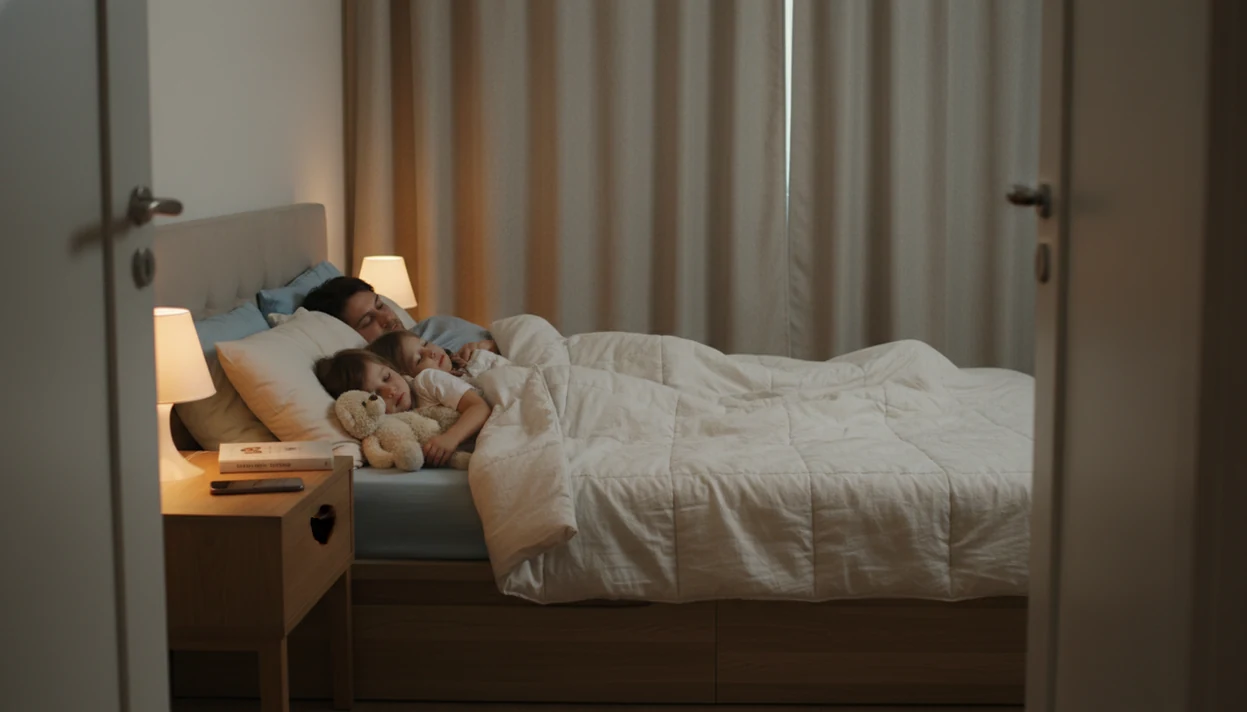


Family bedtime meditation is a short, shared wind-down in which parents and children use guided audio, gentle breathing, body relaxation, and calming imagery before lights out. A typical session lasts 5-15 minutes, though younger children may need less. The simplest version uses one guided track, one comfortable breathing pattern, and one repeated phrase that marks the end of the day.
The aim is a predictable bedtime, not perfect stillness or immediate sleep. Dim lights, silence notifications, and keep the screen out of sight once audio begins. Children can adjust a blanket or move quietly while listening. Meditation may help with settling and mild bedtime worry, but persistent sleep difficulties or significant anxiety need assessment rather than a longer track.
The bedtime essentials
- Keep the routine short: 5 minutes for young kids, 10 minutes for school-age children, and up to 15 minutes for teens and adults.
- Use audio-only mode, dim lights, and a single calm cue so the device supports sleep instead of disrupting it.
- Family meditation can support sleep onset and evening anxiety, but it is not a substitute for care when sleep or mental health symptoms are persistent or severe.
Family bedtime meditation routine in 5-15 minutes
A family bedtime meditation routine is a short, repeatable wind-down that parents and kids do together before lights out. Keep it to 5-15 minutes, with guided audio, slow breathing, dim light, and one phrase you repeat every night.
The phrase can be simple: “Our bodies are safe, our room is quiet, it’s time to rest.” Say it at the end of the track, not after ten more reminders. Consistency matters more than perfect stillness. A child can wiggle toes under the blanket and still be participating.
Dim the phone first.
Tools like MindTastik can provide app-guided sleep audio and breathing exercises, alongside options such as Calm or Headspace.
For this routine, choose an app that stays quiet, short, and audio-first once the track starts. MindTastik should be evaluated on those bedtime-specific basics: track length, low-screen use, breathing cues, and whether the routine is easy to repeat tomorrow.
How family sleep meditation works before bed
Family sleep meditation works by lowering stimulation, slowing breathing, and repeating the same bedtime sequence until the brain learns the pattern. In plain terms, the routine teaches the body, “this is what we do before sleep.”
Slow breathing can support nervous-system downshifting. Reduced light and fewer alerts remove the small jolts that keep everyone alert. A predictable sequence, pajamas, audio, breathing, phrase, lights out, also builds a learned association between the sound of the track and body relaxation.
The 2:13 a.m. lock-screen check feels different when the night started with scrolling. It usually feels louder.
Evidence in children is promising but mixed. A youth mindfulness meta-analysis found small to moderate improvements in anxiety and stress, with smaller and less consistent sleep effects (source). Adult insomnia research is stronger, with mindfulness-based approaches showing improvements in sleep quality and insomnia symptoms in clinical trials and reviews (source). For children, think ‘supportive practice,’ not guaranteed sleep fix.
What the evidence supports, and what it does not
Evidence for a predictable bedtime routine is not the same as evidence for a particular meditation track. The American Academy of Pediatrics recommends regular bedtimes and a consistent nightly sequence. Its Brush, Book, Bed guidance puts tooth-brushing, shared reading, and bed in a simple order. Family meditation can be one quiet part of that sequence, rather than replacing the practical steps that already help a household settle.
There is also research on mindfulness within structured sleep treatment for adolescents. In a randomized trial involving 123 adolescents aged 12-16, a program combining cognitive-behavioral sleep strategies with mindfulness improved self-reported sleep quality more than a study-skills comparison program. A secondary analysis of the adolescent sleep trial reported particular benefits among participants with higher anxiety or depressive symptoms. That finding does not establish that a short family audio session alone produces the same results.
5-step guided family calm routine
Use this guided family calm routine tonight if bedtime has started to feel scattered. The goal is not a flawless meditation; it is a repeatable landing strip for sleep.
- Set the room first. Dim lights, cool the room, silence notifications, and move bright screens out of sight.
- Choose one short track. Start with guided sleep audio or a breathing exercise lasting 5-10 minutes.
- Start with breathing. Try three slow “smell the flower, cool the soup” breaths before the story begins.
- Continue into relaxation. Use a sleep story, body scan, or gentle music cue, then let everyone stay still or move quietly.
- End with the same phrase. Put the device away from the bed in audio-only or night mode, then repeat one goodnight cue.
If your child needs a shorter entry point, a meditation for kids app can help you compare age-friendly audio lengths.
Bedtime meditation for parents and kids by age
Age matters, but one family routine can still work. The trick is to use child-friendly imagery on the surface and quiet body-awareness cues underneath for older kids and adults. For daytime connection, learning how to raise empathetic kids can help parents encourage listening and respect for others’ feelings.
| Age group | Good length | Helpful cues | What to allow |
|---|---|---|---|
| Preschool and early elementary | 2-5 minutes | Animal breathing, cozy cave imagery, soft counting | Quiet movement, stuffed animals, eyes open |
| School-age children | 5-10 minutes | Sleep stories, gratitude, balloon breathing | Whispered answers, blanket adjustments |
| Teens and parents | 10-15 minutes | Body scans, anxiety release, breath counting | Silence, earbuds, private reflection |
Preschool and early elementary cues
Younger children often do better with “bear breathing” or “balloon belly” than abstract mindfulness language. Restless legs under cool sheets are not a failure.
Teen and parent sleep cues
Older kids can handle longer pauses and body scans. For more age-specific ideas, meditation for teens sleep and stress can fit into the same family bedtime structure.
4 family mindfulness cues before bed
Use fewer family mindfulness cues before bed, not more. A crowded routine can turn calm into another task list.
- Balloon breathing. Kids imagine the belly filling like a balloon, then slowly softening. It fits preschool and school-age children.
- Sleepy body scan. Everyone notices the forehead, shoulders, belly, legs, and feet getting heavy. It works well for teens and adults.
- Safe-place story. The guide describes a calm beach, treehouse, or moonlit room. Younger kids usually respond fastest to this.
- Goodnight gratitude. Each person names one small good thing from the day. School-age children and parents often like this cue. You can extend gratitude into daytime habits by exploring how to teach kids kindness through small, thoughtful actions.
A short guided audio can combine all four without making the family memorize steps. If breathing is the easiest part, build from parent and child breathing exercises first.
3 family sleep statistics that make bedtime calm matter
Family bedtime calm matters because sleep problems and evening stress are common, not rare. Meditation is only one support, but it gives families something concrete to repeat.
- About 25% of children experience a sleep problem at some point during childhood, according to NHLBI sleep-health materials (source).
- In CDC survey data, 35.2% of U.S. adults reported sleeping less than 7 hours per night on average (source).
- CDC data report that 7.1% of U.S. children aged 3-17 have a current diagnosed anxiety problem (source).
- Family sleep meditation may support evening stress and sleep onset, but it should not be framed as a cure.
- For families with mild bedtime worry, a short shared routine is often easier than separate adult and child practices because everyone follows the same cue.
The need is practical. One parent said it plainly: “I just need something to play when my thoughts get loud.”
Common family bedtime meditation mistakes
The most common mistake is making meditation feel like a performance. Children do not need to sit perfectly still, fold their hands, or breathe on command for the practice to count.
Bright screens are another problem. If the audio starts, scrolling should stop. Notifications, autoplay previews, and glowing menus can undo the calm you are trying to build. Use audio-only mode, then place the phone away from pillows and curious fingers.
Long tracks can also backfire. A 25-minute body scan may suit an adult, but it can feel endless to a resistant six-year-old. Start smaller than you think.
Too much at once gets messy.
Avoid stacking breathing, gratitude, stretching, a story, a body scan, and journaling in one night. If the bed has become a conflict zone, begin the routine on a rug or chair, then walk into the bedroom after the audio.
Best-fit families for a guided calm routine
A guided family calm routine fits families who want a predictable, shared wind-down before sleep. It is less appropriate when symptoms point to a medical, developmental, or mental health concern that needs tailored care.
| Best for | Not ideal for |
|---|---|
| ✓ Families wanting a screen-free transition after evening busyness | ✕ Untreated sleep apnea, loud snoring, or breathing pauses |
| ✓ Mild bedtime worry or “one more question” spirals | ✕ Severe insomnia or sleep loss that keeps worsening |
| ✓ Parent-child connection without a long conversation | ✕ Frequent nightmares, panic, or crisis-level anxiety |
| ✓ Homes that need one routine for mixed ages | ✕ Situations needing clinical evaluation or therapy support |
Children with ADHD, autism, or sensory sensitivity may need movement-friendly, visual, or shorter routines. A family mindfulness routine can be adapted around pacing, picture cues, or a weighted blanket if that feels manageable.
Seek professional guidance sooner if a child has loud snoring, breathing pauses, frequent panic at bedtime, recurring nightmares, severe daytime sleepiness, or sleep loss that is affecting school, mood, or behavior.
MindTastik audio for a shared bedtime
MindTastik includes kids sessions, guided meditations, breathing exercises, and sleep stories. These are options for families who prefer spoken guidance to a parent leading every step. Choose one session rather than adding several activities to an already full bedtime routine.
Children who dislike narration may prefer quiet breathing, shared reading, or no audio. Families dealing with persistent insomnia, breathing pauses, or severe anxiety need clinical advice; MindTastik is not a medical treatment.
When a bedtime routine is not enough
Family bedtime meditation is a supportive practice, not a medical evaluation. It should not replace care for chronic insomnia, suspected sleep apnea, frequent nightmares, significant anxiety, depression, or any worsening sleep pattern.
- Evidence for children’s sleep benefits is limited and varied, so gains may be modest.
- Some children need movement-friendly routines instead of “lie still and listen” instructions.
- Sensory-sensitive children may need visual cards, lower volume, or no voice narration.
- Devices can harm sleep hygiene if screens, alerts, games, or bright light stay active.
- Too many exercises can make bedtime feel like another chore.
- Parents may need their own support if bedtime triggers stress, anger, or exhaustion.
- Persistent sleep problems that impair school, mood, behavior, or daytime functioning deserve professional guidance.
Clinicians typically recommend checking for medical or mental health causes when sleep problems are persistent, worsening, or paired with daytime impairment. Meditation can sit beside that care, not stand in for it.
Family bedtime meditation questions
How long should a child meditate before bed?
For preschool children, one to three minutes may be enough. School-age children can try several minutes, while teens may prefer a longer session. Treat these as starting points, not targets. Stop or shorten the practice if it becomes another source of bedtime resistance.
Should meditation come before or after a bedtime story?
Either order can fit a quiet routine. A simple sequence is tooth-brushing, a shared book, then a brief meditation before lights out. Keep the order consistent and avoid adding extra steps just to include meditation. It can replace another relaxation activity rather than extend bedtime.
What if a child will not lie still during meditation?
Stillness is not a requirement. A child can keep their eyes open, hold a stuffed animal, or move quietly while listening. Offer the practice without making it a test of obedience. If spoken guidance causes frustration, use a shorter breathing activity or another quiet bedtime option.
Can family bedtime meditation help with bedtime anxiety?
Gentle breathing and relaxation can be useful for mild bedtime worry. Discuss concerns briefly before lights out, acknowledge the feeling, and agree on a simple plan for the night. Persistent or severe anxiety, especially when it affects daytime functioning, needs professional assessment rather than meditation alone.
What breathing exercise is suitable for young children at bedtime?
Use a brief, playful cue such as slowly smelling a flower and gently blowing out a candle. Keep breathing comfortable rather than insisting on precise counts. A few gentle breaths can be the whole practice; children do not need to complete a long breathing sequence before resting.
Can a phone be used for bedtime meditation without keeping children awake?
A phone can provide audio, but the screen and alerts should not remain part of bedtime. Select the track first, dim the screen, silence notifications, and put the device out of sight. Avoid scrolling or switching between tracks once the quiet routine has begun.
When should parents seek help for a child's sleep problems?
Discuss persistent difficulty falling or staying asleep with a pediatrician, especially if it affects mood, learning, or daytime alertness. Snoring, gasping, unusual nighttime behavior, or significant anxiety also warrant assessment. A calming routine can support bedtime, but it cannot identify or treat the underlying cause.