
Parent and Child Breathing Exercises for Shared Calm
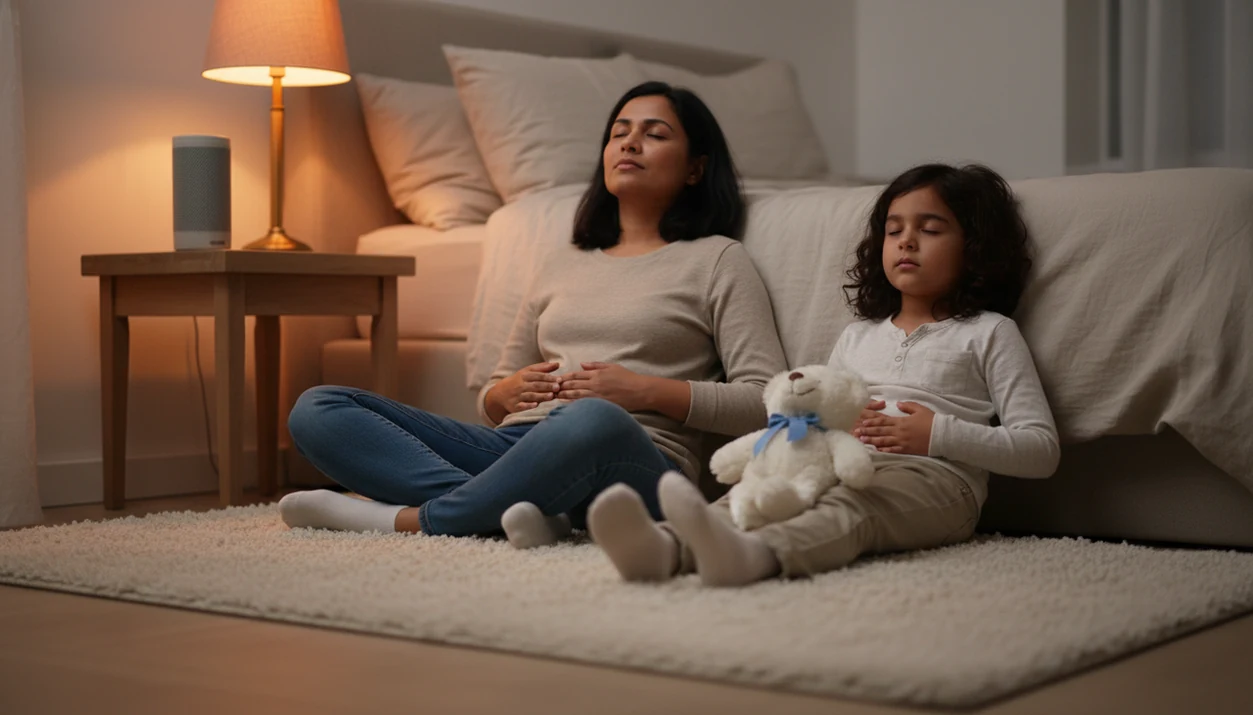


Parent and child breathing exercises are short, shared practices in which an adult and child breathe slowly together to support emotional regulation, connection, and everyday calm. They can fit into bedtime, transitions, anxious moments, or reconnection after a tantrum. The adult provides a steady voice and relaxed presence; the child can copy the breathing without being asked to calm down on command.
Practice during calm moments first, using playful images such as smelling a flower, blowing out a candle, tracing fingers, or watching a stuffed animal rise and fall on the belly. Guided audio can supply gentle prompts so the parent can join in rather than remember every step. Keep the practice brief and optional, not a test of good behavior.
The essentials
- Practice breathing during calm moments first, not only during meltdowns.
- Use playful visuals such as flowers, candles, fingers, waves, or stuffed animals to keep children engaged.
- A guided audio track can act as the companion for family breathing practice, bedtime wind-downs, and daily resets.
What parent and child breathing exercises do
Parent and child breathing exercises are co-regulation practices, not discipline tactics. The goal is to help a child feel a steadier adult nearby, then slowly match that adult’s voice, posture, and breathing pace.
A child who is upset usually cannot “just calm down” on command. They often learn calm by borrowing it first. That might mean sitting beside a parent after a hard school morning, breathing together before a bedtime story, or repairing after a tantrum once the shouting has passed.
The most useful moments are ordinary ones: bedtime, transitions, school stress, waiting, and post-tantrum reconnection. Short works.
Guided audio can reduce guesswork for busy parents because the timing, voice cues, and pauses are already there. For families building a wider family mindfulness routine, breathing is often the easiest first step.
How parent and child breathing exercises work
Slow shared breathing works by linking body rhythm, attention, and emotional safety. Longer, softer exhalations can support the parasympathetic relaxation response, the “rest and settle” side of the nervous system.
- Slow breathing gives the body a repeated cue that the immediate danger has passed.
- A parent’s calm voice and relaxed posture help the child co-regulate before they can self-regulate.
- Breath rhythm gives a child something concrete to copy when feelings feel too big.
- Youth mindfulness research, including a 2021 JAMA Pediatrics meta-analysis of 80 randomized trials, found small-to-moderate improvements in anxiety and stress when programs included practices such as breathing source.
- Parent participation matters because children often learn regulation through repeated shared practice, not one perfect lesson.
Clinicians typically recommend breathing and relaxation skills as supports within broader behavioral care, especially when anxiety, sleep stress, or family conflict is part of the picture. The lock-screen check at 2:13 a.m. is not the teaching moment. Practice earlier.
Best parent-child breathing exercises by family moment
The easiest breathing exercise is the one that fits the moment. Younger children usually do better with 30 seconds to 3 minutes, especially when the exercise feels like play instead of a lesson.
| Family moment | Exercise | Age fit | How long to practice |
|---|---|---|---|
| Bedtime breathing | Wave Breath with slow “in and out” prompts | 3+ | 1 to 3 minutes |
| Morning reset breathing | Balloon Breath before shoes or breakfast | 4+ | 30 to 90 seconds |
| Transition breathing | Finger-Tracing Breath at the doorway | 4+ | 1 minute |
| Car-seat or school-drop-off breathing | Flower and Candle Breath | 3+ | 3 to 5 breaths |
| Post-tantrum cool-down breathing | Teddy Belly Breath while lying down | 2+ | 1 to 2 minutes |
Guided audio can help with timing and gentle prompts, especially when a parent is tired too.
5 guided breathing steps for families
Use this routine when your child is already calm first. A child is more likely to use breathing during hard moments if the pattern feels familiar from ordinary days.
- Choose one short time, such as after pajamas, after school snack, or before leaving the house. Before the school day starts, try mindfulness for kids before school as a brief shared practice.
- Sit beside your child, not across from them like a test. Knees tucked under a throw blanket can be enough.
- Play a short guided breathing track if you want voice cues, timing, and consistency.
- Breathe together for 30 seconds to 3 minutes, using a simple image like waves, flowers, or a balloon.
- Repeat the same exercise for several days before adding a new one. You can also try gratitude meditation for kids to practice noticing small things your child appreciates.
For young children, parent and child breathing usually works best when it is practiced during calm routines, while crisis-only breathing fits poorly because the child has not learned the pattern yet.
Give bedtime breathing a predictable place
At bedtime, breathing can sit inside a familiar sequence rather than become a separate lesson. The American Academy of Pediatrics recommends a regular bedtime and the same routine each night. Its Brush, Book, Bed routine offers a simple starting point: brush teeth, read together, then go to bed. A brief shared breathing pause can follow the book, keeping the order predictable.
If worries are keeping a child awake, leave room for a short conversation before lights-out instead of expecting breathing to settle every concern. Ask what is bothering the child, acknowledge it, and agree on a simple plan for the night. The AACAP guidance on children’s sleep problems supports addressing worries alongside a predictable calming routine. Breathing is one quiet step, not a reason to dismiss fear or prolong bedtime negotiations.
Five child calming breathing exercises parents can try
These breathing exercises for kids and parents are simple enough to try today. Keep the tone light, and stop before it turns into a struggle.
1. Flower and Candle Breath. Ask your child to smell an imaginary flower through the nose, then blow out a candle slowly through the mouth. Use 3 to 5 rounds.
2. Finger-Tracing Breath. Trace up one finger while breathing in, then trace down while breathing out. The hand gives the child a path to follow.
3. Teddy Belly Breath. Place a stuffed animal on the child’s belly and watch it rise and fall. Tiny movement counts.
4. Balloon Breath. Pretend the belly is a balloon that gently fills, then slowly softens. Avoid huge breaths or breath-holding.
5. Wave Breath for Bedtime. Breathe in like a wave coming to shore, then breathe out like it rolling back. This pairs well with bedtime meditation for children when nights feel stretched.
Best-fit and not-fit moments for family breathing practice
Family breathing practice is a supportive tool for everyday regulation. It is not a substitute for safety planning, therapy, medical care, or trauma-informed support when those are needed.
| Best fit | Not fit |
|---|---|
| Bedtime transitions when the child needs a softer landing | Replacing therapy, diagnosis, or professional treatment |
| Mild anxiety before school, appointments, or separation | Managing dangerous behavior alone |
| Everyday stress after a loud day or busy schedule | Forcing compliance during a power struggle |
| Waiting-room restlessness or long lines | Treating severe anxiety, panic, trauma, or ongoing distress |
| Reconnection after conflict, once everyone is safe | Any breathwork that causes dizziness, fear, or discomfort |
Children with sensory sensitivities may need modifications. Try eyes open, shorter sessions, no body-focus language, or a favorite sound in the room. For bigger anxiety patterns, meditation for anxious kids can be one part of a broader support plan.
2021 research on breathing exercises for kids and parents
Research supports the underlying skills used in family breathing practice, but it does not prove that any specific app or single exercise treats a mental health condition.
- Per the CDC, about 7.1% of U.S. children ages 3 to 17 had diagnosed anxiety in 2016, which is one reason families look for everyday calming skills source.
- A 2021 JAMA Pediatrics meta-analysis found small-to-moderate improvements in youth anxiety and stress from mindfulness-based interventions, which often include breathing.
- A 2020 classroom mindfulness and relaxation trial reported fewer behavioral problems and better emotional regulation among primary school children compared with controls. For a broader overview, explore meditation benefits for kids, including emotional regulation and support for calmer bedtimes.
- The American Academy of Pediatrics notes that parent participation can improve child outcomes in behavioral and mental health interventions.
- Most evidence supports techniques like breathing, relaxation, mindfulness, and parent involvement, not one branded family breathing program.
The most common medically supported way to help a child build calming skills is repeated practice combined with adult support and appropriate professional care when symptoms are persistent.
MindTastik guided audio for parent and child breathing
Guided audio supplies the breathing prompts, so the parent can breathe alongside the child rather than lead every step.
That matters at bedtime, after school, or during a quiet parent-child pause. Earbuds on a nightstand, one side slightly tangled around a charging cable, are a real part of the routine. So is dimming the phone screen before starting bedtime audio.
MindTastik can support sleep audio, beginner meditation, breathing exercises, and everyday calm routines without claiming to replace therapy or medical care. Parents comparing options may also want a meditation for kids app that keeps instructions short, gentle, and repeatable.
When to seek professional help
Seek professional help when a child’s anxiety, panic, aggression, shutdowns, or school refusal is frequent, intense, or disrupting daily life. Breathing can be a helpful adjunct skill, but it is not a diagnosis, treatment plan, or reason to postpone care.
A parent does not have to decide alone whether something is “serious enough.” If the pattern keeps returning, or if the whole household is walking on eggshells, bring in support.
- Call your child’s pediatrician if symptoms are new, worsening, linked with sleep, appetite, pain, breathing, fainting, or medication questions.
- Contact a licensed child therapist or mental health clinician when fear, panic, avoidance, sadness, aggression, or shutdowns are showing up again and again.
- Ask the school counselor, teacher, nurse, or support team for help if school refusal, separation distress, bullying, learning stress, or behavior changes are part of the picture.
- Use breathing only as a calming support while you arrange appropriate care; do not use it to manage unsafe behavior alone.
- Get emergency help right away if a child may harm themselves, harm someone else, cannot stay safe, or you feel unable to keep the situation contained.
Guided breathing that lets the parent join in
MindTastik’s breathing exercises and kids sessions are options for families who prefer spoken prompts during a shared calming pause. Audio can carry the instructions while the parent sits beside the child and participates. For bedtime, choose gentle guidance that fits the existing routine rather than adding another task.
Children who dislike spoken instructions may prefer silent finger tracing or a parent’s familiar voice. Families dealing with persistent anxiety, panic, or disrupted daily life need professional support, not an app as the main plan. MindTastik is not a medical treatment.
When shared breathing is not enough
Parent and child breathing exercises are helpful for many families, but they have limits. Use them as a supportive practice, not as the whole plan.
- Breathing exercises are not a replacement for professional evaluation, therapy, medication, emergency care, or school-based support.
- Some children dislike focusing on breath because it feels strange, boring, or too body-focused.
- Children with respiratory, cardiac, fainting, or complex medical conditions may need medical guidance before breathwork.
- During intense emotion, validation should come before instruction. “You’re really upset” lands better than “take a deep breath.”
- Benefits depend on regular practice and parent participation, not one rushed attempt during a meltdown.
- Evidence for specific app-based family breathing programs is still emerging.
- Children with trauma histories may need choices, open eyes, movement, or a clinician-guided approach.
If a child’s fear, sleep disruption, aggression, or shutdowns are frequent, breathing can sit beside professional help. It should not delay it.
Parent and child breathing questions
What is the easiest breathing exercise to do with a child?
Flower and Candle Breath is a simple starting point: pretend to smell a flower through the nose, then gently blow out a candle through the mouth. Try three to five rounds together. Keep the image playful and the breathing comfortable rather than asking for precise counts or a perfect technique.
Can toddlers do breathing exercises with a parent?
Toddlers can be invited to copy a gentle breath or watch a stuffed animal move on their belly. Treat it as brief shared play, not an instruction they must follow. The parent can model the action, but there is no need to insist on a particular rhythm or completion.
How long should parent and child breathing exercises last?
For younger children, start with about 30 seconds and keep the practice within one to three minutes. School-age children may be comfortable with several minutes, while adolescents may prefer a longer guided practice. Stop before it becomes a struggle. A short, familiar exercise is more useful than a forced session.
Should a parent ask a child to breathe during a tantrum?
Breathing should not become a command during a power struggle. During intense emotion, acknowledge the child’s distress and attend to safety first. Offer shared breathing once the child is ready to reconnect. Practicing on ordinary, calm days makes the exercise familiar before it is needed in a difficult moment.
Do children need to count their breaths or hold their breath?
The exercises here do not require breath holding or precise counting. Younger children can follow a simple image, such as a flower, candle, or wave, while breathing gently. The aim is a comfortable shared rhythm, not a target number. Children with relevant medical conditions may need guidance before breathwork.
What if my child refuses breathing exercises?
Do not make participation a requirement. Some children find attention to breathing strange, boring, or uncomfortable. Offer another quiet activity, such as shared reading or guided imagery, and leave breathing available for another time. The calming routine matters more than getting a child to complete one particular exercise.
Can breathing exercises help a child fall asleep?
Brief breathing can be one calming part of a consistent bedtime routine, but it does not guarantee sleep. Keep regular bedtimes and predictable quiet steps, and address worries before lights-out. Persistent sleep difficulties, daytime impairment, snoring, or gasping should be discussed with a pediatrician rather than managed with breathing alone.