
Self-Compassion for Teen Stress: A Practical Guide
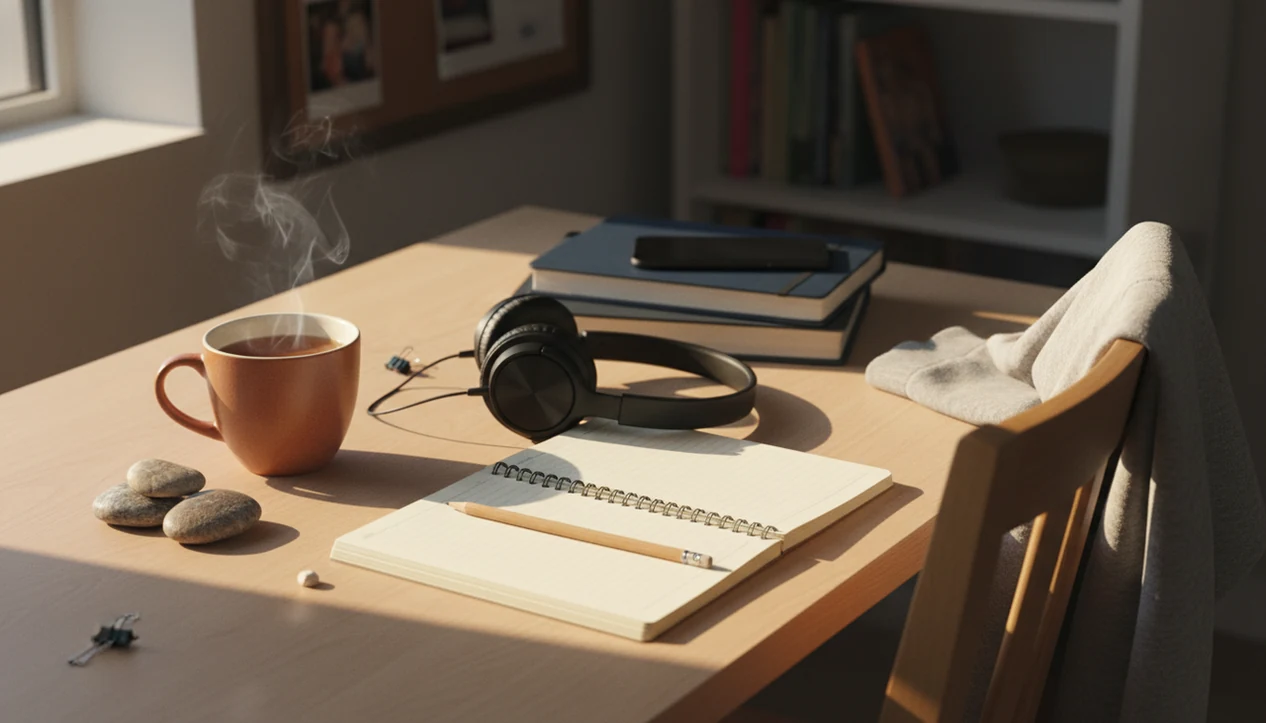


Self-compassion for teen stress means noticing pressure, mistakes, or overwhelm without self-attack, then responding with the kindness a friend would receive. It has three parts: mindfulness, or recognizing difficult emotions; common humanity, or remembering that struggle is not unique; and self-kindness, or choosing helpful words instead of shame. It does not mean giving up, excusing harmful behavior, or pretending a problem is small.
Research links higher adolescent self-compassion with less anxiety, depression, and stress and better well-being, although much of that evidence cannot establish cause and effect. Short breathing practices, guided meditation, and kinder self-talk offer ways to practice the skill. The aim is not forced positivity. It is a response that leaves room for both difficult feelings and a useful next step.
The essentials
- Self-compassion is not giving up; it helps teens face stress honestly without spiraling into self-blame.
- Research links higher adolescent self-compassion with lower depression, anxiety, and stress and better well-being.
- Short practices such as breathing, guided meditation, and kinder self-talk can make self-compassion easier to repeat daily.
Self-Compassion for Teen Stress: The Fast Answer
Self-compassion for teen stress means you notice, “I’m having a hard time,” instead of jumping straight to “I’m failing.” It gives teens a calmer way to respond to stress without pretending everything is fine.
The three core parts are mindfulness, common humanity, and self-kindness. Mindfulness means naming what is happening. Common humanity means remembering that other teens also mess up, panic, compare, and feel left out. Self-kindness means using a voice that helps, not one that attacks. For younger family members, mindfulness books for kids can introduce noticing feelings through stories and simple activities.
This is support, not a substitute for therapy or medical care. If stress includes self-harm thoughts, feeling unsafe, or severe depression, a trusted adult or clinician should be involved.
Small counts.
How Self-Compassion for Teen Stress Works
Self-compassion for teen stress works by changing the response pattern around stress, not by making school, relationships, pressure, or conflict disappear. It creates a pause between the first stress signal and the next reaction.
Mindfulness is the first part: the teen names what is happening before reacting, such as “This is embarrassment” or “My body is in stress mode.” That small act of labeling can reduce the automatic pile-on. Common humanity comes next. After a mistake, rejection, or awkward moment, it reminds the teen, “Other people go through this too,” which lowers the lonely feeling that often makes stress sharper. Self-kindness then replaces attack language with next-step support: “I can be upset and still ask for help,” instead of “I’m useless.”
In practice, the sequence is simple:
- Name the stress signal before arguing with it.
- Remember that struggle is part of being human, not proof of being broken.
- Use one supportive phrase that points toward the next small action.
- Repeat the pause during school stress, bedtime worry, or after a hard conversation.
Repetition matters because the pause gets easier to find when stress is loud.
Teen Stress Data: Why Self-Compassion Matters Now
Teen stress is not just “drama.” In a 2021 U.S. survey of 7,703 high school students, 44% reported persistent sadness or hopelessness during the past year, up from 26% in 2009, per the CDC source.
- Grades can turn one test score into a whole identity: “I’m stupid.”
- Social pressure can make a delayed reply feel personal.
- Sports, music, or performance mistakes can replay all evening.
- Family conflict can leave teens tense before they even open homework. For family conflict, responding to an angry teenager starts with listening, setting boundaries, and checking safety.
- Social media can keep comparison running long after school ends.
Self-compassion is one emotional regulation tool. It does not remove the workload, the coach, the group chat, or the argument at home. It can help a teen pause before the stress story gets mean. For younger family practice, a family mindfulness routine may help make calm language normal at home.
3-Part Self-Compassion Model for Teen Stress
Self-compassion works by changing the teen’s response to stress from threat and self-attack toward awareness, connection, and support.
The model has three parts. Mindfulness says, “This is stress,” without exaggerating it. Common humanity says, “Other people struggle too,” which cuts the lonely feeling. Self-kindness says, “What would help me take the next step?”
Harsh self-criticism can intensify stress arousal. The body may react with tight breathing, a racing heart, or a frozen feeling before a presentation. Then the mind adds fuel: “Everyone noticed.” “I ruined it.” “I always do this.”
Breathing, meditation, and supportive self-talk create a small gap. That gap matters. For many teens, a 60-second breath practice is easier than a long sit, especially during a school day. For teens using audio, meditation for teens sleep and stress can be a practical starting point.
2017-2019 Research on Self-Compassion for Teen Stress
Research supports self-compassion as a helpful teen stress tool, but not as a cure. Outcomes vary by teen, setting, practice length, and the level of support around them.
- A 2019 systematic review of 19 studies found higher adolescent self-compassion was linked with lower depression, anxiety, and stress, and higher well-being source.
- A 2017 randomized trial of 34 adolescents found a six-session mindful self-compassion program reduced depression and stress compared with a waitlist group source.
- A 2019 meta-analysis of 41 youth mindfulness trials found small-to-moderate improvements in anxiety, depression, and stress source.
- The evidence is stronger for “may help” than “will fix.”
- Clinicians typically recommend extra support when stress is severe, persistent, or connected to safety concerns.
For everyday teen stress, self-compassion is often easier to practice than forced positivity because it starts by admitting the moment is hard.
What a 2022 Review Adds to the Evidence
A 2022 systematic review of kindness- and compassion-based meditation in children and adolescents found improvements in 47% of the well-being outcome measures studied. These included some measures of stress, anxiety, depression, negative affect, mindfulness, and self-compassion. That figure describes outcome measures, not the percentage of young people who benefited. Reported effects ranged from small to medium.
The authors also noted differences in study quality and outcomes. This supports offering compassion practice as an additional skill, not promising that it will relieve every teen’s stress. The review covered kindness- and compassion-based meditation, so its findings should not be treated as evidence for every exercise or commercial app. A teen’s lack of improvement is not proof that they are practicing incorrectly or failing to be kind enough.
5 Steps to Use Self-Compassion for Teen Stress
Use this five-step practice after a bad grade, social conflict, panic spiral, or practice mistake. It can fit between classes, after training, or before opening a homework tab. Schools can also consider meditation instead of detention as a supportive practice, while keeping accountability and student needs in view.
- Pause for one slow breath and name the moment: “This is stress.”
- Notice the body signal, such as tight shoulders, hot cheeks, or a fast heartbeat.
- Normalize the struggle: “Other people feel embarrassed after mistakes too.”
- Speak like a decent friend: “I can be upset and still take the next step.”
- Choose one small action, such as asking a teacher, drinking water, texting a safe person, or restarting the assignment.
The most common way to build self-compassion is short repetition combined with a supportive routine. Not a long speech in your head. Just enough kindness to stop the pile-on.
5 Teen Stress Situations and Self-Compassion Responses
The same self-compassion skill looks different depending on the stress moment. A teen who missed a goal, got left out, or can’t sleep needs language that matches the situation. Adults can also consider how shielding kids from boredom may limit opportunities to practice patience and manage everyday discomfort.
| Teen stress situation | Inner phrase | Calming action |
|---|---|---|
| School stress | “One grade is information, not my whole worth.” | Write the next question to ask. |
| Social stress | “Being left out hurts, and I don’t have to attack myself.” | Step away from the thread for ten minutes. |
| Sports or performance stress | “A mistake is part of practice.” | Exhale slowly before the next rep. |
| Nighttime stress | “Thinking harder won’t solve this at 2:13 a.m.” | Dim the phone and play short bedtime audio. |
| Family conflict | “This feels heavy, and I can still speak carefully.” | Take space if it is safe to do so. |
If sleep is the main struggle, bedtime meditation for children can offer a gentler family wind-down pattern.
Teen Use Cases and Red Flags for Self-Compassion Practice
Self-compassion is best for common stress patterns, not crisis care. It helps when the teen can pause, reflect, and try one supportive response.
| Best for | Not enough for |
|---|---|
| Everyday school stress | Self-harm thoughts or urges |
| Perfectionism after mistakes | Severe depression or hopelessness |
| Self-critical thoughts | Trauma symptoms that feel overwhelming |
| Sleep-related worry | Unsafe home situations |
| Beginner meditation practice | Crisis moments or immediate danger |
A teen may say, “I just need something to play when my thoughts get loud.” That can be a real need, especially at night. Still, if the thoughts include danger, fear, or wanting to disappear, the next step is not just breathing. Talk with a trusted adult, school counselor, doctor, or emergency support. In the U.S., call or text 988 for the Suicide & Crisis Lifeline if a teen may hurt themselves or feels unable to stay safe. If there is immediate danger, call emergency services or go to the nearest emergency department.
MindTastik Support for Self-Compassion for Teen Stress
For teens, app-based practice should be chosen with parent or caregiver judgment, age fit, and safety in mind.
For this teen-stress use case, MindTastik is most relevant as a guided-audio support for breathing, bedtime decompression, and repeated self-kindness cues; it should be introduced by a parent or caregiver rather than positioned as teen mental-health treatment.
Guided sessions can make self-compassion easier because the teen does not have to invent kind words from scratch. Breathing exercises can support a short reset before homework or after a tense message. Sleep audio can help when earbuds sit on the nightstand, one side slightly tangled around a charging cable.
Tools like MindTastik, Calm, and Headspace can support repetition when used carefully.
Self-Compassion for Teen Stress Worksheet and Image Caption
Use this worksheet when stress is fresh, not hours after the teen has spiraled. Keep the answers short. One line is enough.
Self-compassion worksheet prompt
- What happened? “I got a bad grade on the quiz.”
- What I feel: “Embarrassed, scared, angry.”
- What I would say to a friend: “You’re not dumb. Let’s figure out what went wrong.”
- What I need next: “Ask about corrections and study for 20 minutes.”
Short activity: put one hand on your chest or sleeve, breathe out longer than you breathe in, and repeat one kind phrase three times. If a younger child needs a simpler version, calm down meditation for kids may fit better.
Suggested image caption
A teen practices breathing and kinder self-talk before sleep as part of a self-compassion for teen stress routine.
Guided audio for school pressure and bedtime worry
MindTastik’s guided meditations and breathing exercises can provide a prompt for pausing before homework or settling after a tense exchange. Sleep stories and soundscapes are other options for bedtime restlessness. A parent or caregiver should consider the session’s language, age suitability, and the teen’s willingness to listen.
These sessions are optional practice aids, not teen mental-health treatment. Teens who dislike guided audio can use a written friend-to-friend response instead. Persistent distress, self-harm thoughts, or an unsafe situation call for adult support and professional care, not another session.
When Self-Compassion Is Not Enough for Teen Stress
Self-compassion is useful, but it has real boundaries. It should not be sold as a fix for every teen stress problem.
- Self-compassion does not replace professional mental health care, therapy, medication guidance, or emergency support.
- It may not be enough for severe depression, trauma symptoms, self-harm, eating disorder concerns, or crisis risk.
- Some teens feel worse at first when they slow down and notice emotions.
- Meditation apps vary in evidence quality, safety design, privacy practices, and age suitability.
- Self-compassion does not remove external pressure, such as workload, bullying, family conflict, or financial stress.
- Some teens prefer music, movement, journaling, art, sports, or live support instead of traditional meditation.
- Parents should avoid using self-compassion as a way to shut down real complaints.
For shared calming practice, parent and child breathing exercises can be easier than asking a teen to meditate alone.
Teen Self-Compassion Questions
What does self-compassion look like for a teenager?
It can sound like, “That grade hurt, but it does not define me. What can I ask the teacher?” The teen acknowledges the feeling, remembers that mistakes happen to other people too, and chooses a supportive response. The problem still matters, but it does not become a verdict on the teen’s worth.
Does self-compassion actually reduce teen stress?
Research links higher self-compassion with lower stress, anxiety, and depression in adolescents. Much of that research is correlational, so it cannot prove that self-compassion caused the difference. Compassion-based practices may help some young people, but effects vary. They are supportive skills, not a guaranteed treatment for an anxiety disorder or depression.
What can a teen say when positive affirmations feel fake?
Use a believable sentence rather than a glowing claim: “This is hard,” “Other people make mistakes too,” or “I can be upset and still ask for help.” Self-compassion does not require feeling confident or happy. A balanced phrase that acknowledges the problem is enough to begin practicing a less punishing response.
How can parents encourage self-compassion without lecturing?
Start with the specific event and feeling: “That result was disappointing.” Then ask what the teen would say to a friend in the same situation. Offer help with one next step rather than insisting on a meditation or a positive phrase. If distress persists or disrupts daily life, seek professional support rather than relying on home practice.
Can self-compassion help a teen who worries at bedtime?
It can offer a less critical response to nighttime worry, such as, “I do not have to solve this tonight.” A short breathing practice or quiet guided audio may fit that routine. Self-compassion is not a treatment for persistent sleep problems. Marked sleep changes, especially alongside withdrawal or low mood, warrant professional advice.
What if meditation makes a teen feel worse?
Stop the session rather than pushing through distress. Some teens feel worse when they slow down and notice difficult emotions. A written prompt or conversation with a trusted adult may be a better option. If distress is intense, recurring, or connected to trauma symptoms, seek professional guidance instead of treating discomfort as a practice goal.
When does teen stress need professional help?
Seek professional help when symptoms last weeks or months and interfere with school, home life, or friendships. Withdrawal, major sleep or eating changes, self-injury, and suicidal thoughts also need attention. Self-harm concerns should not wait for a meditation to help. In the United States, call or text 988 for crisis support; imminent danger requires emergency services.