
Calm Down Meditation for Kids: A Parent-Guided 2-5 Minute Practice


Calm down meditation for kids is a short, parent-guided routine that combines slow breathing, body awareness, and reassuring words to help children feel safer during big emotions. Start with 2-5 minutes when the child is already calm, not when everyone is waiting for a tantrum to stop. The aim is to support emotional regulation, not to demand silence, stillness, or obedience.
A caregiver stays nearby, names the feeling, and offers a simple invitation such as, “Let’s breathe together.” Eyes can stay open, bodies can move, and the child can decline. Short guided calm audio can supply words when a parent needs support, but it should not replace a responsive adult or become a punishment.
The essentials
- Use calm-down meditation as co-regulation, not as discipline or a demand to be quiet.
- Practice child breathing meditation during calm moments so it feels familiar during stress.
- MindTastik can provide short guided calm audio for kids, while parents stay present and responsive.
Calm down meditation for kids in one simple reset
A calm-down meditation for kids is a short, gentle reset led by a parent or caregiver. It uses breathing, body awareness, and reassuring words to help a child move through big feelings without making those feelings “bad.”
Think of it as sitting beside the storm, not shutting it down. A child may still cry, wiggle, or say, “I don’t want to.” That can still be part of the practice. For everyday disappointments, helping kids let go can offer gentle mindfulness practice without asking them to hide their feelings.
Two to five minutes is enough for most children. Try one slow breath, one body cue, and one kind sentence: “Your body is upset right now. I’m here. Let’s breathe together.” For more routine ideas, a family mindfulness routine can help meditation feel normal before hard moments arrive.
Small counts.
Before You Start: Make Calm-Down Meditation Feel Safe
Before you guide a child through calm-down meditation, make the practice feel safe, optional, and familiar. The best time to teach it is not the hardest moment; it is a quiet pocket of the day when no one has to calm down quickly.
- Choose a calm practice time. Try after a snack, before bed, or during a relaxed weekend moment so the routine is already known before distress shows up. During calm practice, try gratitude meditation for kids to notice small comforts without dismissing difficult feelings.
- Let your child stay comfortable. Keep eyes open if that feels better. Let them wiggle, lean against you, hold a blanket, or sit nearby instead of facing you.
- Remove the performance pressure. Avoid using meditation to make a child obey, stop crying, or become quiet on a deadline. “We can breathe together” lands softer than “You need to calm down.”
- Preview any audio first. Listen before playing a guided track with your child, especially if they are sensitive to voices, music, silence, or headphones.
- Use a soft voice and pause early. If your child looks overwhelmed, stop the exercise and return to connection: “That was too much. I’m still here.”
How kids calming meditation works in the nervous system
Kids calming meditation works by pairing slow breathing with adult co-regulation, which means the child borrows steadiness from a calm caregiver. The goal is not instant obedience. The goal is helping the body notice safety again.
Slow breathing gives the brain a simple job. Instead of chasing every scary or angry thought, the child follows “breathe in” and “breathe out.” Body awareness adds another signal: tight shoulders can soften, clenched hands can rest, and the belly can rise and fall.
A calm voice matters here. So does validation. “You’re really mad” often lands better than “Calm down.” Pediatric guidance generally recommends supportive routines, caregiver reassurance, and professional help when anxiety, behavior, sleep, or safety problems persist or interfere with daily life source.
Research on youth mindfulness is promising but still emerging. A 2017 meta-analysis of 33 randomized trials found small to moderate improvements in anxiety and depressive symptoms for some children and adolescents source.
How to use a child breathing meditation at home
Use child breathing meditation first during calm moments, then bring it into mild upset. For many children, bedtime or after school is easier than the middle of a meltdown.
- Set a safe, low-pressure space. Sit on a couch, rug, or bed where your child can move a little without being corrected.
- Name and validate the feeling. Say, “You’re frustrated because the game ended,” or “Your body feels worried right now.”
- Breathe with simple imagery. Invite, “Smell the flower,” for the inhale, then, “Blow the candle,” for the exhale.
- Add body relaxation cues. Try, “Shoulders soft, hands resting, belly moving slowly.”
- Return gently with a choice. Ask, “Do you want water first, or should we sit for one more breath?”
For children who like breathing games, parent and child breathing exercises can make the steps feel less like a lesson.
A 3-minute parent script for short meditation for children
Does a short meditation for children need complete silence? No. A child can listen, wiggle, look around, or keep their eyes open and still receive support.
Parent script for upset moments
“Come sit near me. You don’t have to be still. You don’t have to close your eyes. You can look at the wall, the floor, or my hand.”
“Breathe in. Breathe out. Let’s do that again. Breathe in like you’re smelling a flower. Breathe out like you’re blowing a candle.”
“Shoulders soft. Hands resting. Feet on the floor or legs tucked in. Your body had a big feeling, and I’m right here.”
“Let’s take one more slow breath together. Breathe in. Breathe out.”
“You were really upset, and that was hard. What would help next: a hug, a drink of water, or sitting quietly for one minute?”
The most useful short meditation for children is often parent-led because the child hears safety in a familiar voice.
If breathing instructions make things harder
A child who refuses breathing practice does not need a more persuasive script. Offer a concrete alternative: notice feet on the floor, name a few things in the room, stretch, draw, or hold a familiar object. Keep the choice voluntary and stop if distress increases. These are regulation options, not tests of cooperation or substitutes for anxiety treatment. A clinical review of childhood anxiety care describes relaxation strategies within broader behavioral treatment. If breathing feels uncomfortable, try a snow globe mindfulness exercise as a voluntary way to watch settling movement together.
For a child with a trauma history or strong sensory preferences, predictability and control matter more than completing the routine. Offer eyes open, movement instead of stillness, and no touch unless wanted. Do not require breath-holding, a body scan, or talking about frightening memories. AACAP guidance for parents emphasizes safe, predictable surroundings and psychological support for children reacting to extreme circumstances.
Best fit and not-for moments for guided calm audio for kids
Guided calm audio for kids is most useful when it supports a parent-led routine, not when it replaces connection. It can be especially helpful when everyone is tired and the adult needs simple words to follow.
| Best for | Use carefully for | Not for |
|---|---|---|
| Bedtime wind-down | Sensory-sensitive children | Punishment |
| Transitions after school or screen time | Children who dislike headphones | Stopping every emotion |
| Mild worry before a new activity | Children who prefer eyes open | Crisis situations |
| Post-meltdown recovery | Children who get distracted by devices | Replacing professional care |
| Daily practice when calm | Shared spaces with noise | Making a child “be quiet” |
If sleep is the main challenge, bedtime meditation for children may be easier than using a daytime calm-down track at night.
Meditation apps for sleep anxiety and everyday calm deliver structured audio support, not a guarantee that a child will stop feeling upset on command.
Five facts parents should know about kids calming meditation
- Practice works best before big upsets happen. A child who knows the routine on a quiet afternoon is more likely to accept it when emotions rise.
- Belly breathing and simple imagery are core tools. “Smell the flower, blow the candle” is easier than abstract instructions like “regulate yourself.”
- Short sessions are usually more realistic than long ones. For most children, 2-5 minutes beats a long practice that turns into a power struggle.
- Youth mindfulness research shows small to moderate benefits in some studies. In one randomized clinical trial of 300 children in grades 4-6, a 12-week mindfulness-based school program was linked with lower stress and depression symptoms and higher optimism. For example, school-based mindfulness trials have reported improvements in stress, mood, and attention, though effects vary by program and child age. source
- Meditation supports calm but is not medical or behavioral treatment. Children with ongoing anxiety, trauma, ADHD, or unsafe behavior need appropriate professional guidance.
For anxious patterns that show up often, meditation for anxious kids should stay supportive and non-clinical.
MindTastik guided calm audio for kids and family routines
Audio can make a family routine easier, especially when a parent has run out of words. Tools like MindTastik can offer short meditations, breathing exercises, sleep audio, and everyday calm support, but the adult still matters most.
Before playing MindTastik audio, a parent should preview a short breathing or calming track, keep the screen out of the child’s hands, and stay nearby to pause it if the child becomes frustrated. For family use, parents can preview tracks, choose age-appropriate audio, and stay nearby for younger children.
One parent told us, “I just need something to play when my thoughts get loud.” Children often need the same simplicity, with a caregiver close enough to pause the track and say, “I’m here.”
If you are comparing family audio tools, a meditation for kids app can help you choose a starting point.
Image guide for child breathing meditation posture
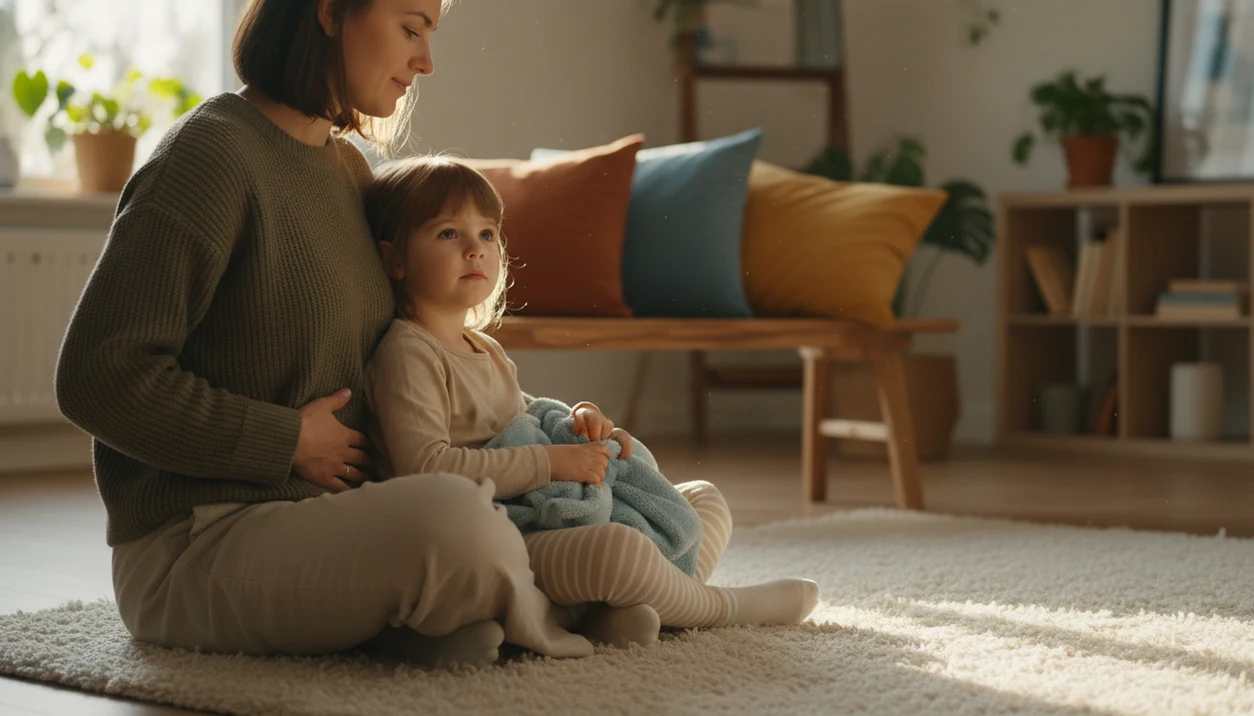
A helpful image for child breathing meditation would show a parent sitting beside a child on a couch or soft rug. The posture should look relaxed, not corrected. The child can have eyes open or softly focused, with one or both hands on the belly.
Avoid imagery that looks clinical, disciplinary, or like a child is being forced to sit still. No pointed finger. No timeout chair. No worried adult hovering.
Better: a dim room, a small blanket, and two people breathing together. Earbuds can sit on the nightstand, one side slightly tangled around a charging cable, but they do not need to be the focus.
Caption: A calm-down meditation works best when a parent stays close, speaks gently, and helps the child breathe slowly.
When to Seek Professional Help
Seek professional help when a child’s distress is persistent, severe, escalating, unsafe, or disrupting daily life. Meditation can be a supportive calming tool, but it is not a diagnosis, treatment plan, or replacement for pediatric or mental-health care.
Some hard days are normal. The red flag is a pattern: worries that keep growing, meltdowns that become more intense, sleep that falls apart, school refusal, friendship struggles, family life revolving around avoidance, or behavior that puts the child or someone else at risk. ADHD, trauma, anxiety, and sensory overwhelm can all show up in different ways, so parents do not have to figure it out alone.
- Notice the pattern. Track what happens, when it happens, how long it lasts, and what helps your child return to safety.
- Start with your pediatrician. Ask about sleep, anxiety, attention, development, trauma stress, or referrals.
- Contact a child therapist. Look for support if distress is affecting school, friendships, routines, or family relationships.
- Use urgent support when safety is unclear. Call emergency services or a local crisis line if your child may hurt themselves or someone else.
A calm adult, a short breath, and the right help can all belong in the same plan.
Choosing audio for a parent-led calming routine
MindTastik’s kids sessions and breathing exercises can support a brief practice before bed, after school, or during a familiar transition. A parent should preview the track, choose simple instructions, and remain nearby to pause it if the child becomes uncomfortable.
Children who dislike spoken instructions, headphones, or devices may prefer a caregiver’s voice, quiet movement, or a familiar object. Persistent anxiety or distress that disrupts daily life needs professional assessment, not a different audio track.
When a short calming practice is not enough
Calm-down meditation is useful, but it has boundaries. Parents should know those boundaries before relying on it during hard moments.
- It is not a treatment for diagnosed anxiety disorders, trauma, ADHD, or serious behavioral concerns.
- Some children dislike closing their eyes, body scanning, headphones, or spoken audio.
- It may not work during intense meltdowns until the routine has been practiced often.
- It should never be used as punishment or as a way to make emotions seem wrong.
- Device-based audio can backfire at bedtime if it leads to scrolling, bright screens, or stimulating app use.
- A child in panic, rage, shutdown, or unsafe behavior may need space, safety steps, and adult support before breathing practice.
- Parents should seek professional guidance when distress is severe, persistent, unsafe, or interfering with school, sleep, friendships, or family life.
Seek urgent help if a child may hurt themselves or someone else, cannot return to basic safety, or shows panic, shutdown, or distress that feels beyond normal family support. Meditation can support regulation, but it should not delay appropriate medical, mental-health, or emergency care.
The 2:13 a.m. lock-screen check is real. If a child is awake night after night, meditation may support the wind-down, but it should not be the whole plan.
Questions about calming meditation for children
What age can children start calm-down meditation?
The practice should match the child’s developmental level rather than a fixed starting age. For a young child, use concrete words, a brief invitation to breathe together, and caregiver support. A child who cannot follow spoken instructions can be offered movement or a familiar object instead of a formal meditation.
How long should a calm-down meditation for kids last?
Start with 2-5 minutes during a calm part of the day. One shared breath may be enough if the child loses interest or becomes uncomfortable. Treat the duration as a flexible guide, not a target to enforce. Familiarity and a low-pressure routine matter more than finishing the whole script.
Can meditation stop a tantrum?
Not reliably, and stopping a tantrum should not be the condition for success. During intense distress, breathing instructions may add pressure. A caregiver can stay present, use reassuring words, and offer the familiar routine without insisting. Meditation is support for moving through a feeling, not a demand to stop crying.
What if my child refuses to take deep breaths?
Do not force breathing or require breath-holding. Offer another simple action, such as feeling feet on the floor, stretching, drawing, or holding a familiar object. The child can also stop altogether. If following the breath increases discomfort, choose a different activity rather than repeating the instruction more firmly.
Do children need to close their eyes or sit still?
No. Children can keep their eyes open, look at a familiar object, lean against a caregiver, or move gently. Eye closure and stillness are not requirements. Avoid correcting posture unless there is a safety concern, and let the child choose a position that feels comfortable.
Can calm-down meditation help at bedtime?
A short, familiar practice can be part of bedtime wind-down, especially if it has already been introduced during calm moments. Keep instructions simple and avoid turning audio into screen time. If the child dislikes spoken tracks or becomes more alert around devices, use a caregiver’s voice or leave the audio off.
When should a child’s anxiety get professional attention?
Seek an evaluation when anxiety becomes severe, keeps growing, or interferes with sleep, school attendance, friendships, separation from caregivers, or ordinary activities. Meditation may remain a supportive routine, but it is not treatment for an anxiety disorder. A pediatrician or qualified mental-health professional can help assess what care is needed.