
Meditation for Kids Benefits Guide
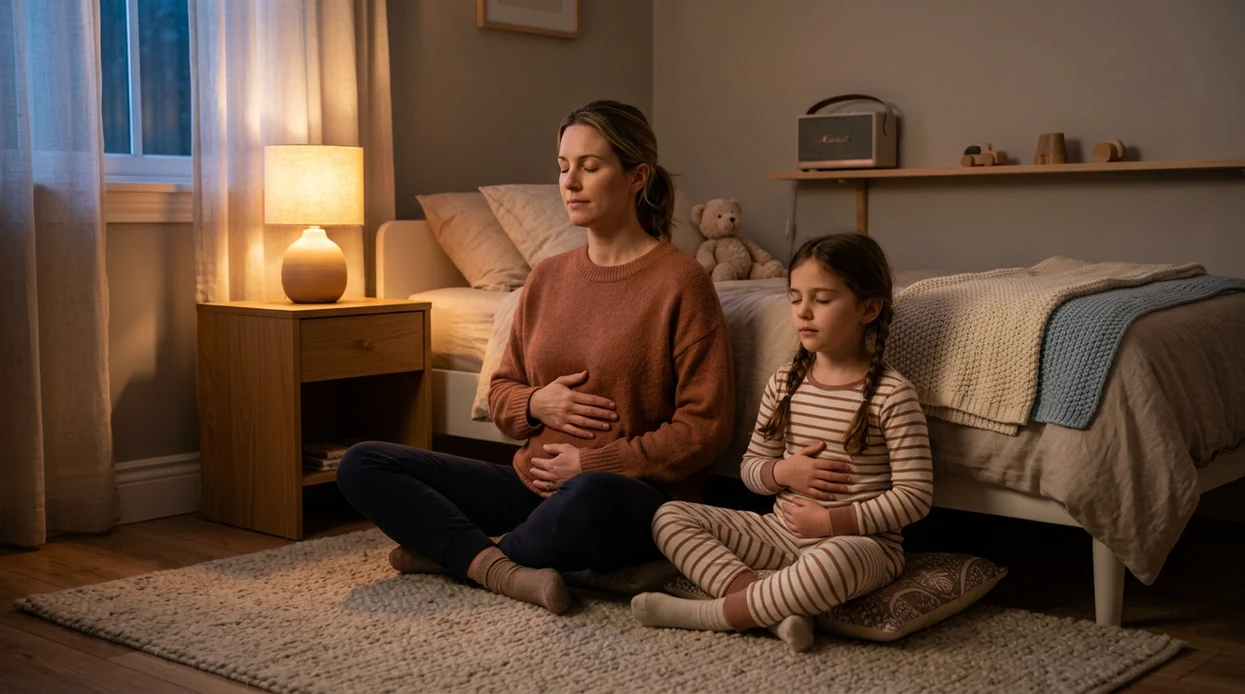


Meditation for kids is a brief, age-appropriate practice that may help children build attention, manage feelings, cope with stress, and settle before sleep. Breathing games, body scans, and guided stories teach children to notice breathing, body sensations, thoughts, and feelings without pressure or judgment. The aim is practice, not perfect stillness or an empty mind.
Keep sessions short: a few minutes for preschoolers and about 3-10 minutes for grade-school children are common starting ranges. Research is strongest for structured programs, particularly those delivered in schools, rather than individual bedtime recordings. Benefits vary, and meditation belongs alongside ordinary parenting and professional care when needed. Participation should stay optional, with room to move, keep eyes open, or stop.
Key points for parents
- Keep children’s meditation short: a few minutes for preschoolers and about 3-10 minutes for grade-school children is a common pediatric range.
- The strongest evidence is for attention, stress, resilience, and emotional regulation, especially in school-based mindfulness programs.
- Use meditation as a supportive routine, not as therapy, medical treatment, or a replacement for pediatric or mental health care.
At-a-glance meditation for kids benefits guide
Meditation for kids is most useful as a small daily tool for calming down, getting ready for bed, improving focus, and practicing what to do with big feelings. For many families, that means one breathing game after school or a short guided story before lights out.
Pediatric guidance often suggests only a few minutes for preschoolers and about 3-10 minutes for grade-school children. For example, Nemours KidsHealth recommends keeping children’s mindfulness or relaxation practices brief and age-appropriate rather than forcing long silent sessions kidshealth reference. The moment matters. A tired child staring at clock digits glowing on the dresser may need a softer bedtime wind-down than a child bouncing before homework.
Tools like MindTastik can support calm routines, but they are not pediatric treatment. Meditation apps for sleep, anxiety support, and everyday calm can provide guided structure, not diagnosis, therapy, or guaranteed behavior change.
Results vary by age, temperament, family rhythm, and how gently the practice is introduced.
5 facts parents should know about meditation for kids benefits
- Mindfulness practice is linked with attention and emotional regulation benefits. School-based studies often show improvements in focus, stress coping, resilience, and emotional regulation, though the size of the benefit varies.
- Children’s meditation should be short and developmentally adapted. A preschooler may do better with one minute of “smell the flower, blow the candle” breathing than a formal silent session. For younger children, mindfulness for preschoolers uses playful, brief activities that adults can practice alongside them.
- Guided formats are usually easier than silent sitting. Breathing games, body scans, and calming stories give children something concrete to follow. One eye peeking at the timer is normal.
- Meditation can support routines, not replace care. It may help with stress, anxious moments, bedtime settling, and behavior transitions, but it should not replace pediatric or mental health guidance.
- The evidence is promising but mixed. Research includes different ages, settings, programs, and outcome measures, so broad claims for every child are not reliable.
For younger children, a short meditation for toddlers usually works better when a parent joins instead of handing over audio and leaving the room.
How meditation for kids works in the brain and body
Meditation for kids works by training attention, calming the nervous system, and helping children name feelings before reacting. The core skill is simple: notice the breath, sound, body, or story, then gently return when attention wanders.
That “returning” is attention training. Slower breathing and relaxed muscles can support parasympathetic activation, which is the body’s shift toward rest and recovery. Slow-paced breathing has been associated with increased parasympathetic activity and reduced physiological arousal in relaxation research NIH research: PMC5709795. In plain language, the body gets a cue that it does not have to stay on high alert.
Emotion labeling also helps. A child who can say “my stomach feels tight” or “I’m mad and scared” has a little more response space before yelling or shutting down. Practicing letting go of things can help children notice disappointment and respond with more patience when plans change.
Guided audio adds structure and consistency. Parents are not inventing a script at 8:47 p.m. with pajamas half on and a backpack still unpacked. Still, meditation does not cure ADHD, anxiety, trauma, or sleep disorders.
Research on meditation for kids benefits guide claims
Does meditation for kids have real evidence? Yes, but the stronger evidence is usually for structured school-based mindfulness programs, not sweeping promises that one app or bedtime story will change every child.
A 2016 randomized controlled study of 91 primary school children found that an 8-week mindfulness-oriented meditation program reduced attention problems and improved several well-being measures compared with controls NIH research: PMC4894866. A 2014 systematic review of 24 school-based mindfulness studies reported consistent small-to-moderate gains in cognitive performance, stress, and resilience outcomes PubMed research: 24865142.
Better-supported benefits
Better-supported benefits include attention practice, stress coping, resilience, and emotional regulation, especially when children practice regularly in structured settings. The American Academy of Pediatrics has also discussed mindfulness as a possible support for attention, anxiety, school performance, sleep, behavior, and mood, while emphasizing that it should complement, not replace, clinical care when symptoms are significant publications reference: Mind Body Therapies in Children and Youth.
Promising but not guaranteed benefits
Promising areas include bedtime ease, anxious-moment coping, and smoother transitions. Clinicians typically recommend meditation as a supportive skill alongside care plans when symptoms are persistent, severe, or disruptive.
What changes when mindfulness is compared with another activity?
A 2019 meta-analysis of 33 randomized controlled studies included 3,666 children and adolescents. Across comparisons with control groups, it found small improvements in attention, executive functioning, depression, anxiety or stress, negative behavior, and mindfulness. That supports cautious expectations: a program may help with particular skills or symptoms, but the findings do not establish large changes across every area of a child's life.
The results narrowed when researchers compared mindfulness with active controls, meaning groups offered another activity rather than simply waiting. Significant benefits remained for mindfulness, depression, and anxiety or stress, but not for all the other outcomes. This distinction matters when choosing a family routine: evidence of improvement against a comparison group does not mean meditation is consistently better than other supportive activities.
Meditation options for children by age and situation
The right meditation format depends on age, attention span, sensory comfort, and the situation you are trying to support. For grade-school children, guided breathing or a body scan often lands better than “sit still and clear your mind.”
| Child or situation | Format to try | Best use | Caution |
|---|---|---|---|
| Preschoolers | 1-3 minutes of stuffed animal breathing or imagination | Calm play, bedtime, parent bonding | Avoid forced stillness |
| Grade-school children | 3-10 minutes of guided breathing, body scan, or calming story | Focus, bedtime, post-school reset | Keep instructions concrete |
| Tweens and teens | Longer audio, journaling prompts, self-selected sessions | Stress, sleep, privacy, school pressure | Watch for isolating with headphones |
| Pre-school nerves | Short breathing with a parent | Separation, morning transition | Do not make it a test |
| Post-meltdown reset | Grounding, movement, then audio | Recovery after big feelings | Wait until the child is safe and calmer |
For bedtime, a dedicated bedtime meditation for children can pair audio with dim lights, a predictable order, and a clear stopping point.
How to use meditation for kids benefits guide at home
Start meditation when your child is already fairly calm, not in the middle of a crisis. A first practice works better on a quiet Saturday afternoon than during a hallway standoff over shoes.
- Choose a calm time when your child is fed, rested enough, and not being rushed.
- Pick one short format such as a breathing game, body scan, guided audio, or sleep story.
- Invite participation by saying, “Want to try this with me for two minutes?” rather than making it a rule.
- Stay nearby so younger children can open their eyes, ask questions, or stop without shame.
- Stop if distress rises including panic, fear, intrusive thoughts, body discomfort, or stronger dysregulation.
- Track what changes across bedtime, focus, mood, transitions, and recovery after upset.
For anxious mornings, parent and child breathing exercises can be easier than asking a child to meditate alone.
MindTastik meditation app routines for family calm
MindTastik offers guided meditation, sleep audio, breathing exercises, and self-hypnosis sessions for adults seeking support with rest, anxious moments, and everyday calm. For kids, a parent or caregiver should select and supervise each session, including the length, volume, language, and any screen use.
In this context, MindTastik is best treated as a supervised audio library, not a child-development program. Parents should preview the session first, choose the shortest suitable track, and avoid adult self-hypnosis or emotionally intense recordings for children unless clearly labeled as child-appropriate.
- Sleep audio: useful for a bedtime wind-down routine, especially with the screen dimmed and the phone placed face-down on the nightstand.
- Breathing exercises: useful for calm transitions before homework, school, or leaving the house.
- Beginner guided sessions: useful when parents want simple language and a predictable start.
- Self-hypnosis sessions: designed for adults unless specifically labeled appropriate for children.
For younger kids, use audio-only when possible and stay present. MindTastik can sit beside resources for sleep meditation, anxiety support, beginner meditation, and everyday calm. Families comparing tools may also look for a meditation for kids app that clearly separates adult and child-friendly content. Parents can also explore mindfulness resources for families and kids to find activities they can try together.
Check privacy and treatment claims before choosing a kids' app
An app's inclusion of breathing exercises or calming stories does not establish that the product itself is effective for children. NCCIH's guidance on complementary approaches for children emphasizes limited evidence and the need for careful clinical judgment. When selecting audio, check the intended age, preview the instructions, and reject claims that a recording can treat a child's mental health condition.
For a digital service, also read its data-collection and deletion policies before creating a child's profile. Look for unnecessary requests for sensitive information, check how advertising is presented, and confirm that a caregiver can oversee use. These are selection checks, not proof of effectiveness. A popular app or a large library should not take priority over suitable content and clear information about privacy.
Safety boundaries in a meditation for kids benefits guide
Meditation is appropriate for many children when it stays brief, flexible, and supervised. It becomes less appropriate when adults use it to force silence, suppress feelings, or delay needed care.
Talk with a pediatrician or mental health professional if your child has severe anxiety, depression symptoms, trauma reactions, eating disorder concerns, self-harm talk, or major sleep disruption. Also ask for guidance when symptoms interfere with school, friendships, eating, safety, or family life.
Do not force closed eyes. Some children feel safer looking at a wall, holding a toy, naming five colors in the room, or walking slowly. Children with ADHD, autism, anxiety, or sensory sensitivity may need movement, shorter timing, lower volume, or a different voice.
If a child reports fear, panic, intrusive thoughts, or body discomfort, stop the practice. Ground first. Feet on the floor. Name the room. Then consider professional support if it repeats.
Keeping Classroom Mindfulness Separate From School Discipline
Ask how your child's school uses mindfulness during transitions, such as returning from recess, settling after lunch, or preparing for dismissal. These moments can involve noise, peer disagreements, and an abrupt shift from movement to sitting. A breathing pause should not become a punishment for talking, fidgeting, or struggling to follow instructions. Children should be able to keep their eyes open or choose a quiet alternative without losing recess or classroom privileges. If your child says the activity feels uncomfortable, ask the teacher what participation involves rather than assuming reluctance means poor behavior.
There is some evidence relevant to this setting: an eight week preschool mindfulness pilot reported improvements in wellbeing, sleep quality, perceived safety at school, and classroom disruptions among children ages 3 to 5, but larger studies are needed to confirm the findings. For families, the useful question is whether classroom practice supports the child's school day. Ask when sessions happen and whether children have choices. Avoid turning teacher reports about participation into another bedtime performance goal.
Choosing supervised audio for a child's bedtime
MindTastik's sleep stories and short guided breathing sessions can provide a simple bedtime activity when a caregiver previews the recording and checks its length, language, and volume. The library includes kids sessions, but not every recording is suitable for children.
Choose a child-appropriate track rather than adult self-hypnosis or emotionally intense material. Families seeking a structured school-style mindfulness program or treatment for persistent anxiety or sleep problems should choose qualified support instead. MindTastik is an audio option, not medical treatment.
What children's meditation can and cannot do
Meditation for kids has real promise, but the limits matter as much as the benefits.
- The child meditation evidence base is smaller and more varied than adult meditation research.
- School-based findings may not generalize to every home routine.
- Benefits are usually modest and require consistency over time.
- Meditation is not a stand-alone treatment for severe anxiety, depression, trauma, ADHD, autism, eating disorders, or sleep disorders.
- Some children feel bored, frustrated, silly, or more aware of uncomfortable feelings.
- App-based audio is not ideal for every child, especially children sensitive to sound, narration, or bedtime devices.
- Parents should stop or adapt any practice that increases distress, avoidance, panic, or body worry.
- A child may like breathing exercises but dislike body scans, especially if body attention feels uncomfortable.
For anxious children, meditation for anxious kids should be framed as one coping skill, not a demand to “calm down” on command.
When children get silly, bored, or overloaded at bedtime
If your child gets silly as soon as the session starts
Choose a playful breathing exercise instead of a long body scan. Humor can be part of settling down, and a simple cue like “smell the flower, cool the soup” may fit better than asking for silence.
If bedtime already feels overloaded
Use one brief guided story or breathing track, not several relaxation tools at once. A routine usually works better when the next step is obvious and the parent does not have to negotiate.
If your child says meditation is boring
Try a shorter session with a clear image, such as a balloon breath or a quiet animal walk. Children often respond better to concrete scenes than abstract instructions about awareness. A snow globe mindfulness exercise gives children a concrete image for noticing thoughts and waiting for calm.
Children's meditation questions
What are the main benefits of meditation for kids?
Research suggests small improvements in attention, stress coping, and some emotional and behavioral outcomes. Results differ by program and comparison group, with much of the evidence coming from structured programs rather than home recordings. Meditation is best treated as practice in noticing and responding, not a promise of better behavior.
At what age can children start meditation?
Preschoolers can try brief, playful activities such as noticing a stuffed animal rise and fall with breathing. Formal silent sitting is not necessary. Readiness depends on the child's interest, comfort, and ability to follow simple instructions. A caregiver should stay nearby, and stopping should always be allowed.
How many minutes should a child meditate?
A few minutes for preschoolers and about 3-10 minutes for grade-school children are common starting ranges, not targets every child must meet. Begin with a length the child can comfortably tolerate. A short, willing practice is preferable to extending a session until it becomes a struggle.
Does meditation help kids fall asleep?
A brief breathing exercise or calming story may support the transition to bedtime, but it is not a proven fix for every child's sleep difficulty. Broader sleep research does not establish that a particular children's recording works. Persistent or major sleep disruption calls for pediatric guidance rather than longer meditation sessions.
Can meditation help a child with anxiety?
Mindfulness programs may produce small improvements in anxiety or stress, but benefits vary and the evidence has limits. Brief, optional exercises can be a supportive activity. Anxiety that interferes with school, friendships, eating, sleep, or family life needs professional attention, and meditation should not replace established care.
Can meditation replace ADHD treatment for children?
No. Findings about attention do not establish meditation as a stand-alone ADHD treatment. A short guided practice may sit alongside a child's care plan if it is comfortable and appropriate. Decisions about diagnosis, medication, school support, or other treatment should remain with the family and qualified professionals.
Does a child need to sit still or close their eyes to meditate?
No. Children can keep their eyes open, hold a toy, notice colors in the room, or try a slow walking activity. The useful skill is noticing and gently returning attention, not performing stillness. Avoid turning meditation into a rule about silence or a consequence for unwanted behavior.
What should parents do if meditation makes a child upset?
Stop the exercise and return to ordinary comfort or conversation. Do not insist on closed eyes, continued breath focus, or finishing the recording. If fear, panic, intrusive thoughts, or other distress persists or worsens, involve a pediatrician or mental health professional before trying another session.