
Teaching Kids Emotional Intelligence: A Practical Parent Guide
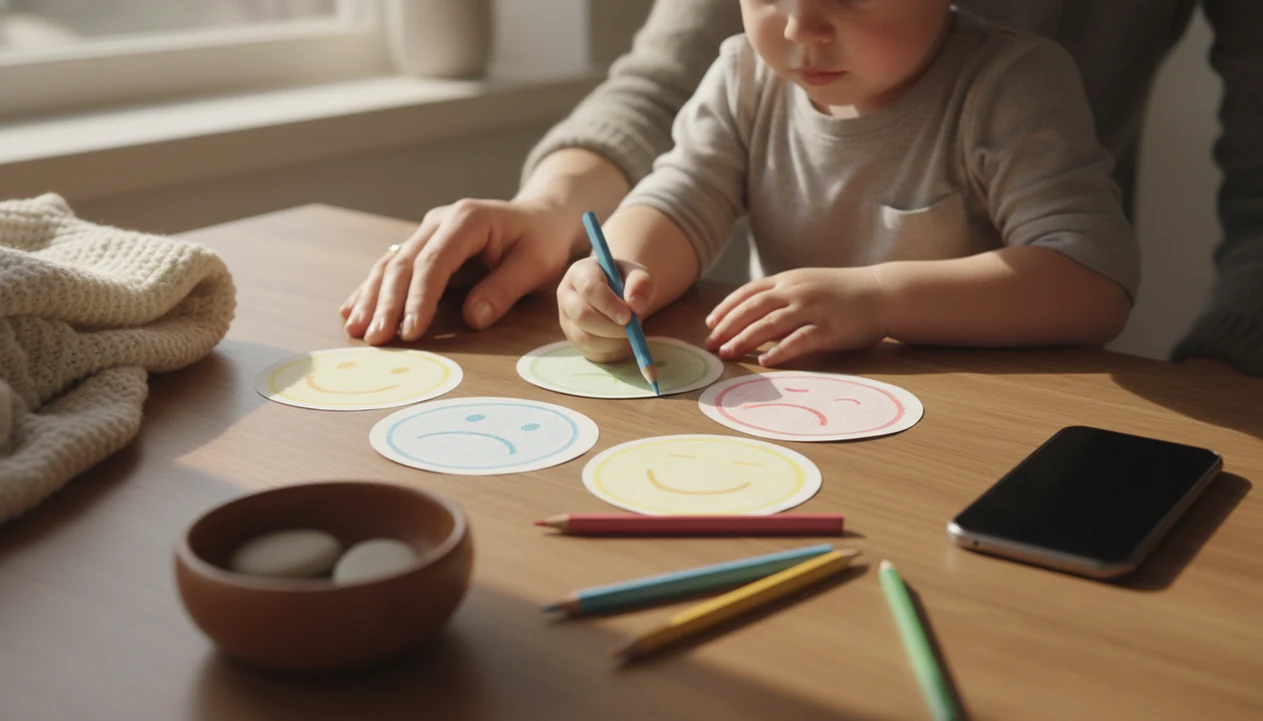


Teaching kids emotional intelligence means helping children notice, name, understand, and manage emotions while respecting other people’s feelings. The core skills are concrete: recognize a feeling, put it into words, calm the body, and choose a response that does not hurt anyone. These skills develop through repeated everyday practice, not a single conversation about behavior.
Adults can model feeling words, offer simple breathing exercises, and return to difficult moments after strong emotions have passed. Short check-ins and predictable bedtime routines make practice easier to repeat. Progress may mean accepting help sooner or naming anger before acting on it, rather than never getting upset. Guided meditation can support that practice, but it cannot replace parent-child conversations, clear limits, or professional care when needed.
The core skills
- Start with four core skills: notice feelings, name feelings, regulate the body, and choose a helpful response.
- Kids learn emotional intelligence best through adult modeling, daily repetition, and calm repair after hard moments.
- Guided breathing, bedtime meditation, and short check-ins can support emotional regulation, but they do not replace parenting routines or professional care when needed.
Teaching Kids Emotional Intelligence Skills: The Core Answer
Teaching kids emotional intelligence starts with four skills: recognizing emotions, naming emotions, managing body reactions, and choosing a response that does not hurt anyone. These skills grow through small moments, not one serious talk at the kitchen table.
A child may still yell, slam a door, or refuse pajamas. Progress looks more like recovering faster, accepting help sooner, or saying “I’m mad” before throwing the toy. That counts.
Keep the goal practical. Use feeling words during ordinary routines, then add calming audio, breathing exercises, or bedtime meditation when the house is already shifting toward quiet. For younger children, a short meditation for toddlers works best when a parent stays close and keeps the practice brief.
Before You Start Teaching Kids Emotional Intelligence
Before you teach emotional intelligence, make sure your child is safe, your own voice is steady enough, and the moment is teachable. Big feelings are not the best time for a long lesson; they are the time for protection, presence, and simple support.
Use this quick readiness check before scripts, breathing, guided audio, or problem-solving:
- Check safety first. Move sharp objects, create space between siblings, block hitting if needed, and use a calm, firm phrase like, “I will keep everyone safe.”
- Wait for the peak to pass. Teach later, when your child can hear you. During the storm, fewer words usually work better.
- Choose small words. Match your child’s age. “Mad body” or “scared feeling” may land better than a full explanation about self-control.
- Ask before adding tools. Say, “Do you want breathing, a hug, quiet, or the audio?” Do not force touch, sensory tools, or guided meditation.
- Keep the first practice tiny. Stop within two minutes, even if it goes well. Ending early builds cooperation for next time.
Teaching Kids Emotional Intelligence in the Brain and Body
Emotional intelligence works through co-regulation, body awareness, and repeated practice with language. In plain terms, children first borrow adult calm, then slowly learn how to calm themselves.
Big emotions are not just “bad behavior.” They involve stress activation, attention, and impulse control. A worried child at 2:13 a.m. checking the glowing clock digits may not be ready for logic. Their body is already alert. A steady adult voice, dim light, and one simple label can lower the heat.
Naming feelings helps children connect body signals with choices. “Your chest feels tight, and you’re scared” gives the brain a map. Over time, that map supports better decisions. A snow globe mindfulness exercise gives children a visual way to explore how feelings can settle with time.
School-based social and emotional learning research is encouraging. A large meta-analysis of 213 programs involving 270,034 students found improved social-emotional skills, attitudes, behavior, emotional distress, and an average 11 percentile-point gain in academic achievement source.
5-Step Teaching Kids Emotional Intelligence Routine for Home
Use this as the daily how-to practice for teaching kids emotional intelligence when emotions are loud, but safety is stable. Keep your voice low. Keep the script boring in a good way.
- Name the moment. Say, “This is bedtime worry,” “This is a sibling conflict,” or “This is school frustration.”
- Model one feeling word. Try, “I feel overwhelmed,” or “You look disappointed.” One word is enough.
- Guide one body-calming skill. Use slow breathing, hand-on-heart breathing, or a quiet count to five.
- Ask one problem-solving question. After calm returns, ask, “What would help next time?” or “What can we repair?”
- Repeat daily and keep it short. Two minutes every day beats a 30-minute lecture once a month.
Tools like MindTastik can support adults with guided meditation, sleep audio, breathing exercises, and self-hypnosis sessions for sleep, anxiety, and everyday calm. The parent’s calm presence still does the main teaching.
Teaching Kids Emotional Intelligence Tips by Age Group
Emotional intelligence teaching should change with age. A preschooler needs pictures and play; a tween often needs privacy, choice, and fewer speeches. For younger children, mindfulness for preschoolers can introduce noticing and pausing through short, playful activities.
| Age group | Helpful tools | What to avoid |
|---|---|---|
| Preschoolers | Feelings faces, stuffed animals, mirror games, simple labels like mad, sad, scared, happy | Long explanations during tantrums |
| Elementary-age children | Body maps, calm-down corners, bedtime check-ins, repair conversations | Treating every feeling as a behavior problem |
| Tweens | Private journaling, body scans, self-talk, problem-solving, more autonomy | Lectures that feel like control |
Older children still need adult modeling. They may roll their eyes, but they notice whether adults pause, apologize, and try again. For middle schoolers who want more independence, meditation for teens sleep and stress can fit better than a parent-led bedtime script. Practicing mindful parenting with teenagers starts with managing your own reactions while respecting their growing need for independence.
5 Teaching Kids Emotional Intelligence Activities for Daily Routines
Short activities work because families can repeat them. Long lectures usually collapse right when everyone is tired.
- Feelings Check-In: Use at breakfast or after school. Ask, “What color is your mood today?”
- Worry Unload: Use before bed. Let your child say or draw one worry, then put it on paper.
- Breathing Buddy: Use during bedtime or car rides. A stuffed animal rises and falls on the belly.
- Repair Replay: Use after conflict. Retell what happened, name one feeling, and choose one repair.
- Kindness Detective: Use in the car. Notice one person showing patience, courage, or care.
Image caption idea: A child-friendly feelings chart beside a bedtime breathing routine for teaching kids emotional intelligence.
Guided audio can support bedtime, focus, and anxiety routines without becoming the whole solution. For a fuller home structure, build a simple family mindfulness routine around the same words each day.
Teaching Kids Emotional Intelligence Through Parent Modeling
Children learn emotional intelligence by watching adult nervous-system regulation in real time. They study your pause, your tone, and your repair after things go sideways.
- Say the feeling out loud: “I feel frustrated, so I’m taking one breath before I answer.”
- Show repair: “I am sorry I yelled. That was too loud. I’m going to try again.”
- Skip shame: “Stop being dramatic” teaches hiding, not regulation.
- Wait on forced apologies: A child who is still flooded may need calm before accountability.
- Let some feelings exist: Not every sadness needs a fix in the first minute.
Parents lose patience. Everyone does. The useful lesson is not flawless calm; it is returning, naming what happened, and showing responsibility. For many families, parent and child breathing exercises give both people the same reset language.
Common Mistakes When Teaching Kids Emotional Intelligence
The most common mistakes happen when parents try to teach too much, too soon, while the child’s body is still in alarm mode. Emotional intelligence grows better from timing, simplicity, and repair than from perfect scripts.
Use this troubleshooting reset when the moment starts going sideways:
- Pause the lesson. If your child is flooded, focus on safety, space, and a steady voice. Save the “what could you do next time?” talk for later.
- Use one feeling word. During conflict, “mad” or “disappointed” is usually enough. A long list of emotions can feel like another demand.
- Validate without erasing limits. You can say, “You really wanted more screen time,” and still hold the bedtime boundary or consequence.
- Wait before asking for apologies. A forced “sorry” may end the scene, but calm accountability teaches more.
- Offer more than meditation. Some children settle through walking, wall pushes, drawing, silence, or a dark room. Guided audio is a tool, not a test they have to pass.
Teaching Kids Emotional Intelligence for Sleep, Anxiety, and Focus
How does emotional intelligence help at bedtime, during worry, and before homework? It gives children a repeatable path: name the feeling, calm the body, then choose one next step.
At night, try a worry unload, two minutes of breathing, a short guided meditation, and consistent lights-out timing. Earbuds on a nightstand, one side tangled around a charging cable, are a small sign the routine needs to be easy. Not fancy.
Before homework, use a focus routine: “I feel annoyed,” three slow breaths, then one tiny task. Open the notebook. Write the date. Start there.
A youth mindfulness meta-analysis reported small-to-moderate improvements in anxiety, depression, and stress among children and adolescents source. That evidence does not prove that a home meditation app treats diagnosed anxiety. Treat guided audio as coping practice, not clinical care.
What mindfulness research says about emotional skills
Mindfulness research does not establish that meditation reliably increases children’s emotional intelligence. A 2023 systematic review of group mindfulness interventions found mixed results for emotion regulation, although some studies reported improvements. That distinction matters: learning to notice a feeling is a useful practice goal, but it is not the same as demonstrating a dependable improvement across children or treating an emotional difficulty.
A 2021 review of meditation techniques in mindfulness programs found reasonably supportive evidence for cognitive and social-emotional skills, but not for improved academic skills. These findings concern structured programs, not proof that a particular commercial app produces the same results. At home, a modest goal is repeated practice with noticing feelings and pausing before responding, rather than expecting meditation to prevent conflict or improve grades.
Teaching Kids Emotional Intelligence Tools: Best For and Not For
Apps, worksheets, feelings charts, and guided audio work best as practice supports. They should not replace the parent-child conversation that helps a child make meaning from an emotion.
| Tool use | Best for | Not for |
|---|---|---|
| Guided audio | Bedtime routines, shared breathing, short focus resets | Outsourcing emotional conversations |
| Feelings charts | Naming feelings and noticing patterns | Diagnosing anxiety or depression |
| Worksheets | Repair talks and problem-solving | Stopping all meltdowns |
| Meditation apps | Parent consistency and calm routines | Adding more screen time at bedtime |
| Sensory tools | Children who need movement, pressure, or quiet | Forcing audio on a child who hates it |
App-based tools work best when paired with off-screen practice. If you compare app-based supports, look at how MindTastik, Calm, Headspace, and Moshi handle child-safe audio, bedtime screen exposure, parent controls, and evidence disclosures. Some children with sensory sensitivities may need drawing, movement, weighted blankets, or silence instead of a guided voice. A calm down meditation for kids can help some families, but choice matters.
When to Seek Professional Help
Seek professional help when a child’s worry, sadness, fear, sleep disruption, or behavior starts interfering with ordinary life. Emotional intelligence practice can support coping, but it is not a replacement for medical or mental health care.
Use a simple escalation plan when you are unsure:
- Call the pediatrician if anxiety, low mood, stomachaches, school refusal, irritability, or bedtime distress keeps repeating and affects sleep, learning, friendships, or family routines.
- Seek urgent support right away if your child talks about self-harm, threatens harm, runs into unsafe situations, or you cannot keep people safe at home.
- Ask the school about the counselor, psychologist, learning evaluations, and classroom support plans if emotions are affecting attendance, behavior, or focus.
- Use therapy for trauma symptoms, severe anxiety, depression signs, panic, grief that feels stuck, or sleep problems that do not improve with steady routines.
- Keep tools in their lane. Breathing exercises, guided audio, feelings charts, and apps like MindTastik can help a child practice calm, but treatment decisions belong with qualified professionals.
Guided practice for family calm and bedtime
MindTastik’s kids sessions, guided meditations, and breathing exercises can support shared practice when a child is calm enough to participate. They fit bedtime settling, short emotional check-ins, and pauses before homework. Parents can also use guided sessions to support their own calm before a repair conversation.
A child who dislikes audio may prefer a feelings chart, drawing, movement, or quiet company. During an unsafe outburst, safety and adult support come first. Persistent distress needs professional assessment, not more meditation sessions.
What emotional skills practice cannot replace
Emotional intelligence practice is supportive, not a guarantee. Clinicians typically recommend professional evaluation when a child’s anxiety, mood, behavior, or safety concerns are intense, persistent, or impair daily life.
- Emotional intelligence practice does not replace mental health care for significant anxiety, trauma, depression, self-harm risk, or severe behavior changes.
- Evidence for commercial kids’ meditation apps is still emerging. Much of the stronger research comes from school-based SEL or mindfulness programs.
- Too much screen use can crowd out sleep, play, movement, and connection.
- Some children dislike guided breathing or audio. They may need movement, drawing, sensory tools, or quiet co-regulation instead.
- Meltdowns, bedtime battles, and worries may still happen, even when families practice daily.
- Per the CDC, about 9.4% of U.S. children ages 3 to 17 have diagnosed anxiety, so persistent worry deserves careful attention source.
- MindTastik and similar tools are better viewed as adult support for routines, not a substitute for care from a qualified professional.
Questions about teaching children emotional skills
At what age can children start learning emotional intelligence?
Practice can begin in the preschool years with simple feeling words, pictures, stuffed animals, and play. A young child does not need to explain an emotion in detail. Older children can add body awareness, repair conversations, and problem-solving. Tweens may prefer private check-ins and more choice about how they participate.
How do I help a child who cannot name their feelings?
Start with a few familiar words, such as mad, sad, scared, and happy. Offer a tentative label: “You look disappointed.” Feelings pictures or drawing can help when speaking is difficult. Avoid turning the moment into a quiz. Adults can model the same skill by naming their own feelings during ordinary routines.
Should I teach emotional skills during a tantrum?
During the peak of a tantrum, focus on safety, space, a steady voice, and fewer words. Move dangerous objects and prevent hitting where needed. Save explanations and problem-solving for later, when the child can listen. Once calm returns, name one feeling and discuss one safer response or repair.
How can I validate feelings without allowing hitting or yelling?
Separate the emotion from the action. A parent can say, “You are angry, and I will not let you hit.” The feeling can be acknowledged while the safety limit stays firm. After calm returns, discuss what happened and choose a repair. Validation does not mean removing every limit or accepting harmful behavior.
What if my child refuses breathing exercises or meditation?
Do not make audio or breathing another demand during conflict. Offer a different support, such as drawing, a feelings chart, movement, or quiet space with an adult nearby. Practice can happen later, during a calmer routine. The goal is learning a usable calming skill, not completing a particular exercise.
Can mindfulness improve a child’s emotional intelligence?
Mindfulness may support skills related to emotional intelligence, including noticing body signals, attention, and self-regulation. Research on children’s emotion regulation is mixed, so improvement is not guaranteed. Brief, age-appropriate practice is best treated as a support alongside adult modeling and conversations, not as a treatment or a way to eliminate difficult feelings.
When do emotional difficulties need professional help?
Contact a pediatrician when repeated worry, sadness, irritability, school refusal, stomachaches, or bedtime distress affects sleep, learning, friendships, or family routines. Seek urgent support if a child talks about self-harm, threatens harm, enters unsafe situations, or cannot be kept safe. Emotional skills practice should not delay medical or mental health care.