
Doing Nothing For Productivity: A Practical Guide to Better Focus
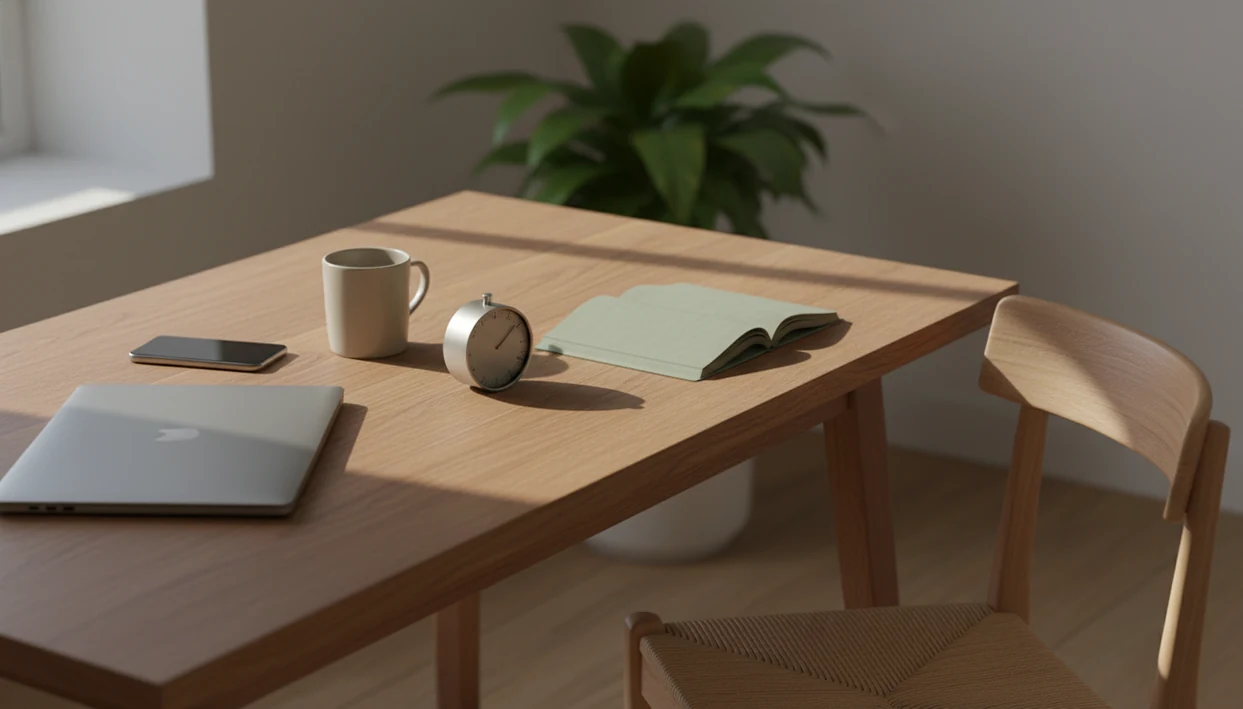


Doing nothing for productivity means deliberately pausing work, screens, and task-switching to give attention a rest before returning to a task. It is not laziness or a demand to empty the mind. The useful version is brief and intentional: three to ten minutes of quiet sitting, simple breathing, mindful stillness, or guided meditation, without checking messages or planning the next project.
Start with two to five minutes between demanding tasks rather than adding another elaborate routine to the workday. These pauses are intended to reduce stress and mental overload, not guarantee more output. MindTastik offers guided meditation and breathing exercises for adults who prefer some structure during a break. Sleep audio and self-hypnosis serve separate rest and calm needs, rather than replacing a workday pause.
What matters most
- Use short, true-rest breaks instead of scrolling, multitasking, or pushing through mental fatigue.
- Start with 2-5 minutes between tasks, then build toward a repeatable daily routine.
- MindTastik can support this habit with guided meditation, breathing exercises, sleep audio, and self-hypnosis sessions for adults who want sleep, anxiety, and everyday calm support.
Doing Nothing For Productivity Meaning in Plain English
Doing nothing for productivity is a deliberate mental reset, not wasted time. The point is to stop feeding your brain new input for a few minutes, so attention can settle before the next task.
A true pause means no work, no inbox checking, no scrolling, and no “quick” project planning in another tab. If your laptop fan is the loudest thing in the room during a five-minute pause, you’re probably doing it right. If your home doubles as your office, meditation for remote workers can help create clearer pauses between tasks.
Useful forms include slow breathing, a body scan, silent sitting, a short walk, or an app-guided meditation. The most practical doing nothing for productivity guide starts small: one clean pause between two demanding tasks, not a whole new lifestyle by Monday.
For busy people, a short reset is often easier than a long meditation because it fits the real gaps already inside the day. For women balancing demanding careers and personal responsibilities, meditation for women professionals offers a more specific starting point.
How Doing Nothing For Productivity Works in the Brain
Doing nothing helps productivity by lowering cognitive load, reducing stress arousal, and giving attention a chance to reorganize. In plain terms, your brain stops reacting to every signal and gets a moment to choose what matters next.
Five useful facts explain the mechanism:
- Attention fatigue is real: after long task blocks, the mind becomes more distractible and less precise.
- Stress arousal narrows thinking: when your body is keyed up, small emails can feel like emergencies. When small workplace tensions feel overwhelming, responding mindfully to frustration at work can help you pause before reacting.
- Mental clutter has a cost: every open loop competes for working memory.
- Short pauses reduce load: a quiet break helps the brain shift from reactive mode to reflective mode.
- Mindfulness can train related skills: a 2014 meta-analysis of 19 randomized trials found small to moderate improvements in attention, executive control, and working memory after brief mindfulness training psycnet reference: a0034988.
NIH-funded research has also linked eight weeks of mindfulness-based stress reduction with measurable changes in brain regions tied to learning, memory, emotion regulation, and perspective taking. (NIH). That does not mean meditation guarantees higher output. It means rest can support the systems work depends on.
Doing Nothing For Productivity Evidence From Workplace Mindfulness
The strongest evidence for workplace mindfulness is not “instant productivity.” It is stress reduction, less burnout, better well-being, steadier attention, and improved emotional regulation.
Five research-backed points are worth keeping:
- Worker stress can shift: randomized workplace studies have found mindfulness training can reduce perceived stress, although effects vary by program and population (PubMed research: 22229120).
- Burnout may ease: a 2016 systematic review of workplace mindfulness interventions found reductions in stress and burnout, plus improvements in well-being (PubMed research: 27605198).
- Job satisfaction may improve: a corporate randomized trial reported improved mindfulness, lower distress, and better work-related well-being after an online mindfulness program (PubMed research: 22060566).
- Recovery supports focus: people often work better after they stop draining the same attention system without pause.
- Productivity gains are indirect: the path is usually recovery, clarity, and less emotional depletion, not a magical speed boost.
Clinicians and workplace well-being researchers typically frame mindfulness as a supportive practice for stress regulation, not a replacement for sleep, workload boundaries, or mental health care. Managers can adapt this idea inside meditation for managers routines without treating it like a performance hack.
What eight weeks of daily practice can show
A 2025 randomized trial involving 1,458 employees assigned participants to ten minutes of digital meditation daily for eight weeks or to a wait-list control. The meditation group reported a large reduction in perceived stress, and benefits remained at four months. Participants practicing five to just under ten minutes daily improved more than those practicing under five minutes. That comparison does not establish a minimum effective break length for everyone.
The distinction matters because a two-minute pause between meetings is not the same intervention as a daily meditation program lasting eight weeks. The trial supports repeated practice for employee stress, not a claim that any brief period of doing nothing increases output. A 2019 workplace trial also found that a six-week mindfulness program reduced stress, while a single-day program did not produce comparable effects.
How to Use Doing Nothing For Productivity During Workdays
Use doing nothing during workdays as a small reset between meetings, task blocks, or emotionally loaded decisions. The habit works better when it is boring and repeatable.
- Choose a trigger: place a 2-minute pause after meetings, before deep work, or after sending a difficult message.
- Set a short timer: start with 2-5 minutes, not 20 minutes you’ll avoid.
- Remove stimulation: turn away from tabs, place the phone face down, and let your shoulders drop.
- Notice one anchor: follow your breath, feet, sounds in the room, or forehead resting on clasped hands.
- Add structure when needed: move from silent pauses to a 5-minute guided breathing or focus reset.
- Review gently: ask, “Do I re-enter work with less static?” Skip scoring it like a productivity metric.
Tools like MindTastik, Calm, and Headspace can help when silence feels too loose.
Best-Fit Workdays and Poor-Fit Situations for Doing Nothing For Productivity
Doing nothing fits best when your main issue is mental overload, not a broken work system. Use these doing nothing for productivity tips to decide when it helps and when another solution is needed.
| Best for | Not for |
|---|---|
| Busy professionals moving between meetings | Replacing missed sleep |
| Meeting-heavy days with little transition time | Fixing toxic workloads |
| Anxious overthinkers who need a short reset | Avoiding difficult decisions |
| Creative blocks where more force is not helping | Treating severe symptoms without support |
| Beginners to meditation who need a simple entry point | Solving unclear priorities alone |
Short rest supports capacity, but it does not solve systemic overwork. If the calendar has no breathing room, the real fix may include boundaries, delegation, or priority changes. For especially demanding work conditions, Zen Armor for extreme work stress offers perspective on staying grounded under sustained pressure.
Founders often need both pauses and structural decisions; that mix is covered more directly in meditation for founders. When uncertainty and rapid decisions drive overload, meditation for startup stress can provide a more focused approach to pausing.
Screen-Free Tips That Avoid Fake Rest
Fake rest is stimulation wearing a softer outfit. Scrolling, inbox checking, news checking, multitasking, and obsessing over productivity tracking can keep the brain in input mode.
Try these screen-free options instead:
- The breath reset: take ten slow breaths and let each exhale be slightly longer.
- The window pause: look outside without hunting for a lesson or idea.
- The body scan: notice your jaw, shoulders, hands, stomach, and feet.
- The slow walk: move without a podcast, call, or message thread.
- The guided exception: use your phone only if you are starting a specific guided session, then set it down.
The goal is not a blank mind. It is a lower-stimulation state where the next thought does not have to compete with twelve open inputs.
Caption idea: A two-minute screen-free pause between tasks can be a practical form of doing nothing for productivity.
MindTastik Support for Doing Nothing For Productivity Routines
Guided sessions can make doing nothing easier for beginners who find silence awkward, restless, or too unstructured. Some people do better when a calm voice tells them where to place attention for three minutes.
MindTastik offers guided wellness practices, sleep-focused audio, breathing sessions, and self-hypnosis tracks for adults who want support with rest, anxious moments, and everyday calm. Its strongest fit for doing nothing for productivity is not pushing for more output; it gives beginners a 3- to 10-minute structure when a quiet pause at the desk feels too undefined. For readers comparing sleep-focused options, MindTastik’s wind-down cues may support the recovery that contributes to daytime focus.
That support can be useful during work breaks, but recovery outside work matters too. Sleep audio and anxiety-calming sessions may help people build steadier evening routines, which can support clearer daytime focus. After a demanding day of meetings, when the laptop is shut and the calendar is finally still, a simple audio cue can feel easier than trying to create calm with no guidance.
For people comparing options by role, meditation for entrepreneurs may offer a more work-specific starting point.
When Unfinished Desk Work Follows You Home
For desk workers whose output is a proposal, spreadsheet, or piece of code, the workday can end before the problem feels finished. An unresolved client comment or tomorrow's deadline can turn an otherwise quiet evening into mental rehearsal. Give unfinished work a stopping point: record the next concrete action, note when you will return to it, and leave the remaining uncertainty unresolved tonight. If your role includes evening coverage, distinguish the messages you are responsible for answering from tasks that can wait. Doing nothing should not become another assignment to complete perfectly before bed.
The relevant sleep evidence is broader than this particular work pattern. A systematic review of mindfulness meditation for adults with sleep problems found better subjective sleep quality than nonspecific active controls, but not clear superiority over established sleep treatments. That finding concerns meditation programs, not proof that a few idle minutes will improve sleep. For deadline driven desk work, the practical aim is narrower: let the evening contain time when you are neither producing work nor mentally preparing the next deliverable.
Guided breathing for a pause between tasks
MindTastik's guided meditations, focus sessions, and breathing exercises suit adults who find an unstructured desk pause difficult to start. A spoken practice gives attention somewhere to rest without opening another message thread. Start the audio, then set the phone down.
A silent pause or a walk without audio is a better choice when another voice feels like more input. Sleep-focused audio belongs in a separate bedtime routine. No session can resolve an excessive workload, unclear priorities, or a need for medical or mental health care.
What a quiet work break cannot fix
Doing nothing is useful, but it has real limits. Treat it as a supportive practice, not a cure for every work problem.
- It will not fix unrealistic workloads, unclear priorities, or toxic workplace systems. - Direct long-term evidence for hard productivity metrics is more limited than evidence for stress, attention, and well-being. - Some people with severe anxiety, depression, or trauma may find quiet stillness uncomfortable or triggering. Meditation is generally low risk, but distressing thoughts or emotions can make quiet practice uncomfortable. A single session may feel helpful, while evidence for sustained stress reduction comes from repeated practice, including an eight-week employee meditation trial. Tracking every break can turn rest into another performance task. Meditation does not replace sleep, movement, workload boundaries, therapy, or medical care. If stillness feels overwhelming, try eyes-open breathing, slow walking, grounding exercises, or professional support.
Quiet is not always neutral.
High-output workers may need a different balance of rest, ambition, and boundaries, especially in meditation for high performers.
Between Meetings
- Use a 3-minute desk pause after a tense call, before you open the next agenda. A clean reset works best when the laptop is closed and the next task has not started yet.
- Try doing nothing during a small calendar gap instead of filling it with messages. The pause is most useful when it protects attention rather than becoming another productivity tactic.
- After a meeting reset, sit still long enough to notice what is still lingering: a decision, a tone, or a loose next step. Naming the residue can make the next block of work feel less cluttered.
- This works best when the goal is transition, not escape. A short pause can support clearer re-entry, but it should not replace action on urgent work.
Questions about doing nothing at work
Does doing nothing actually improve productivity?
A deliberate pause can support a return to work, but it does not reliably increase output in every job. Research on brief breaks is stronger for reduced fatigue and improved well-being than for consistent performance gains. Workplace meditation research also supports stress reduction more clearly than direct productivity improvements.
How long should a screen-free work break last?
Two to five minutes is a practical starting point between tasks. Three to ten minutes can accommodate quiet sitting, breathing, or a short guided session. These are starting ranges, not proven optimal doses. Studies of daily meditation often use longer practice periods repeated over several weeks.
What should I do during a doing-nothing break?
Stop working and put messages out of reach. Sit quietly, notice sounds in the room, feel the feet on the floor, or follow the breath without forcing it. A slow walk without audio is another option. The aim is less input, not perfect stillness or a blank mind.
Does scrolling on my phone count as rest?
Scrolling is a break from the current task, but it is not a screen-free pause. It continues to supply new information and opportunities to switch attention. For this particular routine, put the phone aside. If using guided audio, start the chosen session and leave the screen alone.
What if my mind keeps thinking about work during the break?
Work thoughts do not mean the pause has failed. Notice that planning has resumed, then return attention to a simple anchor such as sounds, breathing, or contact with the chair. Avoid solving the problem during the pause. The task can resume when the planned break ends.
Can I use a short pause between back-to-back meetings?
A small calendar gap can hold a two- or three-minute pause without becoming another meeting task. Close the previous agenda and avoid filling the gap with messages. If possible, choose the next task before pausing so the break has a clear endpoint and does not become avoidance.
What if sitting quietly makes me more anxious?
There is no need to force a silent, eyes-closed practice. Try keeping the eyes open, noticing the room, or taking a slow walk instead. Stop if distress increases. Persistent or severe anxiety needs appropriate support; a work break or meditation session is not a substitute for care.