
Body Scan Meditation for Sleep: Bedtime Practice and Evidence
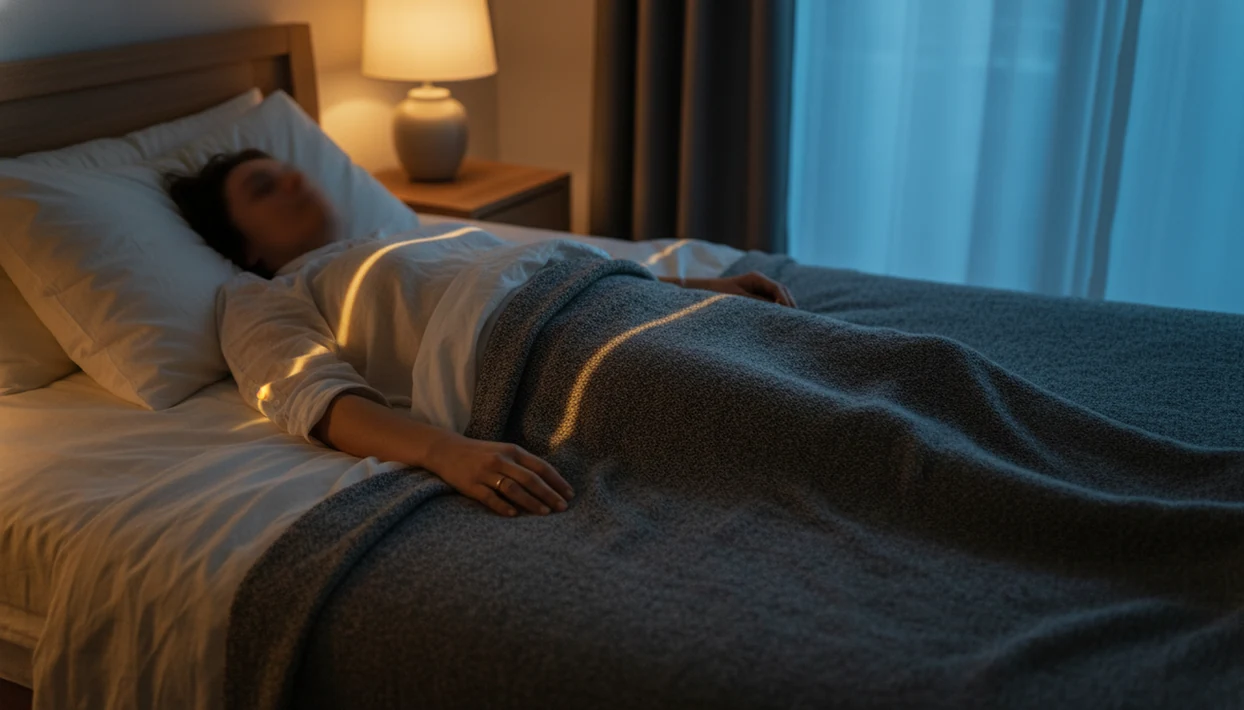


Body scan meditation for sleep is a mindfulness practice that moves attention slowly through the body, noticing sensations without judgment to help settle before bed. Usually practiced lying down, it brings awareness to tension, warmth, heaviness, tingling, or areas where little is noticeable. The aim is to ease bedtime tension and rumination, not to force instant sleep or make every muscle relax.
Most beginners use a guided session lasting 10 to 30 minutes, either in bed or during a wind-down routine. A shorter scan can suit a nighttime waking. Body scanning may reduce stress arousal, but it is not a medical treatment for sleep apnea, chronic insomnia, trauma-related distress, or severe mental health symptoms. Comfortable attention matters more than completing every body region.
The essentials
- A body scan for sleep guides attention from one body area to the next while noticing tension, warmth, heaviness, tingling, or neutral sensations.
- Most beginners use a guided body scan meditation for 10-30 minutes in bed or during a pre-sleep wind-down routine.
- Body scanning can support sleep by reducing stress arousal, but it is not a medical treatment for sleep apnea, chronic insomnia, trauma distress, or severe mental health symptoms.
Body Scan Meditation For Sleep At A Glance
Body scan meditation moves attention through body regions with nonjudgmental awareness, usually while lying down. The goal is relaxation and awareness, not making sleep happen on command.
It fits beginners, overthinkers, people with sleep anxiety, and anyone who notices tight shoulders or a clenched jaw at night. A typical body scan for sleep lasts 10-30 minutes, though a shorter track can help after waking in a quiet room before morning.
Population estimates commonly place short-term insomnia symptoms at roughly 30-35% of adults and chronic insomnia near 10% NIH research: NBK526136. That is why accessible sleep-support tools matter. For beginners, a body scan is often easier than silent meditation because the next body area gives the mind a clear place to land.
Five Body Scan For Sleep Facts Beginners Should Know
- Body scan is mindfulness, not just a relaxation trick. It trains awareness by asking you to notice what is present in the body. For other ways to practice mindful attention, explore these meditation techniques and choose a comfortable starting point.
- The method uses nonjudgmental attention. You notice pressure, warmth, tightness, tingling, or nothing much without trying to fix every sensation.
- For sleep, it may lower stress arousal. The slow shift from thoughts to body cues can soften the “still on alert” feeling.
- Wandering thoughts are expected. Losing the breath count after four is not failure; returning is the practice.
- Regular use works better than emergency-only use. A sleep body scan pairs best with steady sleep habits, dim light, and a repeatable wind-down routine.
Small repetition matters.
If you are new to bedtime practice, the broader basics are covered in our sleep meditation for beginners guide.
How Body Scan Meditation For Sleep Works
Body scan meditation for sleep works through attentional anchoring, which means moving focus away from worry loops and into body sensations. In plain language, you give the mind a quieter job than replaying unread emails behind closed eyes.
The practice often combines three ingredients: slow breathing, body awareness, and gentle muscle release. Breath gives the nervous system a steady rhythm. Body awareness breaks rumination into smaller moments. Muscle softening tells the body it does not need to brace. For a steady breathing rhythm before scanning, try resonant breathing while keeping the pace comfortable.
In a randomized clinical trial of adults with chronic insomnia, an 8-week mindfulness-based stress reduction program that included body scan meditation improved sleep quality and reduced insomnia severity compared with waitlist control JAMA Internal Medicine study: 1731967. Another randomized clinical trial in older adults found that a 6-week mindfulness awareness program improved sleep quality more than sleep-hygiene education JAMA Internal Medicine study: 2110998.
Clinicians typically recommend persistent insomnia be evaluated rather than managed with meditation alone.
What body-scan sleep studies actually show
Evidence for body scanning alone is narrower than evidence for broader mindfulness programs. A 2022 review of body-scan randomized trials described a limited, varied evidence base. Studies differ in participants, practice schedules, and outcomes, so a positive result in one group does not establish that a bedtime recording will shorten the time it takes every adult to fall asleep.
Some encouraging findings come from combined treatment. In a 2020 adolescent insomnia trial, 26 participants practiced body scanning alongside six weeks of internet-delivered cognitive behavioral therapy for insomnia, compared with 28 receiving the comparison treatment. Improvements appeared in sleep logs, activity-based sleep measurements, and self-reported symptoms, and persisted at two-month follow-up. Those findings support body scanning as a possible addition to treatment, not a stand-alone cure or a result that automatically applies to adults.
Before You Start A Body Scan Meditation For Sleep
Before you start a body scan meditation for sleep, make the setup easy enough that you do not have to problem-solve from under the covers. The aim is to create a low-effort runway for rest, not another bedtime test to pass.
- Choose a quiet window before you are completely depleted, irritated, or desperate for sleep. A body scan is gentler when frustration has not already taken over the room.
- Set your phone volume, screen brightness, timer, and do-not-disturb mode before lying down. That one minute of setup prevents the bright-screen stare that wakes you back up.
- Pick a position that lets you breathe comfortably and does not aggravate pain. Side-lying, a pillow under the knees, or a supported reclined position can all count.
- Use a shorter track if middle-of-the-night waking is the main issue. At 3 a.m., less instruction often works better than a full 30-minute lesson.
- Treat the scan as practice, not performance. Do not use it to force sleep, grade your relaxation, or measure whether your body is “doing it right.”
How To Use A Guided Body Scan Meditation In Bed
Use a guided body scan meditation in bed by setting the audio first, lying down comfortably, breathing slowly, then moving attention through the body one region at a time. If sleep arrives, let the track fade into the background.
1. Set your sleep body scan audio
- Choose a low-volume guided track, timer, or app session before you settle under the covers.
- Dim the phone screen before starting, especially if you tend to check the lock screen at night.
2. Lie down without bracing
- Rest on your back or side and soften the jaw, shoulders, hands, belly, hips, and legs.
3. Start with slow breathing
- Take 3-5 slow breaths without trying to control whether sleep happens.
4. Move attention through the body
- Scan from head to toe or toe to head, pausing at each area long enough to notice tension, warmth, pressure, tingling, heaviness, or neutral sensation.
5. Return gently when thoughts wander
- Return to the last body area when the mind wanders, then continue. No scolding needed.
If you want a shorter structure first, try a 10 minute meditation before bed.
Body Scan Meditation For Sleep Versus Breathing Exercises
Body scan and breathing exercises both support bedtime calm, but they use different anchors. Breathing keeps attention on the breath; body scanning moves attention through changing body regions.
| Practice | Main anchor | Often fits | Watch for |
|---|---|---|---|
| Body scan meditation | Feet, legs, belly, chest, hands, face, and other body regions | Physical tension, restlessness, racing thoughts tied to body discomfort | Can feel too long if you are very wired |
| Breathing exercises | Inhale, exhale, counting, or breath rhythm | Quick anxiety spikes, panic-like activation, short resets | Can frustrate people who over-control breathing |
For people with heavy legs, a tight throat, or restless shoulders, body scanning usually works best when discomfort keeps pulling attention back. Breathing fits people who need a short reset before choosing what to do next.
Tools like MindTastik include guided meditation, sleep audio, breathing exercises, and self-hypnosis as complementary options, not one-size-fits-all answers.
Common Sleep Body Scan Mistakes And Fixes
These mistakes make beginners think the practice is failing when it may only need a small adjustment.
- The knockout expectation: Do not judge the body scan by whether it “puts you out” instantly. Use it to lower effort and create a repeatable cue for rest.
- The wandering-mind verdict: Thoughts will drift. Gently returning attention is the training, not a sign you missed the point.
- The forced-relaxation trap: You do not have to melt every muscle. Notice tension, then give it room.
- The wrong-track problem: A voice that is too bright, loud, or long can keep you alert. Pick softer audio or a shorter session.
- The audio-only habit: Guided tracks help, but learn a basic self-guided version too. Earbuds on a nightstand, one side tangled around a charging cable, should not decide your whole night.
For sleep anxiety, useful audio features include a familiar voice, low volume, offline tracks, and a short session that requires little setup during a nighttime waking.
Best Times To Use A Body Scan For Sleep Anxiety
When should you use a body scan for sleep anxiety? Use it before bed as part of a 10-30 minute wind-down routine, or during a middle-of-the-night waking with a shorter 5-10 minute track.
A longer guided body scan fits stressful evenings when rumination is high and the body still feels “on.” A shorter version fits the 3 a.m. moment when you need less instruction and more quiet. Rotating short and long tracks also prevents boredom. Some nights you can manage a 20-minute body scan; other nights, five minutes is enough.
Useful app features include timers, offline access, voice choice, and tracks built for waking in the night. If anxiety is the main bedtime pattern, a meditation app for anxiety support can help you compare short resets with longer sleep sessions.
When to stop scanning and get out of bed
A body scan should not become a reason to stay awake in bed for a long stretch. If a brief scan ends and wakefulness or frustration continues, repeating longer recordings can turn relaxation into another effort to make sleep happen. The VA/DoD insomnia guidance places body scans among arousal-reduction techniques, while treating conditioned wakefulness through other parts of cognitive behavioral therapy for insomnia, or CBT-I.
Stimulus control, a component of CBT-I, generally means leaving bed for a quiet activity when unable to sleep and returning when sleepy. The distinction is practical: a scan offers a brief opportunity to settle, but it is not an endurance exercise. Persistent insomnia or daytime impairment needs assessment. The American Academy of Sleep Medicine recommends CBT-I strongly, while its recommendation for relaxation therapy alone is conditional.
Sleep Body Scan Progress Signs To Notice
Progress with a sleep body scan is not only “I fell asleep before the track ended.” Softer body tension, fewer bedtime worry loops, and an easier return to calm after waking are also useful signs.
Look across several weeks, not one rough night. A systematic review and meta-analysis of randomized controlled trials found mindfulness meditation produced small to moderate improvements in sleep quality compared with controls doi reference: nyas.13996. That wording matters. Small to moderate means helpful for some people, not dramatic for everyone.
Try a simple note in a journal or app: session length, tension level, worry level, and your sleep onset impression. Nothing fancy. If you are deciding between narrated options, the sleep stories vs guided meditation comparison can help clarify what kind of audio fits your brain at night.
Guided audio for a bedtime body scan
MindTastik’s guided meditation library suits readers who prefer spoken prompts to remembering a sequence of body regions. Breathing exercises can provide a simpler attention anchor, while sleep stories offer an alternative when close attention to bodily sensations feels uncomfortable. To compare breath-focused practices, explore breathing meditation vs breathwork and choose an approach that feels comfortable at bedtime.
The useful choice is a session that reduces effort rather than adding another bedtime task. Readers who prefer silence can practice without audio. Persistent insomnia or distress during body-focused practice calls for clinical guidance, not a different recording. MindTastik is not a medical treatment.
What a bedtime body scan cannot treat
Body scan meditation does not work equally well for everyone, and it should not be treated as a stand-alone fix for serious sleep problems. It may create mild relaxation without major sleep changes.
Important limits include:
- It is not a replacement for medical evaluation of sleep apnea, restless legs, chronic insomnia, or severe depression-related insomnia.
- People with trauma histories or body-related distress may find close body attention uncomfortable.
- Occasional use is unlikely to change chronic sleep patterns by itself.
- Audio guides can become a sleep crutch if you never practice a simple self-guided version.
- Some voices, music beds, or pacing styles may feel irritating instead of calming.
- If panic, nightmares, pain, or breathing problems are part of the night, professional support matters.
The most common medically supported way to address persistent insomnia is clinical assessment combined with evidence-based sleep care, while meditation can serve as a supportive practice.
Nighttime Reset
Your thoughts speed up as soon as the room gets quiet.
Start with three slow exhales before the body scan, then move attention from the forehead downward. A simple opening cue can make the first minute feel less abrupt. Before scanning, diaphragmatic breathing can help you practice gentle belly movement without forcing deeper breaths.
You get irritated because you still feel tension halfway through.
Switch from “release tension” to “notice tension without fixing it.” The reset is not to erase every sensation; it is to stop arguing with the body at bedtime.
You fall asleep during the first few minutes and worry you did it wrong.
For sleep preparation, drifting off is not a failure. Choose a shorter guided session or offline audio so the practice can fade without needing another decision.
On nights when guided practice feels like too much effort, MindTastik sleep stories offers low-stimulus audio you can play in the background.
Body scan for sleep questions
Does body scan meditation help people fall asleep faster?
It may make bedtime feel calmer, but faster sleep is not a reliable outcome. Research on mindfulness finds some improvements in reported sleep quality, while effects on sleep-onset time are inconsistent. Most studies examine broader programs, so their results cannot be attributed to a bedtime body scan alone.
How long should a body scan for sleep last?
A guided bedtime scan commonly lasts 10 to 30 minutes. A shorter 5 to 10 minute session can suit a nighttime waking or an evening when instructions feel tiring. Completing a long recording is not the goal. A brief, comfortable practice is preferable to pushing through growing frustration.
Should a sleep body scan start at the feet or the head?
Either direction can work. A toes-up scan provides a straightforward sequence, while a forehead-down scan can begin with noticeable jaw or shoulder tension. There is no need to find a perfect route. Follow one body region at a time and return to the last remembered area when attention drifts.
Is it okay to fall asleep during a body scan?
Yes. When the purpose is sleep preparation, drifting off does not mean the practice was done incorrectly. There is no need to stay awake to finish every instruction. Set the audio and volume before settling down so falling asleep does not leave another task to complete.
What if I cannot feel anything during a body scan?
Little or no sensation is something to notice, not a problem to solve. Attention can rest on contact with the mattress, warmth, pressure, or a neutral area before moving on. A body scan does not require tingling, heaviness, or a strong feeling of relaxation to count as practice.
What should I do if body scanning makes me anxious?
Stop the scan rather than trying to push through distress. A less body-focused practice, such as a quiet sleep story, may feel more comfortable. Return to normal breathing if deliberate breathing causes light-headedness or panic symptoms. Repeated distress, trauma-related reactions, or severe panic warrants clinical guidance.
Can body scan meditation replace CBT-I for chronic insomnia?
No. CBT-I remains the primary recommended treatment for chronic insomnia. Body scanning can support its relaxation component, but does not address all the patterns that maintain insomnia, including conditioned wakefulness and excessive time in bed. Persistent sleep problems or daytime impairment deserve assessment rather than repeated reliance on bedtime audio.