
Mindful Sensory Activities for Kids: A Practical Calm-Down Guide
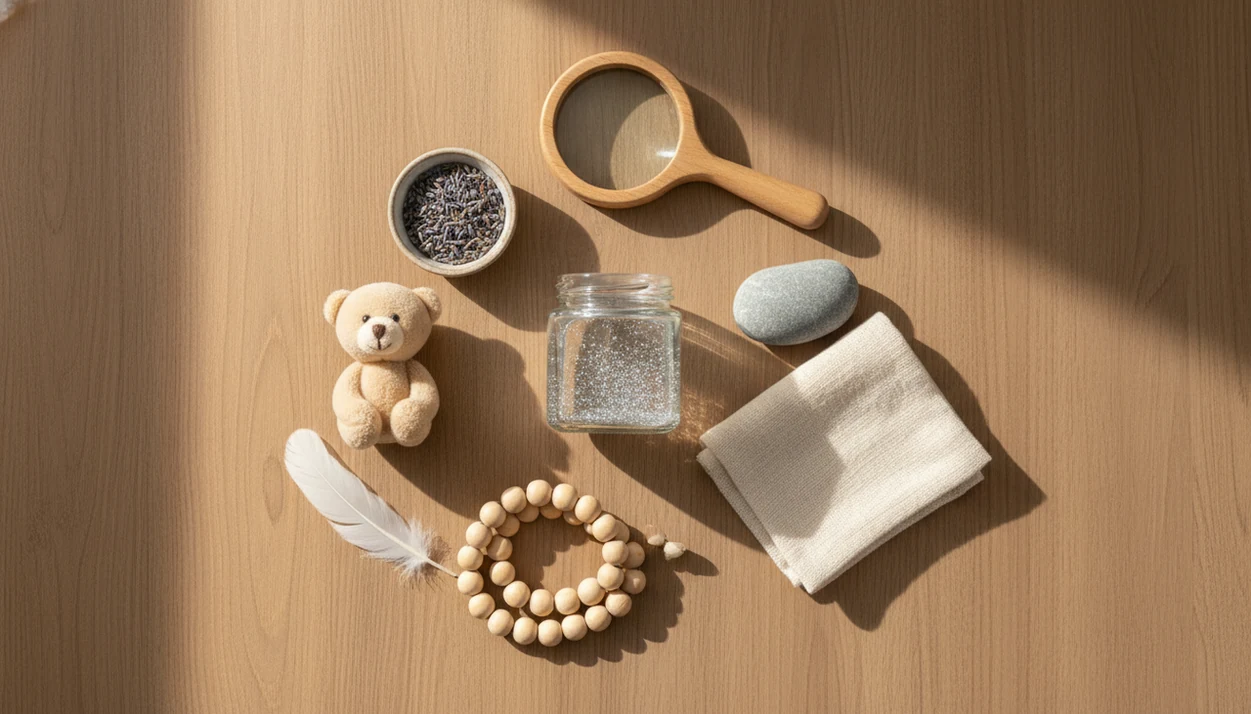


Mindful sensory activities for kids are simple play, movement, breathing, or noticing exercises that bring attention to the present moment through the senses and body awareness. A child might listen for nearby sounds, feel a smooth stone, or watch a stuffed animal rise with each breath. The aim is a brief opportunity to calm, reset, or focus, not a requirement to sit still or perform meditation correctly.
Useful activities pair familiar materials with one short prompt and a choice about participating. Pick an activity for the moment: a transition, homework, bedtime, or screen-free decompression. A review of early-childhood interventions emphasizes developmentally appropriate practice and caregiver support. These routines can support children, but persistent anxiety, sensory distress, or behavioral concerns need more than a calm-down activity.
Choose a calm-down activity
- Use the five senses, body awareness, movement, and breathing as simple attention anchors.
- Choose activities by goal: calming, focus, transitions, bedtime, or screen-free decompression.
- Keep expectations realistic: these tools can support calm routines, but they do not replace professional care for persistent anxiety, sensory distress, or behavioral concerns.
Mindful Sensory Activities for Kids Guide: What Counts
Mindful sensory practice is sensory play with a present-moment prompt. A child may touch, listen, smell, move, breathe, or look closely, but the mindful part begins when an adult gently asks them to notice what is happening right now.
A smooth stone in the palm can become mindful with, “Is it cool or warm?” A walk becomes mindful when the child listens for three sounds. Smelling a flower, watching glitter settle in a jar, or feeling socks against toes can all count.
The adult’s job is not to lecture. It is to offer one small doorway into attention.
Some children settle through stillness. Others need movement, sound, texture, or visual focus first. For younger children, a one-minute activity may be enough. For older kids, sensory noticing can pair well with a family mindfulness routine that feels predictable but not stiff.
Sensory Attention Anchors for Child Calm and Focus
Sensory attention anchors help children shift from worry, restlessness, or distraction toward something concrete. The mechanism is simple: the sense input gives the brain a specific place to put attention.
- Sight can anchor attention: Watching glitter settle, clouds move, or a pencil roll gives the child one visual target.
- Sound can create a pause: Naming the closest sound, then the farthest sound, slows the jump from feeling to reaction.
- Touch can organize attention: A texture tray, fabric square, or cool spoon gives restless fingers a job.
- Breathing is sensory too: Feeling the belly rise under a stuffed animal turns breath into something visible and touchable.
- Body awareness extends the practice: Children can notice heavy feet, soft shoulders, or a fast heartbeat without being told to “calm down.”
The NIH’s National Center for Complementary and Integrative Health notes that meditation and mindfulness practices may help with stress and anxiety, while evidence quality and results vary by population and program: source
The pause matters.
For children who struggle with anxious thoughts, sensory grounding often works best as a short support alongside broader routines, such as meditation for anxious kids.
Mindful Sensory Activities for Kids at a Glance
Use this table to match the activity to the moment. A calm-down jar may help one child settle, but the same glitter and motion may overstimulate another child who is already overloaded.
| Activity | Best for | Main sense | Time needed | Adult prompt | Watch-out |
|---|---|---|---|---|---|
| Calm-down jar | Calming after upset | Sight | 2 minutes | “Watch one piece of glitter fall.” | Busy visuals may irritate some kids. |
| Five-sound listening | Focus before homework | Hearing | 1 minute | “What sound is closest?” | Avoid loud rooms. |
| Breathing with a stuffed animal | Bedtime | Body and breath | 3 minutes | “Can you make it rise slowly?” | Don’t force deep breathing. |
| I Spy walk | Transitions | Sight and movement | 5 minutes | “Find three blue things.” | Keep it short in crowded places. |
| Sensory bag | Waiting rooms or car rides | Touch | 2 minutes | “What shape do your fingers find?” | Check for leaks. |
| Mindful snack | After-school decompression | Taste and smell | 3 minutes | “What changes as you chew?” | Skip if food rules are stressful. |
| Texture tray | Screen-free reset | Touch | 3 minutes | “Which texture feels softest?” | Messy textures can backfire. |
5 Steps to Use Mindful Sensory Activities for Kids
A mindful sensory activity works better when it has one clear goal, one anchor, and one short prompt. Keep the setup small enough that you can repeat it on a tired Tuesday.
- Set one goal such as calm, focus, transition, or bedtime before choosing the activity.
- Pick one sense or body anchor such as sound, touch, sight, breath, feet, or hands.
- Offer one short prompt like “What do you notice?” or “Can you feel your breath move?”
- Watch the child’s response and adjust if the input becomes too loud, messy, bright, fast, or frustrating.
- Repeat the same activity inside a predictable routine, such as after school, before reading, or during a classroom transition. During family changes, mindful parenting through divorce can help caregivers maintain predictable routines and respond calmly to stress.
For many kids, a 90-second reset is easier than a long guided session because it asks for one clear action. If breathing is the anchor, parent and child breathing exercises can make the routine feel shared instead of assigned.
Home, School, and Bedtime Mindful Sensory Activities for Kids
Here are five routine-based options that use household items and short adult prompts. The goal is not a flawless quiet child. The goal is a workable reset.
- Morning focus: Place a spoon, sock, pencil, and leaf on a tray. Prompt: “Pick one item and tell me two things you notice.”
- School transition: Use an I Spy walk to the classroom door. Prompt: “Find one circle, one line, and one soft color.”
- After-school decompression: Offer a sealed sensory bag with gel, beads, or water. Prompt: “What moves slowly when you press it?”
- Bedtime wind-down: Try stuffed-animal breathing after pajamas. Prompt: “Can the animal ride your breath?” More bedtime structure is covered in bedtime meditation for children.
- Screen-free anxiety reset: Listen for five sounds in a quiet room. Prompt: “Which sound is farthest away?”
Adults matter here too. Tools like MindTastik, Calm, and Headspace can give caregivers guided breathing, sleep audio, or short calming sessions so they can stay steadier while helping a child settle. For families with teens, mindful parenting for teenagers emphasizes modeling calm attention rather than demanding participation.
For adults, a meditation app for sleep is most useful when it provides repeatable breathing cues, bedtime audio, or short guided calm sessions the caregiver can model; it should not be framed as an instant fix for a child’s stress, sleep, focus, or family conflict.
Keep glitter jars sealed, supervised, and optional
For a glitter jar or snow globe, use a shatter-resistant container with non-toxic materials sealed inside, and supervise young children. The container is a visual attention aid, not an established treatment for anxiety or trauma. The AACAP anxiety guide for parents supports safe, predictable environments and individualized support. Applying those principles to a jar means keeping both the materials and the activity manageable.
A child can watch the particles fall without shaking the jar, matching breathing to it, or explaining feelings. Stop if the moving glitter, shaking, or suggestion that the child should also “settle down” increases distress. The jar does not need to become a lesson about emotions. A familiar object, gentle movement, or no activity at all can be offered instead, with the child free to decline.
Adult Prompts for Mindful Sensory Activities for Kids
How should adults guide mindful sensory activities for kids? Use short, curious questions and let the child choose whenever possible.
Helpful prompts include: “What do you notice?” “What feels warm?” “What sound is closest?” “Can you feel your breath move?” “Does this feel smooth, bumpy, heavy, or light?” One question is usually enough. More can start to feel like a quiz.
Model curiosity, not pressure. A child who hears “You need to calm down” may resist. A child who hears “Do you want the sound game or the texture tray?” gets a little control back.
Avoid strong smells, loud sounds, forced eye closing, or messy textures for children who dislike them. Some kids hate sticky fingers. If a child wipes their hands on their pants, turns away from a smell, covers their ears, or laughs nervously, treat that as feedback and switch to a different sense. That is useful information, not failure.
Image caption idea: Child watching a calm-down jar settle during mindful sensory activities for kids, with an adult nearby offering one quiet noticing prompt.
Common Mistakes With Mindful Sensory Activities for Kids
Common mistakes usually come from trying to make the activity look calm from the outside instead of noticing what the child can actually tolerate. The fix is to lower pressure, reduce sensory intensity, and repeat what works.
- Stop forcing stillness, closed eyes, deep breaths, or “tell me how you feel” moments. A child can be mindful while moving, looking around, or staying quiet about emotions.
- Start gently with mild input before adding strong smells, sticky textures, bright visuals, or louder sounds. If the body says “too much,” the activity is no longer calming.
- Ask less so the practice does not turn into a quiz. One prompt, followed by space, often works better than five follow-up questions.
- Repeat one routine that the child tolerates instead of switching activities every day. Familiarity can make the sensory anchor feel safer.
- Treat refusal as information about timing, comfort, embarrassment, hunger, fatigue, or sensory overload. It is not automatically defiance. When distress becomes a tantrum, mindful ways to handle tantrums can support a calmer, less reactive adult response.
A useful question for adults is, “What did this response teach me?” That keeps the practice flexible and protects the child’s sense of control.
Home, School, and Clinical Boundaries for Mindful Sensory Activities
Mindful sensory activities are useful for short support, not for replacing care when a child’s distress is persistent or impairing. CDC child mental health data show that anxiety, behavior problems, ADHD, and depression are common among U.S. children, so recurring symptoms deserve more than a calm-down routine: source
| Setting or need | Best for | Not ideal for |
|---|---|---|
| Home calm breaks | A short reset after frustration, noise, or sibling conflict | Ongoing panic, severe worry, or unsafe behavior |
| School transitions | Lining up, changing rooms, starting desk work | Treating ADHD or learning challenges alone |
| Bedtime wind-down | Moving from play to quiet routines | Chronic insomnia or major sleep disruption |
| Classroom focus | One-minute listening, breathing, or texture anchors | Replacing individualized school supports |
| Parent-child connection | Shared calming practice after a hard moment | Processing trauma without professional help |
Clinicians typically recommend professional evaluation when anxiety, sensory distress, sleep disruption, or behavior challenges last, escalate, or interfere with daily life. A calm jar cannot carry that alone.
Evidence Behind Mindful Sensory Activities for Kids
Research supports mindfulness as a promising support for child stress and anxiety, but the evidence is broader than any one jar, bin, or texture tray. The strongest claims belong to structured mindfulness programs, not to a single sensory activity recipe.
Reviews of school and clinical mindfulness programs suggest some children show improvements in stress, anxiety symptoms, attention, or emotional regulation. NIH and peer-reviewed summaries also note that study quality, program design, and participant needs vary, so results should be read as “may help,” not “will fix.” Sensory tools can make mindfulness more concrete for kids by giving attention a touch, sound, breath, or visual anchor. That does not mean a calm-down jar has been proven to treat anxiety, ADHD, autism, trauma, or sleep problems on its own.
A fair way to use the evidence is:
- Treat sensory activities as brief practice tools within a wider routine.
- Separate general mindfulness research from claims about specific products or crafts.
- Watch the child’s age, diagnosis, setting, and sensory preferences. For children with attention challenges, mindful parenting for ADHD offers ways to adapt expectations and respond with patience.
- Consider facilitator skill, because a calm adult prompt can change the whole activity.
- Escalate to professional support when distress keeps interfering with daily life.
Audio support for bedtime and family calm breaks
MindTastik includes kids sessions, breathing exercises, and sleep stories. Its guided meditation library is an option for families who want spoken guidance alongside a bedtime routine or a brief calm break. Audio is not the right starting point for every child. A child who finds voices distracting, dislikes instructions, or is already overwhelmed may prefer a quiet texture activity or gentle movement. The app is not a medical treatment and should not replace care for persistent distress.
When sensory input does not help a child settle
Mindful sensory activities are supportive tools, not proven stand-alone treatments. They can help create a pause, but they cannot promise focus, sleep, emotional control, or reduced anxiety for every child.
- Sound, smell, texture, movement, or visual input can backfire for children who are sensory-sensitive or already overwhelmed.
- Benefits are often short-term and routine-based; one activity rarely solves a larger bedtime, classroom, or behavior pattern.
- Evidence is stronger for mindfulness broadly than for any single sensory activity recipe.
- These activities are not stand-alone treatments for anxiety disorders, ADHD, autism, trauma, or sleep disorders.
- A child may refuse an activity because it feels embarrassing, babyish, boring, or physically unpleasant.
- Claims that an app, toy, jar, bin, or method can fix focus, anxiety, sleep, or behavior should be treated with caution.
If a child’s distress keeps showing up, widen the circle. Pediatricians, therapists, occupational therapists, and school support teams can help sort what is really needed.
Questions about sensory calm-down activities
What makes sensory play a mindfulness activity?
Sensory play becomes mindful when a child notices something happening in the moment. Feeling a fabric square is sensory play; noticing whether it feels smooth, rough, warm, or cool adds an attention prompt. One question is enough. The child does not need to describe emotions or sit still.
Which sensory activity calms children fastest?
There is no single sense or activity that calms every child fastest. Watching glitter may suit one child and irritate another. Start with familiar, mild input, such as a soft fabric or nearby sounds. Watch the response rather than expecting a particular result, and stop if distress increases.
How long should a mindful sensory activity last?
Keep the activity brief and let the child's response guide its length. The examples in this guide range from a one-minute listening game to a five-minute noticing walk. These are practical starting points, not required doses. Ending early is reasonable if the child loses interest or becomes uncomfortable.
What mindful sensory activities work before bed?
Stuffed-animal breathing is one option: the child notices the toy moving with ordinary breaths while lying down. A quiet texture activity or listening for a nearby sound may also fit. Avoid forcing deeper breathing or closed eyes. These activities can support a bedtime routine, but they cannot guarantee sleep.
What if a child refuses a sensory calm-down activity?
Accept the refusal rather than making participation another task. Offer a simple choice, such as movement or stillness, a familiar object or no object, talking or silence. A child can keep their eyes open and stop at any point. The goal is a voluntary pause, not compliance.
Can sensory activities help children with anxiety?
They may offer a brief way to focus attention or practice relaxation. Evidence for structured mindfulness programs is broader than evidence for individual sensory activities, so a jar or texture tray should not be treated as anxiety therapy. Anxiety that disrupts school, friendships, sleep, or separation from caregivers warrants professional evaluation.
Are glitter jars a proven treatment for anxiety?
No high-quality evidence establishes glitter jars as stand-alone treatments for anxiety or trauma. They are visual aids that some children may enjoy watching. Use a sealed, shatter-resistant container with non-toxic materials and supervise young children. Stop if the visual motion or the activity itself makes the child more distressed.
Can young children do mindful sensory activities?
Young children can take part in brief, concrete noticing activities with caregiver support. Feeling a safe texture, noticing feet on the floor, or listening for a sound is more suitable than expecting prolonged silent meditation. Adapt the prompt to the child's understanding and allow movement, silence, or opting out.