
Mindfulness for Kids Before School: A 5-Minute Calm Routine
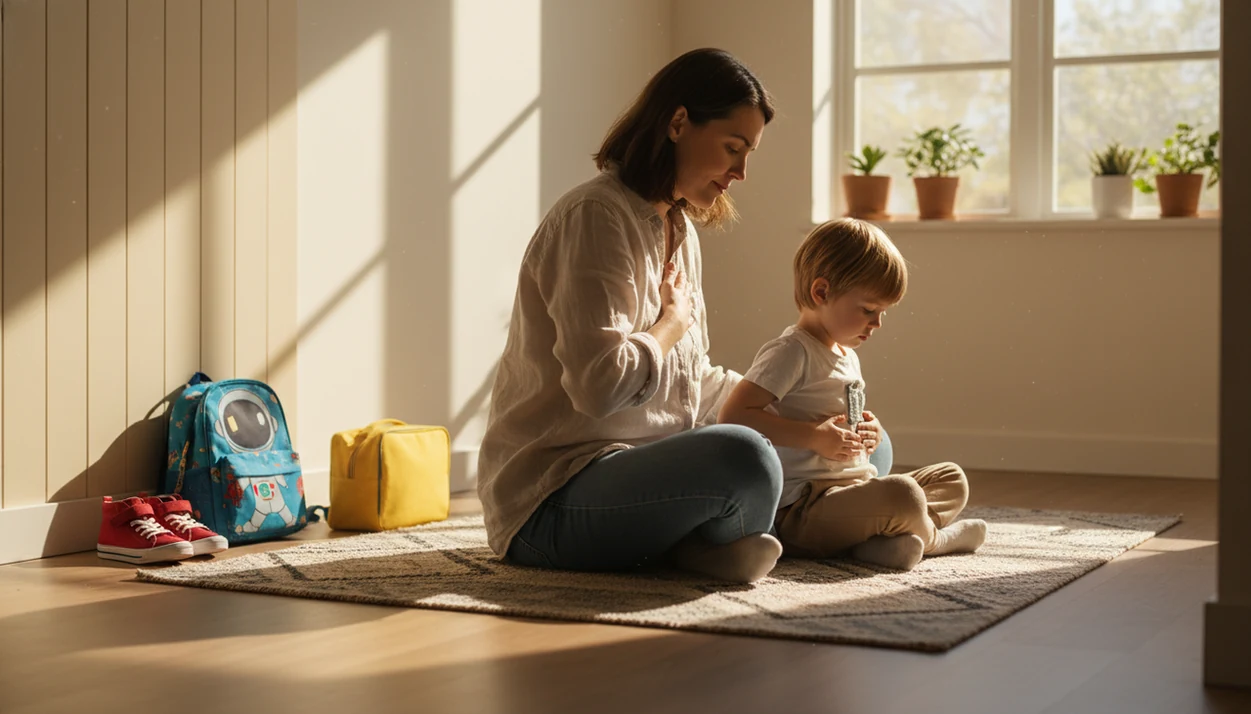


Mindfulness for kids before school is a short, parent-guided practice that helps children notice their breath, body, senses, and feelings before the school day begins. A 3-5 minute routine might include belly breathing, listening for sounds, or a brief guided meditation before backpacks and goodbyes. The aim is not perfect stillness or an empty mind. It is a gentle transition from home to school.
Keep the practice simple enough to repeat on an ordinary morning. A familiar spot, one child-friendly cue, and permission to move or keep eyes open can make it feel less like another task. A short family session can provide a consistent prompt, while the parent stays involved rather than handing the whole routine over to audio.
The morning essentials
- Keep the routine short: 3-5 minutes is enough for most school mornings.
- Use child-friendly cues such as belly breathing, listening for sounds, or a guided morning meditation.
- A short family meditation session can help parents make the routine consistent without turning mornings into another task.
Mindfulness for Kids Before School: Simple Morning Definition
Mindfulness for kids before school is a simple morning practice where children notice their breath, body, senses, and feelings with kindness before transitioning into the school day. It does not mean asking a child to empty their mind, sit like an adult, or stay silent while everyone watches the clock.
Think of it as a transition cue. Home is ending. School is beginning. A parent can guide one calm breath, ask a child to name three sounds, or play a short app-based audio before shoes go on.
The backpack zipper can wait 90 seconds.
For many families, the routine works better when it feels ordinary. Same spot. Same phrase. Same gentle tone. If your child wiggles or keeps their eyes open, that can still count as mindfulness.
Before You Start a Morning Mindfulness Routine
Before you start a morning mindfulness routine, make the moment small, kind, and practical. The best setup happens before the pressure of shoes, bags, coats, and “we have to leave now” takes over.
A good routine is not a test of calm. It is a repeatable cue that fits inside the morning you actually have.
- Choose a quiet micro-moment before departure stress rises, such as after breakfast, after teeth brushing, or while the backpack waits by the door.
- Check basic needs first so mindfulness is not covering for sleepiness, hunger, bathroom urgency, missed medication, or missing school supplies.
- Use eyes-open choices if your child dislikes stillness or inward focus. They can look at a plant, feel their feet, listen for sounds, or hold a small object.
- Pick one cue and one place to make the habit easier. For example: three belly breaths on the hallway rug.
- Stop if distress increases. If the practice brings panic, shutdown, anger, or strong resistance, pause and shift to safety, connection, and practical support.
Five Kids Morning Mindfulness Facts Parents Should Know
- A 3-5 minute kids morning mindfulness routine can be useful when it is repeated consistently. Short practice fits real mornings better than a long session that gets skipped.
- Benefits are usually gradual, not dramatic overnight changes. Research on school mindfulness programs tends to show small to moderate gains in attention, stress reduction, resilience, and behavior regulation.
- A 2010 randomized controlled trial of 99 fourth- and fifth-graders found improvements in behavior regulation, metacognition, and executive function (Flook et al., 2010). That matters before school because children are shifting from home demands to classroom demands.
- A 2015 UK cluster randomized trial of 522 children aged 7-9 found improved attention and reduced negative affect after a 9-week mindfulness program (Vickery and Dorjee, 2016). This supports mindfulness as a skill-building practice, not a quick fix.
- A 2014 meta-analysis of 24 school-based mindfulness interventions involving 1,348 students found small to moderate benefits for cognitive performance, resilience, and stress (Zenner et al., 2014). For families wanting more structure, a family mindfulness routine can make those skills easier to repeat.
School-program results are not proof of a five-minute home routine
The research concerns school mindfulness programs, not this particular five-minute practice at home. A 2023 review of school adjustment found small effects on overall school adjustment and academic performance, small-to-moderate effects on attention, and moderate effects on mindfulness. Those findings support a supplementary role for mindfulness. They do not establish that a few minutes before departure will improve grades or prevent a difficult school day.
For families, the more practical question is whether the routine makes the transition manageable without adding pressure. Notice whether the child willingly participates, which cues feel comfortable, and whether the practice creates another argument about leaving. These observations are not a clinical assessment or proof of benefit. They help adults decide whether to keep the routine, shorten it, offer a different activity, or address the underlying morning difficulty.
How a Before School Calm Routine Works in a Child’s Brain and Body
A before school calm routine works by slowing the pace of the morning and giving the child’s nervous system a predictable cue. Slow breathing, sensory attention, and simple naming can support self-regulation before the school day asks for listening, waiting, switching tasks, and handling noise.
In plain terms, the body gets a signal: we are not in a race.
When a child names “tight belly,” “sleepy,” or “worried,” they are practicing interoception, which means noticing body signals. When they listen for three sounds, they are practicing attentional control, which means choosing where attention goes. A short practice for letting go of things can help children respond gently to small frustrations before school.
Predictable routines also build felt safety. The same chair by the door, the same breath cue, the same school-ready phrase can soften the jump from home to classroom. A large meta-analysis of school-based social and emotional learning programs found an 11 percentile-point academic achievement gain on average (Durlak et al., 2011), but that is not a promise from one home routine. Mindfulness is everyday calm support, not medical treatment or a therapy replacement.
Best Fit and Poor Fit Cases for a Children’s Mindfulness Routine
A children’s mindfulness routine fits best when it lowers pressure. It is a poor fit when adults use it to replace basic needs, school support, therapy, or safety planning.
| Best for | Not for |
|---|---|
| Rushed transitions before leaving home | Replacing enough sleep |
| Mild morning nerves | Replacing breakfast or medication guidance |
| A focus reset before class | Solving school mismatch or bullying |
| Parent-child connection | Replacing therapy or specialist support |
| A screen-free start | Crisis intervention or forced compliance |
Some children do better with eyes open. Others need movement, sound, or a job, such as holding the timer. If inward focus makes a child more distressed, stop and shift outward: name colors in the room, feel feet in shoes, or listen for the refrigerator hum.
Do not make mindfulness a punishment. Kids notice that fast.
How to Use Guided Meditation for Kids Morning Calm
Guided meditation for kids morning calm works best when the adult keeps the routine short, repeatable, and low-pressure. Choose one cue before the school day gets noisy.
- Set a consistent cue after breakfast, before shoes, or once the backpack is by the door.
- Choose one short practice such as belly breathing, sound listening, a body scan, or guided meditation.
- Sit or stand comfortably and let your child keep eyes open if that feels safer or easier.
- Guide one simple cue without correcting every wiggle: “Feel your breath move your belly once.”
- Close with a school-ready phrase such as, “I can take one calm breath when I need it.” You can also try a gratitude meditation for kids to help your child notice something they appreciate before leaving.
A short MindTastik family meditation can serve as the audio guide when parents are packing lunch, finding the library book, and trying not to raise their voice. Tools like MindTastik, Calm, and Headspace can deliver guided calm, sleep audio, and breathing support, not a substitute parent or clinical care.
Age-Based Kids Morning Mindfulness Cues Before School
Age-based cues help the same routine work for different children. Siblings can share the moment, but use different roles, one child counts breaths while another listens for sounds.
Ages 3-6: playful breathing
Use stuffed-animal belly breathing, animal breaths, or the three sounds game. A small toy on the belly gives younger kids something to watch instead of “trying to meditate.”
Ages 7-10: focus and body cues
Try five-finger breathing, a short body scan, or a school-day visualization. For example, “Picture walking into class, hanging your bag, and taking one breath before sitting down.”
Ages 11-13: independence cues
Use box breathing, naming emotions, or a short self-compassion phrase. Older kids may prefer privacy, especially near the front door. For this age group, meditation for teens sleep and stress can feel less babyish than a parent-led script.
Common Before School Calm Routine Mistakes
The biggest mistake is starting when everyone is already late. Fix it by choosing a predictable micro-moment, such as after teeth brushing or before shoes, not after the lost water bottle crisis begins.
Another mistake is expecting silence. Kids may giggle, shift, lean on the wall, or ask whether the bus is coming. Allow movement and eyes-open practice.
Use mindfulness on ordinary mornings, not only during meltdowns. If it appears only when a child is upset, they may hear it as “calm down because you are a problem.”
Keep language short. One cue is enough: “Feel your feet.” “Listen for one sound.” “Breathe into your belly.”
Basics still matter. Sleep, food, school supplies, and enough time do more than any breathing cue. If mornings often end in panic, a calm down meditation for kids may help after the moment, but prevention starts earlier.
Family Meditation Sessions for a Morning Reset
For families, short family-friendly sessions can become a shared morning cue, especially when the parent does not want to invent a script at 7:18 a.m.
The app is a consistency tool, not a replacement for parent connection. A child still benefits from the adult’s voice, eye contact, and calm presence.
A night reset and a morning reset often work together. Bedtime audio may help the house wind down, while a brief morning session gives the next day a steadier start. Families comparing options can also look at a meditation for kids app when they want age-appropriate guided audio in one place.
Short guided audio for a shared morning cue
MindTastik’s kids sessions and breathing exercises are options for families who prefer an audio prompt to making up instructions each morning. Choose a brief practice from the guided meditation library, with a parent nearby and room for the child to decline or change the activity. A child who dislikes spoken audio may prefer listening for sounds or stretching together. Persistent school distress needs attention beyond an app, which is not a medical treatment.
What a morning routine cannot resolve
Mindfulness can support children, but it has limits. The evidence in children is promising and still developing, with effects usually small to moderate across school-based studies.
- A morning routine cannot make up for inadequate sleep, skipped breakfast, chronic stress, or a poor school fit.
- Mindfulness should not be used as punishment, forced compliance, or a way to silence valid feelings.
- Some children with trauma histories or certain mental health needs may find inward focus uncomfortable.
- Parents should seek professional guidance if distress, anxiety, school refusal, aggression, or behavior problems intensify.
- App-based routines require device access, enough time, and a quiet-enough moment, which may not be realistic every day.
- A 2012 JAMA Pediatrics school-based mindfulness study found benefits in at-risk children, but school-program evidence does not prove every home routine treats symptoms.
- Younger children may need movement-based or sound-based practice instead of still breathing.
Clinicians typically recommend professional assessment when anxiety or distress interferes with school, sleep, eating, safety, or family life.
Before-school mindfulness questions
How long should kids practice mindfulness before school?
Plan for 3-5 minutes, but allow a shorter version on busy mornings. One breath or a brief sound-listening activity can serve as the transition cue. The routine should fit around breakfast, medication guidance, and departure, not delay them. Longer practice is not the goal, and finishing the timer is not a test.
What is a simple five-minute mindfulness routine for kids?
Use the first minute to settle comfortably, sitting or standing. Spend the next minute noticing gentle belly breaths, then a minute listening for sounds. Use another minute to notice feet on the floor and name a feeling if the child wants to. Finish with a short phrase about taking one breath before entering class.
Can mindfulness help a child who is anxious about school?
School-based research suggests mindfulness can support anxiety reduction, but that does not guarantee relief from a short home routine. It may offer a manageable pause for mild morning nerves. Persistent distress or school refusal needs discussion with the school and an appropriate health professional, especially when bullying or other safety concerns may be involved.
What if my child refuses to meditate before school?
Do not force the practice or make participation a condition of leaving. Offer a non-meditative alternative, such as stretching, noticing objects nearby, or simply getting ready together. A refusal does not mean the child has failed to calm down. If mindfulness repeatedly creates conflict, remove it from the morning routine.
Do kids need to close their eyes or sit still?
No. Children can keep their eyes open, stand, stretch, or use gentle movement. Listening for sounds and noticing objects are alternatives to focusing on breathing. If inward attention feels uncomfortable, switch to something outside the body or stop. Silence and stillness are not requirements for a useful before-school pause.
Should kids do mindfulness every morning?
A familiar cue can make the routine easier to repeat, but daily completion should not become another demand. Offer it on ordinary mornings rather than only when a child is upset. Skip or shorten it when basic needs or departure require attention. Consistency means a predictable invitation, not compulsory participation.
Can a morning mindfulness routine stop bullying or school refusal?
No. Mindfulness is not a replacement for safeguarding, school-wide bullying prevention, or clinical support. A calmer departure does not resolve an unsafe or unsuitable school situation. Adults should listen to the child's concerns and work with the school on the cause, rather than treating visible distress as the main problem.