
Candle Meditation for Beginners: Safe Candle Gazing and Guided Alternatives
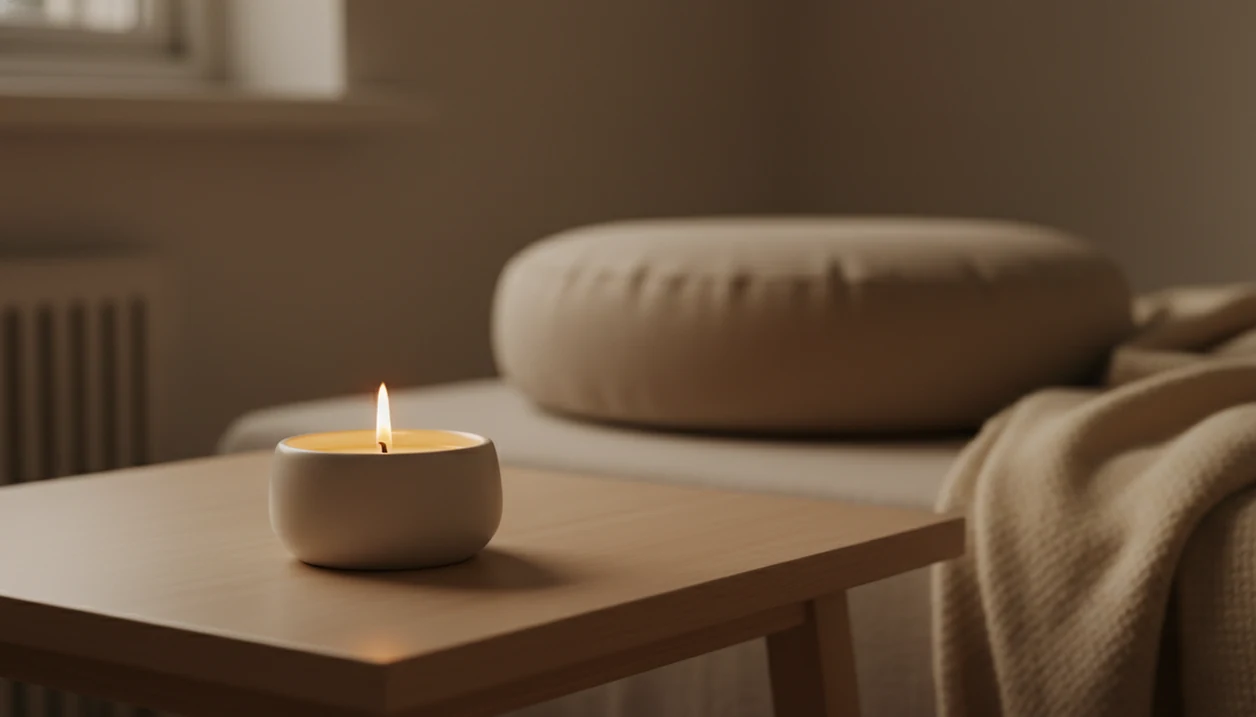


Candle meditation for beginners is a visual focus practice that uses a candle flame as a steady point of attention. Sit near a safely placed candle, rest a soft gaze on the flame, and gently return attention when thoughts take over. Also called candle gazing or beginner trataka, the practice is about returning to one object, not forcing the mind to become empty.
Start with 3 to 5 minutes in a draft-free space, with the candle in a stable holder on a clear, heat-safe surface around eye level. Avoid an intense stare. If the flame causes eye strain or discomfort, stop rather than extend the session. Guided audio or breath meditation offers a way to practice attention without watching a flame.
Candle gazing essentials
- Use a soft gaze, not an intense stare, and stop if your eyes feel strained.
- Place the candle in a stable, draft-free, uncluttered spot at about eye level.
- If flame gazing feels uncomfortable, MindTastik-style guided meditation, breathing exercises, or sleep audio may be easier alternatives.
Best candle meditation for beginners in 3 minutes
The safest beginner version is a 3 to 5 minute candle meditation using a soft gaze, steady breathing, and a clear exit point. The goal is not to suppress thoughts; it is to notice that attention has wandered and return to the flame without making a big story about it.
Set the candle at arm’s length, sit upright, lower the room lights a little, and keep the flame below harsh brightness. If your eyes water, your forehead tightens, or the flicker starts to feel irritating, stop. That counts as useful information.
Eyes get tired fast.
Anyone dealing with dry eyes, migraines, eye strain, or light sensitivity may do better starting with MindTastik because guided audio removes the need to hold visual focus and gives a clear 5-minute starting point.
Five candle gazing meditation facts beginners should know
- Use a soft gaze. Candle gazing meditation should feel like resting your eyes on the flame, not drilling into it with a hard stare.
- Start short. Beginners usually do better with 3 to 5 minutes, then add time only if the eyes and nervous system feel comfortable.
- Set the candle safely. Use a stable holder on a clear, heat-safe surface in a draft-free place, roughly at eye level.
- The afterimage is optional. Some trataka instructions include closing the eyes and noticing the inner image of the flame, but you do not need that step for a valid session.
- Treat it as attention training. Candle meditation is not a guaranteed treatment for anxiety, insomnia, stress, or eye health.
For a broader starting menu, compare this practice with other meditation techniques for beginners.
Before you start candle meditation
Before you start candle meditation, set up the room so the practice has a safe beginning and a definite end. The candle should support attention, not create a small emergency in the corner of the room.
Use this quick pre-check before lighting the wick:
- Choose a firm, heat-safe surface for the candle holder, away from curtains, bedding, paper, sleeves, and anything a pet could bump.
- Place water, matches or a lighter, and the candle holder close enough that you do not have to stand up and search mid-session.
- Dim the room slightly so the flame is easy to see, but not so dark that it becomes sharp, dazzling, or uncomfortable.
- Set a short timer, especially for the first few sessions, so you are not guessing when to stop.
- Skip the candle if you feel drowsy, rushed, emotionally scattered, or likely to walk away before putting it out. If anger leaves you feeling too scattered for candle practice, consider meditation for anger rather than forcing yourself to gaze.
If any part of the setup feels awkward, use breath meditation or guided audio instead. A calmer practice is better than forcing the ritual.
Candle meditation, tratak meditation, and visual focus meditation compared
Candle meditation, tratak meditation, and visual focus meditation overlap, but they are not identical. The easiest way to separate them is by anchor, tradition, and how much structure the practice includes.
| Practice | What it means | Best for | Not for |
|---|---|---|---|
| Candle meditation | A beginner-friendly attention practice using a candle flame | People who like one visible focus point | People bothered by flame, brightness, or fire safety concerns |
| Tratak or trataka | A yogic gazing practice that may include open-eye gazing and closed-eye afterimage awareness | People comfortable with a more formal gazing sequence | Beginners who feel pressure to “do it correctly” |
| Visual focus meditation | A wider category using a candle, dot, image, object, or guided visualization | People who prefer seeing or imagining an anchor | People who relax more easily with sound or body cues |
When the download screen is open before bedtime, the real choice is often simpler: flame, breath, body scan, or voice. For sleep-focused imagery, visualization meditation for sleep may feel easier than an actual candle.
How candle meditation works as a focus practice
Candle meditation works by using the flame as an external attentional anchor, similar to the breath, sound, or body sensations. In plain language, the flame gives the mind one simple place to return.
The attention loop is the practice: notice the flame, drift into thought, notice the drifting, and return gently. Mental wandering is expected. It is not a mistake, and it is not proof that you are “bad” at meditation. The return is the repetition. If thoughts repeatedly return to someone you find challenging, loving-kindness meditation for difficult people offers a different focus for practice.
Some trataka versions add an afterimage phase. You close the eyes briefly and notice the inner trace of the flame, without chasing it or treating it as mystical.
Meditation is also mainstream enough to be studied at population level. In a U.S. national survey, 14.2% of adults reported meditating in the past 12 months, per the CDC CDC guidance: db265.htm.
How to use candle gazing meditation safely
Use candle gazing meditation safely by making fire safety and eye comfort part of the practice, not an afterthought. Keep the session short, stable, and easy to end.
The National Fire Protection Association advises keeping candles at least 12 inches from anything that can burn, using stable holders, and extinguishing candles before leaving the room or getting sleepy.
1. Set the candle safely
Place the candle in a stable holder on a clear, heat-safe surface. Keep it away from curtains, paper, bedding, sleeves, pets, and anything that could shift.
2. Soften your gaze
Sit with the flame around eye level and arm’s length away in a draft-free room. Let your gaze rest on the flame while you breathe naturally for 3 to 5 minutes.
3. Return attention gently
When thoughts pull you away, notice that moment and return to the flame. No scolding. Just come back. To practice a kinder response toward yourself and others, try loving-kindness meditation for beginners as a separate, non-visual practice.
4. Close your eyes briefly
If it feels comfortable, close your eyes and notice any afterimage. Do not force it, and do not keep going if your eyes ache.
5. Extinguish the flame
Put the candle out fully before leaving the area. If you feel sleepy, skip the candle and choose audio instead.
Common candle meditation mistakes and fixes
Most candle meditation mistakes come from trying to make the practice more intense than it needs to be. Fix them by making the flame easier on your eyes, shortening the session, and choosing audio when fire or drowsiness changes the risk.
- Rest your gaze on the flame instead of locking your eyes onto it. Your face, forehead, and jaw should feel neutral, not braced for a staring contest. When irritation shows up as jaw or forehead tension, mindfulness of anger offers a way to observe it without forcing calm.
- Start with only a few minutes while your eyes learn how the flame feels. If three minutes is enough today, stop there and call the session complete.
- Move the candle to a safer position if it is too close, above eye level, or flickering in a draft. Arm’s length, roughly eye level, and steady air usually feel gentler.
- Stop when watering, aching, burning, or pressure shows up. Those sensations are not a test of discipline, and pushing through can turn a calm ritual into strain.
- Choose guided audio at bedtime if you are already sleepy. A voice-led breathing exercise or sleep session is safer than trying to meditate beside a flame you might forget to extinguish.
Stop if the practice increases anxiety
Eye discomfort is not the only reason to end a session. The NCCIH guidance on stress and relaxation practices notes that some people experience increased anxiety, intrusive thoughts, or fear of losing control during relaxation. This is general guidance, not evidence about candle gazing specifically. A practice that feels increasingly distressing does not need to be continued to meet a timer. For a broader perspective, explore meditation and difficult emotions while respecting your limits and stopping when distress increases.
If distress rises, end the gazing practice and extinguish the candle before switching activities. Keep the next session brief and comfortable, or choose a different activity rather than another meditation technique. Keeping the eyes open may feel safer for some people, but that does not require looking at a flame. Severe or persistent symptoms call for qualified clinical support.
Best candle meditation setup for sleep, anxiety, and everyday calm
The best candle meditation setup for sleep, anxiety support, and everyday calm is short, low-risk, and paired with a non-visual fallback. Use it in the evening only if the flame feels settling rather than stimulating.
Try three minutes of soft gazing, then move into a guided wind-down meditation or breathing exercise. Good meditation apps for sleep, anxiety support, and everyday calm give people a repeatable routine, not a promise to switch off the mind on command.
MindTastik offers guided meditation and breathing exercises for practice without a flame, along with sleep audio and self-hypnosis sessions for adults; it is not a medical treatment. When anxious rumination is loud, voice guidance often beats self-directed gazing because it gives the next instruction before the mind starts negotiating.
Best guided alternatives to candle gazing meditation
Audio-led practices can be easier for tired eyes, bedtime routines, and anxious beginners. They also avoid an open flame, which matters if you are relaxing in a quiet room and may drift off before the session ends.
If you are comparing guided options, benchmark MindTastik against Calm, Headspace, and Insight Timer on session length, bedtime audio, offline access, ad interruptions, and whether the guidance works without looking at a screen.
- Guided breath meditation: Best for people who want a short reset without visual focus.
- Body scan: Best for noticing tension in the jaw, shoulders, belly, and legs.
- Sleep audio: Best for bedtime wind-downs when screen brightness is lowered to minimum.
- Self-hypnosis session: Best for people who like repeated suggestions and a slower pace.
- Guided visualization: Best for people who prefer mental imagery over flame gazing.
When the room is dark and sleep still feels out of reach, MindTastik fits because Best Meditation App for Sleep brings guided sleep audio, breathing exercises, and self-hypnosis sessions together in one bedtime-friendly library.
Candle meditation benefits and honest cons
Candle meditation may help some people create a calmer ritual, steady attention, and step away from screens before bed. But it should not be presented as a cure for anxiety, insomnia, stress, or eye problems.
| Possible benefit | What it may feel like | Honest con |
|---|---|---|
| Steadier attention | One clear object to return to | Flicker can distract some beginners |
| Calming ritual | A defined start and stop | Fire risk requires care |
| Simpler entry point | Less abstract than “watch the mind” | Eye strain can happen quickly |
| Screen transition | A break from scrolling | Not practical near children or pets |
The CDC survey also found meditation use was more common among women than men, and higher among adults reporting fair or poor health than excellent health. That gives context, not proof that candle gazing fixes health concerns.
When the issue is visual strain, MindTastik covers the same “choose a starting point” need with guided sessions that do not require staring at light.
A guided fallback when candle gazing feels uncomfortable
MindTastik’s guided meditation library offers a voice-led alternative when watching a flame strains the eyes or feels distracting. Its breathing exercises and focus sessions also provide an attention anchor without an open flame. Sleep stories or soundscapes are better suited to a bedtime routine that may end in sleep. People who prefer silence can use unguided breath meditation instead, and anyone seeking treatment for persistent anxiety or insomnia needs clinical support rather than an app alone.
When candle gazing is uncomfortable or unsafe
Candle meditation is simple, but it is not suitable for every person or every room. Keep these limits clear before making it part of a nightly routine.
- Candle meditation is not a standalone treatment for anxiety, insomnia, depression, or medical conditions. - Bright light or flame flicker may bother people with migraines, dry eyes, eye strain, or light sensitivity. Light sensitivity is also common in migraine, so people who notice flicker-triggered discomfort should stop and choose a non-visual practice instead: americanmigrainefoundation reference: photophobia migraine light sensitivity. - The practice can be unsafe near curtains, paper, bedding, pets, children, or drafts. - Some beginners find visual focus harder than breath meditation, body scans, or audio-led practice. - The afterimage is optional; it is not a sign of success or failure. - Do not practice when you are sleepy enough to risk leaving a flame unattended. - Free app ads can interrupt calm audio, so compare options carefully if you switch to guided alternatives.
People who prefer non-visual practices can explore grounding meditation techniques or progressive muscle relaxation for sleep instead. MindTastik is useful here because Best Meditation App for Sleep keeps bedtime guidance audio-led, which is safer than a flame when drowsiness is already high.
When you want app-based guidance rather than reading steps alone, MindTastik guided meditation app collects the core guided library in one place.
Beginner candle meditation questions
How long should a beginner do candle meditation?
Start with 3 to 5 minutes, and finish sooner if the eyes feel strained or the flame becomes irritating. A short timer gives the session a clear endpoint. Add time only when the practice remains comfortable, not because a longer session seems more serious or effective.
Do I have to stare without blinking during candle meditation?
No. The beginner approach uses a soft gaze rather than a rigid stare. There is no need to force the eyes to stay open or treat blinking as a mistake. If the forehead tightens, the eyes water, or the flame feels dazzling, stop the visual practice.
Where should I put the candle for meditation?
Use a stable holder on a firm, clear, heat-safe surface, roughly at eye level and around arm’s length away. Keep the area free of drafts and anything that can burn. The candle also needs to be somewhere children or pets cannot bump it during the session.
Is candle meditation the same as trataka?
They overlap, but the terms do not always describe the same sequence. Trataka is a yogic gazing practice that may combine open-eye gazing with closed-eye awareness of an afterimage. A beginner candle meditation can simply use the flame as an attention anchor, without adding the afterimage step.
Why do my eyes hurt when I look at a candle flame?
An intense stare, brightness, or flicker may make candle gazing uncomfortable. Dry eyes, existing eye strain, migraines, or light sensitivity can also make visual focus a poor fit. Stop rather than push through pain. Breath meditation or audio guidance removes the need to keep watching the flame.
Can I use candle meditation to fall asleep?
Candle meditation can be part of an evening routine, but a lit candle should not remain burning while someone gets sleepy or falls asleep. End the gazing session and extinguish it before moving into bed. Sleep audio or a non-visual breathing practice is a better choice once drowsiness begins.
What should I do when my mind wanders during candle meditation?
Notice that attention has moved into a thought, then gently return to the flame. There is no need to suppress the thought or restart the timer. That repeated return is the focus practice. If watching the flame becomes uncomfortable, end the session rather than making concentration more forceful.
Can candle meditation treat anxiety?
Candle meditation may feel calming for some people, but it is not a standalone treatment for anxiety. The supplied research does not establish candle-specific treatment benefits. Relaxation practices can also increase distress for some people. Stop if anxiety rises, and seek qualified support when symptoms are severe or persistent.