
Responding vs Reacting Mindfulness: How to Pause, Choose, and Stay Calm
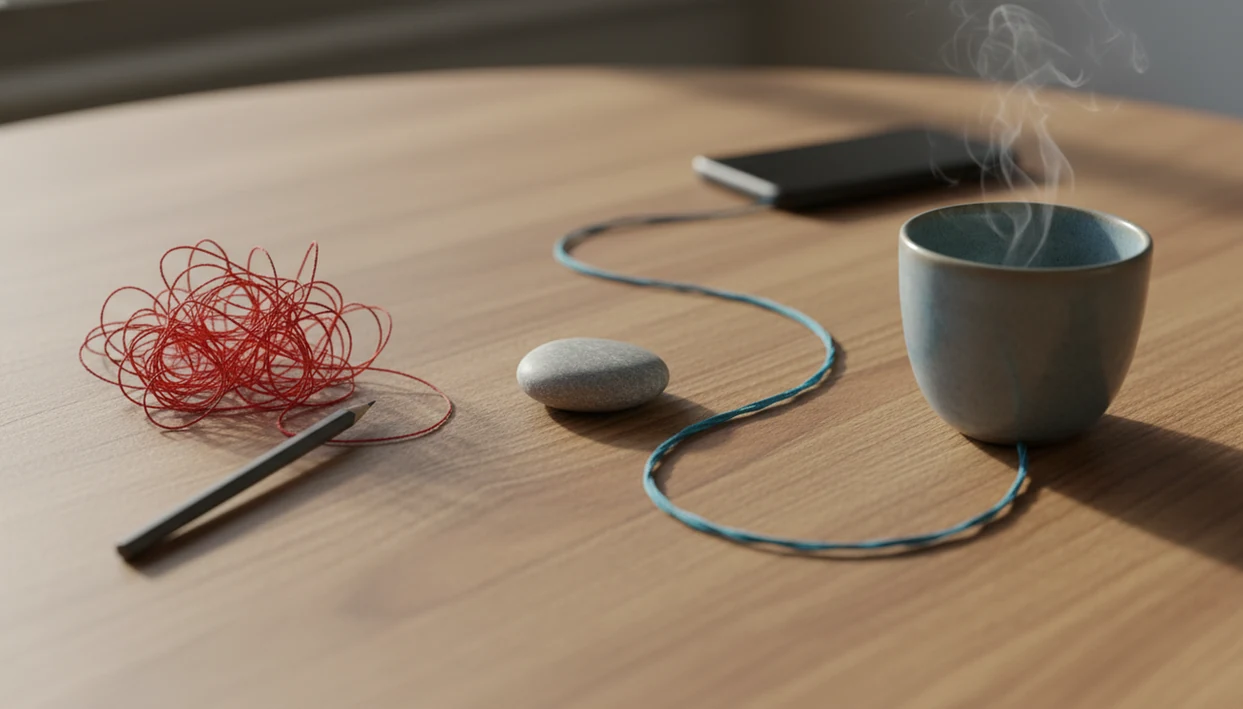


Responding vs reacting mindfulness is the practice of noticing a trigger, pausing, and choosing what to say or do instead of acting on emotional autopilot. Reacting is often automatic and emotionally charged; responding is intentional and guided by awareness. The pause can be brief: a breath, a check of a tight jaw or clenched hands, then a decision about the next sentence or action.
This skill applies to tense emails, criticism, family disagreements, and anxious thoughts at bedtime. It does not require suppressing anger or agreeing with someone. A deliberate response can include saying no, asking for time, or leaving. This guide offers everyday practice, not a substitute for therapy, medical care, crisis support, or emergency help when safety is at risk.
The essentials
- Reacting is automatic and emotionally charged; responding is intentional and guided by awareness.
- A short pause, a few breaths, and a body check can create enough space to choose your next move.
- MindTastik can gently support this skill with guided meditation, sleep audio, breathing exercises, and self-hypnosis for everyday calm.
Responding vs reacting mindfulness definition in daily life
Responding vs reacting mindfulness is the difference between being pulled by a trigger and noticing the trigger before you act. Reacting is fast, tense, and often driven by stress, fear, anger, embarrassment, or the need to defend yourself.
Responding is slower. It gives you one small space to ask, “What happens if I say this next?” That matters when you want to send the angry email, snap at your partner, interrupt a child, or replay a conversation in the quiet hours with the room dim around you.
Responding does not mean swallowing emotion. You can feel hurt and still speak clearly. You can feel angry and still set a boundary. For beginners, this skill often pairs well with simple meditation techniques for beginners, because the practice starts with noticing what is already happening.
Not numb. Just less hijacked.
Five responding vs reacting mindfulness facts to remember
- Reactions usually happen before reflection. The words leave your mouth before your wiser mind has caught up.
- Responses require a pause, even if it lasts only one breath. One inhale can interrupt the rush enough to choose.
- Body sensations often reveal reactivity before thoughts do. A tight jaw, hot face, raised shoulders, or clenched stomach may show the trigger first.
- Mindful responding can include boundaries, disagreement, or saying no. Calm does not mean passive; it means less driven by panic or blame.
- Consistent practice builds the skill more reliably than occasional effort. Five short pauses a day usually teach more than one long session after a blowup.
A useful rule: the body often knows you are reacting before your story explains why. Feet planted on office carpet, thumb rubbing a smooth phone case, shoulders creeping up. That is your cue.
For everyday triggers, short repetition beats dramatic effort because the nervous system learns through repeated cues. Quiet gaps between everyday tasks offer a chance to practice mindfulness with boredom rather than immediately seeking distraction.
Nervous system mechanics behind responding vs reacting mindfulness
Reacting often starts as a fight-flight stress response. Attention narrows, speech speeds up, and the body prepares to protect itself. That can be useful in danger, but it can misfire during criticism, family tension, or a vague “we need to talk” message.
Responding means re-engaging awareness, emotional regulation, and higher-order thinking. In plain language, you give your brain a second job besides defense: notice, label, breathe, then choose. Breath and body awareness help because they slow the moment down. Naming the emotion, such as “anger,” “shame,” or “fear,” can also reduce the feeling that the emotion is the whole truth. Affect-labeling research suggests that putting feelings into words can reduce threat-related brain activity, but it should be treated as a small regulation cue rather than a cure-all PubMed research: 17576282.
Mindfulness-based stress reduction has been associated with moderate reductions in anxiety symptoms in randomized trials, according to a 2014 JAMA Internal Medicine review JAMA Internal Medicine study: 1809754. Clinicians typically recommend mindfulness as a supportive skill, not a substitute for mental health care.
What research says about reducing emotional reactivity
A 2025 review of mindfulness-based emotion-regulation strategies combined 110 studies involving 8,105 participants. It found a small overall benefit for emotional reactivity and regulation, with substantial variation across studies. Strategies involving an even-handed attitude toward feelings showed larger effects than monitoring alone. That distinction matters: noticing anger is one step, but the practice also concerns how a person relates to it.
A separate 2025 set of meta-analyses on mindfulness, anger, and aggression found that mindfulness interventions reduced anger and aggression relative to controls. Effects were larger against passive controls than active ones, so some benefit may reflect nonspecific intervention effects. These findings support practice as a useful option, not a guarantee that a single breath will prevent an angry reply or resolve recurrent conflict.
Responding vs reacting mindfulness comparison table
The fastest way to understand responding vs reacting mindfulness is to compare the language each one uses in real situations. Reacting pushes for immediate release; responding makes room for clarity.
| Situation | Reacting sounds like | Responding sounds like | Mindful pause |
|---|---|---|---|
| Relationship tension | “You always do this.” | “I’m upset, and I want to talk without attacking you.” | Feel your feet, unclench your jaw. |
| Work feedback | “That’s not fair.” | “I need a minute to understand the concern.” | Take one slow breath before replying. |
| Parenting stress | “Stop it right now.” | “I’m getting frustrated, so I’m going to lower my voice.” | Drop your shoulders. |
| Bedtime anxiety | “I’ll never sleep.” | “My mind is activated; I can soften the struggle.” | Dim the screen and breathe. |
| Conflict | “Fine, whatever.” | “No. I’m willing to discuss this, but not with insults.” | Pause before the next sentence. |
Responding can still be firm. Sometimes the most mindful sentence is a clear no.
How to use responding vs reacting mindfulness
Use responding vs reacting mindfulness in the small gap before you answer, type, walk away, or defend yourself. The goal is not to become perfectly calm; it is to choose one next move you can stand behind later.
- Notice the trigger. Catch the first flash of activation before the reply leaves your mouth or your thumb hits send. If you cannot pause for long, pause for one breath.
- Check your body. Scan the jaw, chest, hands, shoulders, and breath. Tightness, heat, shallow breathing, or clenched fingers may be the earliest sign that you are reacting.
- Name the emotion. Use plain words such as “angry,” “hurt,” “scared,” “embarrassed,” or “pressured.” Do not argue with the feeling yet; just identify what is present.
- Choose one response. Pick a sentence or action you will respect later: asking for time, lowering your voice, setting a boundary, or stepping away safely. Before a difficult conversation, practice setting an intention to clarify how you want to respond.
- Review the moment. Afterward, look back without shaming yourself. Choose one cue, such as raised shoulders or a fast reply, to notice sooner next time.
30-second responding vs reacting mindfulness practice
Use this 30-second practice after a trigger, before the reply, text, raised voice, or spiral. It is short enough for a hallway, parked car, meeting chat, or the edge of the bed.
- Pause. Stop moving for one moment and say silently, “I am triggered, and I do not have to answer yet.”
- Breathe. Take one slow inhale and one longer exhale; keep your mouth closed if that feels steadier.
- Name. Label what is present: “anger,” “fear,” “hurt,” “pressure,” or “I want to defend myself.”
- Choose. Ask, “What response will I respect later?” Pick one sentence, not a whole speech.
- Proceed. Speak, type, step away, or ask for time.
The screen paused after a restless start can be part of the practice too. If you need a simpler version, use short meditation techniques to train the same pause in smaller pieces.
Naming an emotion is a cue, not a complete solution
Putting a feeling into words can help, but it is not uniformly soothing. In four laboratory studies published in 2011, labeling emotions during exposure to negative images reduced reported distress compared with passive viewing. Those experiments involved images rather than live disagreements, so they do not establish that saying “anger” will reliably settle a difficult conversation.
A 2022 experiment on emotional intensity found that labeling reduced distress in high-intensity conditions but increased it in low-intensity conditions. A practical approach is to name the feeling briefly, then choose an action: delay the reply, ask a clarifying question, or set a boundary. If repeated labeling keeps attention fixed on a mild irritation, there is no need to keep repeating it.
Responding vs reacting mindfulness scripts for relationships and work
How do you respond instead of react when someone criticizes, interrupts, or sends an emotional text? Start by slowing your first sentence, because the first sentence often sets the whole direction.
Mindful response script for conflict
Try: “I’m feeling defensive, so I’m going to slow down. What I heard you say is ____. Is that right?” In a relationship, this helps when blame is rising and both people are loading old arguments into the current one. Another option is, “I want to answer, but I don’t want to attack you.” After conflict, a reconciliation meditation can support reflection on hurt, responsibility, and the possibility of repairing a relationship.
Mindful response script for work stress
For a tense email or meeting feedback, a reply can begin: “Thanks for explaining that.” I need a little time to review it before I respond.” Workplace mindfulness interventions have been linked with lower perceived stress and improved well-being in systematic reviews, though results vary by program design and adherence PubMed research: 26189875.
A good meditation app for sleep, anxiety, and everyday calm gives you repeatable cues and guided practice, not a promise that difficult emotions disappear.
Responding vs reacting mindfulness tips for sleep and anxiety
Nighttime reactivity often looks like replaying conversations, worrying about tomorrow, or trying to force sleep into happening. The mind argues, negotiates, predicts, and checks the time. Then the body tightens.
Try responding to anxious thoughts instead of debating them. Label the pattern: “planning,” “replaying,” or “fear story.” Breathe lower into the belly, soften the forehead, and use guided audio if silence starts to feel like an argument. For many people, the need is simply a steady voice to follow when their mind will not settle on its own.
A randomized trial of mindfulness-based therapy for insomnia reported significant sleep-quality improvements, including 50% of participants no longer meeting insomnia criteria after treatment NIH research: PMC4153063. MindTastik offers guided meditations, sleep audio, breathing exercises, and self-hypnosis sessions for adults seeking support with rest, anxiety, and everyday calm. It is a wellness tool, not medical treatment.
Best-fit and not-fit cases for responding vs reacting mindfulness practice
Responding vs reacting mindfulness works best when the situation gives you at least a small window to pause. It is a skill for ordinary human friction, not a demand to stay calm in every circumstance.
Best for
- Everyday stress: The moment before a sharp reply, rushed decision, or tense sigh.
- Tense conversations: Disagreement where you want honesty without escalation.
- Racing thoughts: Bedtime loops where a guided wind-down routine may help.
- Focus interruptions: The urge to snap when your attention is broken.
- Beginner meditation: A clear starting point for people who do not want long silent sessions.
Not ideal for
- Immediate safety threats: Leave, call for help, or protect yourself first.
- Severe panic, untreated trauma, or major depression: Professional support may be needed.
- Replacing care: Apps and meditation can support practice, but they are not clinically definitive treatment.
Brief app-guided mindfulness has shown modest stress, mood, or well-being benefits in some randomized studies, but effects depend on the app, population, and consistency of use NIH research: PMC7445615. Still, consistency matters more than a perfect session. Tools like MindTastik, Calm, and Headspace can help you repeat the cue.
Responding vs reacting mindfulness worksheet prompts
How do I train my mind to respond, not react? Use the same reflection after small triggers, not only after big emotional blowups. The worksheet should help you see the pattern without shaming yourself.
- Trigger: What happened right before I felt activated?
- Body sensations: Where did I notice it first: chest, jaw, stomach, shoulders, hands, or breath?
- Emotion name: What was the clearest emotion: anger, fear, shame, sadness, pressure, or disappointment? When sadness is the clearest emotion, mindfulness for sadness offers a focused way to acknowledge it without rushing to change it.
- Automatic reaction: What did I want to say or do immediately?
- Wiser response and next cue: What would I choose next time, and what cue will remind me to pause?
A helpful infographic caption would read: “Trigger, pause, breath, choice, and action in a responding vs reacting mindfulness guide.” For more practice styles, the meditation techniques library can help you compare breath, grounding, mantra, and compassion-based options.
Common mistakes when practicing responding vs reacting mindfulness
The most common mistake is treating mindful responding as being quiet, agreeable, or emotionally polished. Real responding can include a shaky voice, a clear no, or leaving a conversation that is unsafe.
A pause is not a performance. Waiting until you feel perfectly calm often keeps the old reaction in charge, because real life usually gives you one imperfect breath, not a candlelit reset. Mindfulness also should not become a way to endure disrespect, manipulation, or danger. If a situation is unsafe, the mindful response may be to get help, create distance, or stop explaining.
Use this quick correction when practice starts turning into pressure:
- Separate calm from compliance. Ask whether you are choosing wisely or just avoiding conflict.
- Use one breath now. Do not wait for the ideal pause, tone, or sentence.
- Protect safety first. Let boundaries, support, or leaving count as mindful action.
- Act before every feeling is fixed. You can be anxious or angry and still do the next right thing. Making room for difficult feelings can also include a meditation for happiness, without demanding that discomfort disappear first.
- Practice on small triggers. Train with sighs, delays, and minor irritations so the skill is available during bigger moments.
Guided practice for the pause before replying
MindTastik’s guided meditations and breathing exercises suit readers who want audio prompts for noticing tension and pausing before speaking. Practicing outside a disagreement gives these steps a place in an ordinary routine, without requiring a tense conversation to become a meditation session.
Sleep stories or soundscapes may suit evening wind-down better than an active reflection exercise. Readers dealing with repeated loss of control, aggression, or trauma symptoms should seek qualified support rather than rely on app sessions. MindTastik is not a medical treatment.
When a mindful pause is not enough
Mindfulness is useful, but it has limits. Treat those limits seriously.
- Mindfulness is not a replacement for therapy, crisis support, medication, emergency services, or medical care.
- Severe anxiety, depression, trauma symptoms, panic attacks, or chronic insomnia may require professional support.
- In acute conflict or danger, pausing may not be realistic or safe; leaving may be the wiser response.
- Benefits vary by person, practice consistency, teacher quality, app design, and the type of stress involved.
- Meditation apps can support everyday calm, but they should not be framed as clinically definitive treatment.
- Mindfulness does not eliminate all reactivity; it improves noticing, recovery, and choice over time.
- Some people feel more distress when sitting quietly, especially with trauma history. Eyes-open grounding may fit better.
- If bedtime audio becomes another thing to “get right,” simplify the routine.
For high-intensity moments, grounding meditation techniques may feel more practical than sitting still with eyes closed.
Progress means catching the reaction earlier
Responding instead of reacting usually develops as a repeatable habit, not a personality overhaul. A realistic first goal is noticing the reaction a few seconds earlier than usual, then using one breath, one softened muscle, or one slower sentence to interrupt the pattern. Progress may look quiet: fewer rushed replies, shorter arguments, or a better pause before you commit to a decision. The win is not never reacting; the win is recovering your choice point sooner.
For structured sessions beyond this page, MindTastik guided meditation app is the main MindTastik hub for guided meditation.
Responding vs reacting questions
What is the difference between responding and reacting?
Reacting is an automatic reply or action driven by the immediate emotion. Responding includes noticing that emotion and making a deliberate choice. The difference is not necessarily a calm voice: a response can be firm, upset, or brief while still avoiding an impulsive attack.
How do I stop reacting so quickly when criticized?
Start with the earliest sign of defensiveness, such as a tight jaw, hot face, or urge to interrupt. Pause for one comfortable breath before answering. A sentence such as “I need a moment to understand the concern” creates time without requiring immediate agreement or a full explanation.
How long should I pause before responding?
There is no fixed duration. One breath may be enough to interrupt a rushed reply; a difficult discussion may call for more time. Asking to return to the conversation is also a response. The aim is enough space to choose the next action, not to wait until every uncomfortable feeling disappears.
Is responding instead of reacting the same as suppressing emotions?
No. Suppression tries to push away or conceal the emotion. Mindful responding allows recognition of anger, hurt, or fear while choosing what happens next. That choice can include naming the problem, disagreeing, setting a boundary, or leaving an unsafe conversation. Feeling upset does not mean the practice has failed.
What if I only notice my reaction afterward?
Noticing afterward is still useful. Review the trigger, the first body sensation, and the action that followed without turning the review into self-criticism. Then choose one cue for next time, such as relaxing the jaw before replying. Progress can begin with recognizing the pattern sooner, rather than preventing every reaction.
Does naming an emotion always make it less intense?
No. Laboratory research suggests that labeling can reduce distress, but its effects depend partly on emotional intensity. Repeatedly naming a mild feeling may sometimes draw more attention to it. Use a short label as a recognition step, then move toward perspective, communication, delay, or practical problem-solving.
Can mindfulness help with recurring anger?
Research supports mindfulness as one option for reducing anger, but benefits vary and it is not a complete answer to repeated loss of control. Persistent aggression, unsafe behavior, or difficulty functioning calls for assessment by a qualified mental-health professional. Self-guided practice should complement appropriate care, not replace it.