
Mindful Photography: A Practical Guide to Seeing More Slowly
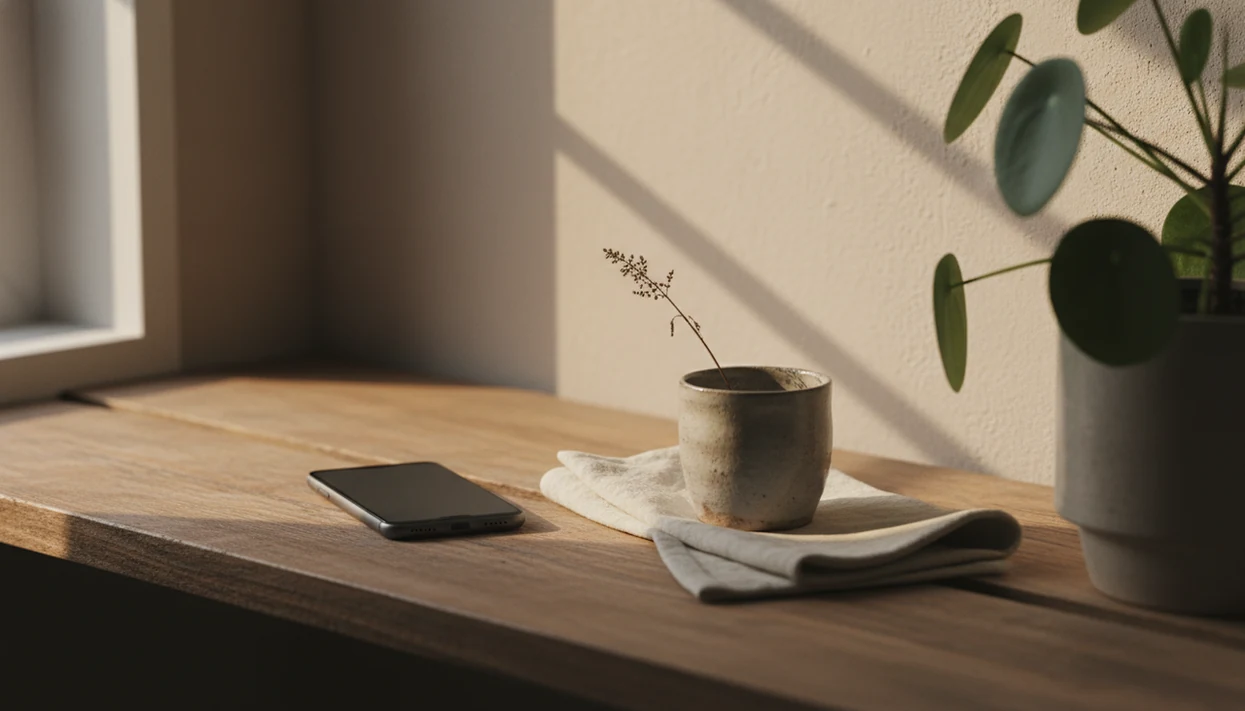


Mindful photography is the practice of using a camera or phone to slow down, notice surroundings, and anchor attention in the present rather than chase a perfect shot. It combines non-judgmental awareness with intentional picture-taking: noticing light, color, texture, shape, breath, and body sensations before pressing the shutter. The act of seeing becomes the meditation, and an ordinary subject is enough.
A walk, a wait during a commute, a quiet room, or an evening pause can provide a place to practise. A phone works well when notifications are silenced and photos are taken slowly. The goal is attention, not artistry. This practice may support calm, focus, and an emotional reset, but it does not replace medical care or therapy. You can also explore simple mindfulness practices for daily life to bring similar pauses into everyday activities without a camera.
The essentials
- You do not need a professional camera; a phone is enough if you reduce distractions and shoot slowly.
- The goal is attention, not artistry: notice light, color, texture, shape, breath, and body sensations before taking each photo.
- Mindful photography can support stress relief, sleep routines, and everyday calm, but it is not a replacement for medical care or therapy.
Mindful photography meaning and five facts to know
- Mindful photography is a mindfulness practice, not a photography performance exercise. The point is to notice, not to impress.
- It uses seeing, breathing, and intentional image-making to return attention to the present. You pause, look, breathe, choose, and take one photo slowly. For a different way to coordinate breath and attention, mindful swimming brings present awareness into the water.
- Any camera can work, including a smartphone. A phone in airplane mode often works better than expensive gear that invites fiddling.
- Image quality matters less than attention quality. A shadow on a hallway wall can be more useful than a dramatic landscape if it keeps you present.
- Benefits are supportive, not curative. Mindful photography may help with anxiety support, sleep wind-down, and focus, but it does not replace therapy, medication, or medical care.
For people new to mindfulness, it can feel easier than sitting still. Socked feet on a bedroom rug, one quiet photo, three breaths. That counts.
How mindful photography works
Mindful photography works by turning picture-taking into a repeatable attention loop: pause, breathe, observe, frame, shoot, and reflect. Instead of letting the mind circle old worries, you give it a concrete visual anchor, such as a line of light, a rough wall, a blue cup, or the shape of your own hand.
The mechanism is simple selective attention, which means choosing one thing to notice on purpose. A useful session might unfold like this:
- Pause before opening the camera and feel your feet, hands, or breath.
- Breathe slowly enough that the body has a cue to settle.
- Observe one sensory detail: color, texture, shadow, pattern, distance.
- Frame the image without rushing to improve it.
- Shoot fewer photos, so each one asks for a real moment of attention instead of a checking habit.
- Reflect on what changed in your body or mood after the image.
The broader evidence belongs mostly to mindfulness practice, not to mindful photography alone. Direct research on photography-based mindfulness is still limited. Phone settings matter too: airplane mode, Do Not Disturb, a dim screen, and no social apps open can protect the practice from notification loops.
Mindful photography and the nervous system
Mindful photography works by giving attention a visual anchor, such as light, shadow, color, shape, or texture, so the mind has somewhere concrete to return when rumination starts.
The basic sequence is simple: pause, breathe, observe, frame, shoot, reflect. That rhythm trains selective attention, which means choosing one thing to notice while letting other mental noise fade into the background. In plain language, you give the brain a job that is calmer than replaying worries.
Mindfulness research supports this broader idea, though direct clinical research on photography-based mindfulness is still limited. That distinction matters: this guide borrows from mindfulness research, but it should not be read as proof that taking photos has the same clinical effect as a structured mindfulness program. A 2014 meta-analysis found that mindfulness meditation programs improved anxiety, depression, and pain with small to moderate effects NIH research: PMC4142584. For visual thinkers, mindful photography may be a practical entry point into grounding meditation techniques.
Apps such as MindTastik can pair a short guided breathing track with a photo walk, so the pacing comes from audio rather than willpower.
What nature research can tell us about outdoor photo practice
Research on mindfulness in natural settings offers context for an outdoor photo practice, but it is not direct evidence for mindful photography. A 2019 systematic review of nature-based mindfulness found positive psychological, physical, and social outcomes, with moderately greater benefits than mindfulness in non-natural settings. The studies used varied methods and often small samples, so the size and persistence of those benefits remain uncertain.
A 2026 pilot trial of brief nature-based mindfulness compared daily 15-minute guided sessions over two weeks with unstructured outdoor walks in 35 participants. Structured mindfulness showed a modest additional advantage for wellbeing and perceived stress, but the authors called the findings preliminary and non-confirmatory. For photography, this supports trying a deliberate noticing routine outdoors, not claiming that taking pictures treats anxiety or works better than simply walking. Exploring mindful movement benefits can help you consider how walking and other physical activities support an attentive routine.
How to use mindful photography in six simple steps
Use mindful photography as a short, bounded routine. Five to ten minutes is enough for beginners, especially if your phone usually pulls you into messages.
- Set a timer for 5 to 10 minutes. Keep the session short enough that you don't start hunting for “better” subjects.
- Silence notifications or use airplane mode. Open the camera only after the phone is quiet.
- Choose one sensory theme. Try blue objects, soft light, circles, reflections, rough texture, or repeating lines. If you prefer working without a camera, mindful drawing offers another way to observe shapes, textures, and light.
- Take three slow breaths before each photo. Let your body arrive before your finger taps the shutter.
- Limit yourself to 5 to 10 images. Fewer photos reduce compulsive shooting and make each frame more intentional.
- Review 3 images afterward. Name what each photo made you feel, not whether it was technically good. A mindful writing practice can extend this reflection by turning a photograph's sensory details into a few thoughtful sentences.
A useful beginner rule: one theme, one walk, one small set of images. If you want a simpler sitting practice first, meditation techniques for beginners can help you choose a starting point.
Mindful photography guide for sleep, anxiety, and focus
Mindful photography can be shaped around a specific need: grounding, wind-down, or focus. For sleep anxiety and everyday calm, a useful meditation app should offer guided sessions, breathing cues, and repeatable routines; it should not promise to cure distress.
For anxiety support
Choose stable subjects: doorframes, tree trunks, pavement lines, desk corners. Walk slowly, match each photo to three breaths, and keep your eyes on ordinary structure. Fingers tracing a jacket zipper before the first shot can become the cue to slow down.
For sleep wind-down
Try low light, soft shapes, and no sharing. Dim the phone screen before starting, take five quiet images, then put the phone away. Tools like MindTastik offer guided meditation, sleep audio, breathing exercises, and self-hypnosis sessions that can follow the photo routine without turning bedtime into scrolling.
For focus resets
Between work blocks, photograph one texture or color near your desk. For busy days, this pairs well with short meditation techniques.
Mindful photography tips for better attention, not better likes
Shoot for yourself first. Posting immediately can turn a quiet practice into performance, especially if you start checking reactions before noticing your own body.
Ordinary subjects work well: mugs, sidewalks, leaves, hands, windows, shadows, laundry folds, a chair leg catching afternoon light. Use one lens or one camera mode so the session doesn't become a settings menu. Decision fatigue is real. If your thumb drifts toward the share button, put the phone face down for one breath and feel your feet in your shoes before continuing.
Fewer photos often deepen awareness because each frame asks for a pause. Before pressing the shutter, ask, “What pulled my attention here?” If frustration shows up, treat it as part of the practice. Return to breathing. Not glamorous, but useful.
The Meditation Techniques: A Practical Library explains how other mindfulness methods train attention.
Mindful photography fit for beginners, commuters, and visual thinkers
Mindful photography fits people who settle more easily through looking than through closing their eyes. It is not ideal when the camera itself triggers comparison, checking, or unsafe distraction.
| Fit | Best for | Not ideal for |
|---|---|---|
| Beginners | People who want an active mindfulness practice with simple instructions | People who need more structure than a self-guided routine provides |
| Visual thinkers | People who notice color, light, shape, or detail quickly | People who become harshly critical of every image |
| Walkers and commuters | People who can practice safely on foot or while waiting | Anyone driving, cycling, crossing traffic, or moving through unsafe areas |
| Creative people | People who enjoy making without needing to publish | People currently stuck in social media comparison |
| Restless meditators | People who dislike sitting still | People whose phone use easily becomes compulsive |
If anxiety, trauma symptoms, depression, or insomnia feel severe or persistent, professional support matters. Mindful photography can sit beside care, not replace it.
Mindful photography reflection after the photo session
What should I do after taking mindful photos? Review only 3 to 5 images, then reflect on attention, body sensation, and emotion instead of editing for perfection.
Ask four questions: What did I notice? What did I feel in my body? What changed in my breathing? What surprised me? Write one sentence per image if that helps. A half-empty water glass by the bed might become, “I noticed I was more tired than anxious.” For a simple approach to these written reflections, try mindful writing with attention to your immediate experience.
Do not crop, filter, sharpen, or compare during this stage. Editing can wait until another time, if you want it at all. The reflection step is what turns casual photo-taking into a repeatable mindfulness practice because it links the image to inner experience.
For people who like imagery-based practices, visualization meditation for sleep may feel like a natural companion.
A guided pause before or after taking photos
MindTastik’s breathing exercises can provide a short pause before opening the camera, while its guided meditations and focus sessions can bookend a photo walk. These suit beginners who prefer spoken instructions to a self-guided routine. Someone whose phone prompts checking, comparison, or distraction may be better served by looking without taking pictures or using a separate camera. The app is not a medical treatment.
Where mindful photography can fall short
Mindful photography is useful for many people, but it has clear limits. Keep the boundaries plain.
- Direct clinical research on mindful photography is limited; most benefit claims come from broader mindfulness research.
- It is not a medical treatment, therapy replacement, or crisis support tool.
- Phone-based practice can backfire if notifications, checking, or social media interrupt attention.
- Photography may trigger perfectionism, comparison, or self-criticism for some people.
- People with severe anxiety, major depression, trauma symptoms, or chronic insomnia should seek professional care.
- Outdoor practice requires normal safety awareness, especially near traffic, water, isolated areas, or unfamiliar neighborhoods.
- Evening practice can disrupt sleep if it turns into bright-screen editing, posting, or scrolling.
- Some days it may feel flat. That does not mean you did it wrong.
A 2015 randomized clinical trial in older adults found that mindfulness awareness practices improved sleep quality compared with sleep hygiene education JAMA Internal Medicine study: 2110998, but that does not prove mindful photography alone improves sleep.
When perfect shots, comparison, or public settings get in the way
- If you keep looking for the perfect subject, try photographing the most ordinary object nearby for three different reasons: texture, light, and distance.
- If your mind races during walks, use a guided voice or simple timer to mark a five-minute photo practice instead of wandering without a clear end.
- If you compare your photos to social media, keep the session private for a week; attention usually deepens when the audience disappears.
- If you feel awkward taking pictures in public, begin with doorways, clouds, pavement lines, or window reflections that do not involve other people.
- If you abandon mindfulness routines quickly, attach the practice to something already familiar, such as arriving early, waiting for coffee, or stepping outside after lunch.
When you want app-based guidance rather than reading steps alone, MindTastik guided meditation app collects the core guided library in one place.
Mindful photography questions
How is mindful photography different from ordinary photography?
The difference is the purpose and pace. Ordinary photography may focus on getting a strong image; mindful photography focuses on noticing before taking it. Pausing to observe light, texture, breathing, or body sensations matters more than composition. A technically imperfect picture can still come from an attentive practice.
How do I practise mindful photography with a phone?
Silence notifications or use airplane mode, then set aside five to ten minutes. Choose one theme, such as shadows or circles. Stop moving, notice one detail, and take three slow breaths before each picture. Limit the session to five to ten images and leave sharing and editing for later.
What should I photograph during a mindfulness practice?
Start with ordinary subjects: a mug, folded laundry, pavement lines, leaves, or light on a wall. Choose one quality to notice, such as color, texture, or shape. There is no need to find something beautiful. A nearby object is useful if it gives attention a clear place to return.
Can mindful photography help with anxiety?
It may offer a concrete visual anchor when thoughts keep circling, but direct clinical research on mindful photography is limited. Broader mindfulness findings do not establish that photography treats an anxiety disorder. Keep sessions brief and stop if distress increases. Severe or persistent anxiety calls for qualified clinical support.
Is mindful photography a good activity before bed?
It can serve as a quiet transition when it stays brief and does not lead to checking messages or sharing photos. Try soft shapes or low light, dim the screen, and put the phone away afterward. If using the camera encourages more phone activity, choose a screen-free wind-down instead.
Should I edit or share photos after a mindful session?
Neither is required. First, review three to five images and reflect on what was noticed, how the body felt, and what changed in breathing or emotion. Editing can wait. If sharing leads to comparison or checking reactions, keep the practice private so attention remains the main purpose.
Can I practise mindful photography while walking or commuting?
Yes, while safely stopped on foot or waiting in a suitable place. Pause before looking through the camera rather than walking while framing a shot. Do not practise while driving, cycling, or crossing traffic. If the surroundings need full attention, put the camera away and resume somewhere safer.