
How to Practice Mindfulness in Daily Life
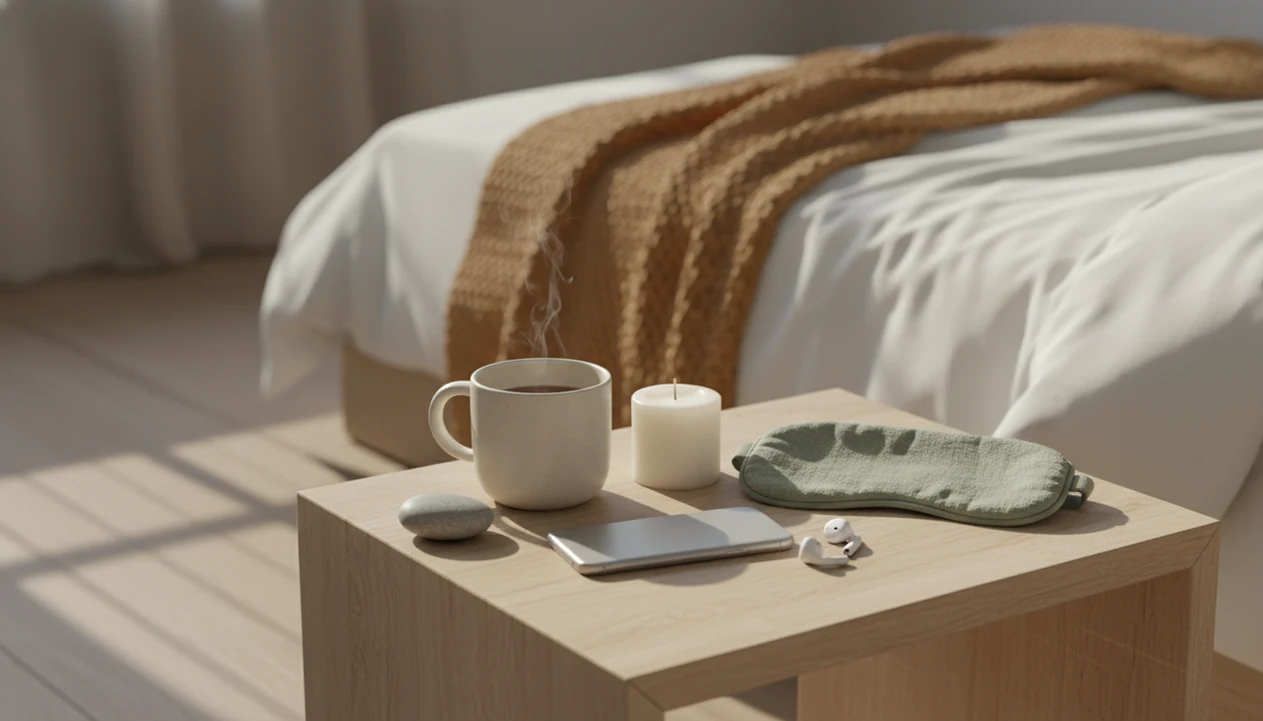


To practice mindfulness daily, attach 2-10 minutes of attention to an existing habit, such as waking up, brushing teeth, eating, opening a laptop, or getting into bed. Mindfulness means noticing the present moment, including breath, body sensations, thoughts, feelings, or surroundings, without judging them or forcing a particular outcome. Start small and repeat the same cue rather than waiting for a quiet day.
A practical routine can include morning breathing, a workday grounding pause, an evening transition, and a bedtime body scan. These are options, not a checklist to complete every day. A phone can provide a timer or guided audio, but notifications and scrolling can compete with attention and interfere with winding down.
The daily practice essentials
- Practice mindfulness daily by pairing 2-10 minute exercises with existing habits like brushing your teeth, opening your laptop, eating, or getting into bed.
- The most practical daily mindfulness routine includes morning breathing, workday grounding, evening transition time, and a bedtime body scan.
- A phone can support mindfulness when used for guided meditation, timers, sleep audio, or breathing exercises, but notifications and scrolling can work against calm and sleep.
Mindfulness basics for everyday calm and sleep preparation
Mindfulness is attention training, not thought-stopping. The practice is learning to notice where your mind went, then gently return to one present-moment anchor.
That anchor can be the breath, body sensations, sound, or one ordinary activity. You might feel your feet on the floor while brushing your teeth, listen to hallway noise for one minute, or follow three slow breaths before getting into bed. Nothing has to look special from the outside. For more ways to bring this attention into ordinary routines, explore these simple mindfulness practices for daily life.
For beginners, two minutes repeated daily usually teaches more than one long session done once a week. A daily mindfulness practice can support calm and pre-sleep wind-down, but it should not be treated as a cure for anxiety, insomnia, or distress. If you want the broader plain-language foundation, our guide to what is mindfulness explains the concept in more detail.
Small counts.
Before You Start a Daily Mindfulness Practice
Before you start, make the practice small, safe, and easy to repeat. You do not need a silent room, a perfect mood, or a long block of time to begin.
- Choose a quiet-enough spot where you can sit, stand, or lie down without needing everything around you to stop. A bedroom corner, parked car, office chair, or kitchen table can work. A few meditation kit essentials can make your chosen space more comfortable without requiring expensive equipment.
- Start with 2-5 minutes if ten or twenty minutes sounds intimidating. A practice you can repeat tomorrow is more useful than one that feels like a test.
- Set your phone to do-not-disturb before any guided audio, timer, breathing exercise, or sleep session. Open the tool you plan to use, then stop browsing.
- Keep your eyes open, look around the room, or end the session if the practice feels too intense. Mindfulness should not become a battle with overwhelm.
- Seek professional support if you are dealing with severe anxiety, trauma symptoms, panic, depression, or chronic insomnia. Mindfulness can support care, but it should not replace it.
Begin gently.
Mindfulness practice effects in the brain and body
Mindfulness works by shifting attention from rumination and autopilot toward present-moment sensory signals. In plain terms, you practice noticing the breath, body, sound, or surroundings before the mind runs another loop.
Breathing exercises, body scans, and grounding practices can also support nervous-system regulation after stress activation. Slow breathing gives the body a steadier rhythm to follow. A body scan moves attention away from planning and replaying and back into physical sensation, such as warmth in the chest or the firm support of the chair beneath you. In a quiet room, that shift can feel very different from trying to think your way into calm.
Research summarized by the American Psychological Association links mindfulness with reduced rumination and stress, plus improvements in working memory and emotional regulation APA research: ce corner. The National Center for Complementary and Integrative Health says mindfulness meditation is generally safe for most people and may help with anxiety, depression, and insomnia alongside standard care NCCIH mindfulness overview: meditation and mindfulness effectiveness and safety.
Mindfulness builds a repeatable skill over weeks, not an instant mood switch.
5-step daily mindfulness routine
Use this 5-step daily mindfulness routine when you want structure without turning practice into another project. The routine works because it attaches mindfulness to normal parts of the day.
- Set one daily cue and one realistic duration. Try “after I sit up in bed, I practice for three minutes.”
- Breathe for 2-5 minutes in the morning. Sit, breathe naturally, and count each exhale up to ten.
- Notice sensations during one ordinary activity. Feel water in the shower, the floor under your feet, or the first bites of lunch.
- Reset during work or stress with five senses grounding. Name one thing you see, hear, feel, smell, and taste.
- Wind down with a body scan or sleep audio before bed. Dim the screen first, then let the practice be audio-only if possible.
For beginners, a short routine is often easier than open-ended meditation because the next step is already chosen.
What research says about daily practice time
A 2025 randomized trial involving 1,458 employees prescribed 10 minutes of app-based mindfulness daily for eight weeks. The program reduced perceived stress more than a wait-list control. Participants who used the app for at least five minutes a day had greater stress reduction than those using it less. That comparison does not establish five minutes as a universal minimum, and the trial studied a repeated program rather than isolated mindful moments.
Longer sessions are not automatically better. In a 2023 study with 161 completers, daily practices lasting approximately 10 or 30 minutes produced improvements over two weeks, with no significant advantage for 30 minutes. Together, these findings support choosing a manageable duration rather than assuming more time always produces more benefit. They do not prove that a one-minute pause has the same effects as a structured daily program.
Morning mindfulness routine for a calmer start
How do I practice mindfulness in the morning? Practice before checking messages or social feeds, even if it is only three minutes.
Sit on the edge of the bed or in a chair. Let the breath move naturally. Count each exhale from one to ten, then start again. When you lose the count after four, notice it without making a story. Return to the next exhale.
If the morning is already crowded, use a normal action instead. Feel warm water in the shower, notice the weight of your mug, stretch before opening the bedroom door, or walk slowly to the kitchen. The goal is to set attention, not guarantee a flawless mood. Thoughts may still arrive fast. You do not need to argue with them.
If you want a more formal version, the basics of how to meditate follow the same return-and-repeat pattern.
Workday mindfulness practice for stress and autopilot
How can I practice mindfulness every day during work or errands? Use transitions, not extra free time.
Try these three micro-practices. First, take a one-breath pause before replying to a message. Second, use five senses grounding after a tense call. Third, practice mindful walking from the car to the door, feeling each step instead of rehearsing the next task.
Transitions make the habit easier to remember. Opening a laptop, entering a meeting, standing in a checkout line, or parking a car can become a cue. Nobody needs to know. A mindful break can be silent and private, even with Slack pings muted for a reset.
In a 2022 JAMA Psychiatry randomized trial, an 8-week mindfulness-based intervention reduced anxiety symptoms by about 30% in adults with anxiety disorders, comparable to escitalopram in that study JAMA Internal Medicine study: 2798510. That is research context, not a personal guarantee.
Phone-supported mindfulness without scrolling
A phone can support mindfulness when it is used as a practice tool, not an attention trap. Set it up before you need calm, because willpower gets thinner when you are tired.
| Phone use | Helpful for mindfulness | Can work against mindfulness |
|---|---|---|
| Guided meditation | Gives structure when you do not know what to do | Becomes distracting if you browse categories for too long |
| Breathing timer | Keeps a 2-5 minute reset contained | Turns into clock-checking if notifications stay on |
| Sleep audio | Supports bedtime wind-down when silence feels hard | Loses value if bright screen checking continues |
| Self-hypnosis session | Can support habit-focused relaxation | Should not replace care for serious symptoms |
| Routine reminders | Helps build consistency | Can become another alert in a noisy day |
Use do-not-disturb, dark mode, audio-only playback, an app shortcut, and a bedtime window. Apps such as MindTastik, Calm, and Headspace can help organize guided meditation, sleep audio, breathing exercises, and self-hypnosis for adults seeking sleep, anxiety, and everyday calm support.
Evening and bedtime mindfulness routine for sleep readiness
Start your bedtime mindfulness routine 20-30 minutes before bed when possible. The aim is to lower stimulation and give attention somewhere steadier to land.
Soften the lighting. Reduce notifications. Choose gentle breathing for a few minutes, then move into a body scan. Start at the forehead and move down slowly, noticing pressure, warmth, tingling, or numbness. Body scanning redirects attention from planning and rumination to physical sensation. For many people, a phone set nearby with guided audio is enough structure to make the practice feel easy to begin.
If silence feels difficult, use audio-only guided meditation or sleep audio. A 2015 meta-analysis of 18 randomized controlled trials found moderate improvement in sleep quality among people with sleep disturbance after mindfulness-based interventions PubMed research: 26135340. A 2014 randomized trial of adults with chronic insomnia also reported improved sleep quality and reduced insomnia severity, with effects maintained at 6 months PubMed research: 25126749.
Mindfulness supports sleep preparation, but it does not replace insomnia care.
5 daily mindfulness exercises for beginners
These five beginner mindfulness exercises are enough for a full week of practice. Pick one or two and repeat them instead of constantly searching for a new technique.
- Mindful breathing: Use in the morning or during stress. Feel each inhale and exhale without changing the breath much.
- Body scan: Use before sleep. Move attention slowly through the body from head to feet.
- Five senses grounding: Use during overwhelm. Name what you see, hear, feel, smell, and taste.
- Mindful walking: Use while commuting, pacing, or moving between rooms. Feel heel, sole, and toes.
- Mindful eating: Use with the first three bites of a meal. Notice texture, temperature, and taste.
Image caption idea: A phone on do-not-disturb beside a bed while a person practices a short body scan before sleep, showing how to practice mindfulness with a simple bedtime routine.
More everyday options are covered in our guide to mindfulness practices.
Common mindfulness routine mistakes that break consistency
These common mistakes make a mindfulness routine harder than it needs to be.
- Mindfulness does not mean emptying the mind. Wandering thoughts are expected; returning attention is the practice.
- Starting too long can backfire. A 30-minute session may sound serious, but five repeatable minutes often fits real life better.
- Perfectionism turns practice into pressure. Missing a day is a cue to restart, not proof you failed.
- Phone switching breaks the container. Using guided audio, then opening social media, can undo the quiet you just created.
- Research benefits usually reflect repeated practice. Occasional sessions may still feel useful, but they are unlikely to match structured programs.
- Discomfort can show up at first. Slowing down may make difficult thoughts or body sensations more noticeable. Understanding why meditation is hard at first can help you respond to early discomfort with patience.
If racing thoughts are the main barrier, try a gentler plan for mindfulness for racing thoughts.
Guided audio for a repeatable daily pause
MindTastik’s guided meditation library suits beginners who prefer spoken instructions for following the breath or settling into a body scan. Pairing one session with starting work or preparing for bed keeps the choice simple. People who find phone use distracting may prefer an ordinary activity, such as walking or washing up, without audio. Guided sessions are an optional aid, not a requirement for mindfulness or a substitute for medical care.
When daily mindfulness is not enough
Mindfulness is useful for many people, but it has clear limits. Treat it as a supportive practice, not a replacement for care.
- Mindfulness is not a quick cure for anxiety, insomnia, trauma, depression, panic, or intense distress.
- Some people notice small or gradual benefits rather than dramatic changes.
- Severe anxiety, depression, trauma symptoms, panic attacks, or chronic insomnia may need therapy, medical care, or both.
- Slowing down can make unpleasant thoughts, memories, or body sensations more noticeable at first.
- Late-night phone use can still disrupt sleep if it leads to notifications, scrolling, bright screens, or “just one more” video.
- Daily or near-daily practice is more realistic for habit-building than occasional practice.
- Mindfulness works better when paired with sleep hygiene, steady routines, and standard care when needed.
- If a practice feels overwhelming, stop, open your eyes, orient to the room, and consider support from a qualified professional.
Reset the plan.
If you are ready to move from tips to practice, MindTastik guided meditation app is where MindTastik keeps its guided meditation experience.
Daily mindfulness questions
How do I start practicing mindfulness every day?
Choose one existing habit as a cue, such as finishing breakfast or sitting down at work. Spend two minutes noticing natural breathing or a physical sensation, such as feet touching the floor. When attention wanders, return to that sensation. Repeat the same cue before adding more practices.
What is a quick mindfulness exercise to do at work?
Use a transition, such as finishing a call or preparing to reply to a message. Pause for one natural breath and notice the feet on the floor. For a longer reset, identify one thing seen, heard, felt, smelled, and tasted. The pause can be silent and does not require closing the eyes.
Should I practice mindfulness in bed before sleep?
A gentle body scan can fit a bedtime routine. Move attention slowly from the forehead toward the feet, noticing sensations without trying to change them. If using audio, set it up before lying down and reduce notifications. Mindfulness can support winding down, but it is not a treatment for chronic insomnia.
How do I use my phone for mindfulness without getting distracted?
Choose the timer or audio session before starting, turn on do-not-disturb, and stop browsing once it is ready. At bedtime, avoid repeatedly checking the screen. The phone has a specific job: providing timing or instructions. If opening it leads to scrolling, an ordinary activity without a phone may be simpler.