
Conscious vs Automatic Mind Mindfulness Guide
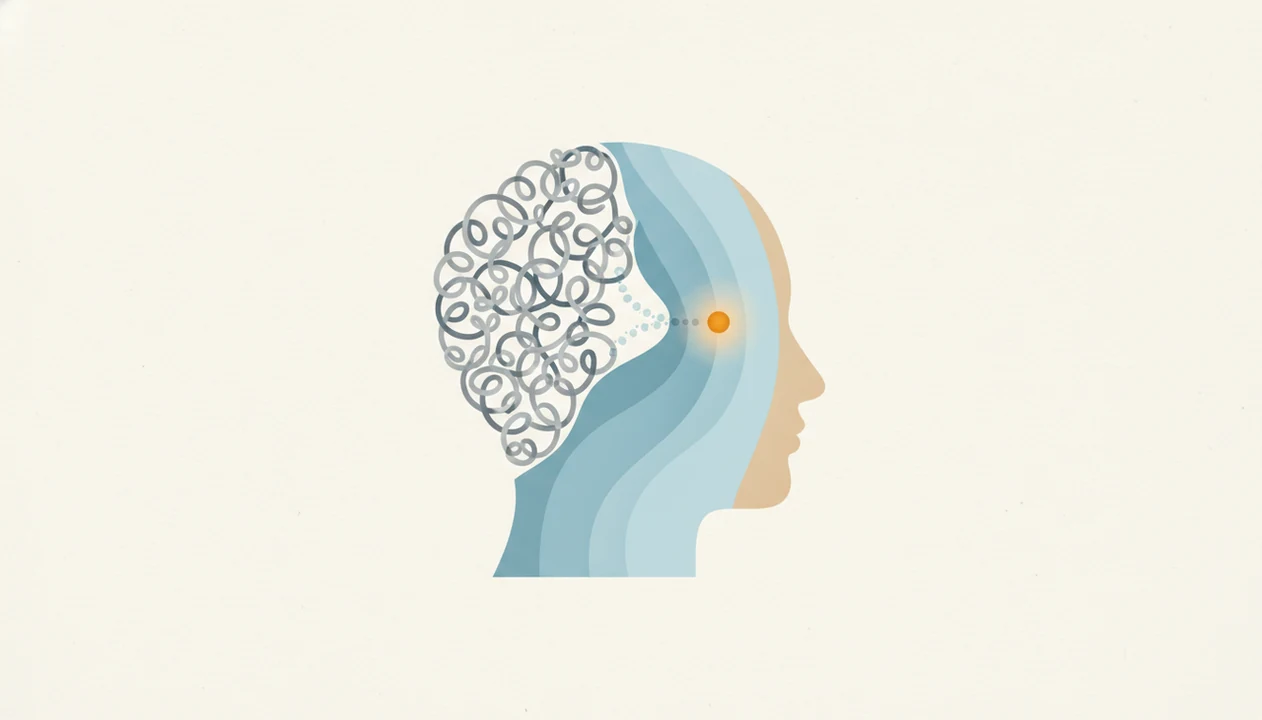


Conscious vs automatic mind mindfulness is the practice of noticing habitual reactions and using present-moment awareness to choose a response. Automatic thinking handles familiar habits, quick reactions, and repeated worry; conscious attention allows a pause to observe thoughts, emotions, and body signals before acting. Autopilot is useful for routine tasks, but it can also keep a stressful conversation replaying at bedtime or send a hand toward a phone without a decision.
Mindfulness practices this pause through breathing, thought labeling, and returning attention after distraction. The aim is not to eliminate automatic thinking or stay perfectly calm. It is to notice a familiar pattern sooner and make room for a deliberate next step, especially during anxious moments, work distractions, or the transition to sleep.
The key distinction
- Your automatic mind is fast, habitual, and useful, but it can also drive stress loops, late-night rumination, and reactive behavior.
- Your conscious mind is slower and more deliberate, helping you notice thoughts, emotions, and body signals before responding. Reflecting on what your heart, mind, and soul want can clarify which needs deserve attention before you respond.
- Mindfulness trains the handoff from autopilot to choice through repeated pauses, breathing, labeling, and gentle redirection.
Conscious vs Automatic Mind Mindfulness: The Core Difference
Conscious vs automatic mind mindfulness is the skill of noticing autopilot before it runs the whole moment. The automatic mind is fast, habitual, and reactive; the conscious mind is slower, observant, and able to choose.
Autopilot is not a flaw. It helps you drive a familiar route, brush your teeth, or reach for your phone before you fully know why. But it can also keep tomorrow's meeting looping at midnight.
The conscious mind steps in when you notice, “I’m worrying again,” or “I’m opening this app without deciding.” Mindfulness is the bridge between those two modes. It gives you a small pause before the next action.
That pause matters.
Learning how to meditate can begin with one breath, noticing a thought, and gently returning attention.
Five Conscious vs Automatic Mind Mindfulness Facts Readers Need
- The automatic mind runs habits and emotional reactions quickly, often before deliberate awareness catches up.
- The conscious mind notices patterns and can choose a different response when there is enough pause.
- Mindfulness strengthens observation without judgment, so thoughts can be seen instead of obeyed.
- Automatic stress loops can affect anxiety, sleep, and focus, especially when worry repeats without action.
- Consistent practice matters more than occasional one-off sessions because the handoff improves through repetition.
A small notebook beside a meditation cushion can help here. Not for long essays. Just a few words after practice: “phone urge,” “tight chest,” “planning again.”
For most people, the useful question is not, “Did I empty my mind?” It is, “Did I notice the automatic pattern sooner than usual?”
Conscious vs Automatic Mind Mindfulness Mechanism
Conscious vs automatic mind mindfulness works by interrupting a habit loop at the moment it becomes visible. A cue appears, the body reacts, a thought follows, and mindfulness adds awareness before the usual response.
The main training tools are thought labeling, body awareness, and attention return. Thought labeling means naming the mental event, such as “worry,” “planning,” or “self-criticism.” Body awareness means feeling something concrete, like the feet, jaw, chest, or breath. Attention return means coming back after the mind wanders.
That return is the practice.
Research on mindfulness suggests benefits for anxiety, stress, sustained attention, and mind-wandering, though results vary by method and person. The practice has three steps: notice the loop, anchor attention, and choose one next action. For people who want more examples, mindfulness exercises and techniques can turn the idea into short practices.
Conscious vs Automatic Mind Mindfulness Evidence for Anxiety, Sleep, and Focus
Research supports mindfulness as a regulation practice, not as a medical cure. In a 2022 JAMA Psychiatry randomized trial, 8 weeks of mindfulness-based stress reduction reduced anxiety symptoms by an average of 39% in adults with anxiety disorders, comparable to escitalopram treatment (JAMA Internal Medicine study: 2798510). A 2014 JAMA Internal Medicine systematic review of 47 trials found moderate evidence that meditation programs improve anxiety, depression, and pain (JAMA Internal Medicine study: 1809754). CDC data also connect insufficient sleep with worse mental health patterns, which supports treating sleep and stress as linked rather than separate problems (CDC guidance: adults sleep facts and stats.html). Focus research points in the same direction. A PNAS trial found improved sustained attention and reduced mind-wandering after 2 weeks of meditation training (pnas reference: pnas.1213846110).
Mindfulness usually works best when it is practiced regularly, while one-off sessions fit people who only need a brief reset. Clinicians typically recommend professional care for severe anxiety, depression, trauma symptoms, or persistent sleep problems.
Noticing a reaction helps more when it includes acceptance
Awareness alone is not the whole skill. A 2024 systematic review and meta-analysis covering 110 studies and 8,105 participants found a modest overall effect of mindfulness strategies on emotion regulation. Components involving equanimity, an accepting and non-reactive attitude, had larger effects than monitoring alone. The practical distinction is between noticing an anxious thought and noticing it without immediately fighting it or following it.
Acceptance does not require agreement with a thought or acting on an impulse. NHS emotional-regulation guidance, written for children and adolescents, distinguishes regulation from suppressing feelings: notice the emotion, name it, and allow its strongest part to pass before responding. For an autopilot moment, a label such as “anger” can identify the feeling without deciding that the first interpretation or impulse must determine the next action. When offering these prompts to others, trauma-informed mindfulness teaching can help you prioritize choice, comfort, and permission to stop.
Conscious vs Automatic Mind Mindfulness Daily Practice Steps
Use conscious vs automatic mind mindfulness in a tiny daily sequence. The goal is not instant calm; the goal is catching one automatic moment and making one conscious choice.
1. Set an autopilot cue
- Choose one cue, such as bedtime worry, an anxious thought, a phone reach, or work distraction.
- Place the cue in a real setting, like the couch, desk, bed, or parked car.
- Keep the practice short enough that you’ll actually repeat it.
2. Pause before reacting
- Take one breath before acting, even if the urge still stays.
- Lower effort, not attention. A forced pause can become another pressure.
3. Name the pattern
- Say a plain label: “worry loop,” “scrolling urge,” “avoidance,” or “planning.”
- Feel one body sensation, such as your feet on the floor or your shoulders dropping.
4. Choose one response
- Pick one small action: close the app, start a timer, write the thought down, or begin bedtime audio.
- Repeat daily, especially on ordinary days.
Best-Fit Readers for Conscious vs Automatic Mind Mindfulness Practice
Conscious vs automatic mind mindfulness fits adults who want to notice stress reactions, bedtime rumination, phone habits, and focus drift. It is beginner-friendly because the first task is noticing, not holding perfect concentration.
| Reader type | Best for | Not ideal for |
|---|---|---|
| Bedtime worrier | Seeing rumination before it becomes a full loop | Forcing sleep on command |
| Anxious beginner | Naming body signals and thoughts earlier | Replacing therapy or medication |
| Distracted worker | Resetting attention to one task | Suppressing every unwanted thought |
| Phone habit user | Catching the reach before scrolling | Shaming yourself for habits |
If sleep is the main issue, combine mindfulness with sleep hygiene, like dim lights, steady timing, and less late scrolling.
Conscious vs Automatic Mind Mindfulness Scripts for Autopilot Moments
Short scripts work because automatic reactions usually pass through quickly. In a quiet room with dim light, when you notice the mind looping instead of settling, a long explanation is not what helps. A simple next step can be enough.
- Bedtime phone reach: “This is the reach. One breath. Phone down. Sleep audio or darkness.”
- Anxious thought: “Worry is here. Feel feet. What is the next useful action?”
- Focus drift: “Distraction noticed. Reset the timer. Return to one task.”
- Emotional reaction: “Pause. Soften jaw and shoulders. Answer after one breath.” If repeated interactions feel harmful, learning how to handle a toxic relationship can help you consider boundaries and support.
Keep scripts under 30 seconds. If a script takes too long, the automatic mind has already moved on. For anxiety-specific routines, a meditation app for anxiety support can offer prompts when thinking feels too loud.
MindTastik Support for Conscious vs Automatic Mind Mindfulness
MindTastik offers wellness-focused guided sessions, sleep audio, breathing exercises, and self-hypnosis practices for adults seeking support with rest, anxious moments, and everyday calm. It can help by giving the conscious mind a clear cue right when practice tends to unravel: begin here, breathe here, come back here.
A guided session can make the handoff easier when the automatic mind is busy. You might choose between a 5-minute breathing exercise and a 20-minute body scan instead of trying to invent a practice at bedtime.
The app can support sleep, anxiety, focus, and everyday calm, but it does not treat, cure, or replace professional care. Short sessions used consistently are usually more manageable than long sessions saved for a hard night. For comparison shoppers, the best meditation app for sleep anxiety guide maps app features to common needs.
Guided practice for worry loops and attention drift
MindTastik’s guided meditation library suits adults who prefer spoken prompts for noticing thoughts and returning attention rather than practicing alone. Breathing exercises can provide a simple focus during an anxious pause, while sleep stories offer an alternative to continuing a bedtime worry loop. These sessions provide structure, not treatment. Adults seeking help for severe anxiety, trauma symptoms, persistent insomnia, or substantial daily impairment should prioritize professional care rather than rely on an app. For difficult memories, mindfulness for trauma offers ways to adapt awareness practices while keeping safety and professional support in view.
When noticing autopilot is not enough
Mindfulness has real limits, and naming them makes the practice safer. It can support awareness and regulation, but it should not be used as a substitute for medical or psychiatric care.
- Mindfulness is not a replacement for therapy, medication, crisis support, or medical treatment.
- Severe anxiety, depression, trauma symptoms, panic, or sleep disorders may need professional guidance.
- Early practice can make distressing thoughts feel louder because you are finally noticing them.
- Benefits depend on consistent practice, not one impressive session during a difficult week.
- Digital app evidence is promising but variable, and different programs may produce different results.
- Trying to force calm, sleep, or focus can increase pressure and frustration.
- Some people need grounding, movement, or clinician-led support before silent practice feels safe.
If mindfulness makes symptoms feel unmanageable, stop the exercise and seek qualified support. Simple is allowed. Safe comes first.
Bring the pause into email, traffic, and conversations
If you can stay calm during practice but snap back into autopilot during email, traffic, or family conversations, your practice may be too isolated from real triggers. Try naming the exact cue that starts the loop, such as rushing, defending, checking, or rehearsing. A practice becomes more useful when it trains the moment you actually lose choice. For tense conversations, practicing how to deal with difficult people mindfully can help you pause before choosing a response.
Match the practice to distraction, mental replay, or bedtime
| If you... | Try | Why | Note |
|---|---|---|---|
| You feel mentally scattered but not highly distressed | A brief conscious-breathing practice | It gives the conscious mind a simple anchor before choosing the next action. | Keep it short enough that you will actually repeat it. |
| You keep replaying a conversation or future problem | A guided meditation focused on observing thoughts | It can help separate the thought loop from the decision you need to make. | Do not use it to avoid a practical next step. |
| Autopilot shows up mostly at bedtime or during wind-down time | Sleep story, breathing exercise, or self-hypnosis audio | A predictable track may reduce decision-making when the tired mind defaults to habit. | If sleep problems persist or worsen, consider professional guidance. |
Conscious and automatic thinking questions
What is the difference between conscious and automatic thinking?
Automatic thinking is fast and habitual, such as following a familiar routine or reacting before considering a response. Conscious thinking is more deliberate: noticing what is happening, weighing a choice, and redirecting attention. Mindfulness practices the pause between an automatic impulse and the action that follows.
Is being on autopilot always a bad thing?
No. Automatic habits make familiar tasks easier and reduce the need to consider every small action. The difficulty comes when a habit no longer fits the situation, such as checking a phone during work or repeating worry at bedtime. The aim is more choice, not constant monitoring.
How can I catch an automatic reaction before acting on it?
Start with one recognizable cue, such as a tightened jaw, a phone reach, or mentally rehearsing an argument. Pause for a breath, name the pattern briefly, and feel a concrete sensation such as the feet on the floor. Then choose one useful action. The impulse may still be present.
Does mindfulness stop unwanted thoughts?
Stopping thoughts is not the goal. Mindfulness involves recognizing a thought without immediately treating it as a fact, instruction, or problem to solve. A brief label such as “planning” or “worry” can help before attention returns to the breath, body, or current task. Wandering attention is part of practice.
Can mindfulness help with automatic worry at bedtime?
It can provide a way to notice rumination and redirect attention toward a body sensation, breathing, or sleep audio. That is different from forcing sleep or resolving every worry in bed. Persistent or worsening sleep problems deserve professional guidance rather than increasingly effortful attempts to control thoughts.
How do I know if mindfulness is changing an automatic habit?
Look for changes in a specific situation: noticing the urge to check a phone, recognizing worry before a long replay, or pausing before replying. Progress can mean recovering attention sooner even when the habit still happens. One calm session does not establish lasting change; repeated practice matters.