
Mindfulness Meditation for Beginners: A 7-Day Starter Plan



Mindfulness meditation is the practice of paying gentle, nonjudgmental attention to the present moment, noticing breath, body sensations, thoughts, or emotions and returning when attention wanders. For beginners, 5 to 10 minutes a day is a practical starting point. The aim is not to stop thinking. Noticing a distraction and returning to an anchor is the practice itself.
This seven-day plan introduces breath awareness, body scans, noticing thoughts, and bedtime wind-downs, with simple mood or sleep tracking to help identify a repeatable routine. Guided audio can reduce the need to remember instructions. MindTastik offers adult wellness audio, including meditation, sleep support, breathing practices, and self-hypnosis. Start with a short mindfulness session rather than trying every type of audio in the first week.
The beginner essentials
- Start with short guided sessions: 5 minutes is enough for a beginner mindfulness meditation practice.
- The goal is not to stop thoughts; the goal is to notice them and gently return to the present moment.
- Use a 7-day plan with breathing, body scans, sleep wind-downs, and simple mood or sleep tracking.
Mindfulness Meditation Meaning for Beginners
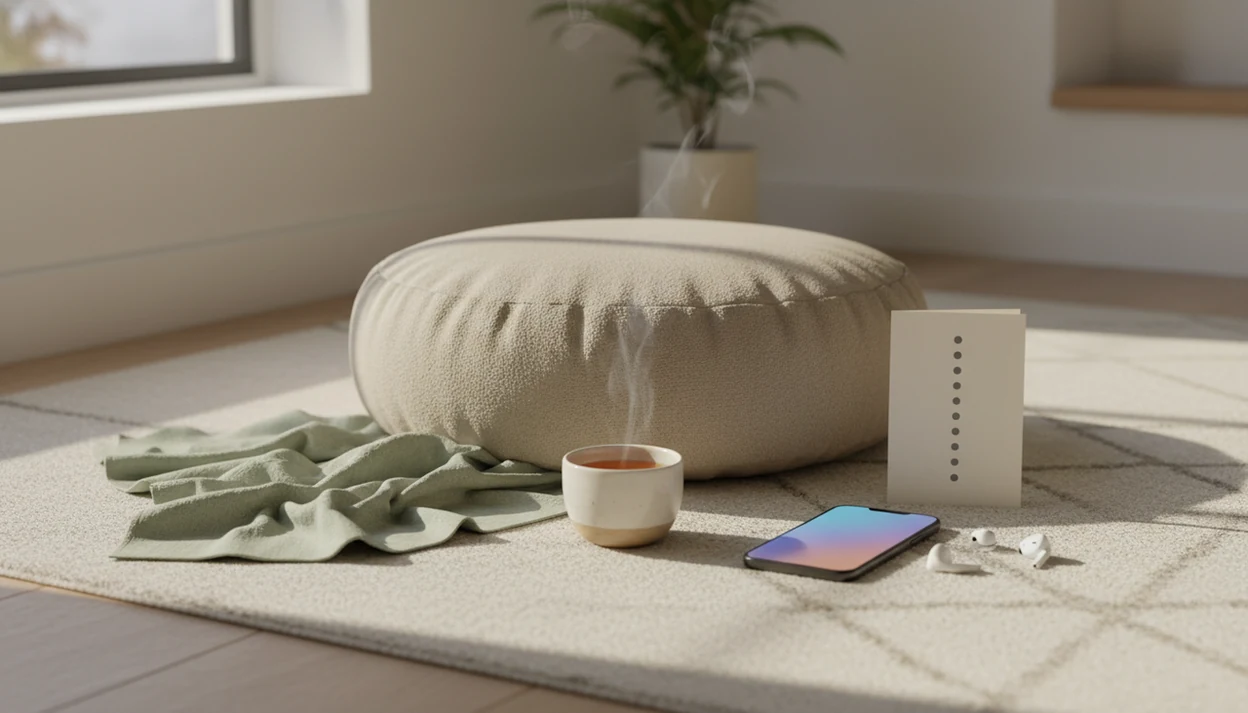
Mindfulness meditation is present-moment attention without judgment. In plain terms, you notice what is happening right now, then return gently when your attention drifts.
For beginner mindfulness meditation, the biggest misunderstanding is that your mind should go blank. It won't. Thoughts are part of the session, not proof that you failed. The practice is the return.
You might use the breath as your anchor. You might notice body sensations, emotions, sounds in the room, or thoughts moving through. One beginner may sit on the couch unsure about posture, then realize the only real instruction is simpler: notice, soften, return.
If you want the broader distinction, our guide to what is mindfulness explains how mindfulness can happen both during meditation and in ordinary daily life.
Five Mindfulness Meditation Facts Beginners Should Know
- Mindfulness meditation trains attention, not perfection; wandering is expected, and returning is the exercise.
- Short daily guided practice usually beats occasional long sessions because repetition makes the habit easier to remember.
- Mindfulness meditation may support stress, anxiety symptoms, sleep quality, and well-being, but it is not a cure-all.
- Guided breathing, body scans, and mindful moments are the most useful first practices for beginners because the instructions stay simple.
- Meditation is generally considered safe for healthy people, with extra care needed for serious mental health conditions or strong distress.
A beginner does not need incense, silence, or a special cushion. A chair works. So does the edge of the bed before sleep, especially when earbuds are on the nightstand, one side slightly tangled around a charging cable.
Keep it ordinary.
How Mindfulness Meditation Practice Works in the Brain and Body
Mindfulness meditation practice works by training attention through a repeatable loop: notice distraction, label it lightly, and return to an anchor. The anchor may be the breath, the body, a sound, or a simple phrase.
The technical term is attentional control. In normal language, it means you practice catching the mind after it has wandered. Non-judgmental awareness matters because it changes the tone of the moment. Instead of arguing with a thought, you notice, “thinking,” then come back.
Breathing and body awareness may also help the nervous system settle. Slow exhaling, relaxed shoulders, and noticing contact with the chair can signal safety to the body. That does not make meditation a medical treatment, but it can support everyday calm.
Benefits usually come from repeated practice over time, not one perfect session. Five steady minutes on four ordinary days often teaches more than one heroic 40-minute attempt.
How to Start Mindfulness Meditation With a Guided App
A guided app helps beginners start mindfulness meditation by removing the need to remember every instruction. Tools like MindTastik, Calm, and Headspace can walk you through breath awareness, body scans, and short resets.
MindTastik fits this beginner use case best when you want short guided sessions, bedtime audio, breathing exercises, and simple self-check-ins in one place rather than a long silent-meditation library.
- Set a realistic time, such as 5-10 minutes on day one.
- Choose a guided mindful meditation session for beginners, not a long silent practice.
- Sit on a chair, bed, or couch with your feet or body supported.
- Follow the voice, and return to the breath when your attention wanders.
- Log one word for mood, sleep, or anxiety before and after the session.
- Repeat at the same time tomorrow if the routine felt manageable.
For beginners, guided mindfulness meditation is often easier than silent meditation because the next instruction arrives before uncertainty takes over.
Meditation apps for sleep anxiety and everyday calm should deliver clear session choices, gentle reminders, and practical tracking, not promises to fix every hard night or anxious thought.
7-Day Mindfulness Meditation for Beginners Plan
A 7-day mindfulness meditation for beginners plan should mix breath, body, thoughts, daily life, sleep, and review. The goal is not variety for its own sake; it is finding the routine you will actually repeat.
Days 1-3: Breath, Body, and Thoughts
Day 1: Breath awareness. Do 5 minutes. Count one inhale and one exhale, then restart when you lose track.
Day 2: Body scan. Do 5 minutes. Move attention from feet to face, noticing pressure, warmth, tightness, or ease.
Day 3: Racing thoughts. Try a 7-minute guided mindful meditation. Label thoughts as “planning,” “worrying,” or “remembering,” then return.
Days 4-7: Daily Life, Sleep, and Review
Day 4: Mindful moment. Choose mindful walking or mindful eating. One slow snack counts.
Day 5: Sleep wind-down. Try a 10-minute bedtime session after dimming the phone screen.
Day 6: Breathing plus emotion labeling. Pair a slow exhale with one emotion word.
Day 7: Review. Check mood, sleep, and consistency, then choose a repeat schedule.
If you want a printable version, use this first week mindfulness plan as a simple next step.
Best Mindfulness Meditation Sessions for Calm, Sleep, and Racing Thoughts
The right mindfulness meditation session depends on the problem in front of you. App-guided sessions are useful because you do not have to remember instructions when you are tired, tense, or distracted.
| Goal | Best session | Try when | Not ideal when |
|---|---|---|---|
| Everyday calm | 5-minute breath awareness | You need a short reset between tasks | You want deep sleep audio |
| Sleep wind-down | 10-minute body scan or sleep meditation | Cool sheets meet restless legs | You need to stay alert |
| Anxiety support | Guided breathing with grounding | Your body feels keyed up | You are in crisis or unsafe |
| Racing thoughts | Labeling thoughts practice | It is 2:13 a.m. and the lock screen says you are still awake | Thoughts feel traumatic or overwhelming |
| Body tension | Progressive body awareness | Jaw, shoulders, or back feel tight | Pain needs medical assessment |
Best for: beginners who want structure, short sessions, and a repeatable starting point.
Not ideal for: people expecting instant silence, medical treatment, or a guaranteed sleep result.
For more examples outside formal sessions, try these mindfulness practices.
Mindful Meditation Evidence for Anxiety, Sleep, and Stress
Mindful meditation has research support for stress-related outcomes, anxiety symptoms, depressive symptoms, pain, and sleep quality, but the evidence points to helpful effects, not guaranteed results. Per the CDC, a 2014 analysis estimated that 18 million U.S. adults practiced meditation, up from 10 million in 2002 CDC guidance: db146.pdf.
A 2014 JAMA Internal Medicine meta-analysis of 47 randomized clinical trials JAMA Internal Medicine study: 1809754 found moderate evidence that mindfulness meditation programs improved anxiety, depression, and pain compared with control conditions. A 2018 systematic review and meta-analysis also found that mindfulness meditation significantly improved sleep quality in people with insomnia and other sleep disturbances NIH research: PMC6557693.
A separate 2014 randomized clinical trial found that a 6-week mindfulness program improved insomnia symptoms, depression, and fatigue more than sleep education in adults with moderate sleep problems JAMA Internal Medicine study: 2110998. Clinicians typically recommend meditation as a supportive practice, not as a replacement for therapy, medication, or medical evaluation when symptoms are serious.
What research can tell beginners about short sessions
Research on a mindfulness program does not establish what a single five-minute recording will do. Programs and techniques differ, and findings cannot automatically be applied to every form of meditation. The NCCIH overview of meditation research makes this distinction important: a short session is a manageable way to learn the practice, not a proven dose for treating anxiety or insomnia.
The comparison group also matters. A 2014 review of randomized trials found benefits for anxiety and depression but no evidence that meditation outperformed active treatments such as exercise, medication, or other behavioral therapies. For this starter plan, useful signs of progress are recognizing distraction and finding a routine that is manageable. A calmer mood is possible, but it is not a requirement for a worthwhile session.
Mindfulness Meditation Checklist Before Your First Session
Use this checklist before your first mindfulness meditation session so the setup does not become the hard part. A chair, bed, or couch is acceptable; cross-legged sitting is optional. Before you begin, use a mindfulness checklist for beginners to prepare your space and choose a manageable session.
- Time: Pick 5-10 minutes, not an ambitious hour.
- Place: Choose a quiet-enough spot, such as a bedroom, parked car, or office corner.
- Posture: Sit or lie down with support. Comfort helps you stay.
- Session length: Start short and stop before frustration builds.
- Anchor: Use breath, body sensations, sounds, or a guided voice.
- App reminder: Set one daily reminder at a time you can usually keep.
- Phone setup: Turn on Do Not Disturb before you press play.
- Evening habit: Replace late-night scrolling with a short sleep session.
- Tracking: Note one word afterward: calm, tense, sleepy, restless, lighter.
Image caption suggestion: A beginner preparing for a short mindfulness meditation session with headphones, a dimmed phone screen, and a simple seated posture.
Small setup choices matter.
People Also Ask About Mindfulness Meditation
What is mindfulness meditation in simple words? Mindfulness meditation means paying attention to the present moment with kindness instead of judging every thought or feeling.
How long should beginners meditate? Beginners should usually start with 5-10 minutes a day. Consistency matters more than session length at the beginning.
Is it okay if my mind wanders? Yes. Mind wandering is expected, and the practice is noticing it without scolding yourself.
Can mindfulness meditation help with sleep? Mindfulness meditation may help some people wind down and improve sleep quality, especially when used as part of a regular bedtime routine.
For people asking how to meditate, the simplest answer is to choose one anchor, notice distraction, and return. Again and again.
Guided audio for the first week
MindTastik’s guided meditation library suits beginners who prefer spoken instructions for breath awareness or body-focused practice. Breathing exercises and sleep audio offer separate options when the goal is settling down before bed rather than practicing attention. A timer may be a better fit for someone who prefers silence. Persistent anxiety, insomnia, or distress calls for appropriate clinical care, not simply a different audio session; MindTastik is not a medical treatment.
When mindfulness needs adjustment or professional support
Mindfulness meditation is supportive, but it has limits. The U.S. National Center for Complementary and Integrative Health says meditation is generally considered safe for healthy people, though some people may experience strong emotions or distress and may need professional supervision NCCIH mindfulness overview: meditation and mindfulness effectiveness and safety.
- Mindfulness meditation is not a replacement for medical care, psychotherapy, medication, or crisis support.
- Serious anxiety, depression, PTSD, trauma symptoms, or severe distress may need professional supervision.
- Some people feel more distress during meditation because difficult emotions become more noticeable.
- Benefits vary, and many people need weeks of consistent practice before changes feel clear.
- Meditation should not be described as curing insomnia, anxiety disorders, depression, or trauma.
- If silence feels unsafe, try open eyes, a shorter session, grounding through touch, or support from a clinician.
- If you are in immediate danger or may harm yourself, use emergency or crisis services now.
Hard nights still happen.
For structured sessions beyond this page, MindTastik guided meditation app is the main MindTastik hub for guided meditation.
Questions about starting mindfulness meditation
What should I focus on during my first mindfulness meditation?
Choose one anchor, such as the feeling of breathing, contact with the chair, or sounds in the room. Notice it without trying to create a special sensation. When a thought takes attention elsewhere, recognize the distraction and return. There is no need to monitor breath, thoughts, and body sensations all at once.
Is five minutes of mindfulness meditation enough for a beginner?
Five minutes is a practical starting length for learning the instructions and building a repeatable habit. It is not an established treatment dose for anxiety or insomnia. Begin with 5 to 10 minutes, and keep the session manageable rather than extending it to meet an arbitrary target.
What should I do if my mind keeps wandering during meditation?
Notice the wandering, briefly name it if helpful, and return to the chosen anchor. Labels such as planning, worrying, or remembering can make the instruction concrete. Repeated distraction does not mean the session has failed. The skill being practiced is recognizing the drift and returning, not holding perfect concentration.
Can I meditate lying down or with my eyes open?
A supported chair, couch, or lying position can work; cross-legged sitting is optional. Eyes do not have to be closed. Choose a position that makes the practice manageable. For a bedtime wind-down, lying down may fit the goal. For attention practice, sitting is another option.
Is mindfulness meditation the same as relaxation?
No. Mindfulness trains attention and a nonjudgmental response to present experience. Relaxation practices primarily aim to reduce arousal. Mindfulness may feel calming, but a restless session can still involve useful practice. When the immediate goal is settling before sleep, relaxation breathing or progressive muscle relaxation may be a better match.
Should beginners use guided meditation or sit in silence?
Guided meditation supplies reminders about where to place attention and what to do when thoughts interrupt. That can make the first sessions simpler. Silent practice suits people who prefer fewer spoken instructions and already understand the basic steps. Neither format requires a blank mind, and research findings do not establish one format as best for everyone.
What if mindfulness meditation makes me anxious or upset?
Stop or shorten the session rather than forcing it. A different anchor, such as sounds or contact with the chair, is an option, but changing techniques is not a substitute for care. Strong, persistent, or impairing distress warrants guidance from a qualified mental-health professional, especially with trauma-related symptoms or serious mental-health conditions.
Can mindfulness meditation help with sleep and racing thoughts?
It may help some people wind down and relate differently to bedtime thoughts, but it does not reliably eliminate thoughts or cure insomnia. Research on sleep quality shows variable results. A body scan or sleep-focused session can be part of a bedtime routine, while persistent sleep problems need appropriate assessment and treatment.