
6 Yoga Poses to Relieve Stress and Ground Yourself at Work
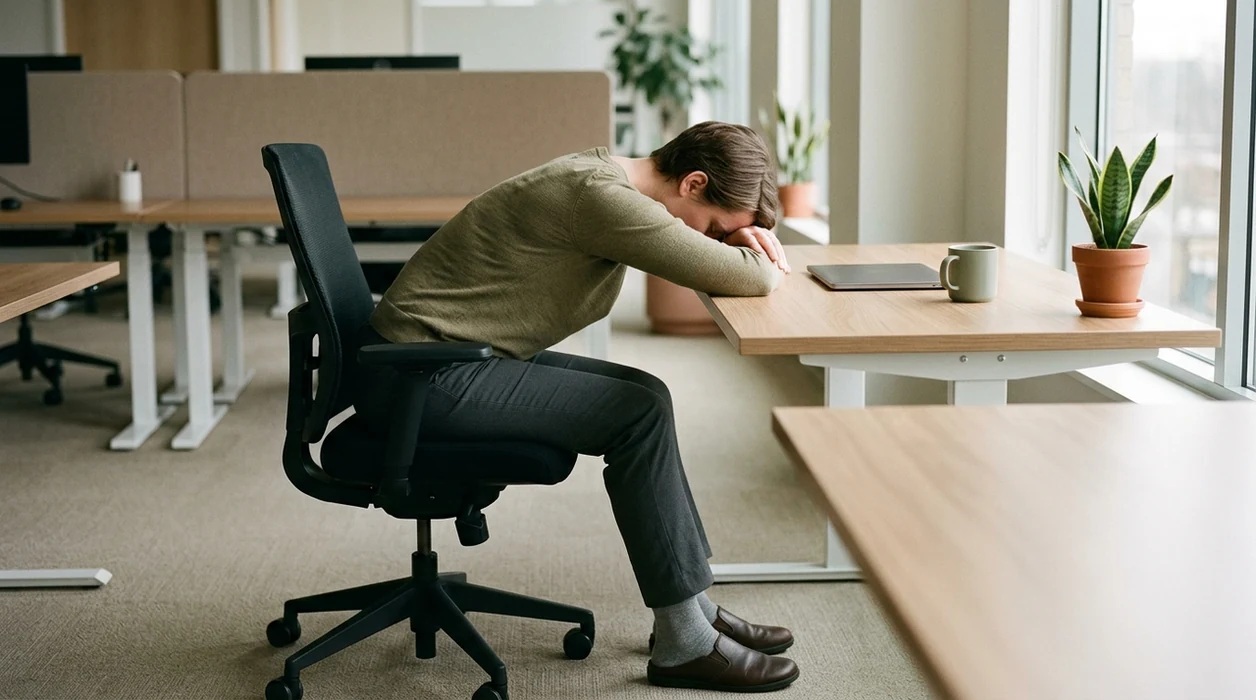


Six yoga poses for workplace stress are chair cat-cow, seated forward fold, seated spinal twist, desk-supported child’s pose, seated pigeon, and legs-up-the-chair. Practiced gently with slow nasal breathing, they form a 5-10 minute break that may ease shoulder tension and help settle racing thoughts. The aim is a comfortable pause, not a deep stretch or a workout.
Most of the sequence can fit beside a desk, with chair-based alternatives when floor space or privacy is limited. Pair small movements with attention to breathing and body sensations; short guided audio can provide cues. Forward bends, twists, and raised-leg positions may need modification for blood pressure, eye, spine, pregnancy, recent surgery, or dizziness concerns.
The desk-break essentials
- Use gentle office-friendly poses, not intense stretching, to calm the nervous system during work stress.
- Pair each pose with slow breathing, body awareness, and short guided audio for a more repeatable routine. Learning how to bring mindfulness to work can help you turn breathing and body awareness into regular habits.
- Modify or skip forward bends, twists, and inversion-like positions if you have blood pressure, eye, spine, pregnancy, surgery, or dizziness concerns.
At-a-glance guide to 6 yoga poses to relieve stress at work
These six office-friendly poses take about 5-10 minutes and can be done in work clothes without a yoga mat. The routine should feel calming, private, and useful, not painful, dizzying, or performative.
| Pose | Target area | Stress cue | Safest modification |
|---|---|---|---|
| Chair cat-cow | Spine, chest, upper back | Rounded desk posture | Keep hands on thighs |
| Seated forward fold | Low back, hamstrings, neck | Holding tension after email | Rest elbows on thighs |
| Seated spinal twist | Mid-back, ribs | Stiffness after calls | Twist from ribs, not neck |
| Desk-supported child’s pose | Shoulders, upper back | Tight jaw and raised shoulders | Forearms on desk |
| Seated pigeon | Hips, glutes | Restless sitting | Keep foot on floor |
| Legs-up-the-chair | Legs, nervous system | Wired but tired | Calves on chair seat |
A small reset works best when it fits the room. Feet planted on office carpet, screen dimmed, shoulders dropping one notch. That counts.
Five facts about yoga poses for stress and anxiety at work
Yoga poses for work stress help most when they combine gentle movement, slow breathing, and attention to body sensation. The goal is not flexibility; it is a short reset your nervous system can recognize.
- A 2017 review in Journal of Psychiatric Research found yoga was associated with reductions in stress, anxiety, and depression across included studies (PubMed research: 28963884).
- Workplace stress is widespread; the American Psychological Association reported that 76% of U.S. workers had at least one negative mental health outcome from workplace stress in the past month (APA research: 2023 workplace health well being).
- Breathing and attention matter more than range of motion, especially when you are practicing between meetings.
- Chair and desk modifications make yoga realistic in office settings, where floor space and privacy are often limited.
- Yoga can support self-care, but it does not replace therapy, medication, crisis care, or guidance from a qualified clinician.
For workday stress that feels more mental than muscular, a short meditation for work stress routine can pair well with these poses.
Break research supports recovery, not this exact six-pose sequence
Research on short work breaks offers a useful reason to make room for this routine, but it does not establish that these six poses are the best combination. A 2022 systematic review and meta-analysis of micro-breaks found benefits for vigor and fatigue across work settings. Evidence for consistent performance improvements was weaker. A break can therefore be useful without producing an immediate increase in output. The benefits of mindfulness at work can include a steadier response to stress and more intentional pauses.
The type of break also matters. In a 2023 study of office workers’ lunch breaks, guided relaxation days were associated with fewer errors on an attention test than usual-break days, while activity breaks were more associated with energetic arousal. This was a within-person observational intervention study, not a trial of desk yoga. Its findings support distinguishing a calming pause from an energizing movement break, rather than expecting one routine to do everything.
How 6 yoga poses to relieve stress and ground yourself at work actually work
Six gentle work yoga poses reduce stress by shifting attention from threat scanning toward breath, posture, pressure, and body awareness. Slow exhalations, proprioception, and interoception give the brain clearer signals of “I am here, and I am safe enough to pause.”
Sympathetic arousal is the body’s alert system. It can show up as shallow breathing, tight shoulders, a clenched jaw, or scanning the next calendar block before the current one ends. Parasympathetic relaxation is the downshift. It does not turn stress off like a switch, but it can make the body less braced.
Gentle movement can reduce muscle guarding in the neck, shoulders, back, and hips. Meta-analysis data also suggest yoga can reduce anxiety symptoms for some people, though effects vary by population, practice style, and study quality (frontiersin reference).
Guided breathing works through similar attention loops. Tools like MindTastik, calm.com, and headspace.com can give a timed voice cue when your breath count gets lost after four.
How to use this 6-pose work yoga sequence in 10 minutes
Use this sequence as a short reset, not a full workout. For most office workers, a repeatable 10-minute practice is often easier than a long class because it does not require changing clothes, clearing floor space, or leaving the building.
- Set a 5-10 minute timer and silence notifications so your body is not bracing for the next ping.
- Sit tall for chair cat-cow and take 3-5 slow breaths, moving the spine gently with each inhale and exhale.
- Fold forward only as far as comfortable, resting elbows on thighs if your back or hamstrings feel tight.
- Twist gently to each side without forcing the neck; keep the movement small and smooth.
- Rest your forearms on the desk for a supported child’s-pose variation, letting the shoulders soften.
- Finish with seated pigeon or legs-up-the-chair, then take one grounding breath before returning to work.
If stress spikes quickly, a 5 minute meditation for anxiety support can follow the final breath.
The 6 yoga poses to relieve stress and ground yourself at work
These six poses are meant to be small, steady, and desk-friendly. Hold each for 3-8 breaths, and stop before sensation turns sharp, nervy, or breath-holding.
Chair cat-cow for spine tension
Sit tall with hands on thighs. Inhale, lift the chest slightly; exhale, round the spine. It should feel like stiffness leaving the mid-back, not a dramatic backbend.
Seated forward fold for slow exhalations
Place feet wide and fold over your thighs. Breathe into the back ribs for 5 breaths. The dim lamp beside wrinkled pillows version can wait; this is the office version.
Seated spinal twist for desk stiffness
Hold the chair edge and rotate from the ribs. Keep the neck easy. You should feel space through the mid-back, not a yank.
Desk-supported child’s pose for shoulders
Rest forearms on the desk and slide the chair back. Let the head lower between arms. Shoulders decompress without needing the floor.
Seated pigeon for tight hips
Cross one ankle over the opposite thigh. Hinge slightly forward. Hold 4-6 breaths per side.
Legs-up-the-chair for grounding
Lie on your back only if you have private space. Rest calves on a chair. Feel the floor hold you.
Desk-friendly modifications for office yoga stress relief
Office yoga should be discreet enough that you will actually do it. Keep shoes on if needed, stay in normal clothes, and choose chair-based versions when floor space is awkward or the room has glass walls. For a quieter seated break, desk meditation at work offers another way to practice without needing floor space.
If you cannot get on the floor, keep all six poses seated. Cat-cow, forward fold, twist, and pigeon all work in a chair. Desk-supported child’s pose can be done with forearms on a desk and hips still in the chair. Legs-up-the-chair can become “feet on a low box” or “calves supported on a second chair.”
Use a wall, desk, or chair back for balance. Keep joints soft. Avoid pushing into pain, tingling, numbness, dizziness, or a headache-like pressure.
Recommended image caption: “Desk-supported child’s pose in an office chair, with forearms resting on the desk and shoulders relaxed.”
MindTastik meditation pairing for 6 yoga poses at work
Pairing these poses with guided audio can reduce decision fatigue. Instead of asking, “What should I do now?” you press play, follow the breath cue, and let the routine carry you. A meditation app for work can offer brief audio cues when you want structure without adding another task.
MindTastik offers guided meditation, sleep audio, breathing practices, and self-hypnosis sessions for adults looking for support with rest, anxiety, and everyday calm. At work, it can pair naturally with a 5-minute breathing practice before chair cat-cow, a short focus reset after a seated twist, or a calming session after legs-up-the-chair.
Good meditation app for sleep anxiety and everyday calm routines deliver repeatable cues, not a diagnosis or a promise that work stress will disappear. If tension follows you into the evening, sleep audio later may support a wind-down routine. For late-night worry, breathing exercises for anxiety at night may fit better than more stretching.
Safety boundaries for 6 office yoga poses
Modify or avoid deep forward bends, strong twists, and inversion-like positions if you have uncontrolled high blood pressure, glaucoma, recent surgery, pregnancy, spine issues, vertigo, severe pain, or neurological symptoms. The safer version is usually smaller, slower, and more supported.
People with health conditions, older adults, and pregnant people should discuss yoga modifications with a qualified health professional.
Stop if you feel pain, tingling, numbness, dizziness, headache pressure, shortness of breath, or symptoms that feel unusual for you. Do not “breathe through” warning signs. Reset the plan.
This guide is educational and not personalized medical advice. Clinicians typically recommend getting individualized guidance when symptoms are persistent, severe, new, or linked with a known condition. If your work stress includes panic symptoms, trauma responses, chest pain, fainting, or thoughts of self-harm, office yoga is not enough support.
A supportive practice can sit beside care. It should not replace it.
Common mistakes in 6 yoga poses to relieve stress at work
Are you doing the poses too hard for stress relief? If the answer is yes, the routine may become another performance task instead of a downshift.
The first mistake is stretching as hard as possible. For stress relief, slow breathing usually matters more than depth. A gentle forward fold with soft exhalations is more useful than forcing your hands toward the floor.
Another common mistake is holding the breath while folding or twisting. If the breath stops, back out. The pose is too intense or too fast.
Some people choose poses that feel embarrassing in their office, then avoid the routine entirely. Pick chair versions if privacy is limited. Hands unclenched after a video call is enough of a win.
Yoga also should not become a way to push through an unsustainable workload. Chronic stress often needs sleep, boundaries, workload changes, and consistent support, not one heroic stretch session. Explore practical mindfulness at work guides for ways to support calmer routines alongside realistic boundaries and workload changes.
Breathing audio for a short desk yoga break
MindTastik’s guided breathing exercises can provide a clear cue before chair cat-cow or after the final pose. Its gratitude and focus sessions are another option for closing the break before returning to work. These are audio supports, not instruction in yoga alignment. Anyone needing help adapting a pose for pain, pregnancy, or a medical condition should choose qualified instruction rather than rely on an app. A quiet, unguided pause is also a reasonable choice.
What a desk yoga break cannot fix
A short office yoga routine can ease everyday stress and muscle tension, but it cannot fix toxic culture, unsafe workloads, job insecurity, harassment, or chronic understaffing. Those problems require workplace action, outside support, or both.
- Evidence for yoga and stress is promising but variable because studies differ in yoga style, dose, duration, and participant groups.
- A 5-10 minute routine is not a substitute for therapy, medical care, crisis support, or formal workplace accommodations.
- Some people need personalized modifications for pregnancy, blood pressure, eye pressure, spine conditions, surgery recovery, or dizziness.
- Benefits require repetition; occasional practice may feel pleasant but may not create durable stress change.
- Apps can support breathing and meditation habits, but they cannot diagnose or treat health conditions.
- Yoga may feel frustrating on high-stress days when the body is too activated to settle quickly.
- Work clothes, shared offices, and limited privacy can make some poses impractical.
For ongoing anxiety patterns, a meditation app for anxiety support can be one self-care tool, but professional care may still be needed.
If your nervous system needs something faster than a full sit, try MindTastik breathing exercises for guided breath pacing.
Workplace yoga questions
Which yoga pose is best for stress at a desk?
There is no established best pose for every worker. Chair cat-cow is a practical starting point for upper-back stiffness, while desk-supported child’s pose offers a supported pause for tense shoulders. Choose a comfortable position that allows steady breathing rather than the deepest stretch.
Can I do all six office yoga poses without getting on the floor?
Chair-based alternatives make a floor-free routine possible. Keep cat-cow, folds, twists, and pigeon seated. For desk-supported child’s pose, rest forearms on the desk while remaining in the chair. Replace legs-up-the-chair with feet on a low box or calves supported on a second chair.
How long should a workplace yoga break last?
The sequence is designed for about 5-10 minutes, with each pose held for roughly 3-8 comfortable breaths. A shorter break can use just one or two poses. There is no proven minimum duration for this exact routine, and extending a hold is not useful if it causes discomfort.
How should I breathe during chair yoga for stress?
Use slow, comfortable breathing while keeping the movements small. Nasal breathing can accompany the sequence, but the breath should not feel forced. If folding or twisting causes breath-holding, reduce the range or leave the pose. A steady breath matters more here than reaching a particular position.
Who should modify or skip seated forward folds and twists?
People with blood pressure concerns, glaucoma, spine problems, pregnancy, recent surgery, or vertigo may need individual guidance. Deep bends and strong twists are not necessary for this routine. A smaller, supported version may be more appropriate, but a qualified health professional should advise on condition-specific restrictions.
What should I do if desk yoga causes tingling or dizziness?
Stop the pose rather than stretching further or trying to finish the sequence. Pain, tingling, numbness, dizziness, and headache pressure are reasons to stop. Persistent or recurring symptoms need medical advice before repeating the movement. A stress-relief break should not require pushing through these symptoms.
Will chair yoga improve concentration at work?
It may help create a calmer transition back to a task, but improved concentration is not guaranteed. Research on brief work breaks supports reduced fatigue and improved vigor more consistently than performance gains. Findings from relaxation-break studies should not be treated as proof that this six-pose yoga sequence increases productivity.