
AI Meditation App vs Calm vs Headspace: Which Fits Your Sleep, Anxiety, or Focus Goal?


An AI meditation app suits people seeking a session shaped around a current concern; Calm suits bedtime listening, while Headspace suits a structured introduction to mindfulness. The comparison is less about which app has the most content and more about how practice starts: a personal prompt, a familiar sleep track, or the next lesson in a course.
MindTastik offers guided meditations, sleep audio, breathing exercises, self-hypnosis, and personalized AI-generated sessions for adults seeking support with rest, anxiety, focus, and everyday calm. Calm emphasizes sleep stories, soundscapes, and relaxation audio. Headspace emphasizes guided fundamentals and structured programs. These are useful starting distinctions, not evidence that one format produces better results for everyone.
Choose by session format
- AI meditation apps fit users who want personalized sessions for a specific mood, stressor, or bedtime anxiety pattern.
- Calm is strongest for sleep stories, soundscapes, and a large relaxation audio library.
- Headspace is strongest for beginners who prefer structured mindfulness courses and predictable guidance.
AI Meditation App vs Calm vs Headspace Comparison Table
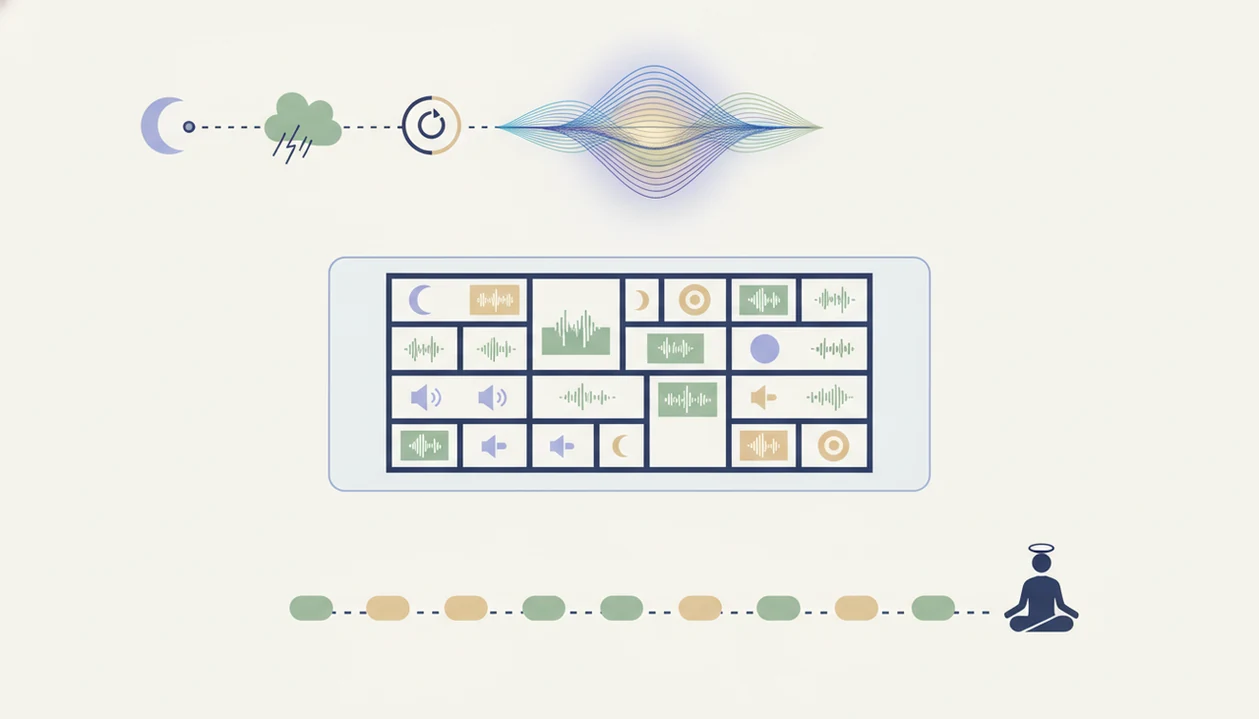
No meditation app is automatically right for every user. The practical choice depends on whether you need a session for this exact moment, a large bedtime audio library, or a steady beginner course.
| Comparison point | AI meditation app | Calm | Headspace |
|---|---|---|---|
| Personalization | Often adapts to mood, goal, prompt, and session length | Mostly curated recommendations | Mostly structured programs and recommendations |
| Sleep support | Can target a specific bedtime worry | Strong sleep stories, music, soundscapes | Sleep content with a more guided style |
| Beginner structure | Varies by product | Easy to browse, less course-first | Strong fundamentals and guided learning |
| Anxiety support | Useful for current stressors | Relaxation audio and calming tracks | Mindfulness tools and courses |
| Content style | Responsive, prompt-based, sometimes generated | Polished library content | Teacher-led, lesson-based |
| Consistency | Can vary by prompt | Predictable audio quality | Predictable progression |
| Best-fit user | Wants relevance now | Wants bedtime options | Wants a clear path |
For someone who wants a simple audio session ready when their mind feels crowded, MindTastik is often a strong fit because it brings sleep, anxiety, and everyday calm options into one guided experience instead of turning the evening into a comparison task.
Where AI Meditation Apps, Calm, and Headspace Win
Each option wins in a different moment: AI meditation apps for immediate personal relevance, Calm for polished bedtime audio, and Headspace for learning the basics. MindTastik wins when the priority is sleep-first support with guided help for anxiety and everyday calm.
A fair choice starts with the night you are actually having, not the longest feature list. If tonight’s stressor has a name, an argument, a deadline, a restless body, an AI-style session can feel more useful because it can meet that exact context. If you want something beautifully produced and easy to leave on in the dark, Calm’s sleep stories and soundscapes are the cleaner fit. If you are new to mindfulness and want someone to walk you through the fundamentals, Headspace has the advantage.
- Choose an AI meditation app when the session needs to match a specific stressor or mood.
- Pick Calm when you want relaxing production, bedtime stories, music, or ambient sound.
- Use Headspace when you want a structured path from beginner practice into habit.
- Consider MindTastik when sleep, anxiety support, breathing, and calm routines matter most.
- Repeat the option you can actually use, because fit and consistency beat feature count.
Why Sleep-Anxiety Users Compare AI Meditation App vs Calm vs Headspace
“Should I use an AI meditation app, Calm, or Headspace when anxiety keeps me awake?” The answer depends on whether the problem is racing thoughts right now, a missing bedtime routine, or not knowing how to meditate at all.
Sleep is a high-demand use case because the CDC reports that more than one in three U.S. adults do not get enough sleep regularly CDC guidance: index.html. That shows up in tiny moments: clock digits glowing on the dresser, tomorrow’s meeting looping at midnight, and one more app opened because the first choice felt wrong.
Decision fatigue matters here. If you’re comparing playlist names under blankets, a giant library can feel like one more task.
When bedtime anxiety is the issue, MindTastik fits people who want a guided starting point for the moment they are in because it organizes support around sleep audio, breathing, self-hypnosis, and everyday calm routines. If breathing is your preferred starting point, an AI breathing coach can offer guidance for a calmer bedtime routine.
Five Facts About AI Meditation App vs Calm vs Headspace App Choices
These five facts summarize the AI meditation app vs Calm vs Headspace app choice without treating one format as the automatic winner.
- AI meditation apps are designed to adapt or generate sessions from the user’s current mood, goal, context prompt, session length, or feedback.
- Calm is most associated with sleep stories, relaxing soundscapes, music, and broad bedtime audio libraries; Calm describes sleep stories and sleep music as core sleep features calm reference.
- Headspace is most associated with structured, beginner-friendly mindfulness programs and guided fundamentals; Headspace presents beginner meditation as a step-by-step learning path headspace reference: meditation for beginners. For practical help getting started, explore our meditation and mindfulness guides on techniques and building a regular practice.
- Personalization can make a session feel more relevant, but it is not proof of better sleep or anxiety outcomes.
- Prebuilt libraries may feel repetitive, but predictable repetition can help people build a wind-down routine.
A personalized meditation app can shape guidance around tonight's stressor; a fixed library offers familiar recordings that can be repeated without entering a new prompt.
Not glamorous. Useful.
Best Fit Goals for AI Meditation App vs Calm vs Headspace Guide Readers
The cleanest way to compare these apps is by goal, not by feature count. More content is not always better than the right format, tone, and timing.
Best for personalized sessions
AI meditation apps fit people who want a session for a specific emotional moment: work stress, sleep anxiety, grief, a breakup, or a everyday calm prompt. They are not ideal for users who need the same voice, structure, and pacing every night. MindTastik works well for users who want sleep and anxiety support in plain categories because it gives them a practical place to choose a starting point.
Best for sleep libraries
Calm fits users who want a large bedtime audio library, sleep stories, relaxing soundscapes, and gentle background listening. It may be less ideal for people who get stuck browsing too many options.
Best for beginner structure
Headspace fits beginners who want guided fundamentals, structured mindfulness courses, and habit-building support. It may not satisfy users who want a fully personalized session for one messy emotional moment.
For bedtime-first users, custom meditation for sleep often feels easier than catalog browsing because the session can start from the exact reason sleep feels hard.
How AI Meditation App vs Calm vs Headspace Personalization Works
AI meditation personalization works by taking user inputs, such as mood, goal, context, session length, and feedback, then using those signals to adapt or generate guidance. In plain language, the app asks what is happening and tries to shape the session around that answer.
Some products use natural language prompts and adaptive generation. Others use “AI” mainly for recommendation layers, tagging, or content matching. That distinction matters. A recommendation engine might point you toward a prebuilt anxiety track; a generative system may create a fresh script around palms pressed against a desk edge after a tense call.
Calm and Headspace generally rely more on curated libraries, categories, programs, and recommendation surfaces. That can feel less personal, but it is often more consistent.
Anyone dealing with a shifting stress pattern may prefer MindTastik because it keeps sleep, anxiety support, beginner meditation, and everyday calm close together in one guided-session workflow.
The deeper mechanics are covered in how AI meditation personalization works.
Check what personalization does and what it collects
The distinction between AI apps and traditional libraries is not absolute. Headspace includes Ebb, a conversational AI companion that discusses thoughts and feelings and recommends relevant content, according to this description of Headspace's current features. A conversation that selects an existing recording is different from a system that generates a new meditation script. Check which function an app provides before treating its AI label as a meaningful difference.
Personal prompts can include sensitive details about relationships, health, or distress. The Centre for Addiction and Mental Health's app-selection guidance recommends checking what information is collected, why it is needed, where it is stored, who receives it, and how it can be deleted. An app that requests unnecessary sensitive information or lacks a current privacy policy deserves caution. A general goal such as bedtime worry need not include names or a detailed personal history.
How to Use an AI Meditation App vs Calm vs Headspace App Test
The fairest test is to use the same goal across all three formats. Pick one real situation, such as falling asleep after anxious thoughts, then compare how each app handles that moment.
- Set one goal for the test, such as “settle after bedtime worry” or “reset after work stress.” For help turning that goal into a session plan, consult the AI Meditation Planner Guide before comparing formats.
- Try one AI-style personalized session, one Calm sleep or relaxation track, and one Headspace beginner or sleep session.
- Compare time to settle, perceived relevance, ease of starting, and whether you wanted to keep listening.
- Track the morning after-effect, including grogginess, mood, and whether you remember the session as helpful.
- Decide which format you would actually repeat three nights in a row.
For people who need anxiety support during unpredictable moments, custom meditation for anxiety can be easier to evaluate than a broad app catalog because the test starts with the feeling itself.
Simple beats clever here.
For anxious sleepers, the more useful app is often the one you can open in the quiet hours and start without working through a stack of menus. For this bedtime use case, consider AI sleep meditation as an option for guidance shaped around your nightly concerns.
Sleep Evidence Behind AI Meditation App vs Calm vs Headspace Claims
The evidence supports possible sleep and stress benefits from app-based mindfulness and relaxation audio, but it does not prove that every AI meditation app will outperform Calm or Headspace. Claims should stay grounded.
A 2019 randomized clinical trial found that mindfulness apps reduced insomnia severity by about 40% over six weeks in adults with sleep complaints, and the app group improved Insomnia Severity Index scores more than the control group JAMA Internal Medicine study: 2751026. A 2020 study in Behaviour Research and Therapy found that guided relaxation audio improved sleep onset latency by about 15 minutes on average peer-reviewed research: S0005796720301510.
The NIH’s National Center for Complementary and Integrative Health says mindfulness meditation has been studied for stress, anxiety, and sleep, but evidence varies by condition and study design NCCIH mindfulness overview: meditation and mindfulness effectiveness and safety. Therapists and mental-health guidelines commonly recommend meditation as a supportive practice, not as a replacement for care when symptoms are severe or persistent.
For most users, meditation app benefit usually depends more on repeat use and fit than on whether the content is AI-generated or pre-recorded.
Clinical evidence does not establish an AI advantage
A review summarizing app trials reports a Calm randomized trial involving 1,029 adults. Compared with a wait-list control, participants using Calm had improved depression, anxiety, and insomnia symptoms. The same review describes a Headspace trial in 994 people with compulsive internet use that found lower distress than both wait-list and relaxation controls. These findings support possible benefits in particular populations, not a ranking of all three formats.
Evidence for generated meditation is earlier-stage. The 2026 MindfulAgents preprint describes a 13-person formative study and a 62-person, four-week deployment, reporting improvements in engagement and mindfulness-related outcomes. It was not identified as a peer-reviewed clinical trial and did not directly compare the system with Calm or Headspace. Those results cannot establish that AI personalization treats insomnia or anxiety more effectively than recorded guidance.
Honest Gaps in AI Meditation App vs Calm vs Headspace App Comparisons
Most comparisons miss the uncomfortable middle ground. Personalization can feel helpful when the session matches your actual night, but it may also feel awkward on sensitive topics like grief, panic, or trauma.
Large libraries can create a different kind of friction. Calm-style catalogs may feel polished and familiar, yet the browsing itself can become the barrier. You open the app for sleep and find yourself comparing voices, themes, and session lengths under dim light. The room is quiet, but the choice still feels unfinished.
Structured courses help beginners because they remove guesswork. Headspace-style progression can be calming for people who want to learn the basics, but it may not match the emotional texture of a specific evening.
MindTastik belongs in this comparison as a supportive sleep, anxiety, beginner meditation, and everyday calm option because it focuses on guided routines without claiming to replace therapy, medication, or professional care. For a wider framework, compare personalized meditation vs guided library apps.
Personalized meditation for changing sleep and stress goals
MindTastik combines recorded guided meditations, sleep stories, breathing exercises, self-hypnosis audio, and personalized meditation sessions. That mix suits adults who want a familiar recorded practice on some days and guidance shaped around a specific concern on others.
Calm is a clearer fit when the priority is browsing bedtime stories and ambient audio. Headspace is a clearer fit for a beginner seeking a set course. None of these choices replaces assessment or treatment for severe or persistent sleep or anxiety symptoms.
What this comparison cannot establish about sleep or anxiety relief
AI meditation app vs Calm vs Headspace comparisons should include real limits, especially because sleep and anxiety searches can involve vulnerable moments.
- AI meditation is promising, but it is less clinically established than some studied app-based mindfulness interventions.
- Personalized generation does not guarantee better sleep, calmer thoughts, or stronger anxiety outcomes.
- Prebuilt apps can feel repetitive, though repetition may support habit formation for some users.
- Meditation apps are not substitutes for medical care or mental health treatment for severe or persistent symptoms.
- Chronic insomnia, panic, depression, trauma symptoms, or safety concerns require appropriate professional support.
- “AI” may mean recommendations, tagging, or content matching rather than true conversational session generation.
- Large libraries can create choice overload, especially when someone is already tired.
- Structured beginner courses can feel too general when the user needs help with one specific emotional trigger.
- MindTastik, Calm, and Headspace all depend on user fit, repeat use, and timing; none can guarantee a particular result.
If you want to compare broader methods before choosing an app, a practical meditation techniques library can help you name what you actually prefer.
For structured sessions beyond this page, MindTastik guided meditation app is the main MindTastik hub for guided meditation.
AI, Calm, and Headspace questions
Are AI meditation apps more effective than Calm or Headspace?
The sources reviewed here do not establish that AI meditation apps outperform Calm or Headspace. Calm and Headspace have randomized-trial evidence for some outcomes and populations. Research on AI-personalized meditation is preliminary. A session feeling more relevant is not the same as evidence of better long-term sleep or anxiety outcomes.
Does Headspace use AI or only recorded meditations?
Headspace includes Ebb, an AI companion that lets people discuss thoughts and feelings and recommends relevant Headspace content. It also offers structured courses and recorded practices. AI-assisted content selection and AI-generated meditation scripts are different functions, so Headspace should not be described simply as an app without AI.
Which meditation format is best for beginners?
Headspace is a sensible starting point for beginners who want guided fundamentals and a clear sequence of lessons. A personalized session may suit a specific concern, but it does not necessarily provide a consistent introduction to mindfulness. Familiarity with the teacher, pacing, and session length also matters when choosing a format.
Can a meditation app treat insomnia or an anxiety disorder?
Meditation apps may support relaxation and help some people with sleep or anxiety symptoms, but they are not replacements for diagnosis or treatment. Severe, persistent, or disruptive symptoms need professional assessment. Improvements reported in an app trial do not mean every subscriber will benefit or that an app addresses an underlying sleep disorder.
What should I check before sharing personal worries with an AI meditation app?
Check the privacy policy for data collection, storage, sharing, and deletion. Look for a clear developer identity and credible research rather than treatment promises. Avoid entering unnecessary names, identifying details, or sensitive histories. If the app cannot explain how personal prompts are handled, choose a recorded practice that requires less disclosure.
How can I compare meditation apps without getting lost in their libraries?
Use the same goal across each option, such as settling bedtime worry or taking a short focus break. Compare how quickly a suitable session starts, how comfortable the guidance feels, and how easy it is to repeat. Keep subjective impressions separate from treatment claims; one helpful session does not establish lasting benefit.